
On this page
Start here
Quick answer
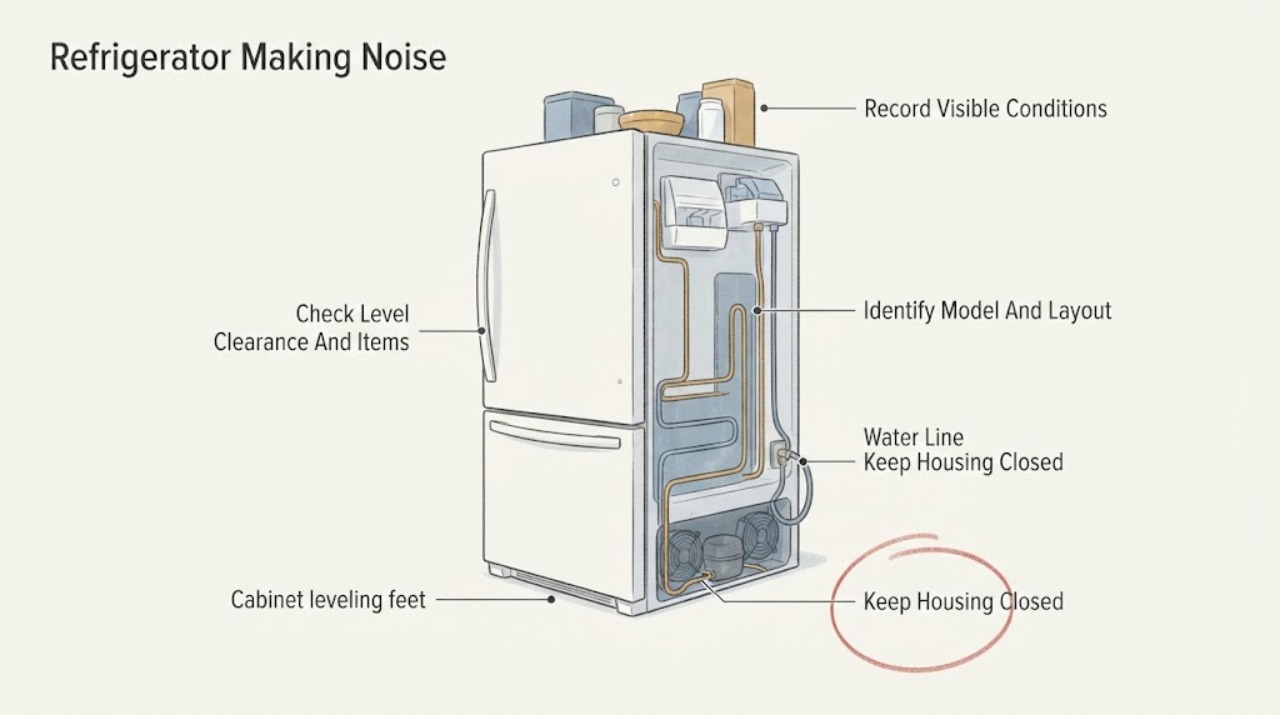
First record the sound's character, location, timing, and effect on cooling. Inglis' official troubleshooting page says that a refrigerator that seems too noisy may be making normal sounds and directs owners to the Use & Care Guide; it also notes that high-efficiency motors can run longer and that a defrost cycle can temporarily stop operation. Whirlpool's official refrigerator guidance, relevant to the Whirlpool Canada family connection shown on Inglis' site, describes low compressor/fan hum, refrigerant gurgling, defrost sizzling or dripping, expansion pops, relay clicks, fan whoosh, and ice-maker or water-line sounds as possible normal operation. A rattle or vibration is more likely an external installation or loose-item issue when cooling is normal and the cabinet is unstable, touching a wall, or carrying a vibrating container. Check only visible leveling, clearance, shelves, door contact, and any model-accessible water-line or ice-maker setting. A new grinding or scraping sound, repeated hard clicks with warming, a sound plus water, smoke, burning odor, severe vibration, a hot or damaged cord, or a sound that persists with cooling loss requires service. Do not remove rear or freezer panels, touch moving parts or refrigerant tubing, make live electrical measurements, or keep running a refrigerator with an electrical or mechanical hazard.
Before you begin
Safety first
- This article covers sound classification, model identification, ordinary settings, and safe visible installation/item checks only. Qualified service must handle rear or freezer access, fans, compressors, defrost parts, refrigerant systems, wiring, live tests, and electrical repairs.
Work through in order
Diagnostic checks
Use only checks that match the exact appliance or system and its official guide.
-
Check 1
From a safe position, record the sound and note whether it is a hum, buzz, click, gurgle, hiss, pop, crack, whoosh, rattle, vibration, thump, scrape, or grind. Note where it is loudest, when it starts, and whether the refrigerator and freezer remain at their usual temperatures. Include whether it follows door opening, cooling start, defrost, ice making, dispensing, moving, or a large food load.
Expected result: The sound is soft and linked to a regular cooling or defrost event with normal temperatures; it changes with a door, item, or cabinet contact; or it is new, harsh, continuous, worsening, and paired with warming, water, odor, or repeated failed starts.
Next step: Continue only with the visible checks when there is no hazard. Preserve a recording and the exact model information for the service or manual branch.
Stop if: Stop immediately for smoke, sparks, burning or electrical odor, water near electrical parts, a hot or damaged cord or outlet, severe vibration, or a repeated failed start with warming.
Why this matters
Why: Timing plus normal cooling supports a normal cycle sound more than a component failure. A sound that changes with a visible contact suggests vibration. A compound symptom or cooling loss needs service rather than a sound-only diagnosis.
-
Check 2
Read the Inglis model and serial label without removing panels and classify the layout as side-by-side, top-mount, bottom-freezer, or another documented arrangement. Check whether the exact manual shows an ice maker, dispenser, water line, automatic defrost, accessible condenser area, or special cooling mode.
Expected result: The model and layout are clear; the model has an ice maker or water connection; or the identity or feature set is uncertain.
Next step: Use the matching Inglis Use & Care Guide and only its feature instructions. If the label or layout cannot be established safely, limit the work to stopping hazards and arrange model-specific service.
Stop if: Do not remove the refrigerator from a built-in opening, open a rear or freezer panel, or use another model's diagnostic or reset procedure to identify the appliance.
Why this matters
Why: Inglis troubleshooting is organized by refrigerator layout, while sound sources depend on whether a valve, water line, ice maker, fan, or defrost system exists. An uncertain identity prevents a reliable model-specific sound interpretation.
-
Check 3
Inspect the visible installation without tipping or forcing the cabinet. Confirm that the refrigerator is stable on a solid, reasonably level floor, does not touch a wall or adjacent cabinet, and has no item on top or inside vibrating against it. Check that shelves, bins, and door containers are seated and that doors close without rubbing.
Expected result: The cabinet rocks, a side or rear surface touches another structure, an item vibrates, a shelf or bin is loose, a door rubs, or the installation is stable and clear.
Next step: Separate only visible items and correct an obvious contact or placement issue using the manual. Get installation help before moving a built-in or connected refrigerator; arrange service if the noise continues or cooling changes.
Stop if: Do not tip the refrigerator, force leveling feet, pull on the cord or water tubing, remove a panel, or reach near a fan or compressor.
Why this matters
Why: A sound that changes after a visible contact or stability correction is more consistent with transmitted vibration, door rubbing, or a loose item than with a sealed-system fault. A stable, clear cabinet shifts attention to the operating cycle or an internal component.
-
Check 4
If the exact Inglis model has an ice maker, dispenser, or water line, note whether the sound occurs only during a fill, dispense, or ice-ejection event. If it occurs during defrost, note the timing and whether there is only normal drainage into the pan. Do not remove ice, water-line fittings, or covers to chase the sound.
Expected result: A brief buzz/click or thump occurs during a documented water or ice event; a hiss, sizzle, drip, pop, crack, or gurgle occurs during cooling or defrost; or the sound is continuous, harsh, or paired with a leak or temperature change.
Next step: For a normal feature-linked sound, use the exact manual and monitor cooling. If a water-line or ice-maker setting is implicated, change it only as the manual directs. For a leak, warming, persistent harsh sound, or failed cycle, keep the appliance safe and arrange service.
Stop if: Do not disconnect water fittings, chip ice near a mechanism, access the defrost heater, or continue an event involving smoke, odor, water near electricity, or repeated failed starts.
Why this matters
Why: Whirlpool describes valve, water-line, refrigerant, expansion, fan, and defrost sounds as possible normal operation when the relevant feature exists. A continuous or compound symptom is not explained by a normal cycle and may need service.
-
Check 5
Compare the sound and motor run time with the exact manual after recent installation, a power interruption, frequent door openings, a large food load, or a special cooling/freezing setting. Keep interior air vents clear and, only if the manual identifies an accessible condenser area, inspect or clean it with power disconnected and the refrigerator stable.
Expected result: The refrigerator is temporarily working harder after a documented load or door event; vents are blocked; an accessible condenser area is dusty; or the noise persists under ordinary load and clear airflow.
Next step: Restore normal loading and clear only accessible vents or condenser areas as the manual permits. Allow the refrigerator to stabilize while monitoring temperature; arrange service if the sound does not settle or cooling declines.
Stop if: Do not spray or wash electrical parts, remove a condenser cover, touch a fan or compressor, or move a connected appliance unsafely.
Why this matters
Why: Inglis says warm conditions, large loads, frequent door openings, dirty condenser coils, and a high-efficiency motor can increase run time. A blocked vent or accessible dust can affect airflow, but neither proves a failed compressor or fan. Persistent noise under normal conditions needs diagnosis.
-
Check 6
Stop owner diagnosis when the noise remains after safe visible checks, becomes scraping, grinding, harsh knocking, repeated failed clicking, or electrical buzzing, or is joined by warming, an alarm, water, odor, or abnormal vibration. Give service the model, serial information, recording, timing, temperature trend, and visible checks completed.
Expected result: The noise stops after a visible correction and cooling remains normal, or the refrigerator is still noisy, warm, leaking, intermittently starting, or otherwise abnormal.
Next step: Continue using the refrigerator only when cooling is normal and there is no hazard. Otherwise keep it off or disconnected when safe and arrange Inglis/Whirlpool-authorized or qualified appliance service; use a qualified electrician for a building-supply fault.
Stop if: Do not remove rear or freezer panels, make live electrical measurements, touch refrigerant tubing, bypass a control, or repeatedly restore power to reproduce an unsafe sound.
Why this matters
Why: A corrected rattle supports installation or item contact. Persistent or compound symptoms can involve a fan, compressor, defrost system, control, water valve, refrigerant circuit, or wiring, and listening cannot identify a safe part.
Use your observations
Decision map
Find the observation that best matches what you see, then follow the next safe action.
-
PATH 01Safety boundary
What you see
The sound is a soft hum, fan whoosh, gentle gurgle, brief click, pop or crack, defrost hiss/sizzle/drip, or an ice/water event sound, and both compartments cool normally.
Do this next
Monitor the sound without opening panels and follow the exact Inglis manual if the pattern changes. No part should be ordered from the sound alone.
Why this path and its safety boundary
Why it matters: The pattern is consistent with documented cooling, fan, refrigerant, expansion, defrost, valve, or water-line operation for a model with the relevant feature.
Safety stop: Stop for warming, a leak, smoke, burning odor, sparks, severe vibration, or a change to grinding or scraping.
-
PATH 02Safety boundary
What you see
The rattle or vibration changes when a visible container, shelf, item on top, nearby surface, or water line is separated, or the cabinet is visibly unstable or touching a structure.
Do this next
Separate the visible item or correct a safe contact/leveling issue using the manual. Obtain installation help if the refrigerator must be moved or a connected line could be strained.
Why this path and its safety boundary
Why it matters: A transmitted installation or contact vibration is more likely than an internal refrigeration fault, provided cooling and electrical conditions remain normal.
Safety stop: Do not tip, dismantle, pull on tubing, or keep using the appliance if the correction exposes damage or a hazard.
-
PATH 03Safety boundary
What you see
The motor sound became more noticeable after installation, power recovery, frequent door opening, a large food load, warm conditions, or an exact-model intensive setting, while temperatures are recovering normally.
Do this next
Close doors, restore ordinary loading and settings, keep vents clear, and observe temperature and sound as the load stabilizes. Arrange service if it does not settle or cooling worsens.
Why this path and its safety boundary
Why it matters: Inglis and Whirlpool guidance support temporarily longer or more noticeable motor operation under higher cooling demand. This does not prove a defect or authorize a hidden reset.
Safety stop: Do not use an intensive setting just to reproduce noise or continue operation through a hot cord, odor, smoke, leak, or warming condition.
-
PATH 04Safety boundary
What you see
The sound is new, harsh, scraping, grinding, repeated clicking, or knocking and the refrigerator is warming, failing to start normally, showing an alarm, or leaking.
Do this next
Protect perishable food, record the display and sound, keep doors closed, and arrange model-specific appliance service. Do not remove a rear or freezer panel to locate the source.
Why this path and its safety boundary
Why it matters: An internal fan, compressor, defrost, control, water valve, or sealed cooling problem becomes more likely than a harmless cycle sound. The symptom does not identify which component failed.
Safety stop: Stop use for smoke, sparks, burning/electrical odor, severe vibration, a hot or damaged cord, or water near electrical parts.
-
PATH 05Safety boundary
What you see
The sound remains unexplained after safe visible checks, or it is accompanied by smoke, burning or electrical odor, sparks, water near electrics, severe vibration, cabinet damage, or a hot/damaged power connection.
Do this next
Disconnect power only from a safe dry location when appropriate, keep the refrigerator off, and arrange qualified appliance or electrical service. Do not return it to use until the hazard is cleared.
Why this path and its safety boundary
Why it matters: The condition exceeds safe owner diagnosis and may involve an electrical, mechanical, or sealed-system fault. Reproducing the noise could damage the appliance or create a shock/fire hazard.
Safety stop: Do not reset repeatedly, touch wet or damaged electrical hardware, open the cabinet, perform live tests, or touch refrigerant tubing.
Helpful context
Understand the symptom
A sound is useful only with its timing and cooling result
A low hum after doors have been opened, a soft airflow sound, a click as a control switches, or a gentle gurgle after a cooling cycle can be normal. A short hiss or sizzle during defrost can also be expected. The same word—buzzing or rattling—can describe either a normal valve or refrigerant sound or a cabinet vibration. Note whether both compartments are holding temperature and whether the sound follows cooling, defrost, ice making, dispensing, or door movement before deciding that a part has failed.
Inglis model and refrigerator layout matter
Inglis' official troubleshooting page separates side-by-side and top-mount refrigerator guidance and sends the reader to the model's Use & Care Guide for controls, defrost, leveling, and features. An ice maker, dispenser, water line, bottom-freezer arrangement, or different fan layout changes which sounds are possible. The Inglis site identifies the brand within Whirlpool Canada LP, but Whirlpool family guidance is not a substitute for the exact Inglis manual.
Visible vibration checks are the safe first correction
If a rattle changes when a bottle, shelf, item on top, nearby wall, or water line is moved without stressing the appliance, an external vibration source is more likely. Whirlpool recommends a solid, level floor and says cabinet contact, stored items, refrigerant flow, and water-line flow can sound like rattling. Correct only an obvious, accessible contact or placement issue using the exact installation guidance; do not tip the refrigerator or pull a built-in unit by its cord or tubing.
Ice-maker and defrost sounds need their own branch
A brief buzz or click can occur when an ice-maker valve opens, including on a model that is not connected to a water supply; a thump can occur during a water fill. Popping, cracking, sizzling, dripping, or gentle gurgling can accompany expansion, refrigerant movement, or automatic defrost. These explanations apply only when the Inglis model has the relevant feature and cooling remains normal. A loud or persistent sound with a leak, warming, or repeated failed starts is not cleared by calling it a cycle sound.
When noise becomes a service symptom
Keep the refrigerator closed and arrange service when a new grinding, scraping, harsh knocking, repeated start-click, or electrical buzz is accompanied by warming, an alarm, water, smoke, or an odor. A fan, compressor, defrost system, control, water valve, or wiring problem cannot be identified safely by listening. Stop immediately for smoke, burning smell, sparks, a hot or damaged cord or outlet, severe vibration, or water near electrical parts. Do not remove a rear or freezer cover or perform a live test.
Safety boundary
Stop conditions
- Stop immediately for smoke, sparks, burning or electrical odor, a hot or damaged cord/outlet, water near electrical parts, severe vibration, cabinet damage, or warming with repeated failed starts.
- Do not remove rear, compressor, evaporator, or freezer panels; touch fans, compressors, defrost heaters, refrigerant tubing, or electrical terminals; or perform live testing.
- Do not tip or pull a connected refrigerator, strain a water line or power cord, bypass a control, or repeatedly restore power to reproduce a noise.
- Keep the exact anti-ice-maker, dispenser, defrost, and cooling-mode instructions model-specific; do not use another Inglis or Whirlpool model's diagnostic procedure.
- If cooling is failing, keep doors closed as much as possible, protect perishable food, and arrange qualified service rather than selecting a part from the noise alone.
When checks do not resolve it
Need a professional?
Arrange model-specific Inglis or Whirlpool-authorized appliance service when an unusual sound persists after safe visible leveling, clearance, loading, and feature checks, or when it is scraping, grinding, repeatedly clicking, or accompanied by warming, an alarm, water, or a fan/compressor symptom. Use a qualified electrician for a damaged outlet, cord, or building supply. Stop immediately for smoke, sparks, burning or electrical odor, a hot or damaged cord, water near electrical parts, severe vibration, cabinet damage, or repeated failed starts. Have the model and serial information, refrigerator layout, sound recording, timing, temperature trend, ice-maker/dispenser status, and visible checks ready.
Safety scope: This article covers sound classification, model identification, ordinary settings, and safe visible installation/item checks only. Qualified service must handle rear or freezer access, fans, compressors, defrost parts, refrigerant systems, wiring, live tests, and electrical repairs.
Common questions
FAQ
Is a humming or gurgling Inglis refrigerator normal?
Often, yes. Inglis directs owners to the Use & Care Guide when a refrigerator seems noisy, and Whirlpool describes compressor/fan hum and refrigerant or defrost gurgling as possible normal operation. The timing and cooling result matter: a soft, recurring sound with normal temperatures is less concerning than a new harsh sound with warming, water, or an odor.
Why is my Inglis refrigerator rattling or vibrating?
Check visible causes first: an unlevel or unstable cabinet, contact with a wall or cabinet, an item on top, a shelf or container touching the liner, or—on applicable models—a water line transmitting vibration. Separate only accessible items and correct safe placement using the manual. Persistent rattling with cooling loss or a harsh mechanical sound needs service.
Why does my Inglis refrigerator click or buzz near the ice maker?
A brief valve or water-line sound can occur while an ice maker fills or water is dispensed, and Whirlpool lists those sounds as possible normal operation. If the model is not connected to water, use the exact Inglis manual to confirm whether the ice maker should be turned off. A continuous buzz, leak, repeated failed start, or warming requires service.
Can defrost cause popping, hissing, dripping, or sizzling sounds?
Yes, applicable refrigerators can make sounds as the interior expands or contracts and as defrost water reaches the heater or drain pan. Inglis says an automatic defrost cycle can temporarily stop operation, while Whirlpool identifies defrost-related sizzling, hissing, and dripping as possible normal sounds. Water escaping onto the floor, warming, smoke, or a persistent harsh sound is not a normal-sound clearance.
When should I call for a noisy Inglis refrigerator?
Call when an unusual sound persists after safe visible checks, or when it is scraping, grinding, repeatedly clicking, or accompanied by warming, an alarm, water, severe vibration, smoke, sparks, or an electrical odor. Do not remove panels or test the fan, compressor, defrost system, refrigerant circuit, water valve, or wiring yourself.
Read the exact guide
Official sources
- Refrigerator Normal Sounds and NoisesWhirlpool Product Help · Official Whirlpool refrigerator guidance used as Whirlpool-family context; it is not a substitute for the exact Inglis model manual.
- TroubleshootingInglis Home Appliances · Official Inglis Canada troubleshooting page; exact Use & Care Guide controls and features vary by model.
- Refrigerator Noise - Rattling or VibratingWhirlpool Product Help · Official Whirlpool refrigerator guidance; it supports general visible vibration distinctions but does not establish construction for every Inglis model.
- Customer CareInglis Home Appliances · Official Inglis customer-care page for the Canadian brand; service route and model documentation remain region- and model-dependent.
Community feedback
Share a repair observation
Share a plain-text repair observation. Accepted observations are published automatically; this page may take a moment to update.