
On this page
Start here
Quick answer
If a JennAir dishwasher began leaving food or detergent residue after you changed tablet products, treat the tablet, dispenser, cycle, water temperature, loading, and water hardness as separate checks. JennAir recommends fresh, high-quality pre-measured tablets or packs in the main dispenser, with the lid closed, and automatic dishwasher detergent only. A tablet can leave residue when it is not suited to a shorter or cooler cycle, while white film or spots can point to rinse-aid or hard-water conditions rather than a failed pump. Do not use hand dish soap, add extra tablets, or keep running cycles if foam, a leak, smoke, burning odor, or water near electrical parts appears.
Before you begin
Safety first
- Do not open the base, remove the circulation pump or heater, probe live wiring, enter service mode, bypass a door or leak interlock, or select a replacement part from poor cleaning or a detergent change alone. Stop immediately for foam with escaping water, smoke, burning odor, a hot or damaged cord or plug, repeated breaker trips, water near electrical parts, or a hidden active leak.
Work through in order
Diagnostic checks
Use only checks that match the exact appliance or system and its official guide.
-
Check 1
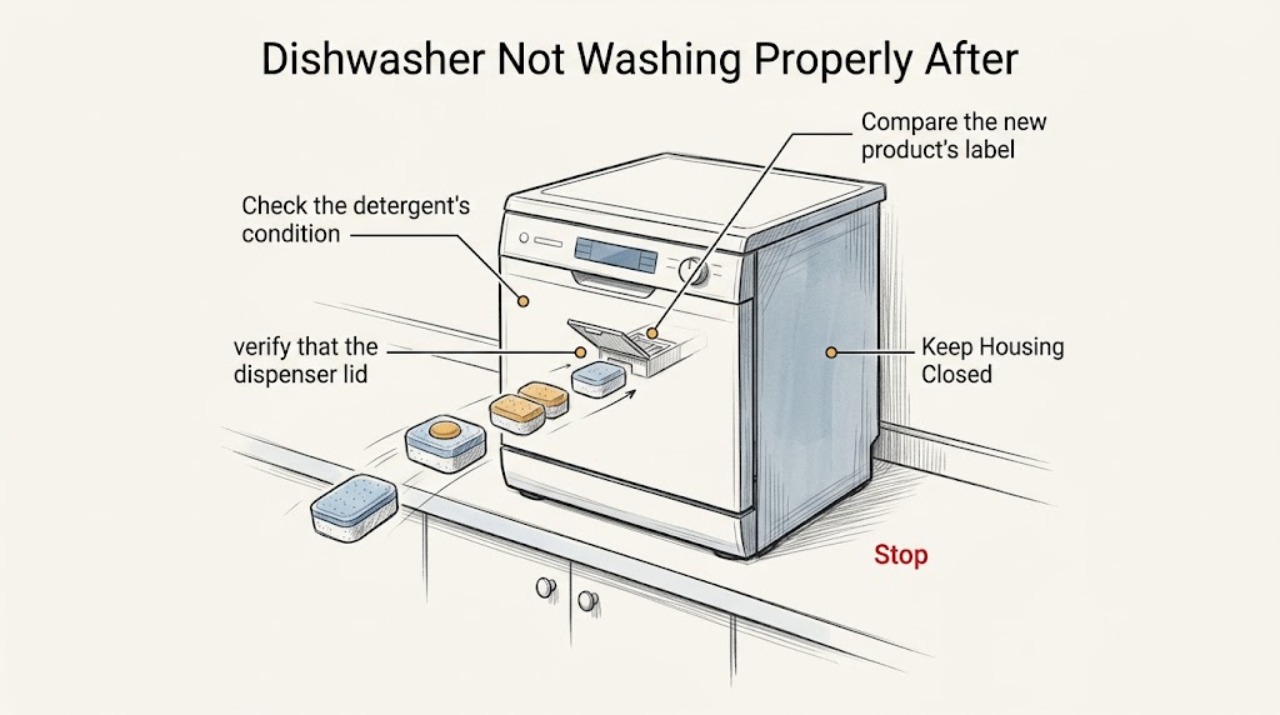
Compare the new product's label with the old product and confirm it is an automatic-dishwasher tablet or pack. Use the package dose, use only one pac when the package calls for one, put the pre-measured product in the main dispenser, and close the lid. Do not combine tablets, pour extra detergent into the pre-wash cup, or use hand dish soap.
Expected result: The new product is for automatic dishwashers and is released from the closed main cup, or it is intended for another use, was overdosed, was combined with another product, or is found outside the cup.
Next step: Use only the exact package direction and the JennAir model manual for the next controlled cycle. If the product is not automatic-dishwasher detergent or foam is present, stop normal use and follow the suds safety branch.
Why this matters
Why: The first pattern leaves detergent chemistry, dose, and placement as plausible contributors; the second can directly cause poor cleaning, residue, or suds and does not justify a pump diagnosis.
-
Check 2
Check the detergent's condition and the cycle selected. Use a fresh product stored tightly closed in a cool, dry place, and note whether the selected cycle is short or low temperature. If the exact model permits it, run one normally loaded test on a normal or heavier cycle rather than judging the new tablet from a quick cycle alone.
Expected result: The tablet is soft, stuck together, old, or left partly intact after a short/cool cycle; or the tablet appears to dissolve and the dishes remain dirty on a normal cycle.
Next step: Repeat only with a fresh, model-appropriate product and an allowed cycle. If an intact tablet or residue remains, inspect the dispenser and spray path before trying another product; if the tablet dissolves but soil remains, continue with loading, water, and filter checks.
Why this matters
Why: JennAir says fresh detergent cleans better and its detergent guidance warns that tablets may not fully dissolve in shorter cycles. Hot water dissolves and activates detergent, so a normal result after a suitable warmer cycle makes dissolution/cycle mismatch more likely than a failed component; continued poor cleaning keeps other branches open.
-
Check 3
With the dishwasher empty and not running, verify that the dispenser lid is not blocked by a rack item and that each visible spray arm turns freely. Reload a small test load with soiled surfaces facing down and inward toward the spray, leaving space between items and avoiding overlapping bowls or plates.
Expected result: A dish blocks the cup or spray arm, a spray arm cannot turn freely, or the small test load is correctly exposed but still comes out dirty.
Next step: Remove only the visible loading obstruction, clean accessible residue, and run the model-approved test cycle. Do not reach into a moving spray path or remove panels to test a pump or motor.
Why this matters
Why: JennAir identifies a blocked dispenser, restricted spray, overloading, and poor orientation as independent wash-performance causes. Correct loading can remove a circulation problem; persistent soil after unobstructed spray access shifts attention to water supply, temperature, filter condition, and service-level causes.
-
Check 4
Check the visible water supply valve and confirm it is fully open, then note whether the dishwasher fills normally. If the model provides a filter-cleaning instruction, clean only the user-accessible filter as directed; do not dismantle the inlet, pump, or recirculation system.
Expected result: The supply is partly closed, filling sounds or water volume are abnormal, the filter is visibly obstructed, or water supply and accessible filter checks are normal.
Next step: Correct only a clearly accessible, safe valve or filter condition documented by the model manual. If fill remains abnormal or cleaning is still poor, record the cycle and arrange service rather than selecting a valve or pump from symptoms alone.
Why this matters
Why: JennAir says a completely open water supply is required for proper washing and that routine filter cleaning supports water circulation. A normal visible supply does not prove that an inlet valve, heater, circulation pump, or control is healthy, but it makes a detergent-only explanation less certain if soil persists.
-
Check 5
Separate food soil from film or spots. Refill the liquid rinse-aid dispenser according to the model manual, and consider the local water hardness; JennAir identifies 15 grains per U.S. gallon or more as extremely hard water that can make good results difficult and recommends a water softener to avoid damage.
Expected result: Food is clean but glasses or the tub have a white film or spots, or food soil remains without a film pattern.
Next step: Use rinse aid and the exact package/manual directions, and use only a model-approved cleaning method for the interior. If food soil remains after the film pattern is addressed, return to the load, spray, water, and service branches; do not add unapproved chemicals.
Why this matters
Why: Film or spots make hard-water deposits, rinse-aid level, and detergent chemistry more likely than a circulation failure. Food soil without film keeps loading, spray, supply, temperature, and detergent release in play. JennAir says tablets/packs can reduce filming over time but not every pack contains rinse aid.
-
Check 6
Stop and document any foam, leaking water, smoke, burning odor, damaged cord, repeated breaker trip, or water near electrical parts. If there is no such hazard and the result remains poor after one controlled cycle with correct detergent, record the exact model, cycle, tablet product, tablet condition, load pattern, and what remained dirty.
Expected result: Foam or water is escaping, an electrical hazard is present, or the dishwasher is dry and safe but still washes poorly after the controlled checks.
Next step: For foam or a hazard, stop use and isolate power and water only from a dry, safe position. Otherwise arrange qualified JennAir or appliance service with the recorded history; do not enter diagnostics or run repeated confirmation cycles.
Why this matters
Why: JennAir says wrong or excessive detergent can create suds that cause leaks or poor performance; a physical electrical or water hazard overrides ordinary wash troubleshooting. Persistent poor washing after the user-level checks needs model-specific diagnosis rather than a guessed part.
Use your observations
Decision map
Find the observation that best matches what you see, then follow the next safe action.
-
PATH 01Next step
What you see
The tablet is partly intact or leaves a paste/residue, especially after a short or cool cycle, while the spray arms and load are unobstructed.
Do this next
Use fresh automatic-dishwasher detergent in the closed main compartment and one model-allowed normal or heavier test cycle. If the tablet still does not dissolve, use the exact manual and arrange service for the dispenser or water-temperature system without choosing a part yourself.
Why this path and its safety boundary
Why it matters: This pattern makes detergent dissolution, product condition, dispenser release, or cycle compatibility more likely than a confirmed pump failure.
-
PATH 02Next step
What you see
Dishes are free of most food but show white film, spots, or a cloudy tub after the detergent change.
Do this next
Refill rinse aid and follow the model-approved interior-cleaning and detergent instructions. If the film persists or the water is extremely hard, have the water condition and dishwasher assessed; do not increase detergent beyond package/model guidance.
Why this path and its safety boundary
Why it matters: Hard-water deposits, rinse-aid conditions, and detergent formulation are more likely than a no-wash circulation fault; JennAir says tablets/packs can reduce filming and rinse aid helps control deposits.
-
PATH 03Next step
What you see
The new tablet dissolves, but food remains on exposed surfaces despite correct loading, free spray arms, a fully open supply, and an allowed cycle.
Do this next
Stop owner-level diagnosis and arrange qualified service with the exact model and controlled-cycle observations. Ask the provider to assess fill, temperature, filtration, circulation, and controls before replacing a component.
Why this path and its safety boundary
Why it matters: The tablet switch no longer explains the entire symptom. Insufficient fill, low water temperature, filter or circulation restriction, or a model-specific component/control issue remains possible, but no single part is proven.
-
PATH 04Next step
What you see
Foam or bubbles appear, a leak starts, or hand dish soap or another non-automatic detergent may have been used.
Do this next
Turn the dishwasher off and let suds dissipate; keep it out of normal use, and isolate power and water only if the controls are reachable from a dry, safe position. Do not add more chemicals, repeatedly rinse to test it, or access the base.
Why this path and its safety boundary
Why it matters: JennAir says dish soap and wrong or excessive detergent create suds that can push water out and cause poor wash performance. The issue has crossed from ordinary tablet comparison into a leak and electrical safety concern.
-
PATH 05Next step
What you see
Cleaning remains poor and there is smoke, a burning smell, a hot or damaged plug/cord, repeated breaker operation, water near electrical parts, or an active hidden leak.
Do this next
Keep clear, disconnect power only if safe and dry, close the water shutoff if safely accessible, and request qualified appliance service or electrical help. Do not run another cycle, pull out a built-in unit, or remove covers.
Why this path and its safety boundary
Why it matters: This is not a detergent experiment. The physical hazard overrides wash-performance checks and may involve electrical, water, heating, or concealed appliance faults.
Helpful context
Understand the symptom
Why a detergent change can change the result
The detergent change is useful timing evidence, not proof that the dishwasher pump or heater failed. JennAir distinguishes tablets or packs, liquids or gels, and powders, and notes that tablets may not fully dissolve in shorter cycles. Dose, formulation, storage age, water temperature, the dispenser's release, and the load all affect what reaches the dishes. Keep the troubleshooting at that level until an exact model manual or qualified technician establishes a component fault.
What counts as a different symptom
Food left on dishes, an intact tablet in the cup, a white mineral film, and suds are not interchangeable results. Each points to a different next check. JennAir also says rinse aid improves wash and drying performance and helps control hard-water deposits, but rinse aid cannot correct hand dish soap or an obstructed spray path.
When checks do not resolve it
Need a professional?
Arrange qualified JennAir or appliance service when the dishwasher still leaves food after a controlled cycle with model-appropriate fresh detergent, unobstructed loading and spray, a fully open supply, and permitted user maintenance; also call sooner for abnormal filling, repeated intact tablets, a recurring leak, or any safety hazard.
Safety scope: Do not open the base, remove the circulation pump or heater, probe live wiring, enter service mode, bypass a door or leak interlock, or select a replacement part from poor cleaning or a detergent change alone. Stop immediately for foam with escaping water, smoke, burning odor, a hot or damaged cord or plug, repeated breaker trips, water near electrical parts, or a hidden active leak.
Have this ready
- Provide the exact model and serial information, country, the old and new tablet product names or package directions, whether the tablet was intact or dissolved, cycle and option selected, load pattern, water-hardness or rinse-aid observations, any foam or leak timing, and photos of only safe, dry, accessible areas.
Common questions
FAQ
Can changing dishwasher tablets make a JennAir dishwasher wash poorly?
It can change the observed result, but it does not prove a failed component. Compare detergent type, freshness, dose, dispenser placement, cycle temperature, film or food-soil pattern, loading, spray, and water supply. JennAir says tablets may not fully dissolve in shorter cycles and recommends fresh, high-quality pre-measured automatic-dishwasher detergent in the main compartment.
Should I use two tablets if the new one is not cleaning?
No. Use the package and exact model-manual direction; do not add extra tablets or combine products. Overdosing can create residue or suds, and JennAir says suds can lead to leaks and poor wash performance.
Does white film after switching tablets mean the pump is bad?
Not by itself. White film or spots more often keeps detergent formulation, rinse aid, and hard-water deposits in the decision. JennAir identifies extremely hard water as 15 grains per U.S. gallon or more and recommends a water softener to avoid damage and achieve good results.
Read the exact guide
Official sources
- Not Draining - Water Remain at End of Cycle - DishwasherJennAir · Used only for the safety branch where wrong detergent creates suds, leaking, or poor wash performance, and for the official stop-use/service boundary.
- Getting the Best Results when Using a DishwasherJennAir · Directly applicable to water temperature, tablet placement, fresh detergent, rinse aid, hard-water and cleaning guidance for JennAir dishwashers.
- JennAir Use & Care GuideJennAir · Official model-family use-and-care guidance opened for loading, spray-arm movement, detergent placement, freshness, rinse aid, and water-hardness cautions; the exact model manual still controls.
- Dishes are not Clean - Product HelpJennAir · Directly applicable to JennAir dishwasher wash performance, detergent type and placement, rinse aid, loading, water supply, hard water, suds, and service escalation.
- Detergent Usage GuidelinesJennAir · Directly applicable to detergent-form comparison, tablet dissolution, dosage, storage, rinse aid, loading, and user-manual boundary for JennAir dishwashers.
Community feedback
Share a repair observation
Share a plain-text repair observation. Accepted observations are published automatically; this page may take a moment to update.