
On this page
Start here
Quick answer
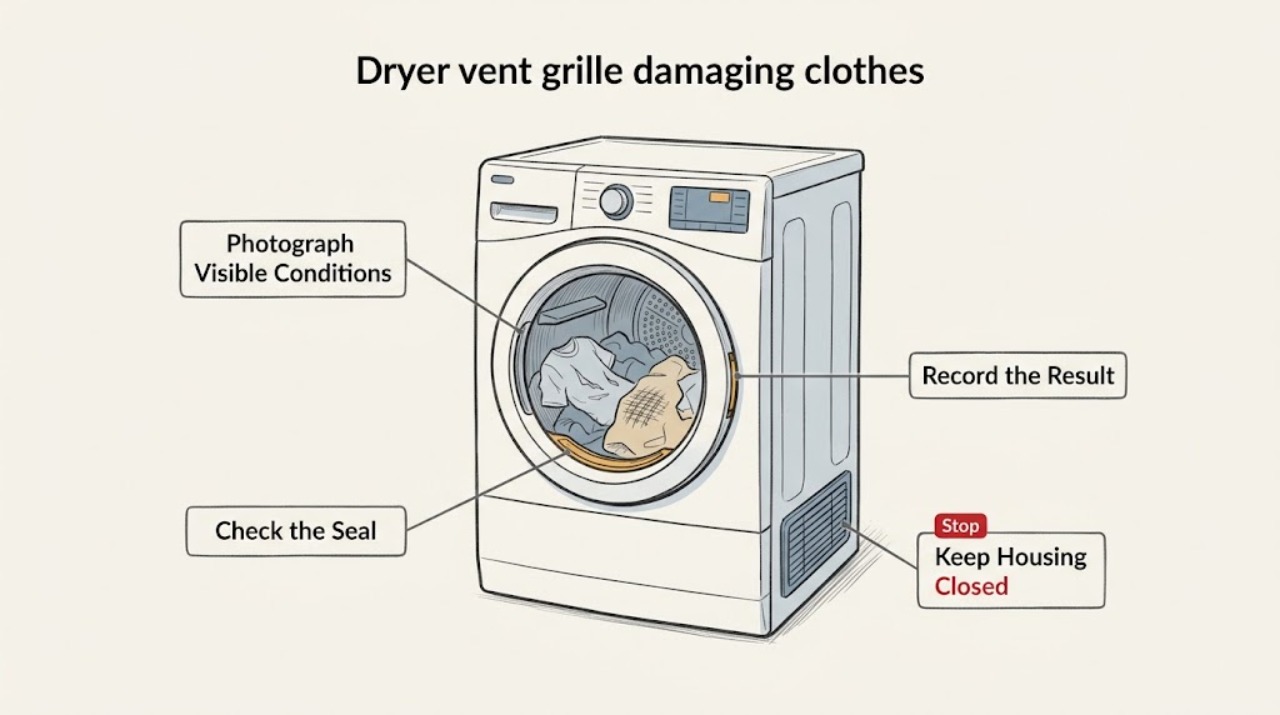
Stop using the Kenmore dryer until you identify whether the damage is coming from the lint-screen housing or vent grille, the drum edge, or the load itself. With the dryer off, unplugged, and cool, photograph the damaged fabric and inspect the inside of the drum, lint-screen opening, and visible grille for a sharp edge, bent or loose section, missing piece, residue, or a gap. A repeated pattern that matches one fixed grille location makes that area the leading suspect, but it does not prove which part is at fault without the exact model. Kenmore directs owners to use the model number to obtain the matching manual; do not assume a grille or lint-screen assembly fits another Kenmore series. Do not run the dryer with a lint screen or grille loose, damaged, blocked, or missing, and do not sand, bend, glue, or cover the grille. Arrange model-specific appliance service if the damage repeats, the grille is damaged, or any internal access is required. Also correct lint and exhaust restrictions because blocked airflow can overheat the dryer and damage fabrics.
Work through in order
Diagnostic checks
Use only checks that match the exact appliance or system and its official guide.
-
Check 1
Stop the dryer, remove the load, and photograph both the damaged fabric and the exact place where the mark, tear, pull, or burn appears. Record whether the pattern repeats on different garments, whether it matches a fixed grille shape, and the full Kenmore model number from the rating label.
Expected result: Damage repeats at one fixed pattern or location, appears randomly, follows the drum seam, or the model number is unavailable.
Next step: Continue only with a cold, disconnected visual inspection when there is no hazard. Use the Kenmore manual lookup with the full model number; do not identify a grille from photographs or from another series alone.
Stop if: Do not run another load to reproduce clothing damage, and stop immediately for smoke, burning odor, scorching, exposed wiring, or abnormal heat.
Why this matters
Why: A repeatable fixed pattern makes the accessible grille or lint-screen housing a leading inspection target; random or seam-following damage keeps other drum or load causes open. The model number is required to select the correct manual and parts information.
-
Check 2
With the dryer unplugged or otherwise safely isolated and fully cool, shine a flashlight through the drum and inspect only the accessible lint-screen opening, vent grille, drum edge, door seal, and nearby surfaces. Look without inserting fingers or tools for a sharp burr, lifted edge, warped or loose grille, missing section, displaced screen, lint packed around the housing, or a visible gap.
Expected result: The grille or screen is visibly damaged or loose, a sharp edge or gap is visible, lint is packed around the screen, or all accessible surfaces look intact.
Next step: Leave the dryer off for any damaged, loose, missing, or sharp grille/screen, and arrange model-specific service. If only removable lint or residue is present, clean and dry the screen exactly as the matching manual directs, then inspect again; do not alter the housing.
Stop if: Do not sand, bend, glue, tape over, drill, pry, or remove the grille or lint-screen housing, and do not operate with the screen loose, damaged, blocked, or missing.
Why this matters
Why: A damaged or loose screen/grille can allow unsafe airflow and may expose fabric to an abnormal edge, but visual inspection alone does not identify the correct assembly or prove the damage mechanism. A clear exterior leaves the drum support, seal, seam, or an internal obstruction unresolved.
-
Check 3
If the accessible grille and screen look intact, inspect the drum edge, door opening, and visible seal for a coin, zipper, screw, lifted seal, rough edge, or gap. Gently rotate the empty drum by hand only while power is isolated, and stop if it binds, scrapes, wobbles, or catches at one position.
Expected result: The drum catches at one position, has a rough or sharp edge, shows a gap or displaced seal, turns smoothly, or the damage occurs only with one garment or fastener type.
Next step: Keep the dryer off for any rough edge, gap, seal displacement, or catching point and provide those observations to qualified service. If the drum is smooth and damage is garment-specific, stop using that item or fastener in the dryer until the cause is established.
Stop if: Do not force the drum, remove the belt or seal, reach behind the drum, or insert a tool into the grille or drum seam.
Why this matters
Why: A catch or rough drum/seal area can explain a fixed snag even when the vent grille appears normal. Smooth rotation does not clear the grille or internal path, and load-specific damage can come from zippers, hooks, or a garment defect rather than the dryer.
-
Check 4
From outside the appliance, check the removable lint screen and the exterior exhaust hood for obvious lint buildup or little/no air movement only according to the exact manual's safe procedure. Do not disconnect ductwork or open the dryer chassis as a clothing-damage test.
Expected result: The screen is blocked or damaged, the outdoor hood has little/no exhaust, the duct is visibly crushed or restricted, or airflow appears normal.
Next step: Leave the dryer off for a damaged screen, overheating, smoke, or restricted vent and arrange qualified appliance or vent service. Clean only the accessible removable filter as directed, and reconnect any duct only if a qualified procedure requires it before use.
Stop if: Do not operate without the lint screen, use a damaged screen, bypass a safety device, use a heat cycle to test damage, or clean inside the chassis without qualified equipment and procedure.
Why this matters
Why: Restricted airflow can raise dryer temperature and increase fire risk, but it does not by itself prove that the grille caused a tear or mark. A blocked or damaged screen is a stop condition; a normal exterior vent does not rule out an inaccessible restriction or mechanical damage source.
Use your observations
Decision map
Find the observation that best matches what you see, then follow the next safe action.
-
PATH 01Next step
What you see
The garment damage repeats in the same grille-shaped pattern and a sharp, lifted, loose, warped, missing, or gapped area is visible at the accessible lint-screen housing.
Do this next
Leave the dryer off, preserve the photos and model number, and arrange model-specific appliance service. Do not reshape, cover, glue, or replace the grille from another Kenmore series.
Why this path and its safety boundary
Why it matters: The grille or screen area is the leading suspect and the dryer is not safe to keep testing. The opened sources do not establish a universal Kenmore replacement or prove that a particular grille part fits without the model.
-
PATH 02Next step
What you see
The grille and removable screen look intact, but the drum catches, has a rough edge, shows a displaced seal or gap, or the damage follows the drum seam rather than the grille.
Do this next
Keep the dryer off and arrange qualified service with the catch location, rotation feel, damage pattern, and model information. Do not remove the belt, seal, panels, or internal drum supports.
Why this path and its safety boundary
Why it matters: A drum-edge, seal, support, or trapped-object issue is more likely than a proven vent-grille defect, and the remaining diagnosis is beyond a safe visual repair.
-
PATH 03Next step
What you see
The screen or exhaust path is blocked or damaged, the dryer becomes unusually hot, drying times increase, or the outdoor vent has little/no air movement, but no grille defect is visible.
Do this next
Stop using the dryer until the removable screen and vent path are corrected through the exact manual or qualified service. Have inaccessible chassis lint or duct restrictions handled professionally, then reassess any remaining garment pattern separately.
Why this path and its safety boundary
Why it matters: Restricted airflow is a separate safety and fabric-care problem. CPSC warns that lint blockage can cause heat buildup, and an official dryer-care source warns that a damaged or missing screen can damage the dryer and fabrics; neither finding identifies the source of a fixed tear.
-
PATH 04Next step
What you see
The accessible grille, screen, drum edge, and seal look intact, the drum rotates smoothly, and the damage occurs only with one garment, zipper, hook, or load type.
Do this next
Do not dry the affected item or similar fasteners again until the pattern is understood. If damage repeats on different loads, leave the dryer off and arrange service rather than escalating the heat or load size.
Why this path and its safety boundary
Why it matters: The dryer has not been shown to be the cause. A garment fastener or item-specific issue remains possible, while an internal grille or housing problem cannot be ruled out without model-specific service if the pattern returns on other items.
Helpful context
Understand the symptom
A grille-shaped mark is a clue, not a confirmed part diagnosis
Photograph the damaged garment next to a sketch or photo of the dryer opening and note whether every mark repeats at the same fixed position. A fixed pattern can make the lint-screen housing or vent grille a sensible first inspection target, while a random snag, a mark that follows the drum seam, or damage limited to one garment may have a different cause. The sources opened for this task do not identify a universal Kenmore grille defect or a universal replacement part, so do not convert the pattern alone into a model-independent diagnosis.
Inspect only the cold, accessible surfaces
With power removed and the drum cool, use a flashlight to look at the lint-screen opening, grille, drum edge, and door area. Look for a sharp or lifted edge, a warped or loose grille, a missing fastener or piece, lint packed around the screen, or a gap where fabric could enter. Do not probe a narrow slot, remove the housing, or reshape the grille. If any grille or screen is damaged, leave the dryer off until the exact manual or a qualified technician establishes the approved repair.
Protect against the separate lint and airflow hazard
Clothing damage and poor exhaust can occur together, but a blocked vent does not prove that the grille caused a tear. CPSC says lint-screen or exhaust blockage can restrict airflow and produce excess heat; the U.S. Fire Administration recommends a clean lint filter, an intact vent path, and professional installation and service. Clean only the removable screen as the exact Kenmore manual directs, and keep the dryer out of service when the screen or grille is loose, damaged, blocked, or missing.
Only after diagnosis
Potential parts
- lint-screen grille or lint-screen housing
Consider this category only if the exact model's manual or a qualified technician confirms that the accessible grille/housing is warped, loose, missing, sharp, or otherwise responsible for the repeated damage pattern.
Kenmore dryers use different model families and layouts. Confirm the complete model number and the manufacturer's exact fit information; do not use a visually similar grille or a generic cover. - dryer drum seal or glide
Consider this category only if service finds a displaced, torn, or worn seal/glide or a drum-edge gap that matches the snag or mark, not from the garment photograph alone.
Confirm the exact model, gas/electric configuration where relevant, and the manufacturer's fit information before any part decision; the opened sources do not establish cross-series compatibility.
When checks do not resolve it
Need a professional?
Have this ready
- Full Kenmore model number, gas or electric type if known, photos of the fabric damage and suspected fixed pattern, grille/screen/drum observations, hand-rotation result, lint-screen and outside-vent observations, load or fastener history, and any heat, smoke, odor, or prior repair history.
Common questions
FAQ
Can a Kenmore dryer's vent grille damage clothes?
A repeated mark that matches one fixed grille location makes the grille or lint-screen housing a reasonable first inspection target, but it is not proof of the cause or of a universal Kenmore defect. Stop using the dryer, inspect the cold accessible area without tools, and use the full model number to obtain the matching manual or service path.
Can I sand or bend the grille smooth?
No. Do not reshape, sand, glue, tape, drill, or cover a grille or lint-screen housing. A damaged or loose screen can create airflow and overheating problems, and the approved assembly and repair method depend on the exact Kenmore model. Leave the dryer off and arrange model-specific service.
Could a blocked vent be causing the clothing damage?
A blocked screen or exhaust can restrict airflow, increase heat, and damage fabrics, but it does not prove that a fixed grille-shaped tear came from the vent grille. Check the removable screen and outside vent only through the exact manual's safe procedure, and stop for overheating, smoke, or a damaged screen.
How do I choose a replacement Kenmore vent grille?
Do not choose by appearance or by the Kenmore name alone. Kenmore directs owners to enter the full model number to locate the matching manual and appliance resources. Use that model identity and manufacturer fit information, or let qualified service identify the assembly after confirming the damage source.
Read the exact guide
Official sources
- Find Your Manual | Kenmore Appliance Manuals & GuidesKenmore / Transform SR Brands LLC · Official Kenmore model lookup page. It supports exact-model identification and the need to use the matching dryer manual; it does not confirm a universal grille defect or part fit.
- Dryer Vent may be Blocked or Restricted - Product HelpWhirlpool · Official Whirlpool manufacturer airflow guidance used as general dryer safety context only; it is not a Kenmore model manual or proof that vent restriction caused the reported clothing damage.
- CPSC Publication 5022 - Overheated Clothes Dryers Can Cause FiresU.S. Consumer Product Safety Commission · Government safety guidance for clothes dryers generally. It supports the stop and airflow boundary, not a Kenmore-specific grille diagnosis or part selection.
- Clothes Dryer Fire SafetyU.S. Fire Administration, FEMA · Government fire-safety guidance for dryers generally. It supports clean-filter, intact-vent, and professional-service boundaries but does not identify a Kenmore grille fault.
- Cleaning the Dryer Lint Filter - Product HelpWhirlpool · Official Whirlpool manufacturer guidance used only as general dryer-care safety reference. It is not evidence that a particular Kenmore model uses the same screen or grille, and it does not prove the cause of a Kenmore clothing mark.
Community feedback
Share a repair observation
Share a plain-text repair observation. Accepted observations are published automatically; this page may take a moment to update.