
On this page
Start here
Quick answer
If the Kenmore 417 98042701 drum turns but the load stays cold, first confirm the selected cycle is meant to heat and identify whether this exact dryer is gas or electric from its model label and matching manual. For an electric dryer, a single tripped fuse or breaker can leave the drum turning while the heater is off. For a gas version, check only that the external gas supply valve is open and that there has not been a known utility or LP interruption. Clean the lint screen and check the exhaust path from the outside, but do not run a gas dryer without an outdoor exhaust duct. If the correct setting, accessible supply checks, and airflow check do not restore heat, stop and arrange qualified service rather than opening the cabinet or testing live circuits.
Before you begin
Safety first
- Do not open the Kenmore cabinet, disconnect a gas connector, test live voltage, bypass a fuse or thermal limiter, bridge a safety device, or replace an igniter, coil, heater, sensor, or control solely from a no-heat symptom. Never operate a gas dryer without an outdoor exhaust duct.
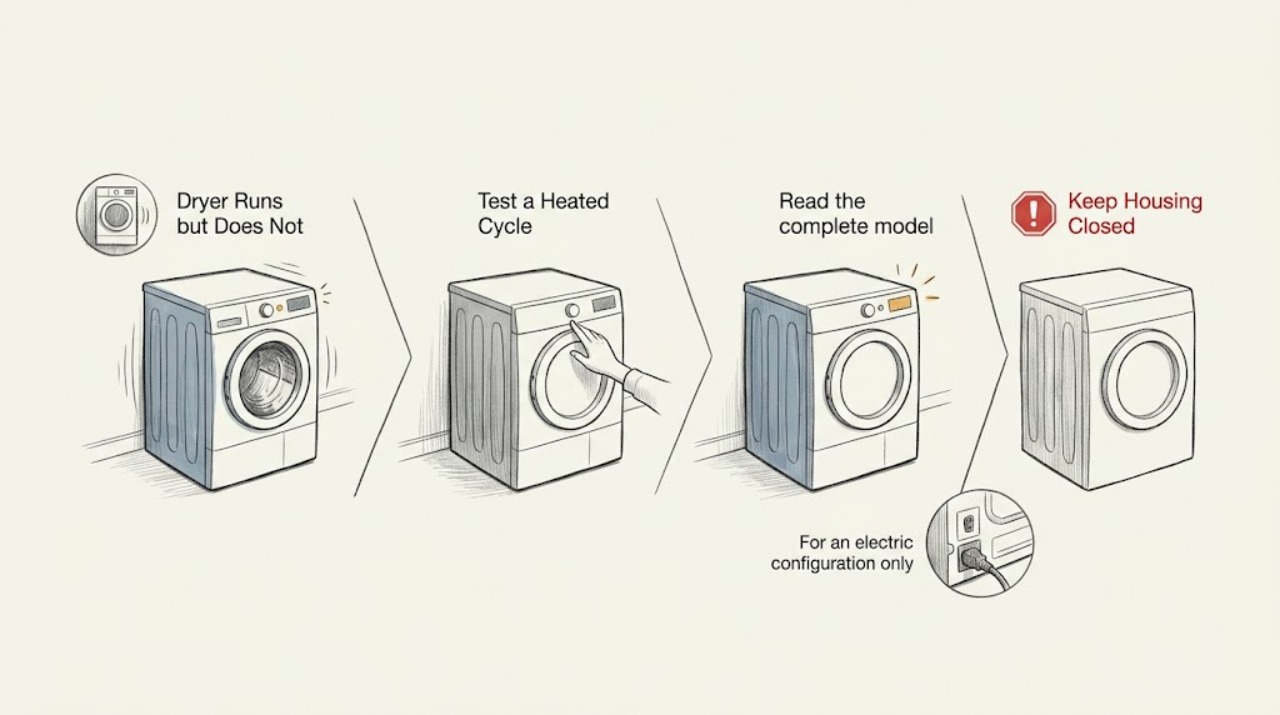
Work through in order
Diagnostic checks
Use only checks that match the exact appliance or system and its official guide.
-
Check 1
With the dryer empty, choose a normal timed or heated cycle documented for the Kenmore 417 98042701, make sure Air Fluff or another no-heat setting is not selected, close the door, and start one cycle. Confirm whether the drum turns and whether the exhaust air becomes warm after the cycle has had time to begin heating.
Expected result: The drum turns and the exhaust remains cool, the dryer does not start, or the selected cycle is Air Fluff/no-heat or otherwise not the matching model setting.
Next step: Correct only the cycle selection if it was wrong. If the correct heated cycle still produces cool air, continue with the external power, fuel-type, and airflow checks; do not repeat heated cycles indefinitely.
Stop if: Stop for smoke, sparks, a burning smell, gas odor, abnormal heat, or a damaged cord or outlet.
Why this matters
Why: A no-heat setting can intentionally tumble without heat. If a correct heated cycle tumbles but stays cold, the problem is in the supply, gas-heating, electric-heating, control, or safety circuit rather than the drum motor alone.
-
Check 2
Read the complete model and serial label and use Kenmore's manual search with the model number exactly as printed. Confirm whether this 417 98042701 unit is the gas or electric configuration before following any heat-system instructions.
Expected result: The matching manual identifies the fuel type and operating controls, or the label/manual is missing, unreadable, or does not match the dryer.
Next step: Use only the matching manual for the confirmed configuration. If the identity or fuel type cannot be confirmed, keep the dryer off and provide the model plate to a service provider instead of guessing the heater system.
Stop if: Do not remove panels, disconnect a gas line, or test a live circuit to discover the configuration.
Why this matters
Why: Gas and electric dryers have different heat sources, supply checks, and hazards. A 417 prefix or a similar-looking Kenmore model is not enough to establish part fit or a safe access procedure.
-
Check 3
For an electric configuration only, inspect the household dryer breaker or fuses from the normal user-accessible panel. If there is one tripped breaker and no scorching, moisture, damaged cord, or other hazard, reset it once; do not increase fuse capacity or open the dryer.
Expected result: A breaker or fuse is open, the breaker trips again, the dryer has a damaged connection, or the accessible supply appears normal while the drum still turns without heat.
Next step: If one reset restores normal heat and the connection remains safe, monitor the next cycle. If it trips again, remains cold, or there is damage, leave the dryer off and call a qualified electrician or appliance technician.
Stop if: Do not remove the dryer rear panel, probe voltage, bypass a fuse, or keep resetting a tripping breaker.
Why this matters
Why: Electric dryers can have the drum motor running while a lost supply leg prevents the heater from operating. A repeat trip or visible damage indicates a supply or appliance fault, not a reason to keep resetting it.
-
Check 4
For a gas configuration only, without moving the appliance or disconnecting the connector, confirm that the external gas supply valve is in its normal open position and note whether other gas appliances work. If the home uses LP, verify only whether the tank is empty; if natural gas service was interrupted, check with the utility from a safe location.
Expected result: The valve is closed, the LP tank is empty, natural-gas service is interrupted, other gas appliances also fail, or the external supply appears normal but the dryer still has no heat.
Next step: Correct only an accidentally closed external valve when it is safe and permitted by the installation instructions, or wait for utility service to return. If supply is normal or the symptom persists, stop using the dryer and arrange qualified gas-appliance service.
Stop if: If gas is smelled, do not operate switches, create a flame, relight anything, or continue testing; leave the area and follow local emergency or utility instructions.
Why this matters
Why: A closed valve or an interrupted fuel supply can prevent burner heat without proving an igniter, coil, valve, or control failure. If supply is normal and the dryer remains cold, the internal gas-heating circuit requires service diagnosis.
-
Check 5
With the dryer off and cool, clean the lint screen and inspect the accessible exhaust hose connection, outside hood, and surrounding clearance for lint, blockage, crushing, or a missing outdoor termination. Do not run a gas dryer without an exhaust duct venting outdoors.
Expected result: The lint screen or external duct is blocked or crushed, the outside hood does not open freely, clearance is restricted, or the airflow path is clear but the dryer still produces no heat.
Next step: Remove only lint or an obvious external obstruction without dismantling the dryer, then perform one normal observation. If no heat remains or the duct requires internal cleaning, arrange authorized service or qualified vent cleaning.
Stop if: Do not operate without the lint screen, bypass the vent, run a gas dryer without outdoor exhaust, or reach inside the cabinet or blower area.
Why this matters
Why: Restricted airflow can cause long drying and heat-related protection; it does not identify a failed heater, burner, fuse, or sensor. A clear external path with true no-heat behavior makes a heating-system fault more likely.
-
Check 6
Record the exact model, fuel type, selected cycle, whether the drum turns, whether any warmth was felt at the exhaust, breaker/fuse or gas-supply result, airflow result, and any odor or shutdown before calling service.
Expected result: The dryer remains cold after the correct cycle and safe external checks, or it stops, overheats, smells abnormal, or repeatedly trips protection.
Next step: Keep the dryer off and give the recorded observations to a qualified appliance technician. Use a qualified electrician for household supply concerns and qualified gas service for gas-line or burner concerns.
Stop if: Do not open panels, test live components, bypass thermal protection, bridge a fuse, or order a part solely from the symptom.
Why this matters
Why: The remaining possibilities include an internal heater or burner circuit, thermal protection, control, sensor, wiring, or airflow fault that cannot be safely isolated from the outside. Repeated operation can worsen a heat or gas problem.
Use your observations
Decision map
Find the observation that best matches what you see, then follow the next safe action.
-
PATH 01Next step
What you see
The 417 98042701 drum turns on a correct heated cycle, but the exhaust stays cool; the unit is confirmed electric and one breaker or fuse is open.
Do this next
Reset only once when the circuit and cord are visibly safe. If heat does not return or the breaker/fuse opens again, leave the dryer off and call a qualified electrician or appliance technician.
Why this path and its safety boundary
Why it matters: A lost electric supply leg is a supported explanation for a tumbling dryer with no heater operation, but a repeated trip or failed reset is a service or electrical-supply condition.
-
PATH 02Next step
What you see
The unit is confirmed gas, the drum turns, the external valve is open, and there is no known LP or natural-gas interruption, but the exhaust remains cool.
Do this next
Stop using the dryer and arrange qualified gas-appliance service. Report the model, fuel type, selected cycle, absence of heat, and whether any gas odor or abnormal clicking occurred.
Why this path and its safety boundary
Why it matters: The external supply checks do not distinguish the burner ignition, valve, sensor, control, or thermal causes. Those components require model-specific service diagnosis.
-
PATH 03Next step
What you see
The dryer was on Air Fluff/no-heat, the load was too large or too small, or the lint screen or external exhaust was restricted, and no hazard is present.
Do this next
Correct the setting or accessible airflow issue, then make one normal no-load observation. If the dryer remains cold on a correct heated cycle, route to the electric or gas service branch.
Why this path and its safety boundary
Why it matters: The symptom may be a setting or drying-performance problem rather than proof that a heater failed. Airflow restrictions still need correction because they can increase drying time and heat risk.
-
PATH 04Next step
What you see
There is gas odor, smoke, burning smell, sparking, abnormal heat, a damaged cord, repeated breaker operation, or the dryer stops with a protection symptom.
Do this next
Stop immediately. For gas odor, leave without operating electrical switches or flames and contact local emergency or utility support from a safe location. Otherwise isolate power only when safe and arrange prompt qualified service.
Why this path and its safety boundary
Why it matters: This is a fire, gas, or electrical safety condition, not a normal troubleshooting branch.
Helpful context
Understand the symptom
Separate no heat from slow drying
A dryer that tumbles with cool air has a different first decision from a dryer that produces some heat but takes too long. The checks below start with the cycle and the accessible supply path, then separate electric and gas possibilities. The 417 98042701 model identity should be confirmed from the plate and the matching Kenmore manual before selecting a component or using an access procedure.
Why the vent still matters
A restricted lint screen or exhaust path can lengthen drying and raise heat-related risk even when the heater is capable of operating. Clean only the accessible lint screen and external vent path. Cabinet, burner, heater, fuse, limiter, and live-voltage work belongs to a qualified technician.
When checks do not resolve it
Need a professional?
Arrange qualified appliance service when the dryer remains cold after the correct cycle and safe external checks, when the fuel type or matching manual cannot be confirmed, when a breaker or fuse trips again, when gas supply is normal but a gas dryer does not heat, or when airflow requires internal access. Use a qualified electrician for household supply faults and qualified gas service for gas-line or burner work.
Safety scope: Do not open the Kenmore cabinet, disconnect a gas connector, test live voltage, bypass a fuse or thermal limiter, bridge a safety device, or replace an igniter, coil, heater, sensor, or control solely from a no-heat symptom. Never operate a gas dryer without an outdoor exhaust duct.
Have this ready
- Provide the complete model and serial information, fuel type, country, selected cycle and temperature, whether the drum turns, whether the exhaust is warm, breaker/fuse result, external gas-valve or utility result if applicable, lint and vent observations, and any odor, noise, shutdown, or repeated-trip event.
Common questions
FAQ
Why does my Kenmore 417 98042701 dryer run but not heat?
First rule out a no-heat cycle and confirm the exact gas or electric configuration. A single lost electric supply leg, an external gas-supply interruption, or restricted airflow can produce a cold-drum symptom; if those safe checks do not resolve it, the internal heat or safety circuit needs qualified service.
Can I reset the Kenmore dryer breaker repeatedly?
No. If there is no visible damage, one reset may be reasonable for a single tripped breaker, but a repeat trip means the dryer should remain off and the supply or appliance should be checked by a qualified professional.
Should I replace the igniter or heating element first?
Not from the no-heat symptom alone. Confirm the exact model and fuel type, then have the technician test the applicable supply, airflow, protection, and heat circuit before choosing a part.
Read the exact guide
Official sources
- What should I do if my dryer does not start?Frigidaire · Used only for external start and household-supply safety boundaries shared by dryers; not used to infer Kenmore model internals.
- Find Your Manual | Kenmore Appliance Manuals & GuidesKenmore · Directly applicable to the identity and manual-selection boundary: Kenmore instructs owners to enter the complete model number and says manuals contain model-specific operating and service information.
- Dryer - Not Drying and Extended Drying TimeFrigidaire · Manufacturer guidance for accessible lint, setting, load, exhaust, and gas-vent safety checks; it does not establish exact Kenmore 417 98042701 component fit.
- My dryer is running, but does not seem to be heating. What should I do?Frigidaire · Manufacturer guidance for dryer no-heat decisions; used for general electric-versus-gas branching and external supply checks, not as proof of a Kenmore part fit.
Community feedback
Share a repair observation
Share a plain-text repair observation. Accepted observations are published automatically; this page may take a moment to update.