
On this page
Start here
Quick answer
For a Kenmore Elite 110.92836100 gas dryer that tumbles but does not heat, do not decide from age or a guessed part alone. First confirm the full model, gas type, cycle, and whether there is any gas odor, smoke, burning smell, abnormal heat, or restricted airflow; stop immediately for those hazards. If the dryer is otherwise safe, a qualified diagnosis should separate an external vent or supply condition from an internal heating or control fault. Repair is the more practical branch when a technician can identify a limited, available repair and the cabinet, drum, gas connection, and controls are sound. Replacement becomes more reasonable when safe service or parts are unavailable, the diagnosis finds several major or recurring faults, or the downtime and logistics of rural service outweigh keeping the older dryer. There is no reliable universal price or age cutoff. An exact Reddit case for this model reports that a repair using a couple of parts succeeded, but that outcome does not identify the parts or predict another unit.
Before you begin
Safety first
- Do not open the cabinet, disconnect gas tubing, access the burner or gas valve, bypass thermal or door safety devices, test live electrical parts, or replace a fuse, igniter, valve, sensor, or control from the no-heat symptom alone. Stop for gas odor/hissing, smoke, sparks, burning rubber, exposed wiring, abnormal heat, a hot or damaged cord, or repeated breaker trips.
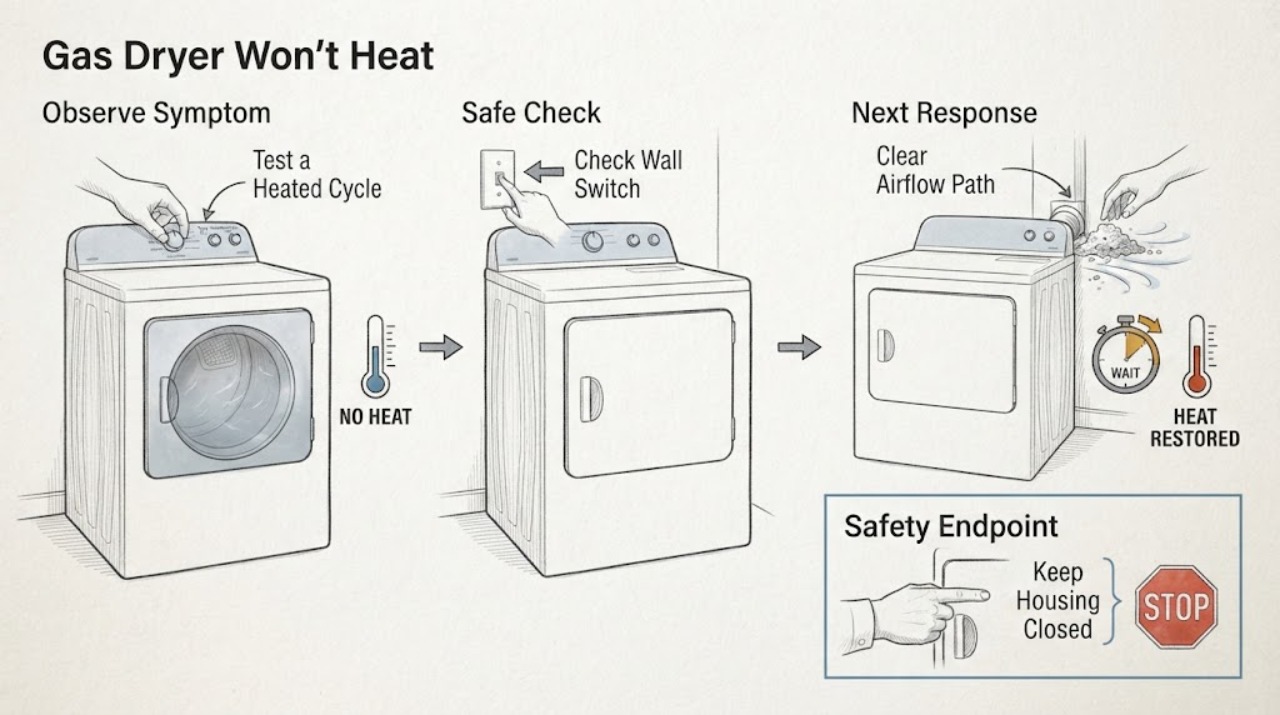
Work through in order
Diagnostic checks
Use only checks that match the exact appliance or system and its official guide.
-
Check 1
Read the complete rating-label model as 110.92836100, confirm that the appliance is the gas dryer rather than another Kenmore product, and record whether the drum tumbles, whether the selected cycle is a heated cycle, and whether any display or airflow warning is present.
Expected result: The full model and gas configuration are confirmed, or the model/energy type is uncertain or the cycle is Air Fluff, No Heat, or otherwise non-heated.
Next step: Use the exact model in the Kenmore manual portal and select a model-supported heated cycle only when no safety warning is present. Do not compare parts or repair decisions using a different Kenmore series.
Why this matters
Why: Kenmore directs users to search manuals by the complete model number, and a non-heated cycle can imitate a heating failure. A different model or cycle needs its own documentation.
-
Check 2
Before any further run, check from outside for gas odor or hissing, smoke, burning rubber, sparks, exposed wiring, a hot or damaged cord, unusual cabinet heat, or a vent that is discharging dangerously hot air. Do not operate switches or relight anything if gas may be present.
Expected result: Any gas, fire, electrical, or abnormal-heat warning is present, or the dryer has no visible hazard.
Next step: For suspected gas, leave the area and contact local emergency or gas services from outside. For smoke, sparks, heat damage, or electrical hazards, keep the dryer off and obtain qualified appliance or electrical help.
Why this matters
Why: A safety warning ends the repair-versus-replace diagnosis; repeated operation can increase gas, fire, or electrical risk. No visible hazard only permits low-risk external checks and a service decision.
-
Check 3
With the dryer off, inspect only the lint screen, the visible vent connection, and the outside vent exit for lint buildup, crushing, a detached hose, or weak airflow. Do not remove cabinet panels or reach into the burner, gas valve, blower, or thermal controls.
Expected result: The accessible lint and vent path is restricted or damaged, or it appears clear while the dryer still runs without heat.
Next step: Correct only a plainly visible external restriction that can be handled safely, then use one supervised heated-cycle check. If airflow remains weak, the hose enters a wall or inaccessible duct, or no heat persists, arrange qualified service.
Why this matters
Why: An airflow problem can affect drying and can contribute to overheating, but a clear external path does not identify the internal heating cause. A damaged vent may make continued use unsafe even if the burner later lights.
-
Check 4
Record what a qualified technician can verify without guessing: whether the drum runs, whether the dryer ever produces heat, whether heat stops after a short period, whether the problem began suddenly, and whether the same failure occurs on more than one model-supported heated cycle. Do not open the gas or electrical cabinet to test a part yourself.
Expected result: The drum runs but heat is absent on every heated cycle, heat is intermittent, or the issue changes with cycle/airflow conditions.
Next step: Give the technician the model, gas type, cycle behavior, vent observations, and any safety symptoms. Request a written or clearly explained diagnosis before authorizing parts.
Why this matters
Why: Different result patterns lead to different diagnostic paths; they do not select a thermal fuse, igniter, valve, sensor, or control board by themselves. The exact community case did not identify the parts used in its successful repair.
-
Check 5
If local service is scarce, ask before booking whether the provider can service a Kenmore gas dryer with model 110.92836100, whether a diagnostic visit can identify the failed system before parts are ordered, whether parts can be sourced, and whether a return trip or special gas-appliance qualification is needed.
Expected result: A qualified provider can diagnose and obtain appropriate parts, or service coverage/parts access is uncertain and the nearest provider requires substantial travel or delay.
Next step: Compare the provider's repair scope and logistics with the effort of obtaining a safe replacement installation. Do not authorize a guessed part or abandon a safe, diagnosable repair solely because the appliance is old.
Why this matters
Why: Rural logistics change the practical value of repair, but they do not change the gas-safety boundary or prove that replacement is cheaper. A repair decision is stronger when diagnosis, parts, and follow-up are feasible.
Use your observations
Decision map
Find the observation that best matches what you see, then follow the next safe action.
-
PATH 01Next step
What you see
The dryer is confirmed as 110.92836100, has no gas/electrical/heat hazard, and a qualified provider can identify one limited repair with parts and follow-up available.
Do this next
Authorize repair only after the diagnosis and scope are clear. Ask the provider to address any vent or gas-safety cause before returning the dryer to service.
Why this path and its safety boundary
Why it matters: Repair has a defensible practical path even though the appliance is old; the exact community case also reports a successful multi-part repair, but it does not prove which parts this unit needs.
-
PATH 02Next step
What you see
The diagnosis finds several major or recurring faults, parts are unavailable, the provider cannot safely service the gas system, or rural travel/return logistics make a verified repair impractical.
Do this next
Keep the gas dryer disconnected and arrange a code-compliant replacement installation by a qualified professional. Do not remove or cap gas connections yourself.
Why this path and its safety boundary
Why it matters: Replacement becomes the more reasonable planning branch, but this is a logistics and condition decision rather than a fixed age or dollar rule.
-
PATH 03Next step
What you see
The lint/vent path is restricted, the dryer has abnormal heat, or the vent requires work inside a wall or inaccessible space.
Do this next
Stop heated operation and have the vent path inspected or cleaned by a qualified provider. Reassess repair versus replacement only after safe airflow and the actual no-heat cause are known.
Why this path and its safety boundary
Why it matters: The immediate priority is airflow and fire prevention; replacing a heating part without correcting the vent can leave the risk unresolved.
-
PATH 04Next step
What you see
Gas odor or hissing, smoke, sparks, burning rubber, exposed wiring, a hot/damaged cord, or uncontrolled heat is present.
Do this next
Leave without operating switches or attempting ignition, contact local emergency or gas services from outside as appropriate, and keep the appliance out of service until qualified help clears it.
Why this path and its safety boundary
Why it matters: This is an urgent safety event and not a normal repair-versus-replace comparison.
Helpful context
Understand the symptom
What the model-specific case establishes
The opened community case identifies the appliance as a 2002 Kenmore Elite gas dryer, model 110.92836100, and makes rural service availability part of the decision. The author later says the dryer was repaired with a couple of parts and kept in service. That is a useful outcome for framing the choice, not a parts list, cost estimate, warranty, or guarantee that another dryer has the same fault.
Why diagnosis comes before the repair-or-replace choice
A gas dryer that runs without heat can have more than one possible cause, and the exact case does not identify which part was replaced. For an older dryer in a remote area, ask for the diagnosis, safe repair scope, part availability, travel or return-visit implications, and expected downtime before committing to repair or replacement.
When checks do not resolve it
Need a professional?
Arrange qualified gas-appliance service when the dryer runs without heat after the external cycle and vent checks, when heat is intermittent, when the vent needs inaccessible work, or when you need a diagnosis before deciding repair versus replacement. Use local emergency or gas services from outside for suspected gas leakage.
Safety scope: Do not open the cabinet, disconnect gas tubing, access the burner or gas valve, bypass thermal or door safety devices, test live electrical parts, or replace a fuse, igniter, valve, sensor, or control from the no-heat symptom alone. Stop for gas odor/hissing, smoke, sparks, burning rubber, exposed wiring, abnormal heat, a hot or damaged cord, or repeated breaker trips.
Have this ready
- Provide model 110.92836100, serial if available, gas type, selected cycles, whether the drum tumbles, whether heat is absent or intermittent, airflow observations, the date and pattern of failure, and any gas, smoke, odor, heat, or electrical symptoms.
Common questions
FAQ
Should I repair or replace a 2002 Kenmore 110.92836100 gas dryer that will not heat?
Do not choose from age alone. Repair is more defensible when a qualified provider can identify a limited, available repair and safe gas/vent conditions; replacement becomes more practical when major or repeated faults, unavailable parts, unsafe service, or rural logistics make a verified repair impractical. The exact community case reports successful repair but does not provide a universal rule.
Can I replace the sensor or igniter first to save a rural service visit?
Do not order a guessed part. The exact community case does not name the parts used, and the model-specific manual is needed before selecting a component. Give the provider the exact model and symptoms and ask whether they can diagnose and source the correct part in one visit.
Is it safe to keep running the dryer while waiting for a technician?
No if there is gas odor, smoke, burning rubber, abnormal heat, sparks, exposed wiring, a hot/damaged cord, or restricted/inaccessible venting. Keep it off and obtain qualified help; do not operate switches during a suspected gas leak.
Read the exact guide
Official sources
- Find Your Manual | Kenmore Appliance Manuals & GuidesKenmore / Transform SR Brands LLC · Official Kenmore manual portal opened directly. For the assigned model 110 92836100, it instructs the owner to enter the complete model number to access the matching manual and resources; it is not used as a component diagnosis.
- 2002 Kenmore Elite gas dryer won't heat--repair or replace?Reddit r/Appliances · Exact Reddit post opened directly; the author names Kenmore Elite gas dryer model 110.92836100, rural service scarcity, and the repair-or-replace question.
Community feedback
Share a repair observation
Share a plain-text repair observation. Accepted observations are published automatically; this page may take a moment to update.