
On this page
Start here
Quick answer
Do not substitute a GE thermal cutoff or high-limit thermostat in the Kenmore Elite 110.66992501 just because the part name, shape, terminal count, or temperature marking looks similar. The opened Kenmore manual finder tells owners to retrieve the manual with the full model number, while GE's official part page says to check the model number to confirm compatibility; neither is an interchangeability approval for this Kenmore model. First confirm the rating label and whether the drum runs, verify the accessible lint screen and exhaust path are not blocked, and record any previous cutoff/thermostat failure. A thermal cutoff or high-limit device is a safety component, so an open part can be a result of overheating rather than the root cause. Use a candidate GE part only if an authorized model-specific cross-reference explicitly names 110.66992501 and matches the exact function, reset behavior, temperature rating, terminals, mounting, and appliance rating. Without that proof, leave the dryer off and have a qualified technician diagnose the no-heat circuit and select the part.
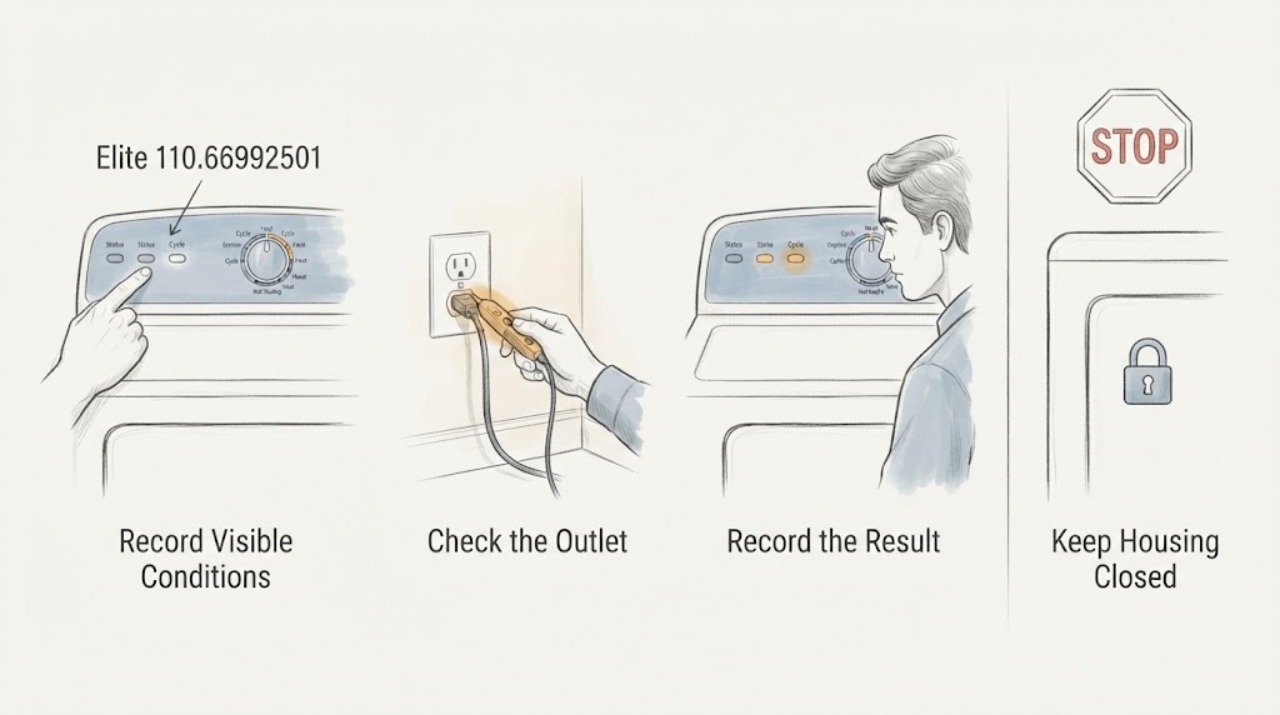
Work through in order
Diagnostic checks
Use only checks that match the exact appliance or system and its official guide.
-
Check 1
Read the rating label and record the complete Kenmore model as 110.66992501, the serial information if available, and the appliance rating. Note whether the drum runs, whether there is any warmth, whether an indicator or breaker event occurred, and whether the candidate GE part has a complete manufacturer part number. Do not infer the machine type from a replacement part listing.
Expected result: The full label matches 110.66992501, the dryer runs with no heat, the dryer does not run, a breaker trips, or the model/part number is incomplete.
Next step: Use the full model in Kenmore's manual finder and preserve photos of every existing part marking for service. If the identity is uncertain, stop parts shopping and arrange identification by a qualified technician.
Stop if: Do not remove covers, pull the dryer forward, or operate it with a damaged cord, scorching, smoke, burning odor, or repeated breaker trip.
Why this matters
Why: Model identity and the no-heat symptom are prerequisites for a valid parts search. A candidate without a complete part number cannot be checked for an exact cross-reference; running/no-heat and no-run do not prove the same failed safety device.
-
Check 2
With the dryer off and cool, inspect only the accessible lint screen, visible exhaust connection, and exterior vent outlet for lint buildup, crushing, kinks, or a blocked outlet. Clean the lint screen as the model manual permits; do not insert tools into the duct or dismantle the dryer.
Expected result: The screen or visible path is restricted, the outlet airflow is weak, the path looks clear, or the dryer has abnormal heat, scorching, smoke, or odor.
Next step: Correct only an obvious accessible lint or routing issue and record it. For recurrence, weak airflow, abnormal heat, or any odor/smoke, leave the dryer off and arrange qualified service before changing a safety part.
Stop if: Do not run a test cycle through a blocked vent, bypass a thermal device, or open the heater/blower cabinet.
Why this matters
Why: A restricted exhaust path can raise operating temperature and make repeated safety-device failures more likely, but a clear visible path does not identify the cutoff, thermostat, heater, or control as the failed part.
-
Check 3
If a technician or prior repair has already exposed the components, record the exact markings on the Kenmore thermal cutoff and high-limit thermostat, their original locations, connector style, and any signs of heat damage without energizing the dryer. Compare those markings only against an authorized parts lookup for 110.66992501; do not compare by photo or by a GE catalog category alone.
Expected result: An authorized lookup explicitly lists the candidate part for 110.66992501, lists only a different Kenmore/GE model, gives no cross-reference, or the original part marking is unreadable.
Next step: Use the candidate only when the exact model and part number are both named by the authorized source and the technician confirms the function. Otherwise leave the dryer off and ask service to identify the correct component.
Stop if: Do not install a GE component as a trial, splice terminals, enlarge mounting holes, substitute a jumper, or test a safety device in an energized circuit.
Why this matters
Why: An explicit model-specific cross-reference is the minimum evidence for compatibility. A listing for another model, a generic 'high-limit thermostat' label, or an unreadable marking leaves fit, electrical behavior, and safety rating unverified.
-
Check 4
Review the repair history: which device opened, whether the same device has failed more than once, whether the vent was cleaned, whether the dryer previously overheated, and whether a prior replacement changed the symptom. Keep the dryer disconnected while collecting this record.
Expected result: The cutoff/thermostat failed repeatedly, the dryer overheated, the vent history is unknown, the candidate part was already installed, or the no-heat symptom remains despite a supposedly matching replacement.
Next step: Give the failure sequence and airflow history to qualified appliance service. Request verification of the heating circuit, safety devices, airflow, wiring, and model-specific parts before authorizing replacement.
Stop if: Do not continue operating after a thermal device opens, do not bridge it to keep the dryer running, and do not make energized measurements.
Why this matters
Why: A repeated safety-device failure or unchanged no-heat symptom means a root-cause diagnosis is still missing; replacing another brand's part can conceal the problem or defeat the intended protection.
-
Check 5
From a dry, safe position, check for smoke, a burning electrical or rubber odor, melted insulation, sparking, a hot receptacle, damaged cord, or repeated breaker trips. Do not touch wet or scorched equipment and do not restart the dryer to see whether a replacement part works.
Expected result: Any fire/electrical warning is present, or the dryer is cool externally with no warning but still does not heat.
Next step: For smoke, sparking, scorching, or burning odor, keep clear, isolate power only if safe, and obtain qualified electrical/appliance help. For ordinary persistent no-heat, leave the dryer off and arrange service with the exact model and part evidence.
Stop if: Do not operate switches near smoke or exposed conductors, open panels, or attempt a live test.
Why this matters
Why: A safety warning overrides compatibility research and requires immediate stop. A normal exterior does not prove the heating circuit or safety device is healthy.
Use your observations
Decision map
Find the observation that best matches what you see, then follow the next safe action.
-
PATH 01Next step
What you see
The full model label is confirmed, the dryer has no obvious hazard, and an authorized parts lookup explicitly names the same candidate part number for Kenmore 110.66992501.
Do this next
Have a qualified technician verify the exact function, cutoff/reset behavior, rating, terminals, mounting, and airflow/root cause before installation. Do not rely on a visual match alone.
Why this path and its safety boundary
Why it matters: This is the only branch in which cross-brand compatibility becomes plausible, and it still does not prove that the no-heat root cause is the safety device.
-
PATH 02Next step
What you see
The GE part is listed for another GE model, has only a generic category name, or no authorized source names 110.66992501.
Do this next
Do not install it or modify the wiring. Retrieve the Kenmore model documentation and ask an authorized parts source or qualified technician for the exact Kenmore cross-reference.
Why this path and its safety boundary
Why it matters: Compatibility is unverified. Similar dimensions, terminal count, or a matching temperature number cannot establish the complete electrical and safety specification.
-
PATH 03Next step
What you see
A cutoff or high-limit device has opened repeatedly, the dryer previously overheated, or no heat remains after a purported replacement.
Do this next
Leave the dryer off and arrange qualified diagnosis of the complete heating and safety circuit. Provide the replacement history and vent observations.
Why this path and its safety boundary
Why it matters: The safety device may be reacting to an unresolved airflow, heater, wiring, control, or installation problem; the symptom does not authorize another substitute part.
-
PATH 04Next step
What you see
The dryer will not run at all, or it runs but has no heat, with no model-specific part evidence yet.
Do this next
Use only the safe external checks and exact manual route; do not open the cabinet or make a live measurement. Arrange service if power, heater, or safety diagnosis is needed.
Why this path and its safety boundary
Why it matters: These are different symptom paths and neither identifies a thermal cutoff or high-limit thermostat without circuit diagnosis.
-
PATH 05Next step
What you see
There is smoke, burning odor, sparking, melted insulation, a hot receptacle, damaged cord, or repeated breaker operation.
Do this next
Keep clear, isolate power only from a safe dry location if possible, and obtain qualified electrical/appliance help. Do not restart the dryer or touch the suspected component.
Why this path and its safety boundary
Why it matters: The issue has crossed a fire or electrical safety boundary; compatibility research and further testing must stop.
Helpful context
Understand the symptom
The answer to 'can I use a GE part?' is not established by the words thermal cutoff or high-limit thermostat. These are functional descriptions, not universal part numbers. Kenmore's official manual page asks for the complete model number, and GE's official part listing tells buyers to check their model number before assuming a fit.
For 110.66992501, keep the candidate part uninstalled until the exact Kenmore documentation or an authorized parts cross-reference ties that part number to this model. A similar bracket or two matching terminals does not prove the same cutoff temperature, reset behavior, current path, mounting location, or safety certification.
If a cutoff has opened, replacing it without asking why can turn a no-heat complaint into an overheating or fire risk. The economical decision is to document the exact failure and airflow history, then have service verify the safety circuit and select a model-approved component instead of buying a guessed GE equivalent.
When checks do not resolve it
Need a professional?
Arrange qualified Kenmore appliance service when no heat persists, a thermal cutoff or high-limit thermostat has opened, the candidate part lacks an explicit 110.66992501 cross-reference, the dryer overheated, or the same safety device failed again. Stop immediately for smoke, burning odor, sparking, melted insulation, a hot receptacle, damaged cord, or repeated breaker operation. Do not install a GE substitute by appearance, jumper a safety device, splice terminals, open the cabinet, or make an energized measurement.
Common questions
FAQ
Can a GE high-limit thermostat replace the Kenmore 110.66992501 part?
Not on the evidence reviewed. GE's official part listing says to check the model number to confirm compatibility, and no opened official source provided a cross-reference approving a GE thermostat for Kenmore 110.66992501. Use only an explicit model-and-part-number cross-reference confirmed by an authorized source or technician.
If the thermal cutoff is open, should I replace the high-limit thermostat too?
Do not decide from the open reading alone or from a generic kit. Record the exact model and component markings, verify the correct service procedure, and have the technician check airflow, heater, wiring, and overheating history before replacing any safety device.
What is the cheapest safe way to resolve no heat?
Start with the exact model identity and accessible lint/exhaust check, then stop parts swapping. A verified model-specific part and root-cause diagnosis are cheaper and safer than installing a similar GE device that may have a different rating, reset behavior, or mounting.
Read the exact guide
Official sources
- Find Your Manual | Kenmore Appliance Manuals & GuidesKenmore · Kenmore official manual finder and model-documentation route for the assigned Kenmore 11066992501 dryer; the page requires owners to enter the complete model number and does not itself approve cross-brand parts.
- WE4M80 | Clothes Dryer high limit safety thermostatGE Appliances · GE Appliances official product page for GE high-limit safety thermostat WE4M80; it is used only to establish GE's model-number compatibility requirement, not to claim fit on Kenmore 11066992501.
Community feedback
Share a repair observation
Share a plain-text repair observation. Accepted observations are published automatically; this page may take a moment to update.