
On this page
Start here
Quick answer
A Kenmore washer-dryer that leaves water in the tub may have a kinked or displaced drain hose, a user-serviceable filter blocked with debris, an overfilled or badly loaded cycle, or a pump, sensor, lock, or control fault. First stop the cycle and protect against flooding and electrical contact. Record the model and symptoms, then use the exact Kenmore owner's manual: Kenmore's official manual finder covers washers and dryers and is the authority for the safe filter location and drain procedure. From ordinary access, check the visible hose path, water level, door or lid state, and external power. If the manual permits a filter cleanout, drain the water using its specified method with the appliance disconnected and the floor protected. If water remains, the pump only hums, the unit leaks, will not unlock, or draining requires cabinet access, stop and arrange qualified appliance service; do not keep restarting a full tub.
Before you begin
Safety first
- This article supports water containment and ordinary-access checks only. Follow the exact model manual for any user-serviceable filter or drain path; do not force a lock, open the cabinet, access energized wiring, or improvise a pump repair.
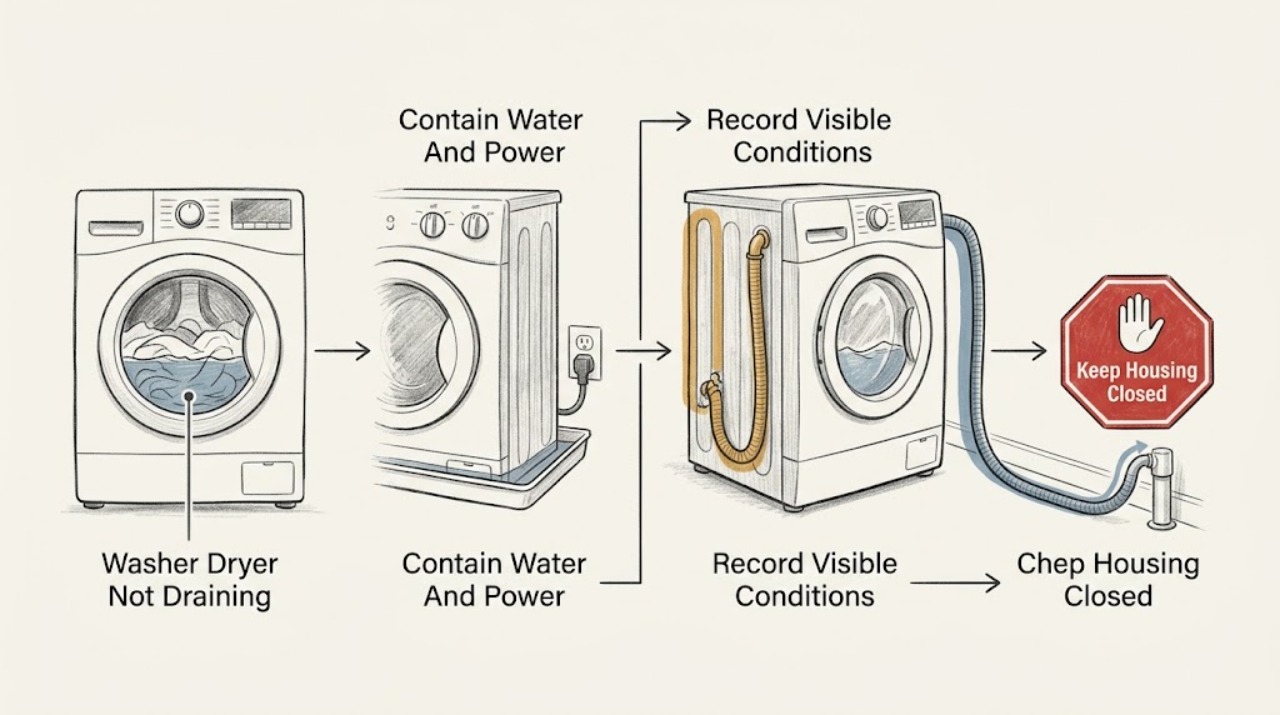
Work through in order
Diagnostic checks
Use only checks that match the exact appliance or system and its official guide.
-
Check 1
Pause the cycle, keep people away from the water, and disconnect power at the normal plug or accessible disconnect only if it can be done without touching water or damaged wiring; close accessible water taps if the appliance is still filling.
Expected result: Record whether water is rising, leaking, near an outlet or control, or standing at a stable level; note whether the drum stops and whether the door or lid remains locked.
Next step: If a hazard is present, leave the appliance off, protect the area without reaching through water, and arrange qualified appliance or electrical service; otherwise photograph the water level and display.
Stop if: Do not restart a full or leaking tub, reach into standing water near electrical parts, or force a locked door or lid.
Why this matters
Why: A rising level, water near electricity, an active leak, or unsafe movement is a flood or electrical safety event, not an ordinary drain check. A contained, stable tub permits the documentation and external inspections below.
-
Check 2
Photograph the complete display and record the model and serial information, cycle, stage, load, water level, and whether the unit filled, agitated, spun, hummed, or stopped before draining.
Expected result: Classify the symptom as water left after a normal cycle, a drain alert, a pump hum with no flow, a silent pump, repeated attempts, or a door or lid that remains locked.
Next step: Enter the model number in Kenmore's official manual finder and use that manual's drain, filter, and lock instructions before removing any part.
Stop if: Stop when the model label or display cannot be read, or when the manual procedure requires cabinet access or electrical testing.
Why this matters
Why: Timing and sound separate a visible hose or filter condition from a possible pump, lock, sensing, or control problem, while the model number determines which procedure is safe. A generic code list cannot establish the cause.
-
Check 3
With power disconnected, inspect the visible drain hose from the appliance to its standpipe, sink, or drain for a sharp kink, crushing, displacement, an obstructed hose end, or a visibly flooded receiving drain; do not pull the cabinet away through a wet area.
Expected result: Record whether the hose path is open and correctly positioned according to the model manual, whether the receiving drain accepts water, and whether water backs up outside the appliance.
Next step: Correct only a loose external hose position or obvious receiving-drain condition allowed by the manual, protect the floor, and perform one manual-approved drain test if the tub is safe to test.
Stop if: Do not insert tools into the hose, detach a water-filled connection without the manual's containment procedure, or continue after an internal or uncontrolled leak appears.
Why this matters
Why: A kink, displaced hose, or blocked receiving drain can prevent water from leaving even when the pump works. A clear hose and open receiving drain make an internal filter, pump, sensor, lock, or control issue more plausible.
-
Check 4
Only if the exact Kenmore manual identifies an accessible filter, drain trap, or emergency hose as user-serviceable, disconnect power, place a shallow container and towels, and follow the manual's sequence to release water and inspect only the permitted path.
Expected result: Record whether water drains through the documented path, whether lint, coins, fabric, or other visible debris is present, whether the filter or cap is damaged, and whether the water flow stops unexpectedly.
Next step: Remove only the visible debris the manual permits, restore the filter, cap, or hose exactly, clean any spill, and run only the documented empty-drain check.
Stop if: Stop for a damaged cap or seal, uncontrolled water, an inaccessible filter, a foreign object that cannot be removed without force, or any need to open the cabinet.
Why this matters
Why: A blocked user-serviceable path can explain a full tub, but a clear path, damaged seal, no water movement, or an unexpectedly large flow points to a pump, hose, sensing, or installation problem that is not solved by more probing.
-
Check 5
After the hose or permitted filter check is complete and the model manual allows a test, run one empty drain or spin-drain program while standing nearby; do not touch the drum or internal parts while it runs.
Expected result: Record whether the pump starts, water exits steadily, the pump only hums, the pump is silent, the alert returns, the tub remains full, or a leak develops.
Next step: Stop the test when the result is abnormal, preserve the sound and display notes, and request service with the model, water level, hose or filter findings, and test result.
Stop if: Do not repeat a failed drain test, run a leaking appliance, or access the pump, wiring, or control while energized.
Why this matters
Why: Steady drainage after the cleanout supports a restricted user-serviceable path. Humming with no flow can indicate a remaining obstruction or pump problem; silence, recurrence, a leak, or a locked full tub needs model-specific service diagnosis rather than a guessed pump replacement.
-
Check 6
After the tub is safely empty or the manual's documented release procedure is complete, check whether the door or lid unlocks normally and whether the drain alert returns on the next manual-approved cycle; do not repeatedly reset the appliance.
Expected result: Record whether the lock releases, whether the alert returns immediately or only at the drain stage, and whether the unit drains with an empty test load but not with a normal load.
Next step: Stop repeating tests and arrange service for recurrence, a locked door or lid, a full tub, or any result that the exact manual does not explain.
Stop if: Do not force the lock, defeat an interlock, open panels, or substitute a drain part based only on the symptom.
Why this matters
Why: A recurring alert or lock problem after a clear external path suggests a pump, lock, water-level sensor, control, or wiring fault. A successful empty drain followed by failure only under load still requires the model manual or service to distinguish load, installation, and component causes.
Use your observations
Decision map
Find the observation that best matches what you see, then follow the next safe action.
-
PATH 01Safety boundary
What you see
Water is rising or uncontrolled, water is near electrical parts, a cord or receptacle is hot or damaged, smoke or burning odor is present, or the drum will not stop safely.
Do this next
Keep the appliance off, keep people away from the hazard, and arrange qualified appliance or electrical service.
Why this path and its safety boundary
Why it matters: Containment and personal safety take priority over drain diagnosis.
Safety stop: Do not restart, reach into water near electricity, or remove a panel.
-
PATH 02Safety boundary
What you see
The visible hose is kinked or displaced, or the receiving drain backs up while the appliance tries to drain.
Do this next
Restore the documented hose position or address the receiving drain, protect the floor, and run one permitted empty-drain check.
Why this path and its safety boundary
Why it matters: The restriction may be outside the appliance and may be corrected without opening it if the model manual permits.
Safety stop: If water still remains, leaks, or the alert returns, stop and request service.
-
PATH 03Safety boundary
What you see
The exact manual identifies a user-serviceable filter or emergency drain, and visible debris is found there without cabinet access.
Do this next
Use only the manual's water-containment and cleanout procedure, restore the seal or cap, and perform one documented drain test.
Why this path and its safety boundary
Why it matters: A restricted user-serviceable path can plausibly explain the no-drain symptom.
Safety stop: Stop for damaged seals, uncontrolled water, force, or no improvement after the permitted cleanout.
-
PATH 04Safety boundary
What you see
The external hose, receiving drain, and permitted filter path are clear, but the pump is silent or only hums, water remains, the lock stays engaged, or the alert returns.
Do this next
Keep the appliance off and arrange qualified service with the code, sound, water level, model, and all checks recorded.
Why this path and its safety boundary
Why it matters: An internal pump, hose, sensing, lock, control, wiring, or installation fault remains possible; the symptom does not identify a part.
Safety stop: Do not disassemble the cabinet, probe wiring, or order a pump or control from a generic symptom match.
Helpful context
Understand the symptom
Prevent a full-tub flood before troubleshooting
Pause the cycle and keep the appliance off if water is rising, spreading toward an outlet, or leaking from the cabinet. Do not reach into standing water near electrical parts. If the door or lid is locked, treat the lock as a safety state and follow only the model manual's release procedure; never force it. Photograph the display, water level, hose routing, and leak area before moving the appliance.
Drain symptoms are model-specific
A washer-dryer may stop with water because a hose path is restricted, a filter or pump is obstructed, the water-level system has not recognized an empty tub, or an internal component has failed. A hum without water movement, a silent pump, a repeated drain alert, and a door that stays locked are useful distinctions, but none identifies a replacement part by itself. Kenmore's manual finder requires the model number and provides official laundry manuals, so obtain the exact document before opening any filter or using a manual reset.
Use one controlled check after a permitted cleanout
If the exact manual identifies an accessible filter or drain path as user-serviceable, disconnect power, prepare a shallow container and towels, and follow that manual's water-removal sequence. Remove only visible debris the procedure allows and restore the cap or hose exactly as documented. A successful empty-tub test supports a blockage in that user-serviceable path; recurrence, leakage, or no pump movement means further disassembly is not the next user step.
Call service for a persistent full tub
Arrange service when the tub cannot be emptied with the model-approved procedure, the pump is noisy or silent, the appliance leaks, the door or lid will not unlock, or a drainage alert returns. Keep the water contained and provide the technician with the model and serial information, alert, cycle stage, hose and filter observations, and whether the pump sounded. Kenmore's customer-care page provides manuals, warranty and repair information, and service-support routes.
Safety boundary
Stop conditions
- Stop for rising or uncontrolled water, water near electrical parts, smoke, burning or electrical odor, a hot or damaged cord, sparks, or unsafe drum movement.
- Do not force a locked door or lid, defeat an interlock, reach into a moving or water-filled drum, or operate a leaking appliance.
- Do not open cabinet panels, access the pump or wiring, perform energized electrical measurements, or substitute parts as an ordinary-user drain check.
- Do not keep restarting a full tub or repeat a failed drain test after a clear external path or permitted filter cleanout.
- Use the exact model manual for filter access, water release, lock release, and testing; request service when that manual does not explain the result.
When checks do not resolve it
Need a professional?
Arrange qualified Kenmore or appliance service when the tub remains full after the exact model's permitted hose or filter procedure, the pump is silent or only hums, a drain alert returns, the door or lid will not unlock, a leak persists, or diagnosis would require cabinet access or electrical testing. Provide the model and serial information, display photo, cycle stage, water level, hose and filter observations, pump sound, and the result of any one-time manual-approved test.
Safety scope: This article supports water containment and ordinary-access checks only. Follow the exact model manual for any user-serviceable filter or drain path; do not force a lock, open the cabinet, access energized wiring, or improvise a pump repair.
Read the exact guide
Official sources
- Find Your Manual | Kenmore Appliance Manuals & GuidesKenmore / Transform SR Brands LLC · Kenmore's official manual finder says owners should enter the model number and specifically lists washers and dryers among the appliances covered; the exact manual controls filter, drain, lock, and test procedures for a particular unit.
- Customer Care & Support | Kenmore AppliancesKenmore / Transform SR Brands LLC · Kenmore's official customer-care page provides general support routes; it does not replace the exact manual or diagnose an individual drainage problem.
Community feedback
Share a repair observation
Share a plain-text repair observation. Accepted observations are published automatically; this page may take a moment to update.