
On this page
Start here
Quick answer
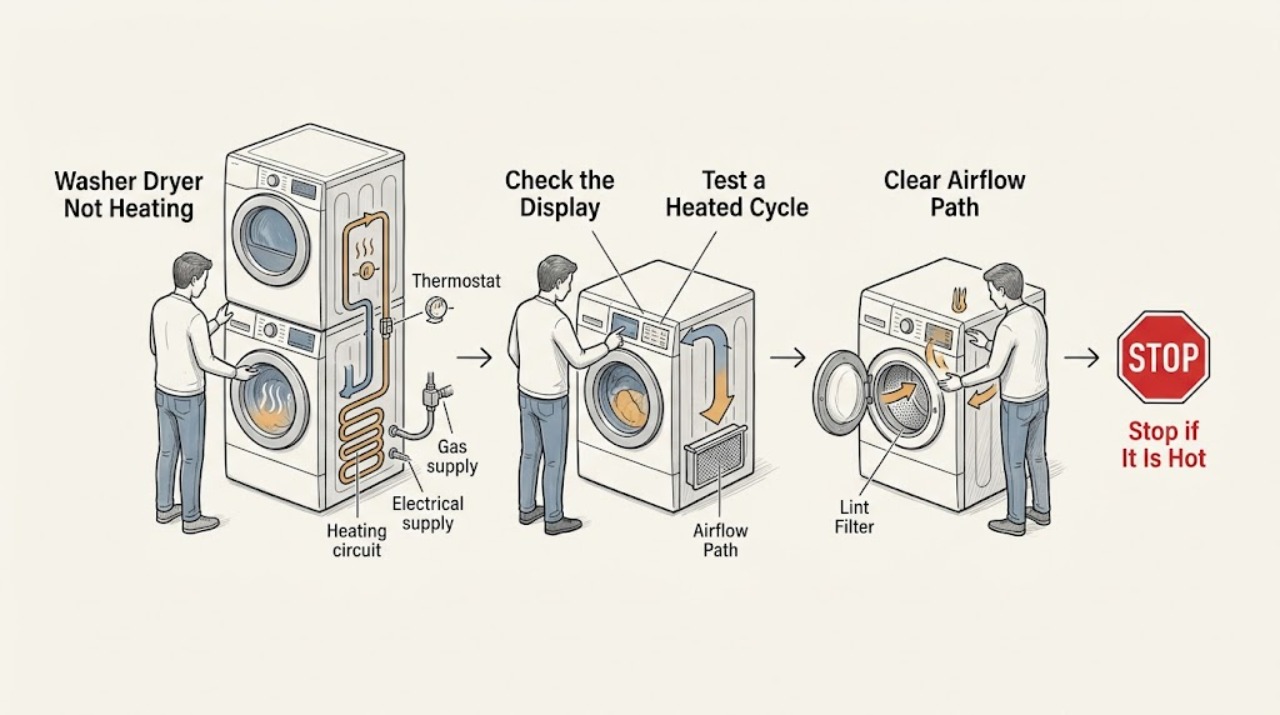
First determine whether the Kenmore washer-dryer is failing to heat wash water, or whether the dryer portion tumbles but produces no warm air. A dryer can appear to work on an Air Dry or no-heat setting, and exact cycles vary by model. Check the selected dry cycle, load, lint screen, exhaust airflow, visible power connection, and—only where the model is gas—the external gas shutoff and any gas odor. Do not open the cabinet, bypass a safety device, probe live wiring, or keep running a dryer with smoke, burning odor, excessive heat, sparks, damaged wiring, or poor airflow. If one safe external check does not restore heat, use the exact Kenmore manual and arrange qualified service; a heating element, thermal cutoff, thermostat, igniter, valve, sensor, or control cannot be identified safely from the symptom alone.
Work through in order
Diagnostic checks
Use only checks that match the exact appliance or system and its official guide.
-
Check 1
Run through the symptom once without opening the cabinet: note whether the washer water is cold, the dryer drum turns, the selected dry cycle is Air Dry or another no-heat option, and whether any display code or warning appears.
Expected result: Only the wash water is cold, the dryer tumbles with no heat, the cycle intentionally uses no heat, the dryer does not tumble, or a code or warning appears.
Next step: Use the branch matching the affected portion and locate the exact Kenmore manual by model. Do not use a generic code list or assume a washer-water symptom identifies a dryer part.
Why this matters
Why: The washer and dryer portions have different functions, and Kenmore documents model-specific cycles. For example, an official Kenmore laundry-center product lists Air Dry as tumbling without heat. A no-heat setting is not a failed heater; a tumbling heated cycle with cold exhaust requires a different path.
-
Check 2
If the dryer tumbles but does not heat, select a model-approved heated cycle and confirm that the temperature or heat option is not set to Air Dry, No Heat, or Cool Down. Use a small normal load for one supervised test.
Expected result: The original setting was a no-heat option, the correct heated setting produces warmth, or the dryer remains cold on a heated cycle.
Next step: Use the correct cycle if it heats normally. Otherwise stop after this single safe test and continue with the lint, exhaust, and supply checks; do not disassemble the unit.
Why this matters
Why: A no-heat cycle can produce normal tumbling without warm air. If a correct heated cycle remains cold, the issue is not explained by the selection and may involve airflow, supply, thermal protection, or the heating circuit.
-
Check 3
With the dryer off and cool, clean the lint screen and inspect the visible exhaust outlet and duct for lint, kinks, crushing, or weak airflow. Do not reach into the cabinet or operate the dryer with the exhaust disconnected.
Expected result: The lint screen is blocked, the external exhaust is restricted or has little airflow, the path is clear, or the dryer overheats or stops during the check.
Next step: Clean the user-accessible screen and have a qualified person clear a difficult or internal blockage. Stop using the dryer if airflow remains poor, it overheats, or the vent cannot be safely restored.
Why this matters
Why: The U.S. Consumer Product Safety Commission warns that lint can block airflow, cause excessive heat, and contribute to dryer fires; damp clothes or longer drying can indicate a blocked screen or exhaust. Airflow must be corrected before judging an internal heater or safety device.
-
Check 4
Check the visible plug, cord, outlet, and household breaker without opening the appliance. For an electric model, do not remove panels or measure a high-voltage circuit; for a gas model, check only that the external shutoff is open if the manual permits and there is no gas odor.
Expected result: Power is absent or a breaker has tripped once, the cord or outlet is hot or damaged, the gas shutoff is closed, power and gas appear normal, or a breaker trips again.
Next step: Correct only an obvious external connection or model-approved shutoff position and retry once when safe. For a damaged cord, repeat trip, gas odor, or uncertain supply, stop and contact qualified electrical, gas, or appliance service from a safe location.
Why this matters
Why: A washer-dryer cannot heat without the supply required by its model. A damaged electrical connection, repeat trip, or gas odor is a safety issue rather than a user repair. A normal visible supply shifts attention to the exact manual and service diagnosis.
-
Check 5
If the dryer heats briefly, takes much longer than usual, or stops after becoming hot, stop the cycle and let the appliance cool. Check the load size and accessible airflow again; do not reset or bypass a thermal fuse, cutoff, thermostat, or other safety device.
Expected result: A smaller load and clear airflow allow normal heat, the dryer stops again after warming, or overheating, smoke, or a burning smell is present.
Next step: Use the dryer only if it completes normally with clear airflow and no warning signs. Otherwise keep it off and arrange qualified service; do not replace a safety component without diagnosing the cause.
Why this matters
Why: Intermittent heat can reflect restricted airflow or a thermal-protection response, but the symptom does not identify which internal component is at fault. Continuing to run an overheating dryer increases fire risk.
-
Check 6
After the cycle, lint, exhaust, and external supply checks, record the model, cycle, load, drum behavior, exhaust temperature impression, code, and any smell or noise. Do not run repeated tests to force a result.
Expected result: The correct heated cycle completes normally, the dryer remains cold with normal external conditions, or a code or hazard returns.
Next step: Use the exact manual for any permitted user maintenance and arrange qualified Kenmore appliance service for persistent no heat. Stop immediately for smoke, burning odor, sparks, abnormal heat, damaged wiring, a gas smell, or a repeated breaker trip.
Why this matters
Why: A repeatable no-heat symptom after safe external checks points toward an internal heating element, igniter, valve, thermostat, thermal device, sensor, wiring, or control issue, but these possibilities require model-specific testing. Kenmore provides manuals and repair-support routes for that next step.
Use your observations
Decision map
Find the observation that best matches what you see, then follow the next safe action.
-
PATH 01Next step
What you see
Only the washer water is not heated, while the dryer portion has not been tested or is working normally.
Do this next
Use the exact Kenmore washer manual for that model's water-temperature and cycle behavior; do not replace a dryer heating part based on a wash-cycle symptom.
-
PATH 02Next step
What you see
The dryer is set to Air Dry, No Heat, or Cool Down, and it tumbles normally.
Do this next
Select a model-approved heated cycle and try one small supervised load. Persistent cold air on a heated cycle needs service.
-
PATH 03Next step
What you see
The lint screen or exhaust path is blocked, airflow is weak, or drying has become unusually long.
Do this next
Clean the accessible screen and have the exhaust path safely cleared. Do not keep running the dryer with poor airflow or open its chassis as an ordinary user.
-
PATH 04Next step
What you see
An obvious external supply issue is present, such as a loose connection, one tripped breaker, or a model-approved gas shutoff position, but there is no damage or gas odor.
Do this next
Correct only that external condition and retry once. A repeat breaker trip or continuing no heat requires qualified service.
-
PATH 05Next step
What you see
The dryer heats briefly, stops after warming, or repeatedly trips thermal protection after airflow is clear.
Do this next
Stop using it and arrange qualified appliance service. Do not bypass or repeatedly reset a thermal safety device.
-
PATH 06Next step
What you see
Smoke, burning odor, sparks, abnormal heat, a hot or damaged cord, a repeated breaker trip, damaged gas components, or a gas smell occurs.
Do this next
Stop immediately. Disconnect power only if safe; for gas odor do not operate switches or create an ignition source, leave the area, and contact emergency or gas service from a safe location. Do not run another test.
Helpful context
Understand the symptom
Identify which side is not heating
Washer-dryer designs differ. A cold wash does not prove that the dryer heater has failed, and clothes that tumble on an Air Dry or cool-down phase do not prove that the heater is working. Record the model number, selected cycle, whether the drum turns, how long it runs, and whether the exhaust is warm before changing settings.
Keep heat and fuel safety ahead of repair
Lint-restricted airflow can create excessive heat and a fire risk. Clean only the accessible lint screen and user-serviceable exhaust path; interior chassis cleaning and heating-circuit work belong with a qualified technician. For a gas model, a gas smell is an immediate stop condition: do not operate switches or create an ignition source, leave the area, and contact the appropriate emergency or gas service from a safe location.
When checks do not resolve it
Need a professional?
Book service for persistent no heat, intermittent heat, a returning fault code, repeated thermal shutdown, or any repair beyond the exact Kenmore manual.
Common questions
FAQ
Why does my Kenmore washer dryer tumble but not heat?
Confirm that the dry cycle is not Air Dry, No Heat, or Cool Down, then check the lint screen, exhaust airflow, and visible supply. If a heated cycle remains cold after those checks, arrange model-specific service.
Can a blocked vent make a Kenmore washer dryer stop heating?
Restricted lint or exhaust airflow can cause excessive heat and a fire risk, and long drying can be a warning sign. Clean accessible areas and have difficult or internal blockages cleared safely before using the dryer again.
How do I know whether the washer or dryer side has the heating problem?
Record whether the wash water is cold, whether the dryer drum turns, which dry cycle is selected, and whether the exhaust becomes warm. Washer and dryer portions have separate functions, so use the exact model manual for the affected side.
When should I stop using a Kenmore washer dryer that is not heating?
Stop for smoke, burning odor, sparks, abnormal heat, damaged wiring, repeated breaker trips, poor airflow that cannot be corrected safely, or any gas odor. Disconnect power only if safe; leave a gas-smell area without operating switches and seek qualified help from a safe location.
Read the exact guide
Official sources
- Find Your Manual | Kenmore Appliance Manuals & GuidesKenmore · Use to find the exact washer, dryer, or laundry-center manual by the model number before interpreting cycles, warnings, or maintenance.
- Customer Care & Support | Kenmore AppliancesKenmore · Use for escalation after safe user checks and for locating Kenmore repair or support resources.
- 24" 1.6 cu. ft. 240V Electric Laundry CenterKenmore · Use only as an example that a Kenmore washer-dryer product can include a separate Air Dry setting; exact model cycles must be confirmed in the assigned appliance manual.
- CPSC Publication 5022 - Overheated Clothes Dryers Safety AlertU.S. Consumer Product Safety Commission · Use for dryer-side airflow and fire-safety boundaries in a Kenmore washer-dryer; it does not diagnose a particular Kenmore model or heating part.
Community feedback
Share a repair observation
Share a plain-text repair observation. Accepted observations are published automatically; this page may take a moment to update.