
On this page
Start here
Quick answer
If a Kenmore 80 Series washer is taking in water while it is switched off, stop the water first: close both hot and cold supply valves, then disconnect power only from a dry, safe location. Do not keep the valves open to see whether the tub overfills, and do not disconnect a pressurized hose or open the cabinet. Water that continues after the washer is unplugged is a high-priority symptom, but it does not by itself prove that one inlet valve, pressure control, drain arrangement, or timer has failed. A Kenmore 80 Series label is not a complete model number; Kenmore's manual finder says model numbers are at least 11 characters, so photograph the full model and serial before using a manual or ordering a part. Because the washer is on an exposed porch, also treat rain, standing water, corrosion, freezing, and an outdoor receptacle as installation and electrical-safety questions. Keep it out of service and arrange qualified appliance service if water continues, the source is underneath or inaccessible, the floor or receptacle is wet, or the full model cannot be confirmed.
Work through in order
Diagnostic checks
Use only checks that match the exact appliance or system and its official guide.
-
Check 1
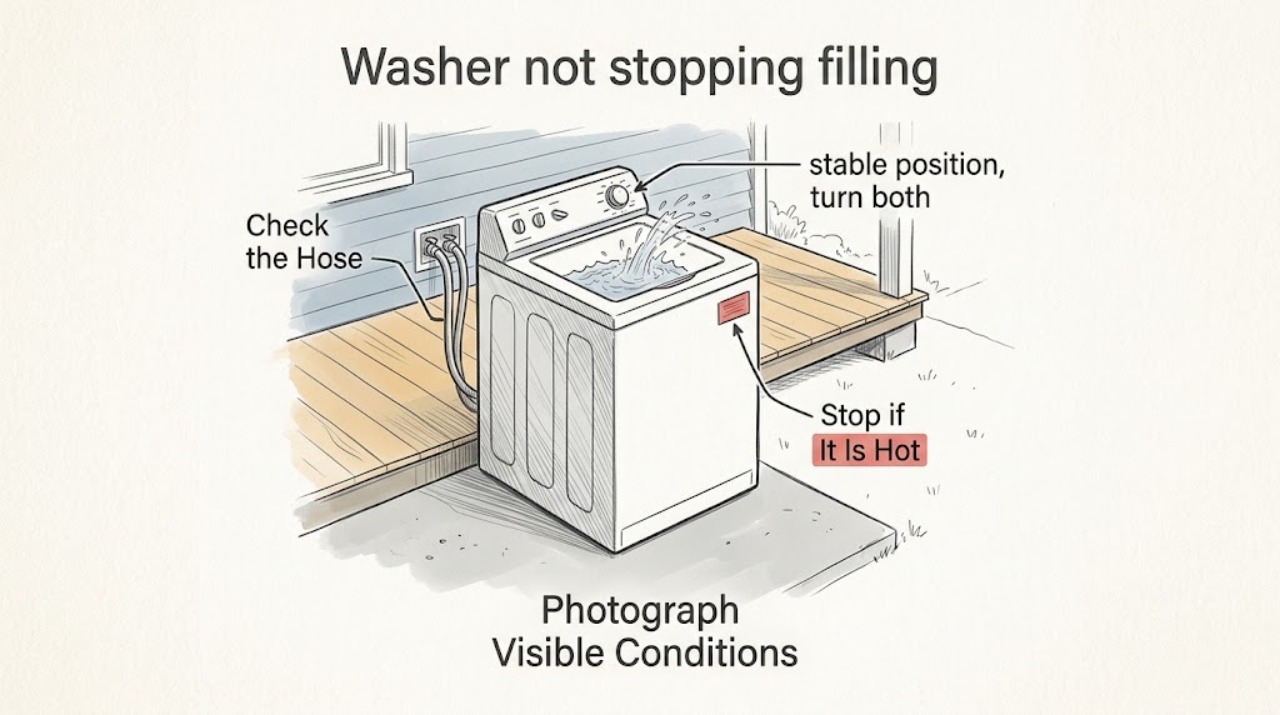
From a dry, stable position, turn both the hot and cold household washer valves fully closed, then disconnect the washer's power only if the plug, receptacle, floor, and your hands are dry and undamaged. Do not reach behind the washer across water or keep the valves open for a test.
Expected result: Water stops after the supply valves close, water continues from the tub or a hose, or the washer/receptacle area is wet, damaged, corroded, frozen, or otherwise unsafe to approach.
Next step: Leave the washer isolated and arrange qualified appliance or plumbing service. If water is near electrical parts, smoke, burning odor, sparks, a hot plug, or a damaged cord is present, keep clear and obtain prompt electrical or emergency help.
Why this matters
Why: Stopping the supply protects against overflow; it does not distinguish an appliance water-entry fault from a hose, connection, residual water, or plumbing problem. A wet or damaged electrical area is a separate immediate hazard.
-
Check 2
With water and power isolated and the floor dry, photograph only visible areas: the two supply hoses and shutoffs, the drain hose and standpipe, the tub level, the floor beneath the washer, and any water trail. Do not disconnect a hose, move the washer, tip it, or remove its cabinet.
Expected result: Water is at an inlet connection, drain or standpipe, under the cabinet, inside the tub with no visible external leak, or nowhere can be seen without moving or opening the machine.
Next step: Keep the valves closed and give the technician the photographs and whether the tub level changed while power was disconnected. Use plumbing service for a house-supply or standpipe issue; use qualified appliance service for an unexplained tub or cabinet source.
Why this matters
Why: A visible hose or household-plumbing path can account for water around the washer, while an unexplained tub rise or underside source requires appliance diagnosis. A floor puddle does not identify an inlet valve or pressure-control part.
-
Check 3
Find and photograph the complete Kenmore model and serial label, including every digit and suffix, rather than recording only '80 Series.' Use Kenmore's manual finder with the full model number; do not substitute a similar-looking 70, 90, 110, or another 80 Series procedure.
Expected result: The label provides a complete model number long enough for the manual finder, or the label is missing, unreadable, or only says 80 Series.
Next step: If the full label cannot be recovered, keep the water off and request service using photographs of the washer and label area. Do not order a part from a family name or a generic diagram.
Why this matters
Why: Kenmore states that its manual search uses the model number and that model numbers are at least 11 characters. Without that identity, valve, timer, level-sensing, hose routing, and outdoor-installation instructions cannot be safely scoped.
-
Check 4
Inspect the porch exposure without energizing the washer: look for rain or condensation, standing water, rust or corrosion, a frozen hose, UV-damaged hose or cord, a non-protected receptacle, and a cabinet or floor that cannot stay dry. Do not operate the washer outdoors or reset a wet or tripping receptacle.
Expected result: The washer and electrical supply are dry and intact, or water, corrosion, freezing, damaged insulation, an unsuitable receptacle, or repeated tripping is visible.
Next step: Keep the washer disconnected and arrange qualified appliance/electrical service to assess the installation and appliance together. Do not improvise weatherproofing, extension-cord use, or a replacement receptacle.
Why this matters
Why: Outdoor exposure can create a supply, connection, or electrical-safety issue independent of the fill symptom. A dry exterior does not prove the internal water-entry system is sound, and a wet or damaged installation makes further testing unsafe.
-
Check 5
Prepare a service record without running another fill: note whether the water entered while the timer or controls were off, whether it stopped when both valves were closed, how high the tub rose, which hose or area was wet, the porch weather or freezing history, and any prior repair or alteration.
Expected result: Water entered with power disconnected, the level changed only while the household valves were open, a prior repair or alteration preceded the symptom, or the timing and source remain uncertain.
Next step: Give the complete model/serial, photographs, isolation result, and repair history to qualified service. Ask for a written finding and the safe repair scope before reconnecting water or ordering a part.
Why this matters
Why: This timeline helps a technician separate supply isolation, appliance water entry, drain behavior, control state, and environmental exposure. It is evidence for diagnosis, not proof of a valve, pressure switch, timer, or control failure.
Use your observations
Decision map
Find the observation that best matches what you see, then follow the next safe action.
-
PATH 01Next step
What you see
Water stops when both household valves are closed, the washer and receptacle remain dry, and no water source is visible at the hoses or drain.
Do this next
Keep the washer off, recover the complete model number, and arrange qualified appliance service rather than reopening the valves for a repeat test.
Why this path and its safety boundary
Why it matters: The immediate overflow risk is isolated, but an appliance water-entry or level-control problem remains possible and cannot be confirmed without model-specific service diagnosis.
-
PATH 02Next step
What you see
Water continues from a hose, shutoff, standpipe, tub, or floor after the appliance is powered down, or water reaches the floor.
Do this next
Keep both valves closed, protect the floor from a dry location, and use plumbing or appliance service as appropriate. Do not disconnect pressurized fittings, move the washer, or keep testing.
Why this path and its safety boundary
Why it matters: This is an active water or plumbing hazard, not a normal washer-control symptom; the visible source still does not identify the internal part.
-
PATH 03Next step
What you see
The porch washer has wet or corroded electrical parts, a damaged cord or receptacle, freezing damage, repeated trips, smoke, burning odor, or sparks.
Do this next
Do not energize the washer. Keep clear and obtain qualified electrical or appliance help; seek emergency assistance for smoke, fire, or sparking.
Why this path and its safety boundary
Why it matters: Environmental or electrical safety takes priority over diagnosing the fill symptom.
-
PATH 04Next step
What you see
Only '80 Series' is available and the full model/serial cannot be read, or a prior alteration or repair changed the water path.
Do this next
Keep water and power isolated, retain photographs and removed parts, and have a qualified technician identify the exact model and approved configuration before any repair.
Why this path and its safety boundary
Why it matters: The manual, control platform, hose routing, and part fit cannot be safely identified from the family name or repair history.
Helpful context
Understand the symptom
Water entering a washer that is off is different from a normal fill that runs too long during a cycle. The safe first move is isolation, not a repeat cycle. Closing the household valves stops the supply while unplugging the appliance prevents the controls or motor from operating; neither step identifies a component by itself. Keep towels and a container nearby only if they can be used without reaching behind a wet machine.
Kenmore's official manual finder requires the complete model number. Older 80 Series washers can have different controls and water paths, so do not borrow a pressure-switch, valve, hose, or reset procedure from another 80 Series listing. The outdoor porch setting adds a separate inspection boundary: a wet cord, receptacle, cabinet, or floor is not a troubleshooting invitation.
The current Kenmore warranty page also ties coverage to correct installation, operation, maintenance, and proof of sale. That language does not decide this claim, but it is a reason to document the porch exposure and any prior alteration and ask for a written, model-specific service assessment rather than assuming the washer is covered or that labor is excluded.
When checks do not resolve it
Need a professional?
Use qualified appliance service for off-state filling or an unexplained tub rise, and plumbing service for a house-supply or standpipe leak. Use prompt electrical or emergency help for water at electrical parts, damaged insulation, smoke, burning odor, sparks, or repeated trips.
Common questions
FAQ
If water keeps entering when the washer is unplugged, can I order an inlet valve?
No. That observation makes isolation urgent but does not safely prove which part is responsible. Close both water valves, keep the washer off, identify the complete model, and have qualified service distinguish the supply, hose, water-entry, and level-control paths.
Is Kenmore 80 Series enough to find the right manual?
No. Kenmore's official manual page says model numbers are at least 11 characters and asks for the model number. Photograph every digit and suffix on the label; do not use a similar 80 Series or another series manual.
Can I keep using this washer on a covered porch?
Do not assume it is safe or warranty-eligible. First isolate water and power, then have the complete model, electrical supply, hose condition, moisture, corrosion, freezing, and installation assessed. Never energize a wet or damaged washer or receptacle.
Read the exact guide
Official sources
- Warranty Information | Kenmore AppliancesKenmore · Official Kenmore U.S. warranty page. It describes proof-of-sale, correct installation/operation/maintenance, and washer coverage language; it does not decide this washer's claim or porch suitability.
- Customer Care & Support | Kenmore AppliancesKenmore · Official Kenmore customer-care page for warranty, parts/literature, repairs, and service routing; it does not provide a model-specific live test or part diagnosis.
- Find Your Manual | Kenmore Appliance Manuals & GuidesKenmore · Official Kenmore manual finder. It requires the complete model number; '80 Series' alone is not treated as an exact model procedure.
Community feedback
Share a repair observation
Share a plain-text repair observation. Accepted observations are published automatically; this page may take a moment to update.