
On this page
Start here
Quick answer
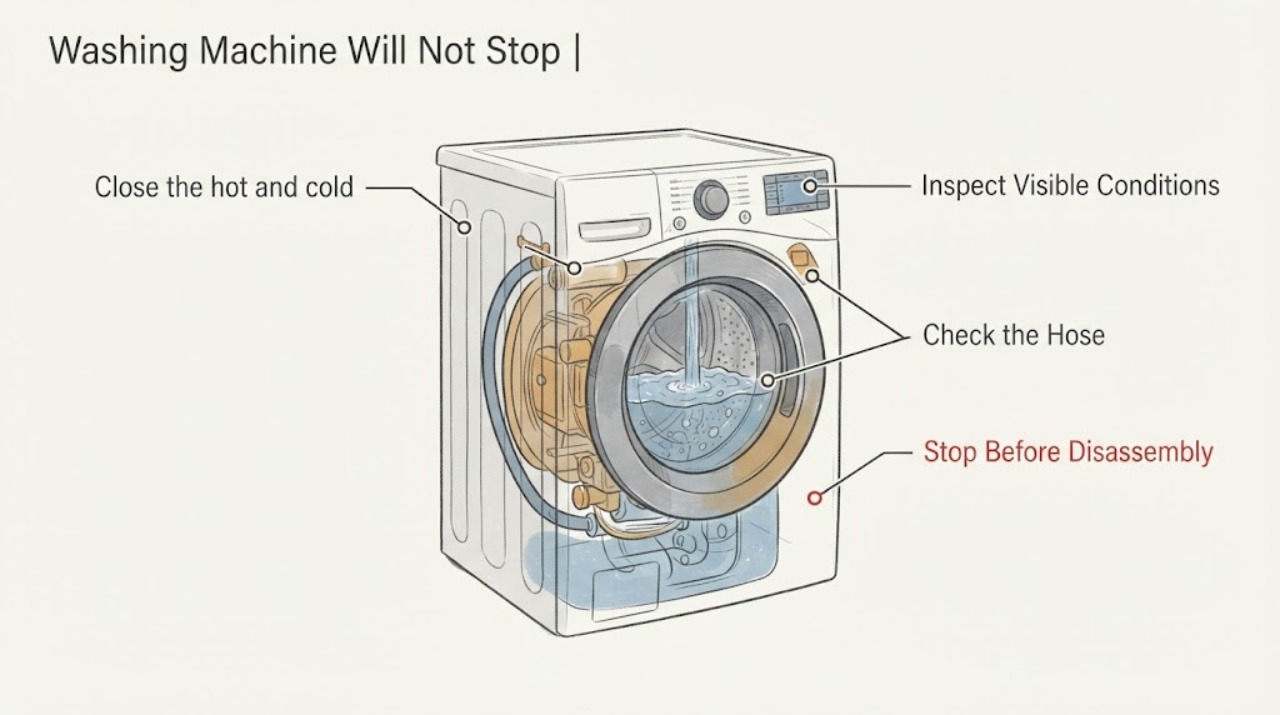
If a washing machine keeps filling, close both household washer water valves first to stop the incoming water. If the tub is rising, water is on the floor, or the plug or outlet is wet, keep clear of standing water and disconnect electrical power only from a safe, dry position; do not reach behind a wet machine. Then check only external conditions: whether the drain hose is too low or forms an airtight seal that can siphon water out while the washer fills, whether supply hoses are kinked or leaking, and whether the problem continues when the washer is off. The exact hose height and controls are model-specific. If water continues with the machine off or after the external hose check, leave the water valves closed and arrange service rather than opening the cabinet or guessing at an inlet valve, pressure sensor, or control board.
Work through in order
Diagnostic checks
Use only checks that match the exact appliance or system and its official guide.
-
Check 1
Close the hot and cold household water valves that feed the washer. If the tub is near overflowing, water is on the floor, or the supply connection is spraying, step away from the wet area and keep people away. Do not pull the washer forward through standing water.
Expected result: The water stops after the valves are closed, continues because a valve was not fully closed, or there is already water on the floor or around the electrical connection.
Next step: If water is on the floor or near the plug, keep clear and disconnect power only from a safe, dry position; otherwise leave the washer unplugged or switched off while the valves remain closed. Clean up only when it is safe, then continue with external checks or service.
Why this matters
Why: Closing the supply valves removes incoming water while the appliance remains out of service. A flooded or wet electrical area creates a shock risk, and the water event must be controlled before any inspection.
-
Check 2
With the water valves closed and power isolated only if safe, observe whether the tub was rising, staying at the same level while water drained away, or leaking from a hose or connection. Do not open the cabinet, remove the inlet valve, or reach under the machine.
Expected result: The tub level rises despite a closed drain, the incoming water was leaving through the drain, a hose or connector visibly leaks, or the source cannot be seen safely.
Next step: Photograph the external hose and leak area if safe, keep the supply valves closed, and use the model manual or a qualified technician for the next step. Do not tighten or disconnect a pressurized hose while water is still supplied.
Why this matters
Why: A tub that never gains level while filling is consistent with an external drain-siphon path in the official GE guidance. A visible hose leak is an external water-supply problem. Neither observation identifies a specific internal component, and a rising tub requires service if the external path is not obvious.
-
Check 3
Inspect the drain hose installation from outside the appliance. Check for a hose that is too low, kinked, pinched, inserted too far, or sealed airtight into the standpipe. Use the exact height and insertion limits in the washer's own manual; do not apply a dimension from another brand as a universal rule.
Expected result: The hose is visibly low, kinked, pinched, inserted too far, sealed into the drain, or correctly installed according to the model manual.
Next step: Correct only an obvious external installation problem according to the model manual, then keep the water valves closed and arrange a supervised service decision. If the washer still fills or the hose path is already correct, do not run another cycle.
Why this matters
Why: Manufacturers describe low or improperly sealed drain hoses as conditions that can cause siphoning or filling/draining at the same time. A correctly installed hose makes that external explanation less likely but does not prove an inlet valve, pressure sensor, or control failure.
-
Check 4
Check the supply hoses and connections without disconnecting them: confirm the hot and cold hoses are connected to the intended valves where the model uses both, are not kinked, and have no visible leak. Do not remove mesh filters or unscrew a hose while the household valves are open or the area is wet.
Expected result: A hose is kinked, a connection is wet or dripping, a filter or hose cannot be assessed safely, or the external supply path looks sound.
Next step: Keep the water valves closed for any leak or uncertain connection and request service. If the path is dry and correctly connected, continue only with the service boundary; do not restore water to test a suspected internal valve.
Why this matters
Why: Samsung's official guidance treats hose routing, valve connection and leak checks as external water-supply checks. A sound external path does not establish which internal part controls filling.
-
Check 5
Determine whether water enters while the washer is powered off or unplugged only after the supply valves are closed and the area is safe. Record the cycle, whether the tub was draining at the same time, the water level, hose condition, leaks, and any display code. Do not restore water or power to reproduce the fault.
Expected result: The problem is resolved by an external drain-hose correction, water would continue whenever a supply valve is opened, or the issue remains unexplained after the external checks.
Next step: Leave the supply valves closed and the washer disconnected, provide the recorded details and model number to the manufacturer or qualified appliance service, and protect the floor from further water. Do not bypass safety devices or replace a part based on the symptom alone.
Why this matters
Why: A resolved siphon or hose condition supports an installation path. Continued filling with the controls off is a service-level symptom, but it still does not prove one specific valve or sensor failure without model-level testing.
Use your observations
Decision map
Find the observation that best matches what you see, then follow the next safe action.
-
PATH 01Next step
What you see
The tub is rising, water is on the floor, or a hose connection is actively leaking.
Do this next
Close the washer water valves. Keep clear of standing water and disconnect power only from a safe, dry position; contact service after the area is safe.
Why this path and its safety boundary
Why it matters: This is an immediate water-damage and possible electrical hazard, regardless of the eventual washer cause.
-
PATH 02Next step
What you see
The washer appears to fill continuously but the tub level does not rise and water can be seen leaving through the drain.
Do this next
Inspect the external drain-hose height, insertion and seal against the model manual. Keep the supply closed if the installation is uncertain and request service if the condition persists.
Why this path and its safety boundary
Why it matters: The official GE guidance identifies a possible drain-hose siphon when the washer fills without beginning agitation.
-
PATH 03Next step
What you see
Water continues to enter whenever a supply valve is open, even when the washer is off, or the hose path is already correctly installed.
Do this next
Leave both water valves closed and arrange qualified appliance service. Do not reopen the valves to test the theory and do not open the cabinet.
Why this path and its safety boundary
Why it matters: The fault is beyond safe external troubleshooting; the observation does not identify a particular inlet valve, pressure sensor or control board.
-
PATH 04Next step
What you see
The washer fills in the expected part of a cycle and the complaint is only that the water level or timing looks unusual, with no overflow or leak.
Do this next
Check the model manual and displayed cycle or code. If the washer truly never stops filling or water safety is uncertain, close the supply valves and request service.
Why this path and its safety boundary
Why it matters: Some washers sense load and fill in stages, and exact behavior varies by model and cycle; a perceived delay is not the same as continuous filling.
Helpful context
Understand the symptom
Stop the water before diagnosing the washer
Continuous filling is a water-damage risk even when the washer still appears to be running a normal cycle. The first decision is whether water is entering the tub, leaving through the drain, or leaking onto the floor. Close the household supply valves at the wall, keep the washer out of service, and use the model manual for any dimensions or control sequence. Samsung's support guidance uses the water-valve shutoff and service boundary for a washer that continuously fills; this is safer than repeatedly restarting the cycle.
A filling washer may be losing water through the drain
If the washer fills while the tub level never rises, check the drain hose from outside the appliance. GE's official guidance says a drain hose that is too low can let water siphon back out while the washer is filling. Samsung's official fill guidance also warns against an airtight standpipe connection and gives model-dependent hose-height ranges. These instructions show why the external drain path must be checked before claiming that an internal valve or sensor has failed; exact dimensions must come from the assigned washer's manual.
When checks do not resolve it
Need a professional?
Call appliance service when water continues with the washer off, when the drain hose is correctly installed but the problem persists, when the tub overfills, or when there is any leak near electrical parts. Keep the household washer water valves closed until the washer is cleared. Use the model's manual for exact hose measurements and do not open the cabinet or replace an internal valve, sensor or control based only on continuous filling.
Common questions
FAQ
What should I do first when a washing machine will not stop filling?
Close the washer's household water supply valves first. If there is flooding or water near the electrical connection, stay clear and disconnect power only from a safe, dry position. Keep the washer out of service until the cause is identified.
Can a low drain hose make a washer seem like it never stops filling?
Yes. GE says a drain hose that is too low can let water siphon out while the washer fills. Check the external drain path, but use the assigned model's manual for the actual height and insertion limits.
Should I replace the water inlet valve?
Not from this symptom alone. Continuous filling can involve an external drain or supply condition, and the official guidance used here directs service when the external checks do not resolve it. Do not open the cabinet or order a part without model-level diagnosis.
What if water keeps coming in when the washer is unplugged?
Close both household washer water valves immediately and leave them closed. Keep the appliance disconnected and request qualified service; do not restore water to test the washer.
Read the exact guide
Official sources
- What to do when my washing machine does not fill up or drain?Samsung Electronics UK · Opened Samsung's UK official support page. It supports checking hose connections, kinks, water-valve shutoff before filter work, leaks at connections, and the model-specific nature of instructions. It is used for external safety checks only, not for an internal component diagnosis.
- Water fill issues with Samsung washing machinesSamsung Electronics America · Opened Samsung's official water-fill troubleshooting page. It explicitly says that a washer continuously filling should have its water valves turned off and should be sent for service; it also covers hose routing and drain-hose installation. Exact dimensions are model-dependent and are not generalized here.
- Washer - Won't Stop FillingGE Appliances · Opened GE's official support article. It describes a washer that fills continuously without beginning agitation, identifies a low drain hose as a siphoning path, mentions the water-level control check, and directs service when the suggestions do not correct the situation. The exact 30-inch instruction is retained as GE-specific and is not applied universally.
- Home Appliance Terms and ConditionsSamsung Electronics America · Opened Samsung's official home-appliance safety terms. The washer section says to turn off water and power immediately if flooded, warns about slippery floors and electric shock, and warns against contacting internal parts while plugged in. It is used for the safety boundary, not for brand-specific diagnosis.
Community feedback
Share a repair observation
Share a plain-text repair observation. Accepted observations are published automatically; this page may take a moment to update.