
On this page
Start here
Quick answer
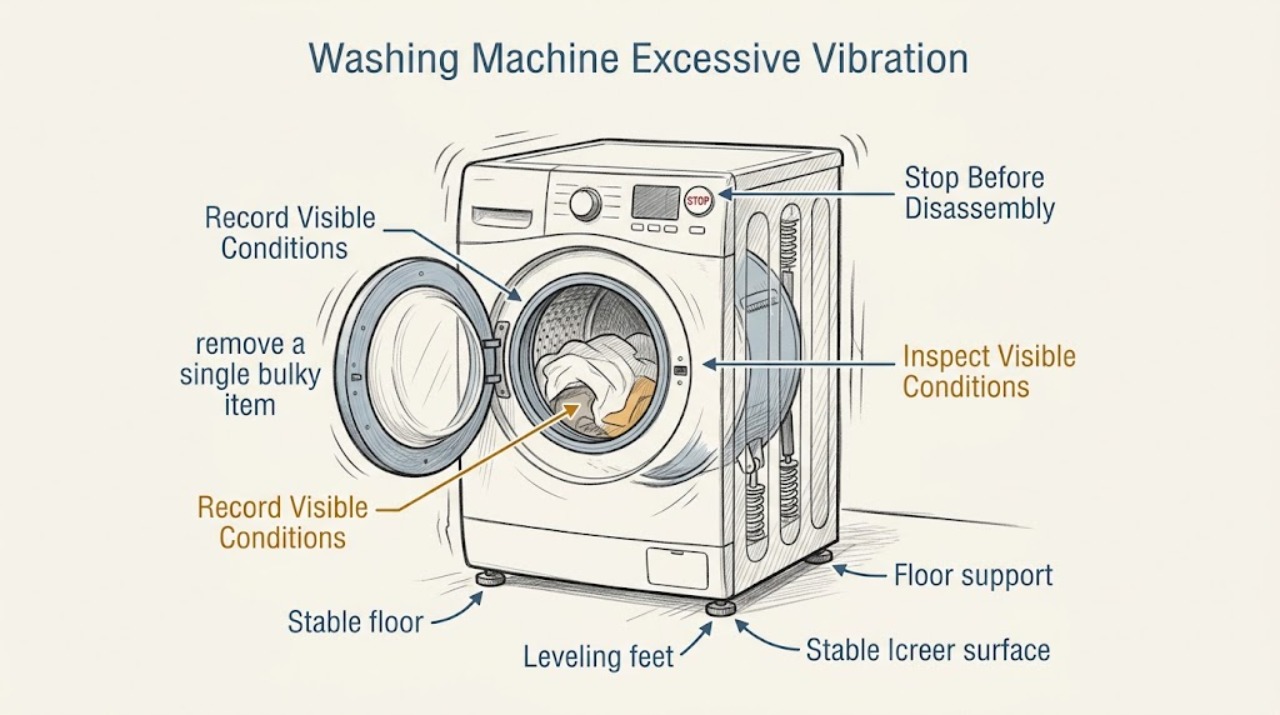
A Kenmore washer that vibrates excessively is most often reacting to an unbalanced load or an installation problem, but the correct check depends on whether it is a front-load or top-load model and whether it was just installed. Stop the cycle if the cabinet walks, slams violently, leaks, smells hot or electrical, sparks, shocks you, or trips the breaker. Otherwise note whether the movement occurs only during spin, redistribute the load, and check that the washer is stable and level from the outside. On a newly installed front-load washer only, use the exact Kenmore model manual to confirm that shipping or transport hardware was removed; do not remove parts from an established machine based on a generic diagram. If an empty drum still produces repeated knocking, scraping or severe movement, keep the washer out of service and arrange model-specific inspection.
Work through in order
Diagnostic checks
Use only checks that match the exact appliance or system and its official guide.
-
Check 1
Stop the cycle and record when the movement begins: filling, agitation, draining, low-speed rotation or high-speed spin. From a safe position, note whether the cabinet only trembles, rocks in place, walks across the floor, bangs against nearby surfaces, or makes a new scraping or grinding sound. Do not restrain the washer or reach into the opening while it is moving.
Expected result: The vibration appears only during high-speed spin, occurs with an empty drum, begins immediately after installation, or is accompanied by walking, violent impact, a leak, smoke, heat, sparks, shock or a repeated breaker trip.
Next step: For any hazard symptom, keep the washer off and arrange qualified help. For a non-hazardous spin-only symptom, continue with the load check; for empty-drum or post-installation movement, follow the matching branch below.
Why this matters
Why: Spin-only movement favors load distribution or installation; empty-drum movement or a new mechanical sound is less likely to be corrected by rearranging clothes. Walking, impact, leakage and electrical symptoms are stop conditions because continuing can injure someone or worsen damage.
-
Check 2
After the drum has stopped, remove a single bulky item if present and redistribute the remaining garments around the drum. Do not overload the washer, wash one heavy item by itself, or add items beyond the capacity and load guidance in the exact Kenmore manual. Run one short, supervised spin or rinse-and-spin only if the washer is stable and there is no leak or electrical warning.
Expected result: The load contains one blanket, bath mat, coat or similarly heavy item; the load is tightly packed; the garments are gathered on one side; or the washer remains balanced with a normal mixed load.
Next step: If redistribution stops the movement, use the model's load guidance and avoid repeating the problem load. If it does not, stop the test and continue with the stability and floor check rather than increasing the spin speed.
Why this matters
Why: A one-sided or unusually heavy load can make the drum become unbalanced at spin speed. If a normal, balanced load still causes the cabinet to move, the load is not a sufficient explanation and installation or mechanical inspection is needed.
-
Check 3
With the washer empty, off and stable, look at the cabinet from the front and sides. Check whether it rocks when gently nudged at the upper frame, whether all visible feet appear to contact the floor, whether a foot locknut appears loose, and whether the floor is soft, uneven or damaged. Do not lift the washer, place objects under a foot, or put hands beneath the cabinet.
Expected result: The cabinet rocks, a foot is visibly off the floor, the floor flexes or is damaged, the appliance is on a platform or soft surface, or the cabinet appears stable on a rigid floor.
Next step: Use only the leveling and foot-lock procedure in the exact Kenmore manual, keeping the washer supported and dry. Do not improvise shims or move the appliance alone; request service for a flexing floor, inaccessible feet or persistent movement.
Why this matters
Why: A rocking cabinet or weak support can amplify normal spin forces. If the cabinet is stable on a rigid, level support but still moves with a balanced load, the likely cause shifts toward a model-specific suspension, drum, bearing or drive issue.
-
Check 4
If the washer is a front-load model that was newly installed or recently relocated, find the exact Kenmore model manual and read its installation section before touching any hardware. Confirm whether that model uses shipping or transport restraints and whether they were removed as directed. Do not remove a panel, suspension component or fastener from a long-established washer just because a similar model has shipping bolts.
Expected result: The machine is newly installed or relocated and the model manual identifies transport hardware, the manual does not identify such hardware for this model, or the washer has been operating in the same location for a long time.
Next step: Follow the exact manual for any user-authorized installation correction and perform only one supervised confirmation cycle. If the hardware location or removal procedure is unclear, stop and ask a qualified installer or technician; never guess or force a fastener.
Why this matters
Why: Unremoved transport hardware can make a newly installed front-load washer vibrate severely, but this is not a universal feature and is not a valid explanation for every Kenmore washer. Long-established machines or models without that hardware need the load, leveling or service branches instead.
-
Check 5
With power isolated and the drum fully stopped, inspect only user-accessible areas for a trapped garment, coin or other object at the door seal, drum opening, dispenser area or floor. Turn the drum by hand only if the exact model manual permits that access and it turns freely without forcing it; do not remove the cabinet, tub, belt, pump or suspension parts.
Expected result: A loose object or trapped fabric is visible and removable without tools, the drum binds or scrapes when moved only as the manual allows, or no accessible object is found and the empty drum remains noisy.
Next step: Remove only an obviously loose, accessible object and stop if it is wrapped around a moving part. For binding, scraping or persistent empty-drum movement, leave the washer off and request model-specific service.
Why this matters
Why: An accessible object can cause a localized rattle or scrape, but resistance, repeated impact or empty-drum noise can indicate a hidden drum, bearing, suspension or drive problem. A clear opening does not rule out an internal fault.
-
Check 6
After any low-risk correction, perform at most one supervised cycle with a normal, balanced load while standing clear of the moving cabinet. Watch the floor, visible supply and drain hoses, cabinet position, sound and any display message. Stop immediately if movement returns violently or the washer contacts a wall, leaks, smells hot or electrical, produces smoke or sparks, gives a shock, or trips the breaker again.
Expected result: The washer remains stable through spin, moves only slightly without worsening, or repeats severe movement or develops a new noise or safety symptom.
Next step: Return to normal use only if the model guidance permits it and the washer remains stable. Otherwise keep it disconnected or out of service as safely possible and provide the technician with the model, cycle stage, load, floor and installation history.
Why this matters
Why: A stable supervised cycle supports the load or installation branch, but it does not authorize internal repair. Repeated severe movement after a balanced load and model-authorized leveling correction needs a technician to assess the suspension, drum, bearing, drive or structural support.
Use your observations
Decision map
Find the observation that best matches what you see, then follow the next safe action.
-
PATH 01Next step
What you see
The washer vibrates only during high-speed spin and the problem changes when a single bulky item is redistributed.
Do this next
Use the exact Kenmore load and cycle guidance, avoid washing the same heavy item alone, and stop if the cabinet still walks or bangs.
Why this path and its safety boundary
Why it matters: The immediate cause is consistent with an unbalanced load rather than proof of a failed component.
-
PATH 02Next step
What you see
The washer is newly installed or a front-load washer was recently relocated, and the exact model manual identifies shipping or transport restraints.
Do this next
Follow the manual's installation procedure or call an installer if the hardware or removal step is unclear; do not open the cabinet or guess.
Why this path and its safety boundary
Why it matters: Installation hardware may still be present, but the conclusion depends on that model's manual rather than the Kenmore name alone.
-
PATH 03Next step
What you see
The cabinet rocks when empty, a foot does not contact the floor, or the floor flexes under the washer.
Do this next
Use only the exact manual's leveling instructions and arrange service for an inaccessible foot, damaged floor or platform that cannot safely support the washer.
Why this path and its safety boundary
Why it matters: Uneven leveling or weak support can amplify vibration and must be corrected without lifting or destabilizing the appliance.
-
PATH 04Next step
What you see
A balanced load still causes severe movement, or an empty drum produces repeated knocking, scraping, binding or a new mechanical noise.
Do this next
Keep the washer out of service and request a qualified technician with the exact model and the stage at which the noise occurs.
Why this path and its safety boundary
Why it matters: An internal suspension, drum, bearing, drive or foreign-object issue is possible; repeated test cycles can worsen damage.
-
PATH 05Next step
What you see
The washer walks, strikes a wall, leaks, emits a burning or electrical odor, becomes abnormally hot, sparks, shocks someone or trips the breaker again.
Do this next
Stop using the washer. Isolate water or power only from a safe, dry position and arrange qualified appliance or electrical service; do not keep resetting the breaker.
Why this path and its safety boundary
Why it matters: This is a safety boundary, not a load-balancing problem.
Helpful context
Understand the symptom
First separate a spin imbalance from a machine that is unstable
A washer can move because a single bulky item has collected on one side, because the cabinet is not supported evenly, or because a mechanical fault is present. The timing matters: movement only during high-speed spin points first toward load distribution or installation, while knocking or scraping with an empty drum needs service. Do not hold the cabinet, add weight to it, or keep restarting a violent cycle to reproduce the symptom.
Installation details are model and configuration dependent
Kenmore sells different washer configurations, and its manual service asks for the model number before showing the applicable guide. Shipping hardware is an installation item on some front-load designs, not a universal repair step and not a reason to open a working washer. Use the model manual to determine whether a particular machine had transport hardware, where it is located, and how it is handled.
Protect the room as well as the appliance
Repeated movement can pull on visible hoses, damage nearby surfaces, or create a wet floor. Keep hands and feet clear while the drum is moving, and inspect only from a stable, dry position after stopping the cycle. A washer that continues to walk, leaks, overheats, or produces an electrical warning is not a leveling experiment; it needs qualified appliance or electrical service.
When checks do not resolve it
Need a professional?
Call a qualified appliance technician when severe movement persists with a balanced load after the exact model's leveling procedure, when an empty drum knocks or scrapes, when the floor or transport hardware is unclear, or whenever the washer leaks or shows an electrical, heat or impact warning.
Common questions
FAQ
Why does my Kenmore washer shake only during spin?
Spin-only movement commonly points first to an unbalanced load or an installation issue. Stop the cycle, redistribute a bulky load, and check stability and leveling only after the drum stops. If a balanced load still makes the cabinet walk or bang, keep the washer out of service and request model-specific inspection.
Should I remove shipping bolts from a vibrating Kenmore washer?
Only investigate shipping or transport hardware when the washer is a newly installed or recently relocated front-load model and the exact Kenmore manual identifies that hardware. It is not a universal step for every Kenmore washer, and an established washer should not be opened based on a generic diagram.
Can I keep running the washer if it walks a little?
Do not keep running it if the cabinet moves progressively, strikes anything, leaks, or makes a new violent or mechanical noise. A low-risk load or leveling correction may be followed by one supervised confirmation cycle, but repeated severe movement needs qualified service.
What information should I give a technician?
Give the exact model, whether it is front-load or top-load, when the washer was installed or moved, the cycle stage where movement begins, whether an empty drum also moves or makes noise, the load type, floor surface, visible hose or foot condition, and any leak, heat, smoke, spark, shock or breaker symptom.
Read the exact guide
Official sources
- Home Electrical Safety ChallengeElectrical Safety Foundation International · General appliance safety guidance; it does not identify a Kenmore model or an internal component.
- Laundry Appliances | Washers & Dryers | KenmoreKenmore · Supports distinguishing Kenmore laundry configurations; it is not a universal installation or repair procedure.
- Find Your Manual | Kenmore Appliance Manuals & GuidesKenmore · Use the exact washer model manual before selecting an installation, leveling, shipping-hardware or user-service step.
- CPSC Guide to Home Wiring HazardsU.S. Consumer Product Safety Commission · General electrical safety guidance for stopping use of an appliance with warning signs; it is not a Kenmore washer diagnosis.
Community feedback
Share a repair observation
Share a plain-text repair observation. Accepted observations are published automatically; this page may take a moment to update.