
On this page
Start here
Quick answer
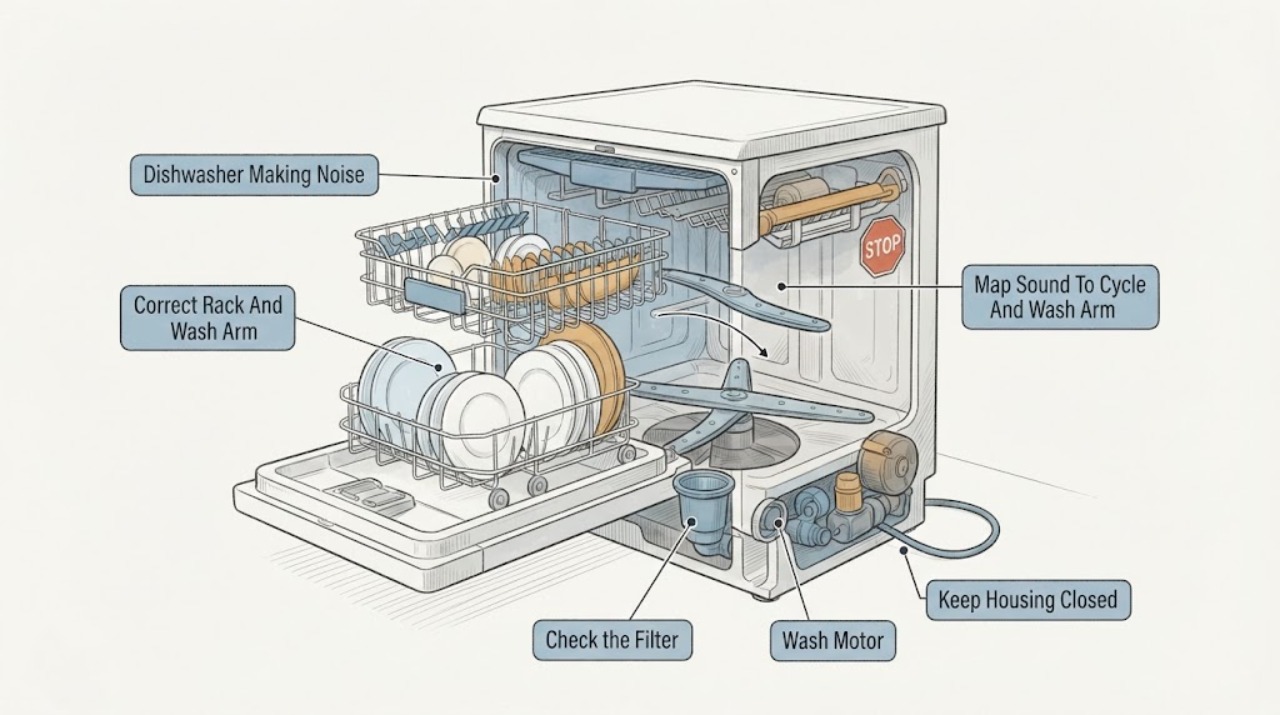
A KitchenAid dishwasher can normally hum, hiss, rush, swish, click, or briefly gurgle as it fills, sprays, drains, or dries. Identify where and when the sound occurs before treating it as a failed part. A thump that follows the wash arm points first to an item extending beyond the rack; a grinding sound calls for a model-appropriate filter or foreign-object check, although some models have a normal food chopper; a fan or low hum after the cycle can be normal on models with fan-assisted drying. With the cycle stopped and surfaces safe to touch, correct only the accessible rack or loading issue and follow the exact model manual for filter access. If the noise is new, continuous, rapidly worsening, accompanied by water on the floor, smoke, burning odor, sparking, a tripping breaker, or a grinding noise that remains after the permitted external check, stop using the dishwasher and arrange qualified service. Do not reach into a running tub, remove pump or motor parts, or make an energized electrical test.
Before you begin
Safety first
- The user may observe sound timing, stop the cycle, correct accessible dish loading, and inspect or clean a filter or foreign-object cup only when the exact manual permits and the dishwasher is stopped and safe. Qualified personnel must handle pumps, motors, choppers, wash-arm mounts, valves, fans, heaters, wiring, lower panels, and installation changes requiring movement of the appliance.
Work through in order
Diagnostic checks
Use only checks that match the exact appliance or system and its official guide.
-
Check 1
Without opening panels or reaching into the tub, record the sound's character and location: rushing, swishing, humming, hissing, clicking, thumping, grinding, squeaking, or rattling; front, bottom, door, side cabinet, or sink drain; and whether it occurs during fill, wash/spray, drain, or drying. Note whether it is brief and phase-linked or continuous and new.
Expected result: The sound is brief and tied to fill, spray, drain, or drying; follows the rack or door; occurs only after the cycle; or is continuous, worsening, and not tied to a normal phase.
Next step: Use the matching sound branch below. If the sound cannot be localized, do not disassemble the dishwasher; observe one safe cycle only if there is no leak, odor, smoke, sparking, or breaker problem, then use the exact manual or service.
Stop if: Stop immediately for smoke, burning odor, sparks, exposed wiring, water reaching electrical components, a floor leak, or a tripping breaker.
Why this matters
Why: KitchenAid documents several phase-linked sounds as normal, while a location or timing change is more useful than loudness alone for separating water flow, pump, spray-arm, drying-fan, load, and installation branches.
-
Check 2
If the sound is a rhythmic thump or clatter during spraying, cancel the cycle and wait for the spray action to stop. With the racks accessible and the dishwasher safe to handle, look for a pan, utensil, lid, or lightweight item extending into the wash-arm path or touching another item. Reposition only the accessible dishware so nothing interferes with the rack or spray-arm path; do not force a rack or remove the wash arm unless the exact manual permits it.
Expected result: A dish or utensil reaches into the wash-arm path, lightweight items move or rattle, items contact one another, or the load is clear and the thump remains.
Next step: If the load caused the sound, correct it and resume only if the dishwasher has no other warning. If the load is clear or the sound continues, stop and arrange model-specific service rather than forcing the rack or spray arm.
Stop if: Do not put hands into a moving tub, hold a spray arm, run with loose metal items, or continue if the rack, spray arm, or tub is visibly damaged.
Why this matters
Why: KitchenAid specifically links thumping to dishware extending beyond racks and interfering with wash arms. If the load is clear but the same sound persists, the cause is not established as a loading problem and should not be guessed as a pump or motor part.
-
Check 3
For a grinding sound from the bottom of the tub, stop the cycle and let hot water and moving parts become safe. Use the exact KitchenAid manual to determine whether your model has a removable filter or a foreign-object cup; inspect only that user-accessible area for glass, bones, labels, or other debris. Clean or empty it only as the model instructions direct, and do not reach toward the pump, chopper, or motor or use tools to probe hidden openings.
Expected result: Debris is visible in the permitted filter or foreign-object area, the area is clear, the model has a documented chopper, or the grinding persists after the permitted check.
Next step: If the model guide permits cleaning and debris is accessible, clean and reinstall the filter or cup correctly, then monitor a normal cycle. If the area is clear, the noise is severe, or it returns, stop using the dishwasher and arrange service.
Stop if: Do not remove a pump, chopper, motor, or lower access panel, and do not reach into the sump or use a knife or energized tool to clear debris.
Why this matters
Why: KitchenAid says debris in the filter area can cause grinding, but also notes that some models have a built-in chopper that can make a normal grinding sound at different cycle points. A persistent or harsh sound after the model-approved check is not enough to identify an internal component.
-
Check 4
If vibration is transmitted through the cabinet, or a low fan/hum continues after the cycle, compare the timing with the exact model's features. Check only visible installation conditions: whether the dishwasher rocks or appears out of square, whether the toe kick or insulation is loose, and whether the sound stops when the door is opened if the guide says the drying fan responds that way. Do not loosen mounting hardware or move an integrated dishwasher as an experiment.
Expected result: The sound is only after drying, the fan stops at the documented condition, the unit rocks or cabinet panels vibrate, the sound follows a loose toe kick, or the fan/vibration is abnormal and continuous.
Next step: If the sound matches the model's normal drying feature, allow the documented period to finish. If visible installation fit is loose or the unit rocks, use the installation guide or qualified installer. If the fan is harsh, grinding, or continuous outside the documented behavior, arrange service.
Stop if: Do not pull an installed dishwasher, reach behind it, or work on mounting, wiring, fan, or heater components while connected to power.
Why this matters
Why: KitchenAid says fan operation after a cycle can be normal on some models and that poor leveling or mounting can amplify vibration. These observations distinguish a documented feature or installation resonance from an unresolved fan, motor, or mounting fault, but they do not select an internal part.
-
Check 5
Record the model number, cycle and option selected, sound description and location, load arrangement, filter or foreign-object observation, drying-fan timing, visible installation condition, and any leak or electrical symptom. If the sound remains after the relevant accessible check, do not remove the lower panel, pump, motor, wash arm, wiring, or heater and do not run repeated confirmation cycles.
Expected result: The noise is new or worsening, persists with an appropriate load and clean accessible area, occurs with poor drainage or a leak, or is accompanied by smoke, burning odor, sparking, exposed wiring, or a breaker trip.
Next step: Stop use, disconnect power only if safe to do so, close the water supply if there is an active leak and it is safely accessible, and arrange qualified dishwasher service. Give the technician the recorded timing and observations without recreating the failure.
Stop if: Immediate stop-use is required for water on the floor, smoke, burning odor, sparks, hot or damaged wiring, repeated breaker trips, or a rapidly worsening mechanical noise.
Why this matters
Why: A persistent noise can involve an internal pump, motor, fan, valve, wash-arm, chopper, or mounting fault, but KitchenAid's public guidance does not establish a universal internal diagnosis across models. Hazard signs make continued operation unsafe.
Use your observations
Decision map
Find the observation that best matches what you see, then follow the next safe action.
-
PATH 01Next step
What you see
The sound is a brief rush, swish, hum, periodic hiss, or gurgle that occurs during fill, spray, drain, or another repeatable cycle phase, with no leak or electrical warning.
Do this next
Compare the sound with the exact model manual and monitor whether the cycle advances normally. If the sound becomes harsh, continuous, or is accompanied by poor filling, draining, odor, or a leak, stop and arrange service.
Why this path and its safety boundary
Why it matters: KitchenAid identifies water entry, spray, drain-pump operation, water-valve operation, and brief drain gurgle as possible normal operating sounds.
-
PATH 02Next step
What you see
A rhythmic thump or clatter occurs during spraying and a pan, utensil, lid, or lightweight item can contact the rack or wash-arm path.
Do this next
Stop the cycle, wait until movement and hot water are safe, reposition the accessible load, and resume only if no hazard is present. If the noise remains with a clear load, arrange service.
Why this path and its safety boundary
Why it matters: The observed pattern makes dishware interference more likely than an internal pump diagnosis; KitchenAid specifically associates this pattern with items extending beyond the racks.
-
PATH 03Next step
What you see
A grinding sound comes from the bottom of the tub, either with visible debris in the model-permitted filter area or at a cycle phase in which the model may use a built-in chopper.
Do this next
Use the exact manual for the filter or foreign-object cup and clean only that accessible area. If the noise is severe, persists, or the area is clear, stop and arrange service.
Why this path and its safety boundary
Why it matters: Debris can cause grinding, but KitchenAid also says a chopper may produce a normal grinding sound on some models. Without the exact model and timing, the sound does not identify a replaceable pump or motor part.
-
PATH 04Next step
What you see
A low fan or hum continues after the cycle, or normal operation vibrates through the cabinet and is louder after installation or cabinet changes.
Do this next
Check only visible fit and the model's drying option. Use the installation guide or qualified installer for leveling or mounting; arrange appliance service for a fan that grinds, rattles, or runs outside documented behavior.
Why this path and its safety boundary
Why it matters: KitchenAid says some models run a drying fan after the cycle and that leveling, mounting, insulation, and toe-kick fit affect perceived noise. A harsh fan sound or rocking unit is not established as normal by that information alone.
-
PATH 05Next step
What you see
The sound is new, continuous, worsening, or accompanied by water on the floor, smoke, burning odor, sparks, hot wiring, exposed parts, or a breaker trip.
Do this next
Stop the dishwasher, disconnect power only if safe, close the water supply if an active leak makes that appropriate and safely accessible, and arrange qualified service. Do not run another test cycle.
Why this path and its safety boundary
Why it matters: The pattern is not a routine phase-linked sound and may involve a mechanical, water, or electrical hazard.
Helpful context
Understand the symptom
Start with timing and location, not loudness
KitchenAid says dishwasher sound changes by cycle phase. Rushing water can occur during filling and cleaning, a hum can come from the drain pump, swishing comes from spray, and a brief gurgle can occur near draining. Record whether the sound is brief and phase-linked or new and continuous, and whether it comes from the rack, bottom of the tub, door, cabinet, or sink drain.
A thump during spraying is often a load-path clue
If a thump or clatter follows the wash-arm rotation, stop the cycle and wait until it is safe to open. Look for a pan, utensil, lid, or lightweight item extending beyond the rack or touching another item. KitchenAid recommends readjusting dishware when it interferes with wash arms. If the load is clear and the sound remains, do not guess at a pump or motor replacement.
Treat grinding as a model-specific filter decision
KitchenAid says objects stuck in the filter area can cause grinding, while some dishwashers have a built-in chopper that may make a grinding sound during parts of the cycle. Use the exact model manual to identify whether your machine has a removable filter or foreign-object cup, and inspect only that accessible area with the unit stopped. Persistent or harsh grinding after the permitted check needs service.
Do not mistake drying-fan or valve sounds for a failure
A fan or low hum after a cycle can be normal on some KitchenAid models with fan-assisted drying, and periodic hissing or buzzing can be the water valve. Compare the timing and options with the exact guide. A harsh, worsening, or continuous sound outside the documented behavior is a service symptom, not a reason to remove the fan, valve, pump, or lower panel.
Check installation vibration only at the visible boundary
KitchenAid notes that an unlevel or insecurely mounted dishwasher can transmit vibration to cabinetry and make normal sounds seem louder. Observe whether the unit rocks, a toe kick or insulation is loose, or cabinet contact changes the sound. Use the installation guide or a qualified installer for leveling and mounting; do not pull out an integrated machine or work behind it while connected to power.
When checks do not resolve it
Need a professional?
Arrange qualified KitchenAid dishwasher service when the exact model's accessible load, filter or foreign-object, and visible installation checks do not explain a persistent noise; when the fan is harsh or abnormal; or when the sound is accompanied by poor filling or draining, a leak, smoke, odor, sparks, exposed wiring, or a breaker trip. Stop use immediately for any electrical, fire, water, or rapidly worsening mechanical warning.
Safety scope: The user may observe sound timing, stop the cycle, correct accessible dish loading, and inspect or clean a filter or foreign-object cup only when the exact manual permits and the dishwasher is stopped and safe. Qualified personnel must handle pumps, motors, choppers, wash-arm mounts, valves, fans, heaters, wiring, lower panels, and installation changes requiring movement of the appliance.
Common questions
FAQ
What dishwasher noises are normal on a KitchenAid dishwasher?
KitchenAid describes rushing water during fill and cleaning, humming from the drain pump, swishing from spray, a periodic water-valve hiss, and a brief drain gurgle as sounds that can be normal. The model, cycle phase, location, and whether the sound is new or continuous still matter.
Why does my KitchenAid dishwasher thump during the wash cycle?
KitchenAid says a thump can occur when items extend beyond the racks and interfere with the wash arms. Stop the cycle, wait until movement and hot water are safe, reposition the accessible dishware, and resume only if there is no leak or other warning. If the thump remains with a clear load, arrange service.
Is grinding in a KitchenAid dishwasher always a failed pump?
No. KitchenAid says debris in the filter area can cause grinding, and some models have a built-in chopper that may make a grinding sound during part of the cycle. Use the exact manual for a permitted filter or foreign-object check. Do not remove the pump or chopper; persistent or harsh grinding needs service.
Why does my KitchenAid dishwasher fan keep running after the cycle?
KitchenAid says a fan or humming sound after the cycle can be normal depending on the model and options, especially with ProDry or fan-assisted drying. Compare your model's guide and selected options. A harsh or abnormal fan sound, visible damage, or a fan that runs outside the documented behavior needs service.
Can an unlevel KitchenAid dishwasher make normal sounds louder?
Yes. KitchenAid says an unlevel or insecurely mounted dishwasher can transmit vibration into surrounding cabinets. Observe for rocking, loose visible toe-kick or insulation, or cabinet contact, then use the installation guide or qualified installer. Do not pull out an integrated dishwasher as a DIY noise test.
When should I stop using a noisy KitchenAid dishwasher?
Stop for a new or rapidly worsening noise, persistent grinding after the exact model's accessible check, water on the floor, smoke, burning odor, sparks, exposed or hot wiring, or a tripping breaker. Disconnect power only if safe, close the water supply if an active leak makes that appropriate and safely accessible, and arrange qualified service without running another test cycle.
Read the exact guide
Official sources
- Thumping - DishwasherKitchenAid Product Help · KitchenAid dishwasher noise topic used for the load-path check; it does not establish an internal part diagnosis.
- Fan Noise - DishwasherKitchenAid Product Help · KitchenAid model-dependent drying-fan guidance; not every dishwasher has the same option or run time.
- Normal Dishwasher Sounds and NoiseKitchenAid Product Help · KitchenAid dishwasher noise guidance used to distinguish phase-linked operating sounds from symptoms needing further checks; exact model and installation still control applicability.
- Grinding - DishwasherKitchenAid Product Help · KitchenAid dishwasher grinding guidance; filter style, foreign-object cup, and chopper architecture vary by model.
- Squeaking - DishwasherKitchenAid Product Help · KitchenAid dishwasher noise guidance used for visible leveling and cabinet-fit observations; it does not justify moving an integrated appliance or internal work.
- Hissing - DishwasherKitchenAid Product Help · KitchenAid dishwasher sound guidance used only for periodic phase-linked hissing; new continuous or hazardous sound requires service.
- KitchenAid Manuals & LiteratureKitchenAid · Official model lookup used to gate filter style, foreign-object cup, cycle options, fan behavior, installation, and service boundaries.
Community feedback
Share a repair observation
Share a plain-text repair observation. Accepted observations are published automatically; this page may take a moment to update.