
On this page
Start here
Quick answer
If a KitchenAid KUIX305ESS has no visible lights but makes a low rumbling sound, treat the sound as evidence that some part of the appliance may still be energized, not as proof that the wall supply or a pump is good. First confirm the exact model and observe whether any normal control responds, then make only external checks of the plug, outlet or breaker/GFCI status, visible water and drain lines, front ventilation, and room conditions. Do not open the cabinet, measure live wiring, bypass a drain module, or order a control board or pump from the sound alone. If the breaker trips again, the cord is damaged, there is heat or a burning smell, or the lights remain off while the hum continues after the external checks, disconnect it when safe and arrange KitchenAid service or a qualified electrician/plumber as appropriate.
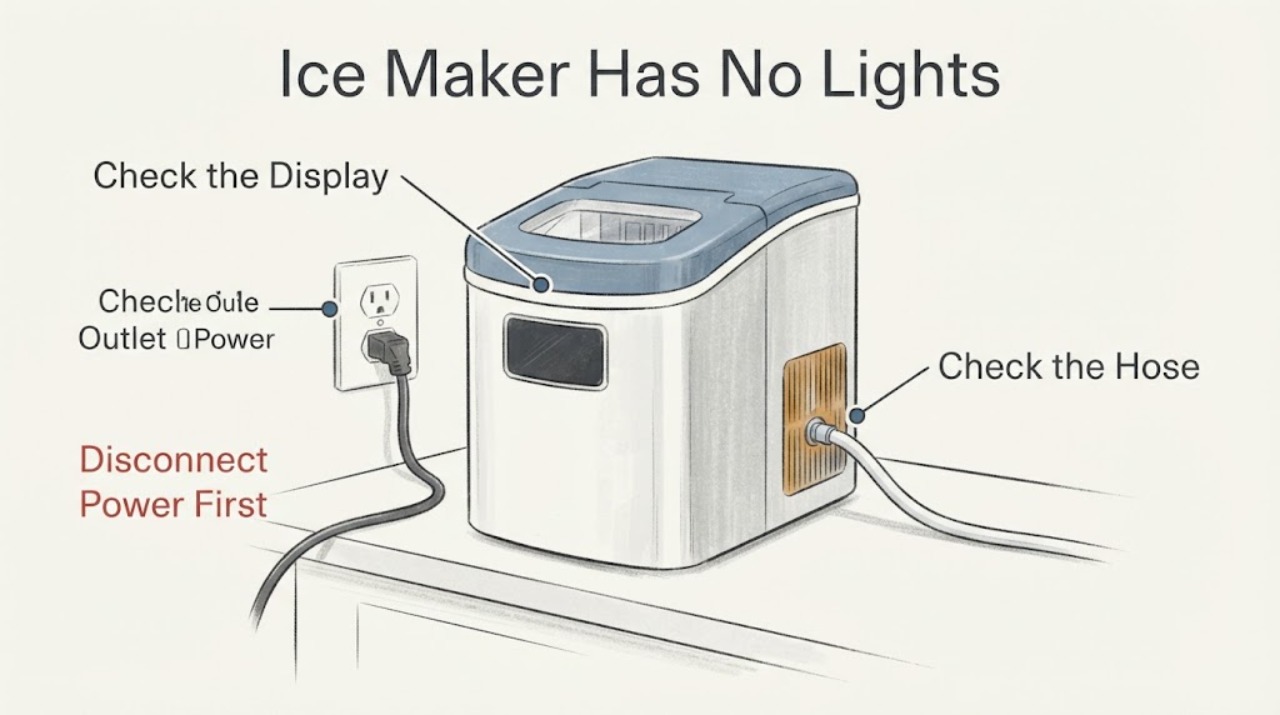
Work through in order
Diagnostic checks
Use only checks that match the exact appliance or system and its official guide.
-
Check 1
Confirm the rating-plate model and watch the front controls while making one normal control selection described by the KUIX305ESS documentation. Note whether any indicator responds, whether the interior light alone is dark, whether the unit produces ice or water, and whether the low rumble starts immediately or changes.
Expected result: The assigned model is KUIX305ESS, the front controls are completely dark, only the interior light is dark, or an indicator responds while the rumble continues.
Next step: Record the exact model suffix, the light pattern, the time the hum begins, and whether ice or water movement is present. Continue only with the external checks below; do not remove a panel to identify the sound.
Stop if: Stop and disconnect power when safe if the cabinet or cord is hot, there is a burning smell, visible arcing, water near electrical parts, or the breaker trips again.
Why this matters
Why: A completely dark control panel is different from an interior-light-only complaint or a machine that is operating normally. The Reddit report establishes the combination of no lights and a low rumble, but neither that report nor KitchenAid's public pages proves which internal circuit or motor is making the sound.
-
Check 2
Without opening the cabinet or probing the outlet, inspect the plug and the visible power cord for damage, pinching or kinks. From the electrical panel, note whether the dedicated breaker or GFCI has tripped; reset it only once if there is no damage, moisture or burning indication and local safety rules permit.
Expected result: The breaker/GFCI will not reset, trips again, the cord or plug is damaged, or the external supply appears normal but the control panel remains dark.
Next step: If the breaker trips, the receptacle is warm or damaged, or the supply remains uncertain, leave the unit disconnected and call a qualified electrician. If the external supply looks normal but the KUIX305ESS remains dark, move to the water/drain and ventilation observations and then service rather than performing a live voltage test.
Stop if: Do not use a meter on live terminals, remove the grounding pin, use an adapter or extension cord, or repeatedly reset a tripping breaker.
Why this matters
Why: KitchenAid's installation documentation calls for a properly grounded supply and warns that nuisance GFCI trips can interrupt operation. A normal breaker position or a nearby working appliance does not prove that this ice maker has a safe supply under load, and it does not identify an internal fault.
-
Check 3
From the accessible side of the installation, inspect the water supply line and drain line for a visible kink, crush point or obvious obstruction. Check that the front of the ice maker is unobstructed and that it has not been pushed back so far that the lines are pinched; do not pull a built-in unit out alone or disconnect a hose.
Expected result: A line is visibly kinked or crushed, an add-on drain pump/module is visibly installed, the front intake or exhaust is blocked, or the lines and front clearance look normal.
Next step: If a visible line can be relieved without moving or opening the appliance, correct only that external obstruction and observe whether the lights return after a safe power restoration. If an external module, inaccessible hose or installation problem is involved, stop and have KitchenAid service or a qualified plumber identify the plumbing arrangement.
Stop if: Do not bypass or rewire a drain module, cut a hose, disconnect a water line under pressure, or slide the appliance out without the installation instructions and appropriate help.
Why this matters
Why: KitchenAid says a kinked or incorrectly routed drain hose can cause no or intermittent power symptoms, and its installation guidance requires the front to remain unobstructed with the appliance serviceable. A visibly normal hose does not rule out an internal drain or electrical problem.
-
Check 4
Check the external operating environment: confirm that the front grille or air path is not covered, the room is not below the documented operating range, and the unit is not exposed to spray or standing water. If the machine is producing a water-related whooshing or rumbling sound, verify from outside that the water shutoff is open and that the accessible drain-cap or water-pan area is not visibly leaking; do not remove internal components.
Expected result: The front is obstructed, the room is outside the documented range, the water supply is closed, a leak is visible, or the environment is normal while the lights remain off.
Next step: Restore only a clearly closed water shutoff or an external airflow obstruction that can be corrected safely. Wipe up water and stop using the appliance if there is a leak or water near electrical parts. If the environment is normal and the no-light/low-hum condition persists, arrange service.
Stop if: Do not operate the machine with a leak, remove the storage-bin or cabinet panels to chase the sound, or keep running it when the low rumble is accompanied by heat, odor or repeated breaker trips.
Why this matters
Why: KitchenAid links clear front ventilation and suitable room conditions to operation, and its noise guidance links restricted water supply or a loose drain cap with whooshing/no-ice symptoms. These observations can explain poor production or noise, but they do not prove that an internal pump or board has failed.
-
Check 5
After the safe external checks, make one normal power restoration and observe the unit without opening it. Record whether the indicators return, whether the rumble stops or changes, and whether the ice maker resumes a normal water/ice cycle.
Expected result: The indicators return and the unit operates, the unit remains dark but hums, the breaker trips again, or the unit is dark and silent.
Next step: If the symptom persists, provide KitchenAid service with the exact model/serial, breaker history, photos of cord and accessible plumbing, light pattern, sound timing and any leak or odor. Use an electrician for a supply or breaker concern and a qualified plumber for external drain plumbing; do not choose a pump or control board from the sound alone.
Stop if: Leave the appliance disconnected until service if the breaker trips, the cord is damaged, the cabinet is hot, there is a burning odor, or water reaches electrical areas.
Why this matters
Why: A restored display with normal operation points toward an interrupted external supply or installation condition, while a persistent no-light/low-hum pattern remains an unresolved internal or supply fault. A tripped breaker is an electrical safety event; a dark, silent unit can still have an unresolved supply or control problem.
Use your observations
Decision map
Find the observation that best matches what you see, then follow the next safe action.
-
PATH 01Next step
What you see
The breaker/GFCI will not reset, trips again, or the cord, plug or receptacle is hot, damaged or wet.
Do this next
Leave the appliance disconnected and have a qualified electrician assess the supply; use KitchenAid service for the appliance after the supply is safe.
Why this path and its safety boundary
Why it matters: This is an electrical safety boundary rather than evidence that the ice maker's control board or pump is bad.
-
PATH 02Next step
What you see
The supply appears normal, the front remains dark, and the low rumble continues after a single safe power restoration.
Do this next
Stop repeated power cycling, document the sound and light pattern, and arrange KitchenAid service with the complete model and serial number.
Why this path and its safety boundary
Why it matters: The external checks have not identified the cause. The sound does not identify a pump, drain module, relay or control board, and the public KitchenAid guidance does not authorize a component diagnosis from this pattern.
-
PATH 03Next step
What you see
A visible water or drain line is kinked, the front ventilation is obstructed, or an accessible water shutoff is closed, and there is no electrical hazard.
Do this next
Correct only the visible, low-risk obstruction or closed shutoff without moving the appliance or opening it, then observe once. If the condition is inaccessible or the no-light symptom remains, use service or a qualified plumber.
Why this path and its safety boundary
Why it matters: KitchenAid identifies drain routing, water supply and front ventilation as operating conditions that can affect production and can produce no or intermittent power symptoms.
-
PATH 04Next step
What you see
The plug, breaker/GFCI, visible lines, front clearance and room conditions are normal, but the unit remains dark or produces a persistent hum.
Do this next
Keep the ice maker disconnected if it is hot, wet, noisy in a worsening way or repeatedly trips protection; otherwise schedule KitchenAid service and provide the full symptom log rather than ordering a guessed part.
Why this path and its safety boundary
Why it matters: The remaining fault is outside safe external troubleshooting scope. No public source opened for KUIX305ESS supports naming or replacing an internal component from these observations.
Helpful context
Understand the symptom
What the case establishes
The opened Reddit post reports that the breaker had tripped overnight and that the appliance then showed no lights while making a low rumbling sound. In a follow-up, the poster identifies the machine as KUIX305ESS. That is useful symptom and identity context, but the discussion's suggestions about a drain module or circulation pump are not a confirmed diagnosis and are not used as a part recommendation here.
Why a low hum does not prove the fault
KitchenAid's documentation for this freestanding or built-in ice-maker family requires a grounded supply and describes visible cord, water-line, drain-line and ventilation conditions. KitchenAid also warns that a kinked or incorrectly installed drain path can produce no or intermittent power symptoms. Those checks can narrow the problem without exposing live wiring. The public guidance does not support naming a board, pump, relay or other internal part from a no-light, low-hum report, so persistent symptoms belong with service.
When checks do not resolve it
Need a professional?
Arrange KitchenAid service when the KUIX305ESS stays dark while humming after the external checks, when the breaker trips again, when the cord or appliance is damaged, or when the accessible water/drain arrangement needs identification. Use a qualified electrician for the house supply and a qualified plumber for external drain plumbing.
Common questions
FAQ
Does a low rumbling sound prove that the KUIX305ESS circulation pump or drain pump has failed?
No. The sound shows only that some operation may still be occurring. KitchenAid's public guidance supports checking external drain, water, ventilation and power conditions, but it does not identify a pump or control board from the sound and no-light pattern. Use service for an internal diagnosis.
What can I safely check when the ice maker has no lights after a breaker trip?
Confirm the model, inspect the visible cord and plug, check the breaker/GFCI status from the panel, and look for visible water/drain-line kinks or blocked front ventilation. Do not open the cabinet, test live wiring or repeatedly reset a tripping breaker.
Should I bypass an external drain module because the ice maker is only connected to a sink drain?
No. Confirming the plumbing arrangement and any pump requirement is a service or qualified-plumbing task when it is not plainly accessible. KitchenAid warns that drain routing affects operation; it does not authorize bypassing or rewiring a module from a no-light symptom.
Read the exact guide
Official sources
- Kitchenaid ice maker with no lights. has power and making low rumbling noise.Reddit r/appliancerepair · Opened the exact Reddit permalink. It supports the assigned model and symptom context; user comments are not treated as proof of an internal part failure or as authorization for a bypass.
- Customer ServiceKitchenAid · Opened KitchenAid's official service and support page. It provides major-appliance owner support and scheduling paths; it is used only for escalation after safe external observations.
- Kitchen Appliance ManualsKitchenAid · Opened KitchenAid's official Manuals & Literature page. It directs owners to search by the appliance model number for the applicable guides and to contact KitchenAid when documentation cannot be located; it supports confirming the full rating-plate identity before model-specific work.
- Dimension GuideKitchenAid · Opened the official KitchenAid PDF and verified the KUIX305E family listing, grounded electrical supply, GFCI caution, visible cord/water/drain routing, unobstructed front and operating location guidance. The assigned ESS finish suffix is not used to infer a different internal design.
- Whooshing Noise - Freestanding Ice MakerKitchenAid Product Help · Opened the official KitchenAid noise article. It connects whooshing/no-ice symptoms with a fully open water supply and a securely seated drain cap, while directing unresolved cases to service. It is not used to label the Reddit low rumble as a specific pump noise.
- Not Making Ice - Has Power - Freestanding Ice MakerKitchenAid Product Help · Opened KitchenAid's official Product Help article. It explicitly states that a kinked, overlong or incorrectly installed drain path can cause no or intermittent power symptoms, and it directs owners to service after accessible checks; it does not authorize internal electrical or pump diagnosis.
Community feedback
Share a repair observation
Share a plain-text repair observation. Accepted observations are published automatically; this page may take a moment to update.