
On this page
Start here
Quick answer
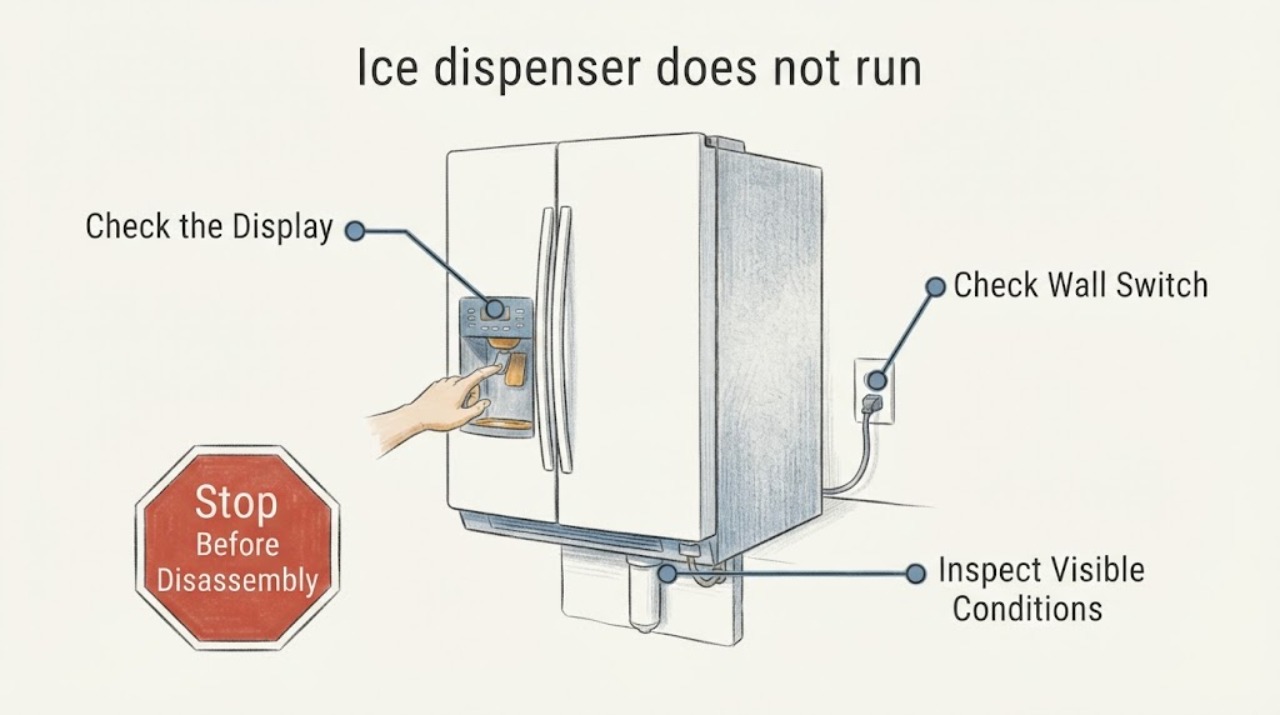
KitchenAid identifies KRSC703HPS as a 22.6-cu-ft counter-depth side-by-side refrigerator with exterior ice and water. If pressing the paddle produces no auger action, first separate an ice-production problem from a dispenser problem: verify that ice is actually in the bin, the doors are closed, Control/Dispenser Lock is off, the selected ice mode is correct, the bin is seated, and ice has not clumped or blocked the chute. Use only external visual checks; do not put a hand or tool into the delivery opening, bypass a door switch, or measure the motor live. If water dispenses and the bin has loose ice but the paddle still produces no sound or movement, or the fault returns after the safe checks, stop and arrange KitchenAid service. That observation does not identify the auger motor, wiring, switch, or control as the failed part.
Work through in order
Diagnostic checks
Use only checks that match the exact appliance or system and its official guide.
-
Check 1
From a safe position, confirm the complete rating-label model is KRSC703HPS and note whether the refrigerator has power, the exterior display responds, water dispenses, and ice is visibly present in the bin. Do not remove panels or reach into the dispenser opening.
Expected result: The model matches, the bin is empty, water also fails, or water works and loose ice is present.
Next step: Record the result and continue only with the matching external checks. If the model suffix differs, obtain its exact manual before applying this path.
Why this matters
Why: The exact Owner's Center identifies KRSC703HPS as an exterior-ice-and-water side-by-side refrigerator. No ice or no water keeps the supply/production branch open; water plus loose ice makes the dispenser-control path the more useful next branch.
-
Check 2
Close both refrigerator doors normally and check the display for Control Lock or Dispenser Lock. If a lock indicator is on, use only the model's normal control to unlock it; never hold or bypass a door switch to make the dispenser run.
Expected result: A door is not fully closed, a lock is active, or doors and locks appear normal.
Next step: Correct only the visible door/lock state and make one normal paddle attempt. If the state is normal and the dispenser remains silent, continue to bin and ice checks rather than bypassing the switch.
Why this matters
Why: KitchenAid says some models require closed doors, and an active dispenser lock deactivates the dispenser controls while leaving refrigerator and ice-maker power on. A lock or door state can therefore produce a silent paddle without proving an auger fault.
-
Check 3
Select ice on the display if the panel requires a selection, then press a sturdy glass against the dispenser paddle from outside. Observe whether the paddle visibly engages, whether any sound occurs, and whether the water side still dispenses. Keep fingers out of the chute and do not repeat rapid presses.
Expected result: The paddle is not fully engaged, water dispenses but ice does not, both outputs fail, or a normal paddle press produces no sound or movement.
Next step: Remove the glass and stop testing after a normal attempt. If the paddle or control feels damaged, or the same no-response result persists with normal selection, arrange service without opening the dispenser.
Why this matters
Why: KitchenAid says an incompletely engaged paddle will not dispense ice or water. Water working while ice does not narrows the symptom to ice selection/bin/ice-path or dispenser-side behavior, but no sound still does not identify the motor or switch.
-
Check 4
With the refrigerator stable and the dispenser idle, inspect the ice bin seating and the visible ice surface. If the owner instructions permit removing the bin, do so only by the normal handle and keep the bin away from the chute; look for a single frozen clump or blockage. Do not use sharp objects, reach into the opening, or force the auger.
Expected result: The bin is not seated, ice is clumped/frozen together, the chute is visibly blocked, or the bin is seated with loose ice and no visible blockage.
Next step: Re-seat the bin normally or clean only the visible exterior with a warm damp cloth and dry it; discard clumped ice rather than forcing it. If no obstruction is visible, do not attempt to free the auger by hand—stop and arrange service.
Why this matters
Why: KitchenAid lists incorrect bin installation, clumped ice and a clogged chute as causes of no dispensing and warns against sharp objects. A seated bin with loose ice and a dead paddle response is a different service branch from a frozen blockage.
-
Check 5
If water works, the lock and doors are normal, the bin is seated with loose ice, and the chute is visibly clear, document one normal paddle attempt and stop. Note whether there was no sound, a click/buzz without movement, or a breaker/display interruption. Do not remove the door panel or test the auger motor live.
Expected result: The dispenser begins working after a visible correction, remains completely silent with loose ice available, makes an abnormal sound, or causes an electrical interruption.
Next step: Stop using the ice dispenser and give KitchenAid service the exact model and observations. Isolate power only from a safe accessible point if there is an electrical hazard; do not bypass, probe or repeatedly test the mechanism.
Why this matters
Why: A corrected lock/bin/clump issue explains that episode. Persistent silence or abnormal/electrical behavior after those checks leaves a dispenser-side fault possible but cannot distinguish the auger motor, coupling, switch, control or wiring.
Use your observations
Decision map
Find the observation that best matches what you see, then follow the next safe action.
-
PATH 01Next step
What you see
The bin has no ice, or water also fails, while the paddle control and lock state appear normal.
Do this next
Use the exact model's ice-production and water-supply guidance; do not replace the dispenser motor based on an empty bin.
Why this path and its safety boundary
Why it matters: The immediate decision is ice production or water supply, not an auger motor diagnosis. KitchenAid directs users to the ice-making branch when the refrigerator is not making ice.
-
PATH 02Next step
What you see
Ice is present but the doors are open, Control/Dispenser Lock is active, the paddle is not fully engaged, or the bin is not seated.
Do this next
Correct only that normal external condition and make one normal attempt. If it still does not dispense, stop instead of bypassing the door switch or ordering a motor.
Why this path and its safety boundary
Why it matters: A visible control or seating condition can inhibit dispensing while leaving the refrigerator and ice maker powered.
-
PATH 03Next step
What you see
Ice is clumped or the chute is visibly blocked, but there is no leak or electrical hazard.
Do this next
Stop dispensing, remove or discard the clumped ice only by the normal bin procedure, and clean visible surfaces with a warm damp cloth. Do not use sharp tools or reach into the chute.
Why this path and its safety boundary
Why it matters: KitchenAid identifies humidity-related clumping and chute blockage as dispensing causes; this is an ice-path branch, not proof of a failed auger motor.
-
PATH 04Next step
What you see
Water dispenses, the bin is correctly seated with loose ice, doors/locks/paddle are normal, and one external paddle attempt produces no auger action or an abnormal electrical symptom.
Do this next
Stop using the ice dispenser and schedule qualified KitchenAid service. Do not open the door panel, bypass an interlock, insert a hand/tool into the chute or measure live motor voltage.
Why this path and its safety boundary
Why it matters: The accessible checks are exhausted. A dispenser-side fault remains possible, but KitchenAid's public guidance does not identify whether the motor, coupling, switch, control or wiring is responsible.
Helpful context
Understand the symptom
First decide whether ice making or dispensing is failing
KRSC703HPS has an exterior ice-and-water dispenser. A bin with no ice points toward production or the ice-maker side; a full bin with no response at the paddle points toward the dispenser path. KitchenAid's public troubleshooting starts with both possibilities, so do not call a silent auger motor failed until ice quantity, bin seating, lock state, doors and the paddle have been checked.
Why a silent paddle test does not name a part
The dispenser control, door interlock, bin coupling, auger and wiring can all affect whether ice moves. KitchenAid's public page gives external checks and a service route, not a model-specific user test for the auger motor. Keep hands and objects out of the chute and do not bypass a door switch or energize the motor for a test.
When checks do not resolve it
Need a professional?
Arrange qualified KitchenAid service when the bin has loose ice and the dispenser remains silent after the doors, lock, paddle and seating checks; when an abnormal buzz/click or electrical interruption occurs; or when the mechanism would require panel removal or interlock bypass. Stop immediately for a damaged chute, exposed wiring, water near electrics or repeated breaker operation. Do not reach into the chute, force the auger, bypass a door switch or test the motor live.
Common questions
FAQ
Why does the KitchenAid KRSC703HPS ice dispenser stay silent?
First check whether ice is actually in the bin, the doors are closed, Control/Dispenser Lock is off, the paddle engages and the bin is seated. A full bin with loose ice and a normal paddle but no response needs service; it does not prove which internal part failed.
Can I reach into the chute or bypass the door switch to test the auger?
No. Keep hands and objects out of the delivery opening and never bypass an interlock. Use only external visual checks and arrange qualified service for a persistent no-response condition.
Does water dispensing prove the ice auger motor is bad?
No. Water working makes a dispenser-side ice path worth checking, but bin seating, clumped ice, chute blockage, paddle and control state can still prevent ice. If those checks are normal, service must distinguish the internal cause.
Read the exact guide
Official sources
- KRSC703HPS | KitchenAidKitchenAid · Opened KitchenAid Owner's Center explicitly identifying model KRSC703HPS as a 22.6-cu-ft counter-depth side-by-side refrigerator with exterior ice and water.
- Not Dispensing Ice or Water - Refrigerator - Product Help | KitchenAidKitchenAid · Opened KitchenAid side-by-side Product Help guidance; used to separate an ice-only dispenser symptom from a shared paddle/lock/water-supply symptom without inferring an internal part.
- Not Dispensing Ice - Refrigerator - Product Help | KitchenAidKitchenAid · Opened KitchenAid Product Help dispenser guidance. It is used for external decision branches only; exact model instructions remain controlling for KRSC703HPS.
Community feedback
Share a repair observation
Share a plain-text repair observation. Accepted observations are published automatically; this page may take a moment to update.