
On this page
Start here
Quick answer
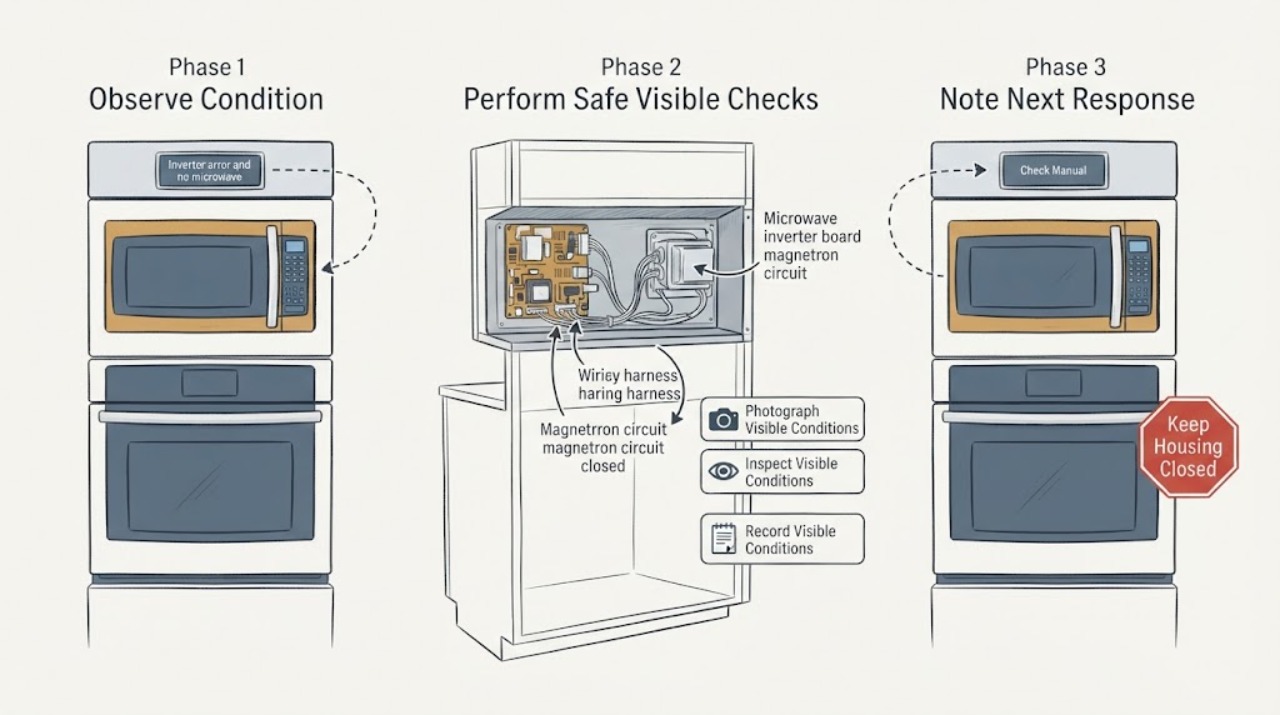
Stop using the upper microwave on the KitchenAid KOCE500EBS and do not run another heating test if it shows an inverter error, smells burnt, sparks, smokes, or appears to have heat damage. KitchenAid identifies KOCE500EBS as a combination wall oven with microwave-convection cooking in the upper oven and a convection oven below. Its F1 E5 wall-oven guidance says the possible area is the microwave inverter, magnetron tube, or associated wiring; that wording does not prove that the magnetron is melted. A visible scorch or melted-looking cavity part is a reason to keep the microwave off, not a safe reason to open it. Photograph the full display and the cavity from the doorway, record the exact model suffix and whether the lower oven is affected, then arrange qualified KitchenAid/appliance service. Do not remove the built-in unit, open a cover, enter diagnostics, reset it to see whether it fails again, or touch high-voltage parts.
Before you begin
Safety first
- Do not remove the wall-oven chassis, open the microwave enclosure, touch the inverter or magnetron, probe live or recently powered circuits, enter diagnostics, bypass door interlocks, run a deliberate heat test, or replace a part based only on the user's melted-magnetron impression. KitchenAid's technician manual limits diagnostic voltage measurements to authorized technicians and warns of electrical shock.
Work through in order
Diagnostic checks
Use only checks that match the exact appliance or system and its official guide.
-
Check 1
Stop the upper microwave immediately. Without starting a cook cycle, photograph the complete display, write down whether it says “inverter error,” F1 E5, or another code, and record whether the message appears at startup, after a prior heating attempt, or only in the upper microwave function.
Expected result: The display is clearly an inverter-related message/F1 E5 on KOCE500EBS, or the text, timing, model suffix, or affected function is uncertain.
Next step: Send the photo and exact suffix to KitchenAid or a qualified appliance provider. If the identity or code is uncertain, do not borrow a meaning from another KitchenAid microwave or another KOCE suffix.
Stop if: Do not intentionally restart the microwave to reproduce the error.
Why this matters
Why: KitchenAid's F1 E5 guidance points to the microwave inverter, magnetron tube, or associated wiring, but a generic user description and a code do not select one component. Exact display text and model suffix determine which support path applies.
-
Check 2
With power left off for the microwave function, inspect only the visible cooking cavity from the open door. Look for smoke residue, an arc mark, bubbled or missing cavity coating, a warped or burnt waveguide-cover area, a damaged door, or a burnt odor. Do not remove the cover, probe the waveguide, touch a melted-looking part, or reach behind the control panel.
Expected result: There is visible charring, melting, an arc mark, smoke/odor, a damaged door or seal, or the cavity looks normal but the error and no-heat symptom remain.
Next step: Keep the microwave off and request qualified service for either result; provide photos and say whether the lower oven is still usable. If smoke or burning odor is present, keep people away and isolate power only from a safe, dry, accessible disconnect.
Stop if: Do not clean, scrape, paint, glue, replace, or remove a cavity/waveguide part as a user repair.
Why this matters
Why: Visible heat or arc damage raises the risk of continued microwave operation and does not prove whether the magnetron, inverter, waveguide cover, interlock, or wiring is responsible. A normal-looking cavity also cannot rule out an internal high-voltage fault.
-
Check 3
Confirm the identity and layout from the rating label or owner's support page: KOCE500EBS, upper microwave-convection cavity, lower convection oven. Record whether the lower oven has a separate display, heats normally without any fault, or shares the fault message.
Expected result: The exact KOCE500EBS layout matches and only the upper microwave is affected, or the suffix/layout is different or the lower oven also reports a fault.
Next step: Give the provider the exact suffix and which cavity is affected. Do not dismantle the built-in unit to read a hidden label; use the visible rating label, paperwork, or a photograph.
Stop if: Do not operate the microwave merely to compare it with the lower oven.
Why this matters
Why: KitchenAid documents KOCE500EBS as a combination wall oven with the microwave-convection function above and the convection oven below. The inverter-error path is specific to the upper microwave function; a different suffix or a lower-oven fault requires its own manual and service diagnosis.
-
Check 4
Check the door and controls only from the outside: note whether the door closes and latches normally, the display remains stable, the control panel is cracked or wet, or the circuit breaker trips. Do not enter diagnostics, defeat an interlock, perform resistance/voltage tests, or remove the combination unit from the cabinet.
Expected result: A door, control, moisture, smoke, cord/circuit, or breaker abnormality is present, or the visible controls and door appear normal while the inverter error/no-heat symptom remains.
Next step: For any hazard sign, keep the microwave off and arrange urgent qualified service; for a normal exterior with recurring error/no heat, schedule service and provide the code history. Do not reset repeatedly or substitute a fuse, board, inverter, or magnetron.
Stop if: Stop immediately for smoke, flames, burning odor, sparking, a hot/damaged cord, water on controls, exposed wiring, a damaged door, or repeated breaker trips.
Why this matters
Why: A door/interlock or electrical symptom can change the safety response, but normal visible operation cannot clear an inverter-related fault. KitchenAid's technician material reserves diagnostic voltage measurements and internal checks for authorized technicians and warns of electrical shock.
-
Check 5
Prepare the service handoff instead of ordering a part: provide the exact suffix, display photo, cavity affected, symptoms before the error, visible cavity/door observations, any odor or arcing, breaker behavior, and whether the lower oven has a separate normal or abnormal result.
Expected result: The provider can match the model and error to the correct documentation, or the model/code remains unverified.
Next step: Use KitchenAid support or a qualified built-in microwave/oven technician. Keep the microwave disabled until the technician confirms the appliance is safe and complete panels and door/interlock checks are restored.
Stop if: Do not accept a part-only diagnosis based solely on the words “magnetron melted.”
Why this matters
Why: A matching service path can assess the inverter, magnetron, wiring, interlocks, cavity damage, and controls in a safe order. An unverified code or suffix is not enough to claim that a magnetron or inverter board is the correct replacement.
Use your observations
Decision map
Find the observation that best matches what you see, then follow the next safe action.
-
PATH 01Next step
What you see
The exact KOCE500EBS upper microwave shows an inverter-related message or F1 E5 and does not heat, with no safe user test able to clear the risk.
Do this next
Leave the microwave off, preserve the code/photo history, and arrange qualified service for the built-in combination unit.
Why this path and its safety boundary
Why it matters: This is an upper-microwave service condition involving the inverter, magnetron, or associated wiring—not a confirmed magnetron-only failure and not a normal cooking-setting issue.
-
PATH 02Next step
What you see
There is smoke, burning odor, sparking/arcing, a melted or charred cavity area, a damaged door/seal, hot or damaged wiring/cord, water on controls, or repeated breaker operation.
Do this next
Do not operate it. Keep people away, isolate power only from a safe accessible disconnect if needed, and request qualified service or emergency assistance for active smoke/fire.
Why this path and its safety boundary
Why it matters: The microwave has crossed from a no-heat diagnosis into a fire, radiation-containment, or electrical hazard. A reset or another cup-of-water test could worsen the condition.
-
PATH 03Next step
What you see
The lower convection oven appears normal while only the upper microwave reports the inverter error.
Do this next
Tell the provider that the upper and lower cavities differ. Use the lower oven only if the exact manual and service provider confirm it is safe with no shared hazard, and never use the microwave to compare results.
Why this path and its safety boundary
Why it matters: The symptom is localized to the upper microwave path in a combination product; it does not establish a failure in the lower oven's heating system.
-
PATH 04Next step
What you see
The display text, model suffix, or cavity identity cannot be confirmed, or the fault appears in both upper and lower functions.
Do this next
Stop all cooking functions if there is any odor, arcing, or control abnormality; otherwise photograph the rating label and display and have KitchenAid or a qualified technician identify the correct documentation before further use.
Why this path and its safety boundary
Why it matters: The KOCE500EBS/F1 E5 interpretation is not safely established for the appliance state, and cross-model or cross-cavity conclusions could direct the wrong repair.
Helpful context
Understand the symptom
The user's melted-magnetron observation is not a diagnosis
An inverter error is a fault path, not a part-order instruction. The official KitchenAid F1 E5 guidance names the microwave inverter, magnetron tube, and associated wiring as possible problem areas. A mark seen through the cavity may instead be a waveguide-cover, paint, seal, or arcing problem, and the actual magnetron and inverter are behind the enclosure. Treat the observation as a stop signal and useful evidence for the technician, not as confirmation of which component failed.
Upper microwave and lower oven are separate functions in one built-in chassis
KOCE500EBS combines an upper microwave-convection oven with a lower Even-Heat true-convection oven. A microwave inverter message belongs to the upper microwave path; it does not by itself prove that the lower oven's heating elements or controls are defective. The built-in layout also means moving or opening the appliance is a service job, not an ordinary countertop check.
When checks do not resolve it
Need a professional?
Arrange qualified service immediately for an inverter-related message with no heat. Escalate urgently for smoke, flame, burning odor, arcing, visible melting/char, a damaged door or seal, hot/damaged cord, water on controls, exposed wiring, or repeated breaker trips. Do not use the upper microwave again until the technician has assessed it and restored all panels and safety interlocks.
Safety scope: Do not remove the wall-oven chassis, open the microwave enclosure, touch the inverter or magnetron, probe live or recently powered circuits, enter diagnostics, bypass door interlocks, run a deliberate heat test, or replace a part based only on the user's melted-magnetron impression. KitchenAid's technician manual limits diagnostic voltage measurements to authorized technicians and warns of electrical shock.
Have this ready
- Provide the exact model KOCE500EBS and any suffix, full display photo/transcription, upper versus lower cavity, whether the fault follows a prior heating attempt, visible cavity/door marks, odor/smoke/arcing, breaker behavior, and whether the lower oven has a separate symptom.
Common questions
FAQ
Does “inverter error” prove the magnetron is melted?
No. KitchenAid's F1 E5 guidance names the microwave inverter, magnetron tube, or associated wiring as possible areas. A visual mark may be cavity or waveguide damage, and the magnetron is not safely user-confirmable from the display alone.
Can I run a cup of water to see whether it still heats?
Not when an inverter error, smoke, arcing, burnt odor, visible melting, or no-heat fault is already present. Do not deliberately re-energize a suspected high-voltage fault; leave the microwave off and arrange qualified service.
Can I keep using the lower oven?
The product page identifies a separate lower convection oven and an upper microwave-convection oven, but a microwave fault does not by itself prove the lower oven is safe. Have the provider confirm there is no shared electrical, control, smoke, or cabinet hazard before using the lower cavity; never use the upper microwave for comparison.
Read the exact guide
Official sources
- Kitchen Appliance Manuals | KitchenAidKitchenAid · Supports the instruction to use the exact model/suffix manual rather than a neighboring KOCE/KOSE model; it is not itself a code definition.
- 30" Combination Wall Oven with Even-Heat™ True Convection (Lower Oven) Black Stainless Steel with PrintShield™ Finish KOCE500EBS | KitchenAidKitchenAid · Directly applicable to the exact model; distinguishes upper microwave-convection cooking from the lower convection oven.
- KOCE500EBS | KitchenAidKitchenAid · Directly identifies the exact model as a 30-inch combination wall oven with Even-Heat True Convection lower oven and provides model-matched manuals, troubleshooting and service links.
- F1 E5 - Wall Oven - Product Help | KitchenAidKitchenAid · Directly relevant to interpreting an inverter-related F1 E5 display on KitchenAid wall-oven families; it is not proof that a particular KOCE500EBS part has failed.
- Tech Manual - W11382178 - Rev AKitchenAid Canada · Official technician-only material for a related KitchenAid built-in combination wall-oven platform; used here to establish the professional boundary and the multi-component nature of the inverter error, not to give a user repair procedure.
Community feedback
Share a repair observation
Share a plain-text repair observation. Accepted observations are published automatically; this page may take a moment to update.