
On this page
Start here
Quick answer
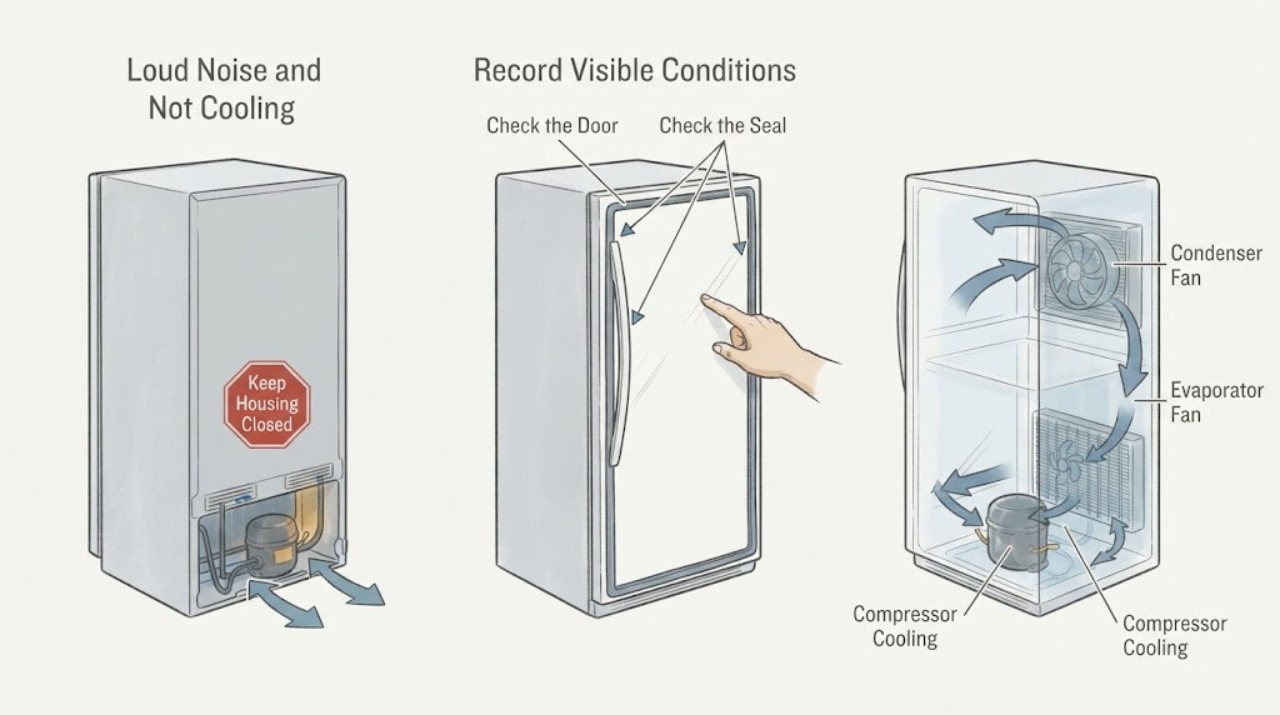
If your KitchenAid KRFC704FBS00 is making a loud or newly changed noise while the refrigerator is not cooling well, treat the two symptoms together. Record the refrigerator and freezer temperatures, confirm Cooling is enabled, and note whether the sound is a low hum, fan-like buzz, clicking, rattling, or grinding. KitchenAid says compressor and fan sounds can increase when the refrigerator is working harder after warm groceries or frequent door openings, but restricted condenser airflow, poor clearance, a fan problem, or a cooling fault can also leave the appliance warm. Check the visible vents, door seals, surrounding clearance, and any condenser area that the exact manual says is owner-accessible. If both sections remain warm, the noise stays unusually loud, a fan does not run normally, or the source is inaccessible, stop at external checks and arrange model-specific service.
Work through in order
Diagnostic checks
Use only checks that match the exact appliance or system and its official guide.
-
Check 1
Check the refrigerator and freezer temperatures with a reliable thermometer if available, confirm that Cooling is enabled, and record whether one compartment or both are warming. Keep doors closed while the test is stabilizing and move vulnerable food to safe cold storage if necessary.
Expected result: The refrigerator section is warm but the freezer is cold, both sections are warm, temperatures are normal, or the control shows Cooling Off or another non-cooling state.
Next step: Restore only a clearly disabled cooling setting according to the exact manual and allow the model's stabilization period. If both sections remain warm or food safety is at risk, stop user diagnosis and arrange service.
Why this matters
Why: A warm refrigerator with a cold freezer keeps an internal air path or vent issue in consideration, while both sections warm with cooling enabled points toward airflow, fan, compressor, control, or sealed-system diagnosis. A disabled cooling function explains warmth without identifying why the setting changed.
-
Check 2
Listen from outside the cabinet without opening panels and describe when the loud sound occurs: continuously while cooling, after doors open or warm groceries are added, during ice-maker filling, or as a new grinding, scraping, or rattling sound. Note whether the sound changes when the doors remain closed.
Expected result: The sound is a brief low hum or buzz during high cooling demand, a water-valve buzz during ice-maker fill, a rattle transferred to the cabinet, or a persistent new fan-like, grinding, or scraping noise while temperatures rise.
Next step: Continue only with the external airflow and clearance checks for a stable, familiar sound. For persistent grinding, scraping, abnormal fan noise, or a loud sound with warming food, keep the refrigerator closed and arrange service.
Stop if: Do not touch a fan, remove a cover, or place hands behind the refrigerator while it is powered.
Why this matters
Why: KitchenAid lists compressor and fan sounds and increased cooling demand as common buzz sources, and it identifies the ice-maker water valve as another source. A persistent new mechanical sound paired with poor cooling is not cleared by the fact that some refrigerator sounds are normal.
-
Check 3
Inspect the visible space around the refrigerator and the interior air vents. Confirm that the cabinet is stable, the rear and side clearances match the exact installation instructions, food is not blocking the vents, and the door gaskets close against a clean, unobstructed surface.
Expected result: A vent is blocked, the refrigerator is too close to a wall or cabinet, the floor is transmitting vibration, a door gasket is dirty or torn, or the visible airflow and sealing conditions look normal.
Next step: Rearrange food and clean an accessible gasket gently. Correct only a clearly visible clearance or stability issue without moving the heavy refrigerator alone; if cooling and noise do not improve, arrange service.
Why this matters
Why: KitchenAid says blocked vents can reduce airflow between compartments, poor clearance can prevent heat release, and damaged or dirty gaskets can let cold air escape. A level, clear, sealed cabinet shifts attention toward condenser or fan operation when cooling remains poor.
-
Check 4
If the exact KRFC704FBS00 literature identifies an owner-accessible condenser area, disconnect power from a dry, safe position, let surfaces cool, and remove dust only as the manual directs. Do not remove an access panel or reach toward a fan if the manual does not authorize that step.
Expected result: The permitted condenser area is visibly dusty, airflow around the cabinet is restricted, the area is clear, or the condenser and fan are behind an inaccessible cover.
Next step: Restore the panel and power only after the manual-permitted cleaning is complete and the area is dry. Allow temperatures to stabilize once; if the loud noise or poor cooling returns, arrange service rather than cleaning deeper or testing a fan by hand.
Stop if: Do not bend refrigerant tubing, remove sealed-system parts, touch a powered fan, or open the cabinet.
Why this matters
Why: KitchenAid says dust on condenser coils can make heat release and cooling harder and can contribute to buzzing from restricted airflow. A clear accessible area does not rule out a failed fan, compressor, control, or sealed-system problem.
-
Check 5
Prepare a model-specific service report with the full KRFC704FBS00 marking, both compartment temperatures, control state, sound description and timing, recent loading or relocation, vent and clearance observations, and any visible frost, leak, or error indication.
Expected result: Both compartments remain warm, the loud sound persists with doors closed, a fan appears not to run, frost or a leak is present, or all accessible checks are normal but cooling is still weak.
Next step: Keep food safe and arrange KitchenAid or qualified refrigerator service. Ask for diagnosis against KRFC704FBS00 before ordering a part; do not repeatedly change the thermostat or run the refrigerator with a suspected internal fault.
Why this matters
Why: These patterns leave a fan, compressor, control, airflow, sealed-system, or other internal fault possible. The model parts document confirms the exact variant for service, but it does not establish which assembly has failed.
Use your observations
Decision map
Find the observation that best matches what you see, then follow the next safe action.
-
PATH 01Next step
What you see
The sound became loud or newly changed while both refrigerator sections are warming, especially with clear vents and normal door sealing.
Do this next
Check only the exact manual-permitted condenser and clearance conditions, then stop and arrange model-specific service if temperatures do not recover or the noise remains unusual.
Why this path and its safety boundary
Why it matters: The coupled symptoms make restricted condenser airflow, a condenser or evaporator fan issue, a control problem, or another cooling fault more likely than a harmless familiar hum. KitchenAid links cooling demand and condenser or fan operation to refrigerator noise and identifies those systems in its cooling guidance.
-
PATH 02Next step
What you see
The freezer is cold, the refrigerator section is warm, and containers or food block an internal vent or the air path between compartments.
Do this next
Clear the vent area without packing food against the rear wall, keep the doors closed, and reassess after stabilization. Arrange service if the refrigerator remains warm with clear vents.
Why this path and its safety boundary
Why it matters: An obstructed shared-air path is more likely than total loss of cooling. KitchenAid says cool air enters and exits the refrigerator compartment through vents and that blocking them reduces airflow.
-
PATH 03Next step
What you see
The noise is a brief hum or buzz after warm groceries, frequent door openings, or an ice-maker fill, and both compartments return to the expected temperature.
Do this next
Limit repeated door openings, confirm the ice maker's water connection or off state as the manual allows, and monitor. Arrange service if the sound becomes louder, changes character, or cooling worsens.
Why this path and its safety boundary
Why it matters: Increased cooling demand or the water valve may explain the temporary sound. KitchenAid lists these as possible normal operating causes when cooling performance is otherwise normal.
-
PATH 04Next step
What you see
The loud noise remains with doors closed and normal load, both sections stay warm, a fan does not run normally, or there is frost, a leak, grinding, or scraping.
Do this next
Keep the refrigerator out of service as appropriate, protect food, and arrange KitchenAid or qualified service with the KRFC704FBS00 model and recorded observations. Do not open panels or order a part from the symptom alone.
Why this path and its safety boundary
Why it matters: An internal fan, compressor, control, airflow, sealed-system, or mechanical fault is possible and cannot be selected safely from an exterior listening test.
Helpful context
Understand the symptom
Read the noise and temperature together
A soft hum or brief buzz can be normal when a refrigerator is cooling, but a sudden increase in noise paired with food warming is a different observation from a familiar steady operating sound. KitchenAid says the compressor and fans may run more often after warm groceries or frequent door openings. It also identifies condenser airflow, clearance, and fan operation as cooling factors, so the temperature result helps decide whether the noise is simply increased demand or a fault that needs service.
Keep the model boundary clear
The supplied model parts document identifies KRFC704FBS00 as a KitchenAid bottom-mount French-door refrigerator. It does not turn a noise symptom into a confirmed compressor, fan, or sealed-system diagnosis. Use the model marking when consulting the owner's literature or booking service, and keep internal electrical, refrigerant, fan, and control work with a qualified technician.
When checks do not resolve it
Need a professional?
Stop user troubleshooting and seek KitchenAid or qualified refrigerator service for persistent loud or grinding noise, both sections staying warm, a fan that does not operate normally, frost or a leak, a damaged gasket, a suspected sealed-system or compressor fault, or any need to open panels or handle refrigerant, wiring, or motors.
Common questions
FAQ
Why is my KitchenAid KRFC704FBS00 loud and not cooling well?
The noise and warmth may be related to increased cooling demand, restricted condenser airflow, poor clearance, a fan issue, or another cooling fault. First confirm Cooling is enabled, record both compartment temperatures, clear vents, check door sealing and visible clearance, and use only the condenser procedure permitted by the exact manual. Persistent loud noise with warmth needs service.
Is a humming or buzzing KitchenAid refrigerator always a problem?
No. KitchenAid says compressors and condenser or evaporator fans can hum or buzz, and cooling demand may increase after warm groceries or frequent door openings. A brief familiar sound with normal temperatures is different from a newly loud sound paired with warming food, grinding, scraping, or abnormal fan behavior.
What should I check when the freezer is cold but the refrigerator is warm?
Check that food or containers are not blocking the vents between compartments and leave room for air to circulate. KitchenAid says blocked vents can reduce airflow and cause temperature problems. If the refrigerator section stays warm after the vents are clear, arrange service.
Can I clean the condenser on a KRFC704FBS00 myself?
Only if the exact owner literature identifies the condenser area as owner-accessible and gives a cleaning procedure. Disconnect power from a dry, safe position, let the area cool, and do not remove panels or touch a fan unless the manual explicitly permits it. A clean accessible area does not rule out an internal cooling fault.
Read the exact guide
Official sources
- Why is my refrigerator not cooling and how to fix it?KitchenAid · Opened KitchenAid's official not-cooling guidance. It covers cooling settings, blocked compartment vents, recent warm loads, door sealing, clearance, dirty condenser coils, condenser fan operation, and control faults.
- Refrigerator Normal Sounds and Noises - Product Help | KitchenAidKitchenAid Product Help · Opened KitchenAid's official normal-sounds guide. It is used to distinguish a familiar operating hum or buzz from a new, louder sound paired with poor cooling.
- Refrigerator Noise - Rattling or VibratingKitchenAid Product Help · Opened KitchenAid's official rattling and vibrating guide. It supports the external stability and cabinet-transmitted vibration branch without identifying an internal failed part.
- Repair Parts List - W10851171 - Rev HWhirlpool Corporation / KitchenAid · Opened the official repair-parts PDF, which explicitly lists KRFC704FBS00 as the black-stainless model. It is used only to lock the model identity and service context, not to infer a failed part from the symptom.
- Refrigerator Noise - BuzzingKitchenAid Product Help · Opened KitchenAid's official refrigerator noise guide. It covers compressor, condenser and evaporator fan sounds, increased noise after loading, level and clearance, condenser cleaning where allowed, and ice-maker water-valve buzzing.
Community feedback
Share a repair observation
Share a plain-text repair observation. Accepted observations are published automatically; this page may take a moment to update.