
On this page
Start here
Quick answer
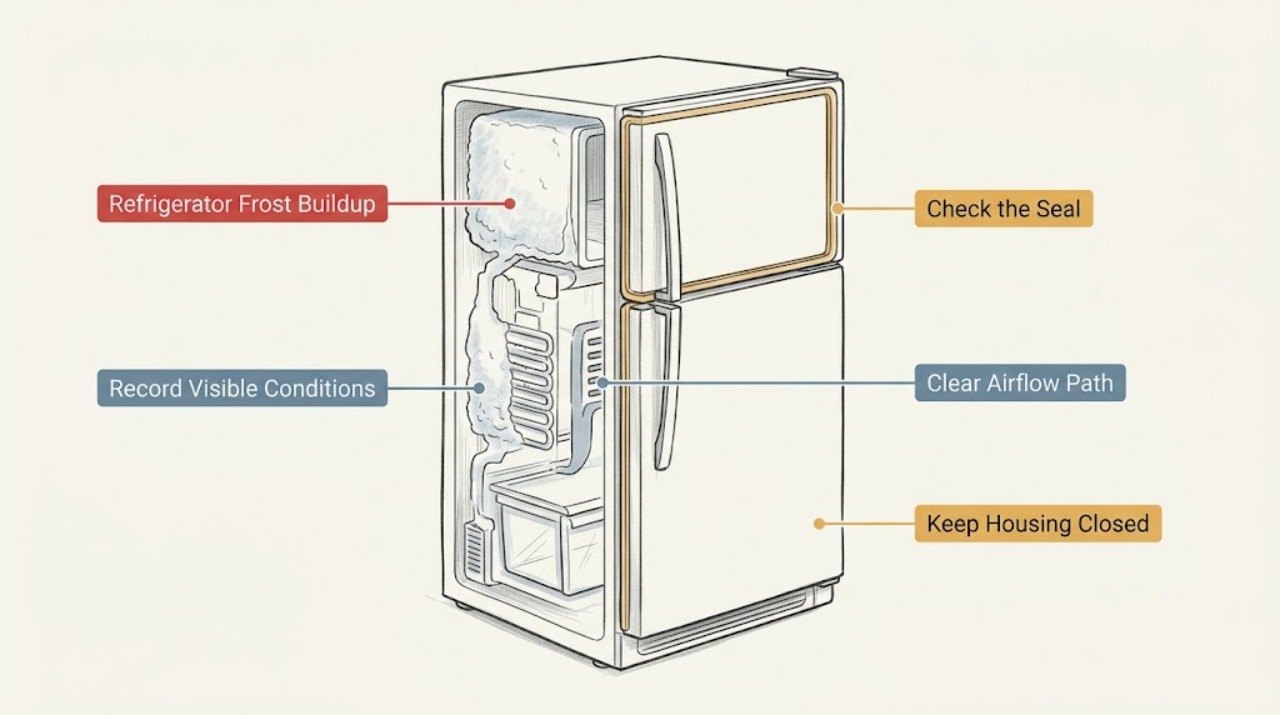
Find out whether frost is localized near the door, spread across a wall, or blocking an air vent. Keep the freezer door fully sealed, clean a dirty gasket, avoid putting hot or uncovered wet food inside, and remove frost only with a cloth or warm method allowed by LG. Never use a knife or ice pick; recurring frost after a complete seal check needs service.
Before you begin
Safety first
- Never chip frost with a sharp tool or remove internal panels; keep water away from electrical connections.
Work through in order
Diagnostic checks
Use only checks that match the exact appliance or system and its official guide.
-
Check 1
Record where frost appears—door edge, upper wall, shelves/food, vents, or one freezer side—and whether it began after a power outage, cleaning, or a door that was left ajar.
Expected result: Frost is concentrated at a seal/edge, covers vents, or follows a recent warm-up/power restoration.
Next step: Continue with door and food checks; do not chip the frost with a sharp object.
Why this matters
Why: A localized edge pattern supports outside-air entry; a recent warm-up can temporarily create frost as moist air cools, while vent frost can restrict circulation.
-
Check 2
Remove containers that project into the door, verify shelves and drawers are fully seated, and close the door while inspecting the gasket for dirt, folds, compression, or a visible gap.
Expected result: An item blocks closure, the gasket is dirty/compressed, or the door closes with a continuous clean contact.
Next step: Rearrange items, clean the gasket with the approved mild method, and gently restore only a displaced section; seek service for damage or persistent gaps.
Why this matters
Why: LG identifies blocked closure and a dirty or poorly seated gasket as causes of outside humid air entering and freezing.
-
Check 3
Check food practices and airflow: let hot food cool before storage, seal watery foods, and keep packages away from return-air vents and the top sensor area.
Expected result: Hot/uncovered food or blocked vents were present, or food is sealed and the vents remain open.
Next step: Correct the storage pattern and allow the compartment to stabilize. Do not use a knife, pick, or heat source that could damage plastic or sealed parts.
Why this matters
Why: Steam and food moisture can condense and freeze; blocked vents can prevent normal circulation and worsen frost.
-
Check 4
If a substantial ice layer remains, follow the model's safe defrost guidance; protect food, keep water away from electrical connections, and dry the compartment before reconnecting power.
Expected result: Frost clears and stays away after the seal/storage correction, or it returns in the same area.
Next step: Arrange qualified service for recurring frost or inaccessible ice. Do not remove panels to reach the evaporator or defrost components.
Why this matters
Why: A one-time moisture event can clear after defrosting; rapid recurrence points to an ongoing seal, airflow, or defrost-system problem.
Use your observations
Decision map
Find the observation that best matches what you see, then follow the next safe action.
-
PATH 01Next step
What you see
Frost is localized at a door edge and falls after clearing the obstruction and cleaning the gasket
Do this next
Keep the gasket clean and the door path unobstructed.
Why this path and its safety boundary
Why it matters: Outside humid air entering at the seal is the supported cause.
-
PATH 02Next step
What you see
Frost follows hot/unsealed food or a recent power restoration and dissipates after moisture correction
Do this next
Cool food before storing, seal wet items, and observe without sharp-tool scraping.
Why this path and its safety boundary
Why it matters: A temporary moisture load is more likely than a failed defrost part.
-
PATH 03Next step
What you see
Frost quickly returns after complete defrosting with a clean gasket, clear vents, and correct closure
Do this next
Stop using improvised defrost methods and request qualified service.
Why this path and its safety boundary
Why it matters: The continuing source is not explained by the accessible checks.
Helpful context
Understand the symptom
Frost location reveals the air leak
A band of frost near one door edge suggests sealing or obstruction, while frost on vents changes airflow and can reduce cooling. Moisture introduced by hot or unsealed food can create a broader but temporary layer.
When checks do not resolve it
Need a professional?
Arrange qualified inspection when the accessible seal, storage, and defrost checks do not stop recurrence.
Safety scope: Never chip frost with a sharp tool or remove internal panels; keep water away from electrical connections.
Have this ready
- Provide the model, frost location, door/gasket result, food and power-outage history, vent condition, and recurrence timing.
Common questions
FAQ
Can I use a knife to remove frost from an LG refrigerator?
No. LG warns that knives and ice picks can damage the refrigerator. Use a model-approved cloth or safe defrost method and request service for inaccessible or recurring ice.
Why does frost form on one side of an LG freezer?
LG says one-sided frost can indicate that the freezer drawer or door is not sealing. Clear items, inspect and clean the gasket, and arrange service if the gap persists.
Read the exact guide
Official sources
- LG Refrigerator - Troubleshooting Frost or Moisture Buildup In Your LG RefrigeratorLG USA Support · LG refrigerator frost, moisture, food, door, and safe removal guidance
- LG refrigerator frost build-up: There is frost build-up and icicles in the freezer compartmentLG USA Support · LG freezer frost, gasket, vent, and safe defrost guidance
Community feedback
Share a repair observation
Share a plain-text repair observation. Accepted observations are published automatically; this page may take a moment to update.