
On this page
Start here
Quick answer
Classify the sound before touching anything. Clicking, gurgling, hissing, and a low compressor hum can be normal LG operating sounds. A new rattling that changes when the unit is moved, a fan-like scrape, or a loud noise that persists while cooling is poor deserves a focused inspection and possibly service.
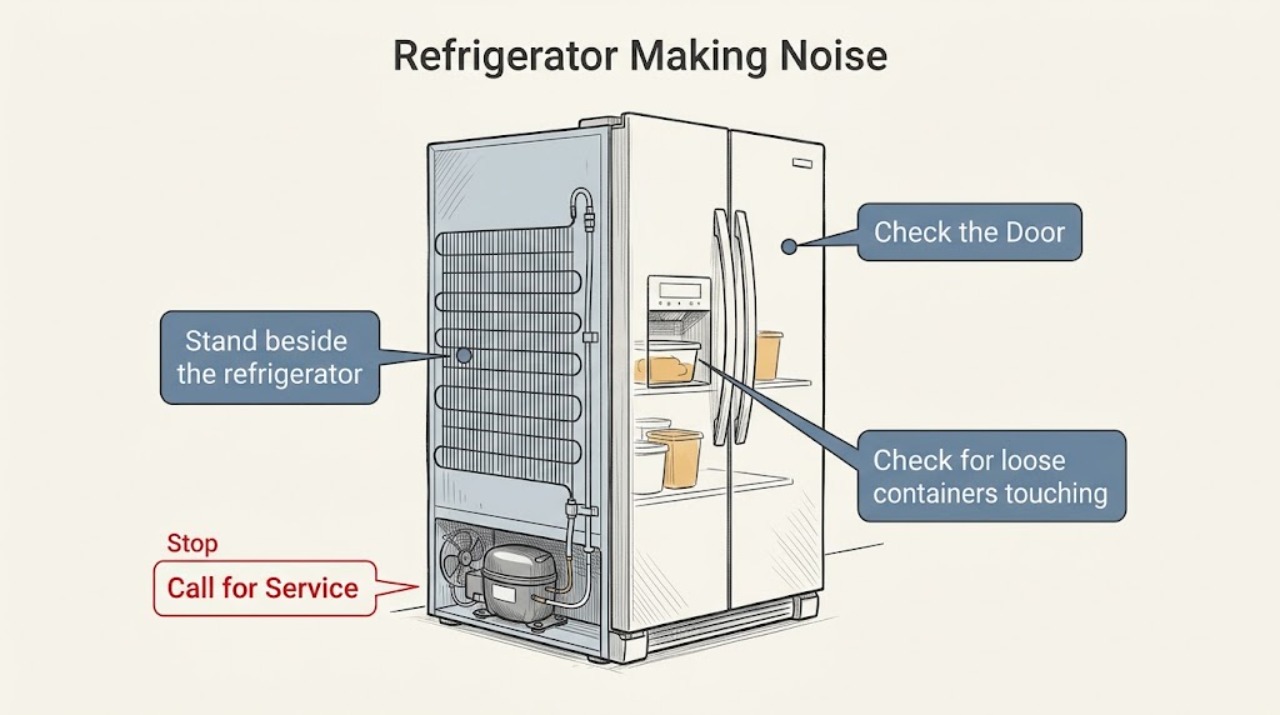
Work through in order
Diagnostic checks
Use only checks that match the exact appliance or system and its official guide.
-
Check 1
Stand beside the refrigerator and note the sound family and timing: click, hum, gurgle, hiss, rattle, scrape, or vibration.
Expected result: The sound is brief and cycle-related, or it is continuous, irregular, or newly much louder.
Next step: If it is continuous or accompanied by poor cooling, move to the fan and service checks.
Why this matters
Why: LG identifies several brief refrigerant, defrost, compressor, and fan sounds as normal; persistent abnormal noise needs a different path.
-
Check 2
With the doors closed, listen near the freezer and then open a door to see whether a fan-like sound stops immediately.
Expected result: The noise stops with a door open and returns after closing, or it continues regardless of the door.
Next step: Do not insert tools into the fan. If frost is visible or the noise persists, preserve food and arrange a safe defrost/service plan.
Why this matters
Why: A door-responsive sound makes a compartment fan or frost/obstruction more likely; an unchanged sound may come from the compressor, cabinet, or external line.
-
Check 3
Check for loose containers touching an interior wall, objects on top, cabinet contact with a wall, and a water line tapping the back.
Expected result: Moving a container or restoring clearance changes the vibration, or the sound is unchanged.
Next step: Remove only accessible external contact and keep clearance; do not move or tilt the refrigerator alone.
Why this matters
Why: LG notes that contact, an unlevel cabinet, and a water line against the wall can amplify otherwise normal vibration.
-
Check 4
Compare the noise with cooling performance and note whether it is loud enough to hear from another room or lasts more than an hour.
Expected result: Cooling is normal and the sound fades, or cooling is weak and the sound remains loud.
Next step: Record the sound and request qualified LG service rather than opening the sealed system.
Why this matters
Why: A normal cycle is more likely when the sound fades with stabilization; persistent loud compressor or fan noise with weak cooling is a service signal.
Use your observations
Decision map
Find the observation that best matches what you see, then follow the next safe action.
-
PATH 01Next step
What you see
The sound is a short click, hiss, gurgle, or low hum and cooling is normal
Do this next
Monitor it and keep the cabinet level and clear.
-
PATH 02Next step
What you see
A scrape or thud stops when a door opens and frost or an obstruction is present
Do this next
Avoid the fan and arrange model-appropriate defrost or service if it does not clear safely.
-
PATH 03Next step
What you see
A continuous loud rattle remains after clearance checks or cooling is also poor
Do this next
Request service and avoid moving the unit without help.
Helpful context
Understand the symptom
Start with the symptom
Noise location and timing are more useful than the word loud. Record whether it starts when the compressor runs, when a door closes, during ice or water operation, or continuously.
When checks do not resolve it
Need a professional?
Request service if noise remains loud or irregular, the compressor or fan seems abnormal, cooling is poor, frost repeatedly returns, or a safe external check does not change the symptom.
Common questions
FAQ
Are clicking and gurgling sounds always a failure?
No. LG describes brief clicking, refrigerant gurgling, defrost hissing, and compressor or fan hum as possible normal operation. Timing, persistence, and cooling performance decide whether service is needed.
Should I pull an LG refrigerator away from the wall?
If it is safe and accessible, restore clearance and check whether the water line is contacting the wall. Do not tilt or move a large refrigerator alone.
Read the exact guide
Official sources
- LG Refrigerator - Common Noises From an LG RefrigeratorLG USA Support · LG refrigerator common noises
- How to Troubleshoot Unusual Noises From Your LG RefrigeratorLG USA Support · LG refrigerator operating noises
Community feedback
Share a repair observation
Share a plain-text repair observation. Accepted observations are published automatically; this page may take a moment to update.