
On this page
Start here
Quick answer
Do not diagnose a part from the words Inverter Direct Drive or from one clunk. Stop the cycle and wait for the tub to stop, then identify whether the sound was tied to drain/fill, clothing or a visible object, an unbalanced load, an unstable installation, or a persistent impact with no load. Inverter Direct Drive is a technology description used on multiple model-specific LG washers, not a complete model number. Without the full model from the rating label, keep the checks external and generic; do not remove panels, run a listening test, or order a bearing, suspension, motor, or pump part.
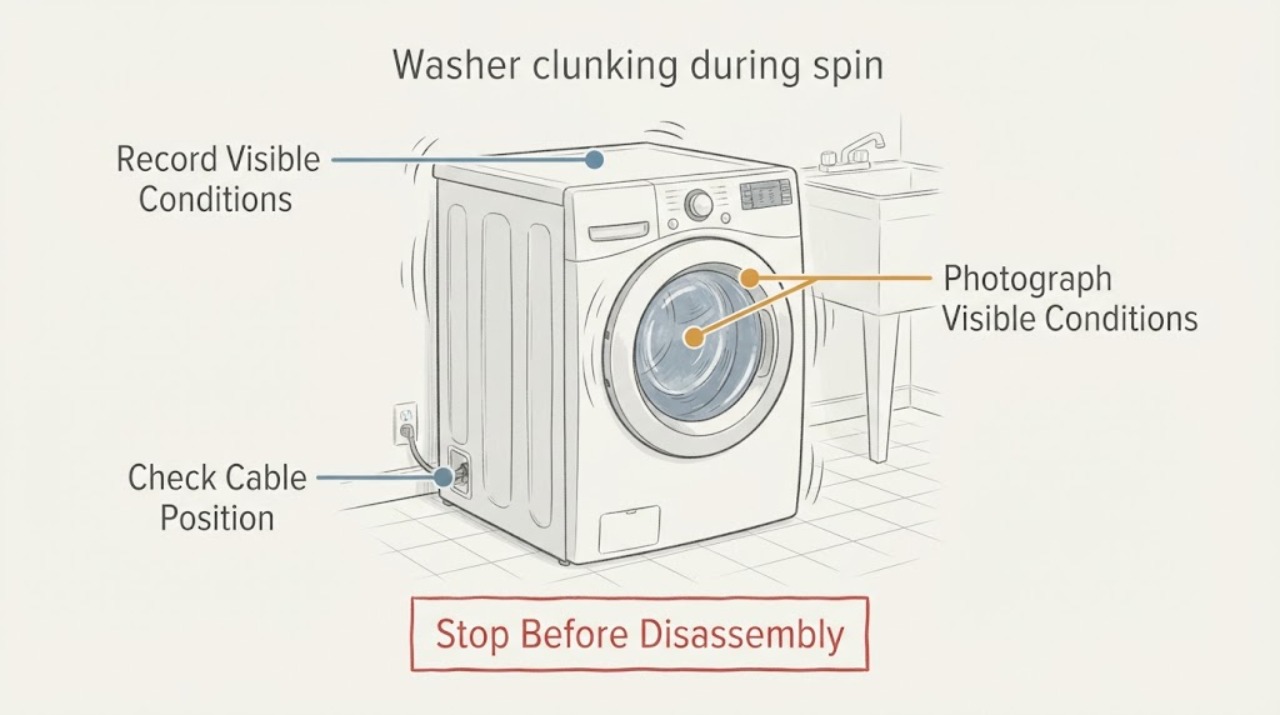
Work through in order
Diagnostic checks
Use only checks that match the exact appliance or system and its official guide.
-
Check 1
Press Pause or Power and wait until the drum or tub is completely still. From a safe, dry position, record when the clunk was heard: filling, washing, acceleration, high-speed spin, draining, or stopping. Note whether the cabinet moved, struck a wall, or leaked.
Expected result: The sound is limited to fill or drain, occurs as clothing is accelerated into spin, or is a repeated metallic impact that continues independently of the load; also note any walking, leak, smoke, hot smell, or repeated breaker trip.
Next step: Keep the washer off for any walking, impact, leak, smoke, electrical odor, or repeated trip. Otherwise continue only the stopped, visible checks below; do not restart merely to listen.
Stop if: Do not approach or touch a moving tub, reach through the door or lid while motion remains, move the washer across connected hoses, or continue a cycle that strikes the cabinet.
Why this matters
Why: Phase and consequence narrow the decision more safely than a sound label. LG treats spin noise as potentially related to imbalance, foreign objects, or leveling, while its washer guidance identifies a drain-pump sound before spin as a separate operating sound.
-
Check 2
With the washer stopped, find and photograph the complete model label before using a manual or ordering a part. On a front-load LG washer, look around the drum opening behind the door; on a top-load model, check the rear control area, under the lid, or the side panel as applicable.
Expected result: The label contains a full alphanumeric model and the market/version details, or it only says LG and Inverter Direct Drive without a complete model.
Next step: Use the exact model and market to open the matching LG support page and manual. Until then, do not infer a front-load instruction for a top-load washer or choose a bearing, suspension, drive, pump, or other part by appearance.
Stop if: Do not remove a cabinet panel or pull the washer out of a tight installation solely to search for a label; get installation help if the label is inaccessible without moving connected services.
Why this matters
Why: Inverter Direct Drive is a technology label, not enough identity for a model-specific repair instruction. LG’s own product page identifies a particular washer by a model such as F2J3QYL3W, and LG lists different label locations for front-load and top-load washers.
-
Check 3
After the tub is still, unload it and inspect the pockets, zippers, buttons, and the visible tub holes for a loose coin, key, wire, or other object. Spread an appropriate load evenly rather than testing an overloaded, single bulky, waterproof, or very small load.
Expected result: A zipper, button, coin, wire, or other loose object is visible, laundry is gathered heavily on one side, or the same clunk remains with the load removed.
Next step: Remove only an accessible object without force and correct the load before any later use. If the object is trapped, the tub is scraped, or the clunk remains empty, leave the washer off and request service.
Stop if: Do not use sharp tools, dismantle the tub, or reach into a gap or pump area to retrieve an object.
Why this matters
Why: LG says fasteners or foreign objects can strike the tub, and that a gathered or unsuitable load can cause pounding or rattling during spin. A load-independent clunk is not explained by laundry balance alone.
-
Check 4
With the washer off and unloaded, press opposite cabinet corners gently and look at the visible feet and floor. Check that the unit is on a solid, level surface, all feet appear to contact the floor, and the cabinet has not shifted.
Expected result: The cabinet rocks, a foot is visibly loose or off the floor, the floor is soft or damaged, or the washer is stable but the clunk persists.
Next step: If the exact model instructions permit, have an installer or qualified technician perform the documented leveling and lock-nut procedure. Do not compensate with loose paper, wood, or improvised blocks; keep the unit off if it cannot be stabilized safely.
Stop if: Do not drag the washer, reach underneath it, or adjust feet while it is powered or while hoses and the power lead are under tension.
Why this matters
Why: LG links an unlevel or unstable installation to spin vibration and unwanted movement. Stability with a persistent clunk makes a load-independent object or internal fault more concerning, but sound alone cannot identify which part.
-
Check 5
If the clunk began after delivery, installation, or a move, make only a safe visual comparison of the rear packing and shipping-bolt area with the exact LG installation instructions. Do not tilt the washer or remove hardware without the correct model procedure and safe installation help.
Expected result: Shipping bolts or packing appear present, the empty tub does not have the movement described by the matching instructions, or the installation is confirmed correct.
Next step: Keep the washer off and have the installer or qualified service remove or correct retained shipping material. If the hardware is confirmed removed and the clunk remains, continue no further than the external checks and arrange diagnosis.
Stop if: Do not operate the washer with shipping hardware or packing installed, and do not tilt it alone or across connected services.
Why this matters
Why: LG warns that retained shipping bolts, retainers, or packing can restrain the tub and cause severe noise and vibration. This condition is installation-specific and cannot be inferred just from the Inverter Direct Drive label.
-
Check 6
Use the earlier phase observation to inspect only accessible hoses and nearby surfaces while the washer is off: look for a fill or drain hose touching the cabinet, a visible mark from hose impact, a leak, or a backed-up standpipe. Do not create a new test cycle to hear the noise.
Expected result: The click occurs only while filling, the drain-pump hum occurs before spin, a hose visibly strikes the cabinet, or the clunk occurs during spin with no hose contact.
Next step: Correct only visible hose routing under the exact installation guidance if there is no leak. For a leak, backup, abnormal drain noise, or persistent spin impact, shut down and arrange appliance or plumbing service as appropriate.
Stop if: Do not disconnect a pressurized hose, open a service cover with water present, or run the machine with a leak or water near electrical equipment.
Why this matters
Why: LG attributes a filling click to water-flow changes or a loose hose striking the washer and describes a drain-pump sound before spin as normal in that context. A spin-only impact with no hose contact follows the load, stability, installation, or service path instead.
Use your observations
Decision map
Find the observation that best matches what you see, then follow the next safe action.
-
PATH 01Next step
What you see
The clunk is a light, occasional tap associated with a zipper, button, pocket object, or clothing falling, and there is no walking, impact, leak, or change in operation.
Do this next
Empty pockets, fasten closures, remove only visible loose objects, and use an appropriate evenly distributed load. Stop and request service if the sound becomes continuous, metallic, or load-independent.
Why this path and its safety boundary
Why it matters: A garment fastener or accessible foreign object is more likely than a confirmed direct-drive failure.
-
PATH 02Next step
What you see
Pounding or clunking starts as the load accelerates or reaches spin, laundry is gathered on one side or is bulky/waterproof, and the cabinet is otherwise stable.
Do this next
Wait for the tub to stop, redistribute or reduce the load, and use the exact model’s permitted settings. Do not keep running cycles that cause cabinet impact or violent movement.
Why this path and its safety boundary
Why it matters: An unbalanced or unsuitable load is more likely than an identified drive component.
-
PATH 03Next step
What you see
The cabinet rocks, a foot is not firmly on the floor, the floor is unstable, or the noise began after the washer was moved.
Do this next
Keep it off while an installer or qualified technician follows the exact model leveling and installation procedure. Do not improvise supports or move connected services.
Why this path and its safety boundary
Why it matters: Leveling or installation has a stronger connection to the movement than the laundry itself.
-
PATH 04Next step
What you see
The sound is tied to filling or draining, or an accessible hose visibly hits the cabinet, while the drum and cabinet remain stable.
Do this next
Inspect routing only while off and dry, and correct visible slack only under the matching installation instructions. Escalate a leak, backup, or continuing loud noise to appliance or plumbing service.
Why this path and its safety boundary
Why it matters: Hose movement or water-flow noise is more likely than a tub or drive fault; a leak or backed-up drain changes this to a service issue.
-
PATH 05Next step
What you see
A repeated metallic clunk, scraping, grinding, or roaring remains with the load removed; the washer walks or strikes the cabinet; or shipping hardware is suspected.
Do this next
Leave the washer off, preserve the full model information and symptom timing, and request qualified LG appliance service. Report any leak, electrical odor, smoke, repeated breaker trip, or injury risk when booking service.
Why this path and its safety boundary
Why it matters: A trapped object, installation fault, or internal mechanical/electrical problem cannot be separated safely by sound alone, and the Inverter Direct Drive label does not identify the failed part.
Helpful context
Understand the symptom
What this label does—and does not—tell you
LG uses Inverter Direct Drive as a motor technology description on model-specific washer pages. It does not tell you whether the washer is a particular front-load or top-load model, market version, control layout, or service configuration. Use the rating label and the matching LG manual before treating any instruction as model-specific. A clunk during high-speed spin is a symptom, not proof of a failed direct-drive motor, bearing, suspension, or rotor.
Keep the observation safe
The drum can retain motion after a cycle is paused. Make the first observation from a safe position, with the washer stopped, and use only visible, non-invasive checks. If the cabinet walks violently, strikes nearby fixtures, leaks toward electrical equipment, smells hot or burnt, smokes, or trips the breaker repeatedly, leave it off and arrange qualified service.
Only after diagnosis
Potential parts
- leveling foot or installation hardware
Only relevant when the exact model’s installation inspection confirms a damaged foot or retained shipping material.
Confirm the complete LG model, market, and matching installation instructions before sourcing anything. - drain pump or foreign-object filter component
Only consider after a model-appropriate service diagnosis links the symptom to the drain path or an inaccessible foreign object; a normal drain-pump sound is not proof of failure.
Do not order by the Inverter Direct Drive label or by appearance; verify exact model fitment. - suspension, bearing, or drive component
Only relevant if a qualified technician confirms a load-independent mechanical fault after the safe external checks.
No model-specific component or compatibility is established without the full rating-label model.
When checks do not resolve it
Need a professional?
Keep the washer off and arrange qualified appliance service for persistent metallic impact, scraping, grinding, or roaring; a clunk with an empty drum; actual walking or cabinet strikes; suspected retained shipping hardware; a leak near electrical equipment; smoke, hot or burnt odor, a hot connection, or repeated breaker trips. Use installation help when leveling or moving connected services is unsafe, and plumbing help for a household drain or standpipe problem. Do not open the cabinet, probe live wiring, bypass a lid or door lock, or order a motor, bearing, suspension, rotor, pump, or control part from this series label alone.
Common questions
FAQ
Is Inverter Direct Drive a complete LG washer model number?
No. It is a technology description. LG’s product pages identify individual washers with a separate model identifier, and LG provides different label locations for front-load and top-load machines. Find the full rating-label model before using a model-specific manual or parts list.
Does one clunk during spin prove the direct-drive motor or bearing is bad?
No. LG’s noise guidance first separates load imbalance, foreign objects, leveling, shipping material, fill-hose movement, and drain-pump operation. A persistent empty-drum impact needs service diagnosis, but this symptom alone does not identify a failed motor, rotor, bearing, or suspension part.
Should I run an empty spin cycle to listen more closely?
Not as a DIY listening test for this series-level topic. Stop the washer first and use only the visible checks. If the noise persists with no load, or if the washer moves, strikes, leaks, smokes, smells hot, or trips the breaker, leave it off and call qualified service.
Read the exact guide
Official sources
- How To Find My LG Model and Serial NumberLG USA Support · LG front-load washer labels are behind the door; top-load labels may be on the rear panel, under the lid, or side panel.
- 2024 LG 7kg Front Loading Washer, WhiteLG UAE · Official page for one model-specific LG front-load washer; it lists the separate model identifier and describes Inverter Direct Drive as a technology, so the technology label alone does not identify the task’s full model.
- LG washer - How to Level an LG Front Load Washing MachineLG USA Support · LG front-load washer guidance for level floor, diagonal rocking check, feet contact, lock nuts, and optional pedestal boundaries.
- LG Washer – Troubleshooting Vibration IssuesLG USA Support · LG front-load washer installation and vibration guidance; shipping bolts/packing, solid level flooring, feet, and load distribution are addressed.
- LG Washer - Troubleshooting Noises During the CycleLG USA Support · LG general washer guidance; the page distinguishes spin noise, imbalance, foreign objects, leveling, and service escalation, while noting model content may vary.
- LG top load washing machine - Why is a “tak-tak” jamming noise is heard during spin cycle?LG USA Support · LG top-load washer guidance for coins, keys, wires, zippers, and buttons striking the tub.
- LG Washer - Troubleshooting Clacking Noise When the Washing Machine is FillingLG USA Support · LG general washer guidance for a click during filling caused by water pressure or a loose hose striking the cabinet.
- [LG Front load washing machine sound] There is a humming noise during spinningLG USA Support · LG front-load washer guide; a drain-pump hum as water drains before spin may be normal, while foreign objects can make it unusually loud.
Community feedback
Share a repair observation
Share a plain-text repair observation. Accepted observations are published automatically; this page may take a moment to update.