
On this page
Start here
Quick answer
Pause the washer if it is walking, striking nearby objects, leaking, or making metal-on-metal noise. Keep hands away from a moving tub. First identify whether the vibration began after installation or moving, happens only with a particular load, or occurs with an empty tub. For a recently installed front-loader, check that the shipping bolts and packing supports were removed, but do not tilt a heavy machine alone. Check that the washer stands on a solid, level floor with all feet firmly contacting it, then redistribute a tangled, bulky, or very small load according to the exact LG manual. A persistent shake with an empty drum, a tub that leans or bangs, leakage, grinding, smoke, burning smell, electrical arcing, or repeated power trips needs qualified service. Do not open the cabinet or replace suspension, bearing, or drive parts based only on vibration.
Work through in order
Diagnostic checks
Use only checks that match the exact appliance or system and its official guide.
-
Check 1
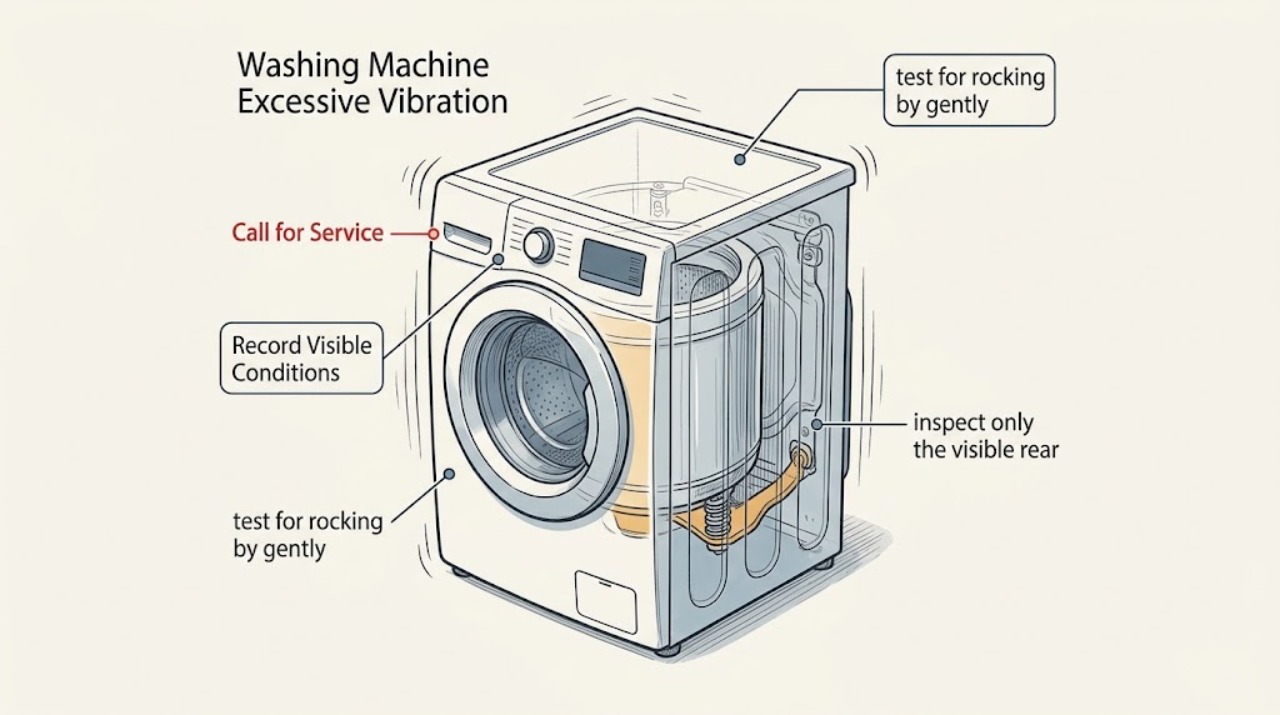
Pause the washer if safe and record the complete model number, front-load or top-load configuration, cycle stage, load type and size, error code if shown, whether the cabinet moves, and whether water, metal noise, smoke, or an electrical odor is present.
Expected result: Vibration appears only during high-speed spin, starts with every load, began after installation or moving, occurs with an empty tub, or is accompanied by leakage, impact, metal scraping, smoke, or a power trip.
Next step: Use the installation, load, floor, or service branch below. Keep the washer stopped until a safe user-level check is selected.
Why this matters
Why: The stage and repeatability separate load or installation causes from a persistent mechanical fault. Impact, leakage, metal scraping, smoke, or electrical symptoms are safety boundaries rather than ordinary leveling symptoms.
-
Check 2
If the washer was recently installed or moved, inspect only the visible rear shipping-bolt and packing areas using the exact model instructions. Do not tilt a heavy washer alone; if access requires moving or lifting it, use two people or arrange service.
Expected result: Shipping bolts or packing supports remain, the machine was not recently moved, the hardware cannot be removed safely, or the rear appears clear.
Next step: Remove shipping hardware only as the exact manual directs and cap the openings if instructed. If removal is uncertain or the vibration continues, stop and arrange qualified installation or appliance service.
Why this matters
Why: LG says shipping hardware fixes the tub during transport and can cause severe vibration if left in place. This check applies primarily to installation or relocation; it is not a reason to remove parts from an established machine without matching instructions.
-
Check 3
With the tub empty and the washer stopped, test for rocking by gently pressing opposing top corners. Check that the machine sits on a hard, level, dry floor and that all visible leveling feet contact it; adjust feet and secure lock nuts only as the exact model instructions permit.
Expected result: The cabinet rocks, one foot is off the floor, the floor is soft, raised, slippery, or wet, the tub is visibly leaning, or the machine is stable when empty.
Next step: Correct only a clearly accessible leveling issue and recheck diagonal rocking. Do not use loose paper or improvised shims. Arrange service or flooring support if the machine cannot be made stable without major movement or if it remains unstable empty.
Why this matters
Why: LG links a solid level floor and firm foot contact to reduced vibration. A floor that flexes or lets the feet slide can defeat a correct washer adjustment; a visibly leaning or unstable tub needs more than a load rearrangement.
-
Check 4
For vibration that follows a particular load, pause after the washer is safe, remove or redistribute tangled items, and compare a suitable mixed load with an unsuitable single bulky, water-resistant, or very small item. Follow the exact model's capacity and cycle guidance; do not reach into a moving tub.
Expected result: Laundry is piled to one side, the load is a single sheet or blanket, the tub is nearly empty or overpacked, or vibration remains after even redistribution.
Next step: Use an appropriate cycle and load size once the washer is safe. If the same vibration returns, note whether it occurs with an empty or balanced test and arrange service rather than repeatedly spinning it.
Why this matters
Why: LG explains that bulky, tangled, very small, or unevenly distributed loads can unbalance the tub during spin. If an evenly distributed suitable load still causes severe vibration, a load explanation is no longer sufficient.
-
Check 5
After shipping, floor, and load checks, run only the exact model's permitted light Rinse and Spin or comparable empty-safe test while observing from a safe distance. Stop immediately if the cabinet walks, the tub bangs, water leaks, or the machine makes a new metal, electrical, or burning sound.
Expected result: The test is stable, vibration returns only with a particular load, vibration remains with a light balanced load, or a hazard appears.
Next step: Do not repeat the test more than the manual permits. If vibration persists, keep the washer off and arrange qualified service with the model, stage, load, and observations recorded.
Why this matters
Why: A stable light test supports a load or installation cause; repeated vibration with a balanced light test points toward suspension, tub, bearing, drive, or control diagnosis. A hazard ends testing.
-
Check 6
With the washer isolated and dry, inspect only the visible door, hoses, cabinet, and floor for leakage, loose external objects, impact damage, or a tub that sits off-center. Do not remove panels or try to inspect suspension rods, bearings, counterweights, motor, or wiring.
Expected result: The tub is off-center when empty, a hose or cabinet is damaged, water is present, the drum makes a rough or grinding sound, or no visible damage is found.
Next step: Keep water supplies closed if leakage is active and arrange qualified appliance service. Use plumbing help for a building drain issue. Do not restart a machine with damage, leakage, grinding, smoke, or electrical symptoms.
Why this matters
Why: An off-center tub, leakage, harsh mechanical noise, or cabinet damage can indicate a suspension, tub, bearing, hose, or structural fault beyond a user adjustment. No visible damage does not rule out an internal problem.
Use your observations
Decision map
Find the observation that best matches what you see, then follow the next safe action.
-
PATH 01Next step
What you see
Vibration began after delivery, installation, or moving
Do this next
Check model-specific shipping bolts, packing, leveling, feet, and floor support. Do not lift or tilt the washer alone; arrange installation service if any step is unsafe.
-
PATH 02Next step
What you see
Vibration occurs only with a bulky, tangled, single, very small, or water-resistant load
Do this next
Pause safely, redistribute or remove the unsuitable load, select the exact model's appropriate cycle, and arrange service if a balanced load still vibrates.
-
PATH 03Next step
What you see
The empty washer rocks, leans, or stands on a soft, raised, slippery, or wet floor
Do this next
Correct accessible leveling and foot contact only as the exact model instructions allow. Do not use improvised shims; arrange service or floor support if stable installation is not possible.
-
PATH 04Next step
What you see
Vibration remains with an empty or light balanced test load
Do this next
Stop testing and arrange qualified service for suspension, tub, bearing, drive, or control diagnosis. Do not open the cabinet or order a part from the symptom alone.
-
PATH 05Next step
What you see
A UE-style imbalance code appears
Do this next
Record the exact code and model, then follow the matching LG manual. Check load distribution and leveling once; a recurring code with a suitable load needs service.
-
PATH 06Next step
What you see
The washer walks, bangs violently, leaks, grinds, smells hot or burned, sparks, smokes, or trips power
Do this next
Stop immediately, keep clear, isolate power and water only if safe, and seek qualified appliance, electrical, or plumbing help as appropriate. Do not restart.
Helpful context
Understand the symptom
Stop a washer that is moving dangerously
Pause the cycle and keep clear if the cabinet is walking, striking a wall, or pulling on hoses. Do not reach into a moving tub. If water is leaking toward an outlet, the floor is damaged, or a sharp electrical smell or smoke is present, isolate the machine only from a dry, safe position and do not restart it.
The timing of the vibration is the useful clue
Vibration that began after delivery or relocation points toward shipping hardware, packing, leveling, or flooring. Vibration that occurs only with a sheet, blanket, single heavy item, or very small load points toward distribution. Vibration with an empty tub, persistent banging, leakage, or harsh grinding points toward a mechanical or suspension fault that needs service.
Safety boundary
Stop conditions
- Do not reach into a moving tub or try to restrain a walking washer by hand.
- Do not tilt or lift a heavy washer alone, and do not move it across a wet or damaged floor.
- Do not open the cabinet, remove suspension or drive parts, or probe live wiring.
- Do not use loose paper, wood, or improvised shims as a permanent leveling fix.
- Do not restart after violent impact, leakage near electrical parts, metal grinding, smoke, burning smell, arcing, or a repeated power trip.
Only after diagnosis
Potential parts
- suspension support or damper assembly
Consider only when qualified service confirms excessive movement with a balanced load and stable installation, and identifies a worn or damaged suspension component.
Suspension parts vary by model and load configuration. Confirm the exact model before any replacement. - tub bearing or drum support
Consider only when service confirms rough drum movement, persistent grinding, or an off-center tub caused by a bearing or support fault.
Bearing and tub assemblies are model-specific and may require extensive qualified repair; do not diagnose from vibration alone. - drive or control component
Consider only when qualified diagnosis finds abnormal spin control or drive behavior after load, floor, and installation causes are ruled out.
Verify the complete model and approved component. Do not perform live tests or bypass motor and safety controls.
When checks do not resolve it
Need a professional?
Use qualified appliance service for vibration that persists after model-approved shipping, leveling, floor, and load checks; for an empty-drum shake, off-center tub, suspension or bearing symptom, recurring imbalance code, leakage, or cabinet damage. Provide the exact model and keep the washer off when a safety symptom is present.
Have this ready
- complete model number
- front-load or top-load configuration
- whether the washer was recently installed or moved
- shipping-bolt and packing observations
- floor and leveling-foot observations
- load type, size, and cycle stage
- whether a light balanced test was stable
- error code and any leak, impact, grinding, smoke, odor, arcing, or power-trip details
Common questions
FAQ
Why is my LG washing machine vibrating violently during spin?
First pause safely and separate a load problem from installation. Check for a tangled or unsuitable load, leveling and firm foot contact, and shipping bolts if the washer was recently installed or moved. Persistent vibration with a balanced or empty test needs service.
Can an unbalanced load make an LG washer shake?
Yes. A single bulky item, tangled laundry, very small load, or laundry piled to one side can unbalance the tub. Pause safely, redistribute the load, and use the exact model's suitable cycle. Do not reach into a moving tub.
Should shipping bolts be removed from a new LG front-load washer?
LG says shipping bolts and packing hold the tub during transport and can cause severe vibration if left installed. Check the exact model instructions and use two people for any movement; arrange service if removal is unsafe or uncertain.
How do I know if my LG washer is level?
With the tub empty and the washer stopped, gently test opposing corners for rocking and check that all feet contact a hard, level floor. Adjust only as the exact manual allows and secure the feet. Do not use loose improvised shims.
When is washer vibration a service problem?
Arrange service when vibration remains with an empty or balanced test, the tub leans or bangs, the cabinet walks, or there is leakage, grinding, damage, smoke, burning smell, arcing, or a repeated power trip. Keep the washer off for those safety symptoms.
Read the exact guide
Official sources
- LG Front Load Washing Machine - Vibrations FloorLG USA Support · LG front-load washer floor and support-surface vibration guidance.
- LG Front Load Washing Machine - Vibrations LoadLG USA Support · LG front-load washer load-size and load-distribution vibration guidance.
- LG Washer – Troubleshooting Vibration Issues on an LG Washing MachineLG USA Support · LG washer vibration, shipping-bolt, load-distribution, leveling, and test-cycle guidance; details can vary by model.
- [LG top load washing machine - tub] The tub looks to be tilted downward Looks to be leaning to one sideLG USA Support · LG top-load washer tub support, normal loaded appearance, and level or load checks; details can vary by model.
Community feedback
Share a repair observation
Share a plain-text repair observation. Accepted observations are published automatically; this page may take a moment to update.