
On this page
Start here
Quick answer
An LG washing machine making noise should be diagnosed by when and where the sound occurs: water fill, wash or drum movement, drain, or spin. A brief valve click, water sound, drain-pump hum, convection-like spray sound, or occasional operating click can be normal, while pounding, repeated rattling, metal scraping, a machine that walks, or a sound that continues with an empty drum needs a different check. Pause the cycle for violent movement, keep the machine on a firm level floor, redistribute a safe load, and inspect only accessible filters or hoses as the exact model guide permits. Stop for leaking water near electrical parts, exposed or sharp metal, smoke, burning smell, arcing, a damaged cord, or repeated electrical trips.
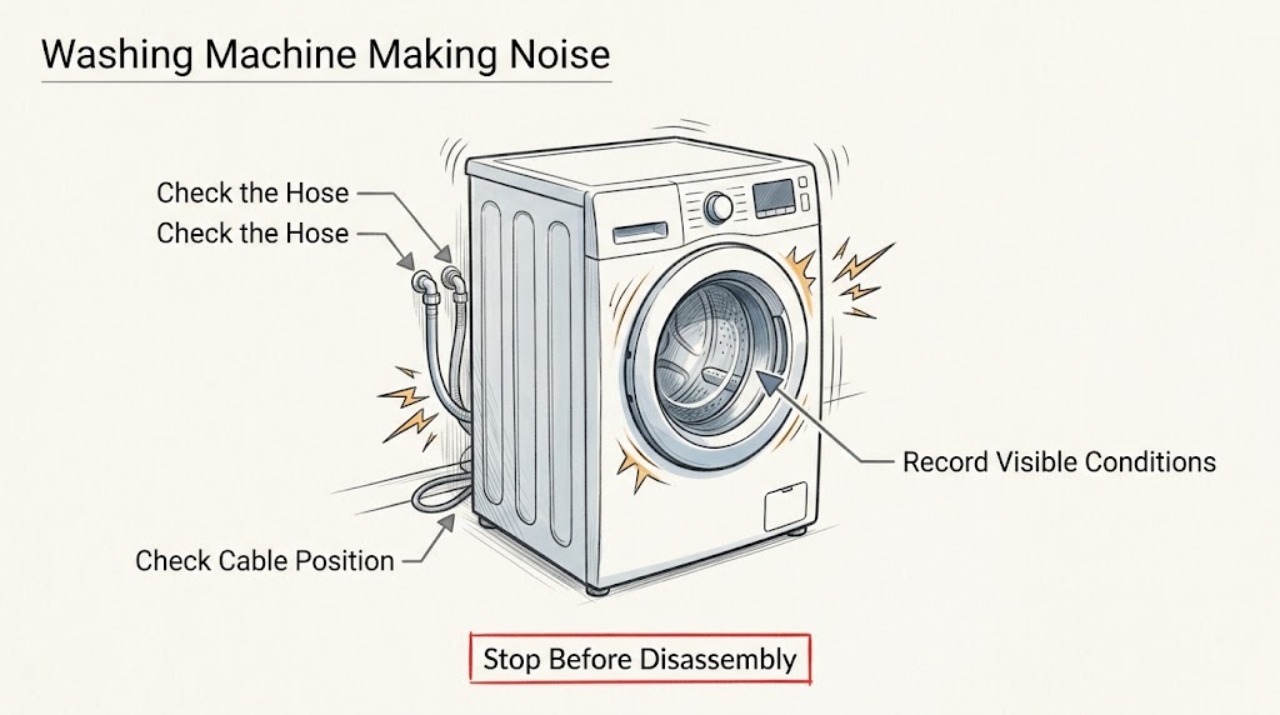
Work through in order
Diagnostic checks
Use only checks that match the exact appliance or system and its official guide.
-
Check 1
Record the complete LG model number, front-load or top-load design, exact sound description, location, cycle stage, load type, display or error, and whether the washer moves or leaks.
Expected result: The sound begins during fill, wash or agitation, drain, spin, or after the cycle; it is a hum, click, splash, rattle, pound, scrape, or repeated impact.
Next step: Use the matching branch and preserve the observation for service. Pause immediately if movement is violent or water is escaping.
Stop if: Stop using the washer for smoke, burning smell, metal scraping with damage, exposed sharp metal, arcing, a hot or damaged cord, water near electrical parts, or repeated electrical trips.
Why this matters
Why: Timing and location separate normal water-valve or pump sounds from load-balance, installation, foreign-object, hose, or drive symptoms. The model determines which checks are accessible.
-
Check 2
During a safe, supervised fill stage, listen at the rear hose and inlet area without touching moving or wet electrical parts; check whether the hose is loose or striking the cabinet and whether the sound is a brief valve click, hum, splash, or harsh rattle.
Expected result: A brief hum or click occurs only while water enters, the hose shakes against the cabinet, a gurgle accompanies restricted flow, or the sound continues after filling stops.
Next step: If the model guide allows, stop water and isolate power before an external hose or accessible filter check; correct only a loose hose or user-accessible restriction. Keep the washer off for leaks or persistent noise.
Stop if: Do not loosen a wet connection over electrical equipment, operate with a leaking hose, or reach behind the washer while it is running.
Why this matters
Why: LG describes valve operation and a closing click as normal, while pressure, a clogged inlet filter, or a loose hose can change the sound. A sound that continues outside the fill event needs service or installation review.
-
Check 3
During wash or agitation, pause the machine and note whether the sound follows one item, a bulky or waterproof load, an empty drum, or the drum's movement; check the visible tub for a loose coin, wire, or other foreign object only after the drum has stopped.
Expected result: Pounding or rattling changes when laundry is spread out, the sound is present with no laundry, or a foreign object is visibly accessible.
Next step: Reposition a safe load and use the model's pause or cancel sequence. Remove only an easily accessible object without reaching into a moving mechanism; persistent empty-drum noise needs qualified service.
Stop if: Do not pull a sharp wire from a confined area, dismantle the tub, or continue when the drum or cabinet is damaged or leaking.
Why this matters
Why: LG identifies tangled or one-sided laundry, unsuitable load size, shipping material on recently installed machines, and foreign objects as distinct wash or spin noise causes. A noise with an empty drum points away from simple balance.
-
Check 4
With the tub empty and the machine stopped, press opposing top corners diagonally and observe whether the cabinet rocks; if recently installed or moved, check the model instructions for shipping-bolt and packing-material status without forcing the cabinet.
Expected result: The washer rocks on the floor, one side is low, leveling nuts are loose, the tub leans, or shipping hardware remains after installation.
Next step: On a dry, firm floor, adjust only the accessible leveling feet as the model guide directs and secure their nuts. If shipping hardware cannot be removed safely or the machine remains unstable, request service.
Stop if: Do not drag a water-connected machine, loosen supports beyond the model instructions, place unstable improvised objects under it, or run a cycle while it walks.
Why this matters
Why: LG says an unstable or incorrectly leveled machine can vibrate and make noise, and shipping bolts that remain in place can create excessive vibration. A stable machine with a continuing noise needs another branch.
-
Check 5
At the drain stage, identify whether the sound is a smooth brief hum before spin, a loud or grinding pump noise, or a rattle that changes with water level; if the exact model provides an accessible drain filter, read its guide and prepare to control residual water before opening it.
Expected result: The hum occurs while water leaves, foreign material is visible in the accessible filter or tub, the filter area leaks, or the pump noise remains abnormal after the path is clear.
Next step: Only when the machine is stopped, cool, and safely isolated, follow the exact model's residual-water and filter instructions; otherwise leave the filter closed and arrange service. Reassemble before any later use.
Stop if: Do not open a filter into uncontrolled water, work near a wet outlet, reach into the pump, or continue for grinding, leaking, smoke, or electrical symptoms.
Why this matters
Why: LG says a drain-pump hum before spin can be normal, but foreign objects in the drain filter can make it unusually loud. Filter work can release substantial water and creates a floor and electrical hazard if uncontrolled.
-
Check 6
During spin, observe from a safe distance whether the tub is balanced, the load is bunched to one side, the washer rocks, the door or cabinet is struck, or the sound is metallic and independent of the load; do not stand on or restrain the machine.
Expected result: The noise is pounding with a single bulky item, the load redistributes and the sound stops, the washer still walks on a level floor, or scraping and impacts continue with a balanced load.
Next step: Pause and redistribute a safe load once, then use the model's controlled continuation only if there is no leak or damage. If the sound returns or the machine moves, stop and request service.
Stop if: Do not continue a violent spin, hold the cabinet in place, reach through the door, or run another cycle after metal contact, cabinet damage, or leaking.
Why this matters
Why: LG links spin pounding to unbalanced laundry and links ongoing vibration to leveling or installation. Persistent metallic contact, movement, or an empty-drum sound points to a tub, bearing, suspension, drive, or foreign-object diagnosis.
-
Check 7
If the sound remains after the fill, wash, drain, load, and leveling checks, record whether it is present with an empty drum, whether it changes with speed, and whether any code, leak, odor, heat, or electrical event occurred.
Expected result: The noise persists with an empty drum, becomes louder, is metallic or grinding, is accompanied by a code or leak, or disappears after a documented user-level correction.
Next step: Leave the washer off when the sound persists or worsens and give qualified service the model, stage, location, load, and recordings or observations. Keep a written note of any correction that actually changed the noise.
Stop if: Do not remove panels, make live electrical measurements, bypass a lid or door lock, or keep running the machine to reproduce internal damage.
Why this matters
Why: A persistent empty-drum or worsening noise is not explained by load balance alone and may involve the pump, tub, suspension, motor, bearing, control, or another internal part. A resolved normal operating sound does not justify unnecessary part replacement.
Use your observations
Decision map
Find the observation that best matches what you see, then follow the next safe action.
-
PATH 01Next step
What you see
A brief valve hum, closing click, or different rinse-water sound occurs only while water enters and there is no leak.
Do this next
Monitor for a change in volume or a sound that continues after filling; check the hose and accessible filter only as the model guide permits if the sound is harsh or flow is restricted.
Why this path and its safety boundary
Why it matters: The sound may be normal water-valve or dispenser operation.
-
PATH 02Next step
What you see
Water-supply noise includes a loose hose striking the cabinet, gurgling flow, or a leak.
Do this next
Stop water and isolate power safely before an external check; correct only a user-level hose position or accessible filter condition. Use service for a leaking or persistent connection.
Why this path and its safety boundary
Why it matters: Pressure, hose movement, an inlet restriction, or a connection problem may be involved.
-
PATH 03Next step
What you see
Pounding or rattling occurs during wash or spin and changes when the load is evenly spread or reduced.
Do this next
Pause and redistribute the safe load once. If the machine still pounds, walks, or damages the cabinet, stop and request service.
Why this path and its safety boundary
Why it matters: An unbalanced, tangled, bulky, or unsuitable load is likely contributing.
-
PATH 04Next step
What you see
The washer rocks on a firm floor, the tub leans, leveling hardware is loose, or shipping bolts remain after a recent installation.
Do this next
Use the model's leveling and installation instructions; have service handle hardware that cannot be removed safely or a machine that remains unstable.
Why this path and its safety boundary
Why it matters: Installation stability or retained shipping material can create excessive vibration and noise.
-
PATH 05Next step
What you see
A hum occurs while draining before spin, with no grinding, leak, or other warning.
Do this next
If it is unusually loud, follow the exact model's residual-water and accessible-filter guidance only after safely isolating the machine; otherwise request service for persistent abnormal noise.
Why this path and its safety boundary
Why it matters: The drain pump may be making a normal operating sound.
-
PATH 06Next step
What you see
Noise is metallic, grinding, or present with an empty drum, or continues after load and leveling corrections.
Do this next
Keep the washer out of service and arrange qualified LG appliance diagnosis; do not open panels or run more cycles to reproduce it.
Why this path and its safety boundary
Why it matters: A foreign object or internal pump, tub, suspension, bearing, drive, or control fault may remain.
-
PATH 07Next step
What you see
The washer walks violently, leaks, contacts a wall or cabinet, smells burnt, emits smoke, arcs, has a hot or damaged cord, or repeatedly trips protection.
Do this next
Stop the cycle, keep clear of moving parts and water near electrical equipment, isolate power or water only from a safe accessible position, and use qualified or emergency help as appropriate.
Why this path and its safety boundary
Why it matters: There may be an immediate mechanical, water, fire, or electrical hazard.
Helpful context
Understand the symptom
The cycle stage is the fastest clue
Listen for the first moment the noise starts and note its location. A hum or click while water enters points toward the inlet valve, hose movement, pressure, or a filter; a brief pump hum before spin can be normal. Pounding during spin more often follows a tangled or uneven load, a rocking floor, or installation hardware. A metallic scrape that remains with the drum empty is a service symptom rather than a load adjustment.
Separate normal operating sounds from a worsening fault
LG documents several sounds that can occur during ordinary operation, but a change in volume, new metal-on-metal contact, repeated impacts, movement across the floor, or a sound that persists after the load and accessible checks are corrected changes the decision. Use the exact model guide because front-load and top-load machines do not expose the same checks.
Pause before a noise becomes a safety event
Pause or cancel if the washer is walking, striking surrounding objects, or leaking. Do not reach into a moving drum, remove panels, or open a drain filter when water could contact electrical parts or flood the floor. Smoke, a burning smell, arcing, a hot or damaged cord, or repeated breaker trips requires the washer to remain out of service and qualified help.
Only after diagnosis
Potential parts
- washer drain pump or filter assembly
Consider this only if qualified diagnosis links persistent drain-stage noise or restricted drainage to the pump or filter assembly after safe accessible checks.
Confirm the complete model and manage residual water safely; do not order from a hum alone. - washer suspension or leveling component
Consider this only when persistent spin movement remains after correct load distribution, stable flooring, and model-approved leveling checks.
Front-load and top-load designs differ; confirm the complete model and use qualified diagnosis for internal suspension work. - washer motor, bearing, or drive component
Consider this only after qualified service confirms metallic or empty-drum noise is caused by a particular drive, bearing, or motor component.
Do not infer fitment or failure from sound alone; confirm the exact model and professional diagnosis.
When checks do not resolve it
Need a professional?
Arrange qualified LG appliance service when noise persists with an empty drum, remains after load and leveling corrections, comes from the pump or drive, causes the washer to walk, or is accompanied by a code, leak, or damaged cabinet. Provide the complete model, front-load or top-load design, cycle stage, sound and location, load, recent installation or move, and any water, odor, heat, or electrical observations. Use qualified electrical service for a suspect outlet or cord.
Common questions
FAQ
Is a humming sound from an LG washer normal?
It can be normal when the inlet valve operates during filling or the drain pump removes water before spin. A new, harsh, grinding, or persistent hum, especially with a leak or code, needs a different diagnosis.
Why does my LG washer bang during spin?
An uneven or tangled load, bulky items, an unstable floor, poor leveling, or retained shipping hardware can cause pounding and vibration. Pause safely, redistribute the load once, and stop if the washer still walks or strikes the cabinet.
Why is my LG washer clicking while it fills?
A valve closing click can be normal, while a hose that shakes against the cabinet or gurgling flow can reflect pressure, a loose hose, or an inlet restriction. Keep water and electricity safe before any accessible hose or filter check.
Can I clean the LG washer drain filter to stop the noise?
Only if the exact model provides an accessible filter and its instructions are followed with the washer stopped and safely isolated. LG warns that substantial residual water can spill, so use the model's drain hose or a container; persistent loud or grinding noise needs service.
When should an LG washer noise be treated as urgent?
Stop for violent movement, metal scraping with damage, leaking water near electrical parts, smoke, burning smell, arcing, a hot cord or outlet, or repeated electrical trips. Do not run another cycle to reproduce the symptom.
Read the exact guide
Official sources
- LG top load washing machine - A noise is heard during water supply.LG Electronics · LG top-load washer water-valve, pressure, hose, inlet-filter, and dispenser sounds
- LG Washer - Troubleshooting Clacking Noise When the Washing Machine is FillingLG Electronics · LG washer fill-hose movement and water-pressure noise
- [LG Front load washing machine installation] How can I do a level installation and adjust the level of the machine?LG Electronics · LG washer stable-floor installation and leveling-leg checks
- [LG Front load washing machine sound] There is a humming noise during spinningLG Electronics · LG washer drain-pump hum, foreign objects, drain filter, and residual-water safety
- LG Washer - Troubleshooting Noises During the CycleLG Electronics · LG washer noise diagnosis by wash or spin stage, load, foreign object, and model type
- LG Washer – Troubleshooting Vibration Issues on an LG Washing MachineLG Electronics · LG washer shipping bolts, load distribution, leveling, vibration, and service guidance
Community feedback
Share a repair observation
Share a plain-text repair observation. Accepted observations are published automatically; this page may take a moment to update.