
On this page
Start here
Quick answer
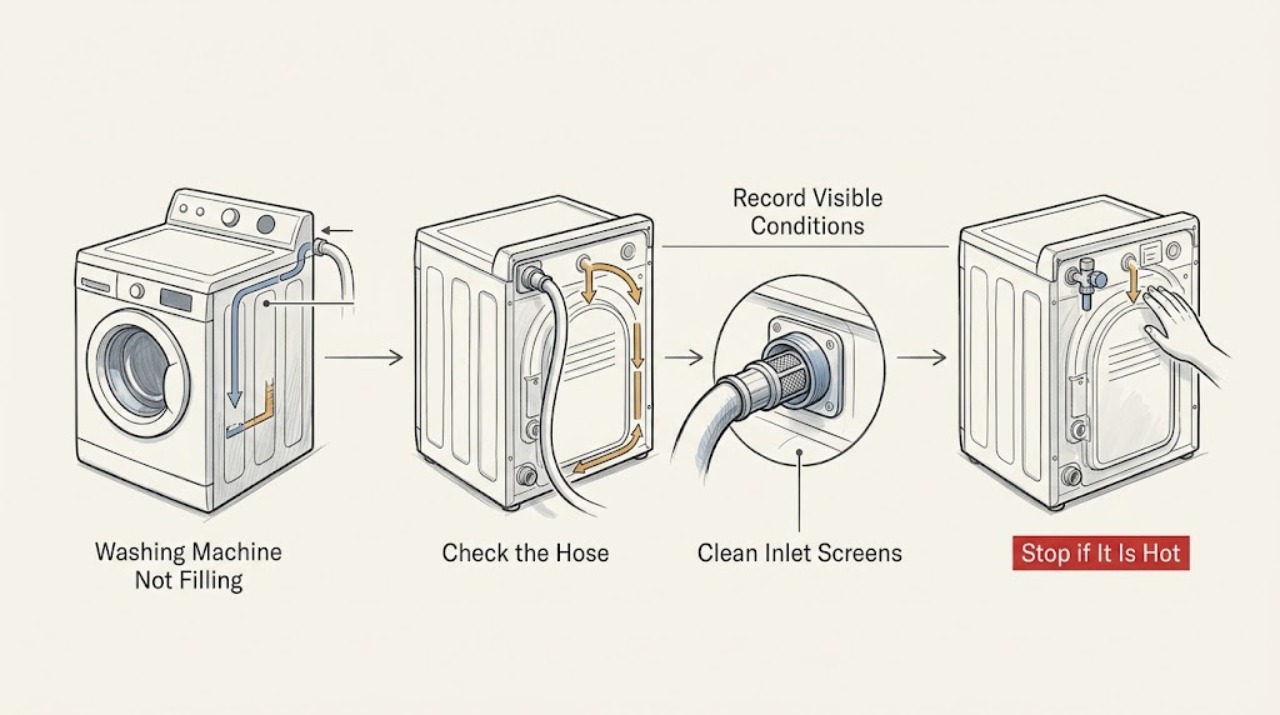
An LG washing machine that does not fill may have closed or weak supply valves, crossed or kinked hot and cold hoses, blocked inlet screens, a frozen supply, a door or lid that is not latched, or a drain hose installed so low or deep that incoming water siphons away. If the display shows IE, record the exact code and model first; LG describes IE as an inlet error when the tub does not reach an adequate level in the allowed time, but codes vary by model. Check only the external, dry, model-appropriate items: confirm the taps and hoses, clean an accessible inlet screen with the power disconnected, and inspect the drain-hose routing. If water leaks, reaches electrical parts, or there is a burning smell, smoke, spark, abnormal heat, or a repeated trip, stop. If the external checks do not restore filling, leave the cabinet closed and arrange qualified LG appliance service.
Work through in order
Diagnostic checks
Use only checks that match the exact appliance or system and its official guide.
-
Check 1
Before changing anything, photograph or write down the full display code exactly as shown, the model number, whether the washer is front-load or top-load, the selected cycle and temperature, and whether the door or lid latches. Press Start once under normal conditions and observe the initial sequence without adding water or opening the cabinet.
Expected result: Classify the symptom as a short top-load sensing delay, a completely dry tub, a weak trickle, water that enters and immediately leaves, or a code such as IE, dE, dL, PE, FE, OE, PF, or another model-specific display. Record whether the drum or wash plate moves, clicks, hums, or remains silent.
Next step: Use the recorded model and exact code to select the matching LG guide, then proceed only with the external check that fits the observed branch. If the panel is blank, wet, damaged, or shows a safety-related electrical symptom, stop instead of starting another cycle.
Stop if: Stop for smoke, burning or hot odor, sparks, shock, abnormal heat, a wet plug or outlet, visible arcing, or a repeated breaker trip.
Why this matters
Why: LG says notification codes vary by model and identifies IE as an inlet error, while some top-load models weigh the load before filling. A different code may point to door, pressure, overfill, outlet, freeze, or power behavior rather than a simple closed tap.
-
Check 2
With the washer idle, inspect the wall taps, both inlet hoses where fitted, and the space behind the machine. Confirm each applicable tap is fully open, the hot hose is on the hot connection and the cold hose is on the cold connection, the hose ends are secure, and neither hose is kinked, crushed, bulging, split, or leaking. Do not force a stuck tap or fitting.
Expected result: Determine whether both supplies are available, one supply is weak or absent, a hose is bent or damaged, the connections are reversed, or water is present around a fitting. In freezing weather, note whether a tap or hose remains blocked after the area has safely warmed.
Next step: Open an accessible tap fully and gently restore a smooth hose path only when dry and safe. Replace a damaged hose through an exact model-compatible route or obtain service; do not continue if water sprays, the valve will not close, or the supply remains unavailable.
Stop if: Stop immediately for a split or bulging hose, continuous leak, uncontrolled water flow, flooding, hot-water hazard, or water near the cord, plug, outlet, or other electrical part.
Why this matters
Why: A closed or partially open tap, a kinked hose, incorrect hot/cold connection, low supply, or frozen line can restrict filling or trigger IE. A damaged hose or leak is a water-safety problem, not a reason to run another cycle.
-
Check 3
If the taps and hoses are sound, close the applicable water taps, disconnect the washer from power from a dry position, place a towel or container below the hose ends, and remove only the inlet hose connection and screen that the model's LG guide identifies as user-accessible. Use a soft toothbrush and running water to remove visible rust, sand, scale, or grit; do not push debris into the valve, enlarge the mesh, or use force.
Expected result: Classify the screen as visibly restricted, clean, damaged, missing, or inaccessible without cabinet removal. Check the hose washer and connection for damage or seepage without disturbing sealed internal parts.
Next step: Rinse and reinstall the screen and hose only as the exact model instructions direct, reopen the tap slowly, check for leaks, and perform one controlled test. If the filter is damaged or filling still fails, keep power disconnected and request service.
Stop if: Stop for a damaged or missing screen, stripped fitting, water that cannot be contained, wet electrical areas, or any need to open the cabinet or perform live electrical testing.
Why this matters
Why: LG states that sediment or foreign material can clog inlet filters and slow or stop filling. A clean screen with a dry, sound connection makes an internal inlet valve, sensing, interlock, wiring, or control issue more likely; it does not justify replacing a part by guesswork.
-
Check 4
Inspect the visible drain hose routing without removing the cabinet or damaging the hose. Confirm the rear retaining arrangement is present where the model uses one, the hose is not deeply inserted into the drainpipe, its end is not submerged, and the hose is secured without a low loop, blockage, puncture, or disconnection.
Expected result: When the washer attempts to fill, observe whether water enters and immediately runs away, whether the drain hose end sits under standing water, or whether the hose is inserted deeper than the model allows. If no water enters at all, record that the siphon branch was not observed.
Next step: Restore only the routing and securing method shown for the exact model and run one supervised test. If water still leaves immediately, the drain installation is damaged, or the standpipe backs up, stop and arrange qualified appliance or plumbing service.
Stop if: Stop for backflow, flooding, a detached or split drain hose, standing water near electrical parts, or any need to cut, drill, or permanently modify the drain installation.
Why this matters
Why: LG explains that deep insertion or a submerged drain-hose end can create siphoning, allowing incoming water to drain away and producing an IE condition even when supply is present. A leak, blocked drain, or damaged hose is a separate service or plumbing issue.
-
Check 5
Check the visible door or lid closure, cycle selection, delay or lock indicator, and any applicable hot-water or cold-weather condition. Close the door or lid normally, cancel an unintended delay or control-lock state only with the exact model procedure, and do not add water manually. If a supply was frozen, warm the tap or disconnected hose only by the safe method in the LG guide; never pour boiling water onto the appliance.
Expected result: Note whether the latch engages, an IE/dE/dL/FE/PE/PF or other code returns, the panel responds to the correct controls, the hot or cold supply is absent, or the washer remains dry after the normal start sequence.
Next step: Record the stage and code and consult the model manual. If all external conditions are normal but no water enters, stop user troubleshooting and provide those observations to qualified LG appliance service.
Stop if: Stop for an interlock that will not latch, a door or lid that is damaged, steam or scalding water, leaking connections, burning odor, smoke, sparks, abnormal heat, or electrical trips.
Why this matters
Why: A door/lid or control state can inhibit filling, while a cold-water or hot-water supply condition can mimic an appliance fault. Error meanings and lock controls are model-dependent; a recurring code after external checks points toward service rather than repeated resets.
-
Check 6
After the applicable external correction is complete, make sure the area is dry, the hoses are secure, the door or lid is closed, and the control is in the intended cycle. Perform one normal power reset using the model's documented controls, then run one short supervised fill or rinse test; do not repeatedly cycle power or reset a breaker.
Expected result: Record whether water enters at a normal rate, enters and then siphons away, remains absent with an IE or another code, leaks at a connection, or is accompanied by an electrical or heat warning.
Next step: Stop testing after this one controlled attempt and arrange service if the tub remains dry, a code returns, a leak appears, or the washer behaves abnormally. Give the technician the model, code, cycle, supply observations, and the result of each check.
Stop if: Stop immediately for smoke, burning or hot odor, sparks, shock, abnormal heat, uncontrolled filling, water near electricity, violent movement, or a repeated breaker trip.
Why this matters
Why: A successful single test after an external correction supports a supply, routing, or temporary control-state explanation. A recurring no-fill symptom with sound supply and clean screens is more consistent with an inlet valve, pressure sensing, door/lid interlock, wiring, or control fault that needs diagnosis.
Use your observations
Decision map
Find the observation that best matches what you see, then follow the next safe action.
-
PATH 01Next step
What you see
The washer is a top-load model and briefly senses or rotates after Start before any water enters, then begins filling normally.
Do this next
Allow the documented start sequence to finish and monitor one cycle; do not interrupt it or add water.
Why this path and its safety boundary
Why it matters: The initial delay may be the model's load-sensing sequence rather than a no-fill failure.
-
PATH 02Next step
What you see
IE appears, a tap is closed or weak, a hose is kinked or frozen, or an inlet screen is visibly restricted.
Do this next
Correct only the accessible supply condition using the model-appropriate safe procedure, then perform one supervised test; service the appliance if IE returns.
Why this path and its safety boundary
Why it matters: The observed condition matches LG's external water-supply causes for an inlet error.
-
PATH 03Next step
What you see
Water enters but immediately drains, or the drain hose is deeply inserted, submerged, low, loose, or missing its model-required securing arrangement.
Do this next
Restore the exact model's drain routing and secure the hose; request appliance or plumbing service if water still leaves or the drain backs up.
Why this path and its safety boundary
Why it matters: Siphoning or incorrect drain installation can make the tub fail to retain its fill.
-
PATH 04Next step
What you see
The door or lid does not latch, a lock-related code remains, or the panel shows another model-specific error.
Do this next
Remove only an obvious external obstruction, record the exact code and model, and use the matching LG guide. Do not bypass the interlock or open the cabinet.
Why this path and its safety boundary
Why it matters: The control may intentionally withhold water or be reporting a different subsystem; IE assumptions do not apply automatically.
-
PATH 05Next step
What you see
Taps, hoses, screens, drain routing, closure and settings are normal, but the washer remains empty or the code returns after one test.
Do this next
Leave the cabinet closed and arrange qualified LG appliance service with the model, code, cycle stage, and recorded observations.
Why this path and its safety boundary
Why it matters: An internal inlet valve, pressure-sensing, interlock, wiring, or control problem is more likely than a user-correctable supply restriction.
Helpful context
Understand the symptom
First separate delayed sensing from a true no-fill fault
Some LG top-load models briefly rotate or weigh the load after Start before opening the water valves. LG says this sensing period can last about 40 seconds on newer models, so a short delay is not proof of a failed inlet. Watch whether the washer begins filling after that normal start sequence. If the display shows IE, the tub stays dry after the sequence, or water enters only as a weak trickle, continue with the checks below and keep the exact model and code recorded. Do not apply a top-load timing expectation to a different model without checking its manual.
The water supply and the drain route both affect filling
A washer can appear not to fill when a tap is closed, a hose is pinched behind the cabinet, or sediment restricts the inlet screen. Conversely, LG explains that a drain hose installed too deeply or with its end submerged can create siphoning, so water leaves while the tub is trying to fill and an IE condition can result. Use the exact model installation guidance for hose routing; do not pull the drain hose out until it is unsecured and safe to handle, and do not create a new leak by forcing a connection.
Do not bypass a door or lid interlock
The control may withhold water when a front door or top lid is open, obstructed, or not locked. Inspect the visible seal or latch area for an item caught outside the closure and close it normally. Do not hold the switch closed, defeat the lock, remove the cabinet, or test live wiring. If the appliance remains empty with the closure correctly shut, note whether the panel shows dE, dL, or another code and use the model-specific support material or service path.
Only after diagnosis
Potential parts
- water inlet valve
Consider this only after the correct taps, hoses, accessible screens, drain routing, closure and one controlled test are normal and the washer still does not admit water.
Confirm the complete LG model and revision with the manufacturer's fit information; do not substitute a valve based only on appearance or an IE code. - inlet hose and sealing washer
Consider this only if inspection finds a split, bulge, crushed section, damaged thread, or persistent seepage at the hose connection.
Match the hose and seal to the exact connection and installation requirements; a hose replacement does not repair an internal valve or control fault. - door or lid interlock
Consider this only when the exact model reports a closure or lock condition, the closure cannot latch normally, and external obstruction checks are clear.
Use the exact LG model and do not bypass or fit an unverified lock assembly.
Common questions
FAQ
Why does my LG washer show IE but the taps are open?
IE means the washer did not reach its required water level in the expected time, but an open tap alone does not prove that the flow path is clear. Check for a kinked or crossed hose, a clogged inlet screen, freezing, low supply, and drain-hose siphoning. Record the model and exact code; if the external checks are normal and IE returns after one test, arrange service.
Why does my LG top-load washer wait before adding water?
Some LG top-load models rotate briefly to sense the load before filling. LG describes about 40 seconds for newer models with this weighing sequence. Watch for normal filling after the sequence; use the exact model guide if the tub remains dry or a code appears.
Can a drain hose cause an LG washer not to fill?
Yes. If the drain hose is inserted too deeply or its end is submerged, siphoning can let water leave as the washer fills. Restore only the routing shown for the exact model and secure the hose; do not cut, drill, or force a damaged installation.
Should I replace the LG inlet valve first?
Not from an IE code alone. A closed or weak tap, kinked hose, blocked screen, frozen line, drain siphoning, closure condition, sensing issue, wiring or control fault can look similar. A valve should be considered only after the external checks and one controlled test, with fit confirmed for the exact model.
When should I stop troubleshooting an LG washer that will not fill?
Stop for a leak or flooding, water near electrical parts, a damaged hose, an interlock that will not latch, burning or hot smell, smoke, spark, shock, abnormal heat, or a repeated breaker trip. Isolate water and power only from a safe, dry position and arrange qualified help. If the external checks are normal but the tub remains dry, leave the cabinet closed and request appliance service.
Read the exact guide
Official sources
- LG Washer - Why is There No Water in My Front Load Washing Machine?LG USA Support · LG front-load washers; the page notes the guide is general and images may differ by product.
- [LG front load washing machine] The IE (No Water Supply) error is displayed.LG USA Support · LG front-load washers; apply hose and drain-routing details only when they match the model installation.
- LG top load washing machine - water supply] Water is not immediately supplied though I pressed the Start button.LG USA Support · LG top-load models with the described load-sensing sequence; not a universal timing rule for every LG washer.
- LG Washer - Troubleshooting Fills Too Slow / Does Not FillLG USA Support · General LG washer troubleshooting; exact procedures and code meanings remain model-specific.
- [LG Top Load Washer] Error Code ListLG USA Support · LG top-load washer code list; use the exact model manual for a definitive code interpretation.
- LG Top Load Washer - Troubleshooting an IE Error CodeLG USA Support · LG top-load washers; code behavior and controls can differ by model.
Community feedback
Share a repair observation
Share a plain-text repair observation. Accepted observations are published automatically; this page may take a moment to update.