
On this page
Start here
Quick answer
Many Maytag oven sounds are part of normal operation: a cooling fan can hum during and after a cycle, a convection fan can cycle during preheat or other functions, heating metal can pop or crack as it expands and cools, and a gas valve or igniter can make an occasional pop or brief clicking while ignition is established. The sound is not normal when it is accompanied by a gas odor, delayed ignition, an abnormal flame, smoke, arcing, burning smell, overheating, a repeated breaker trip, scraping, grinding, loud impact, or a noise that continues with all controls Off. Stop using the oven for those symptoms, leave a gas or fire hazard from a safe location, and arrange qualified service. Otherwise identify the sound, timing, and oven type, then make only the cool, accessible checks below.
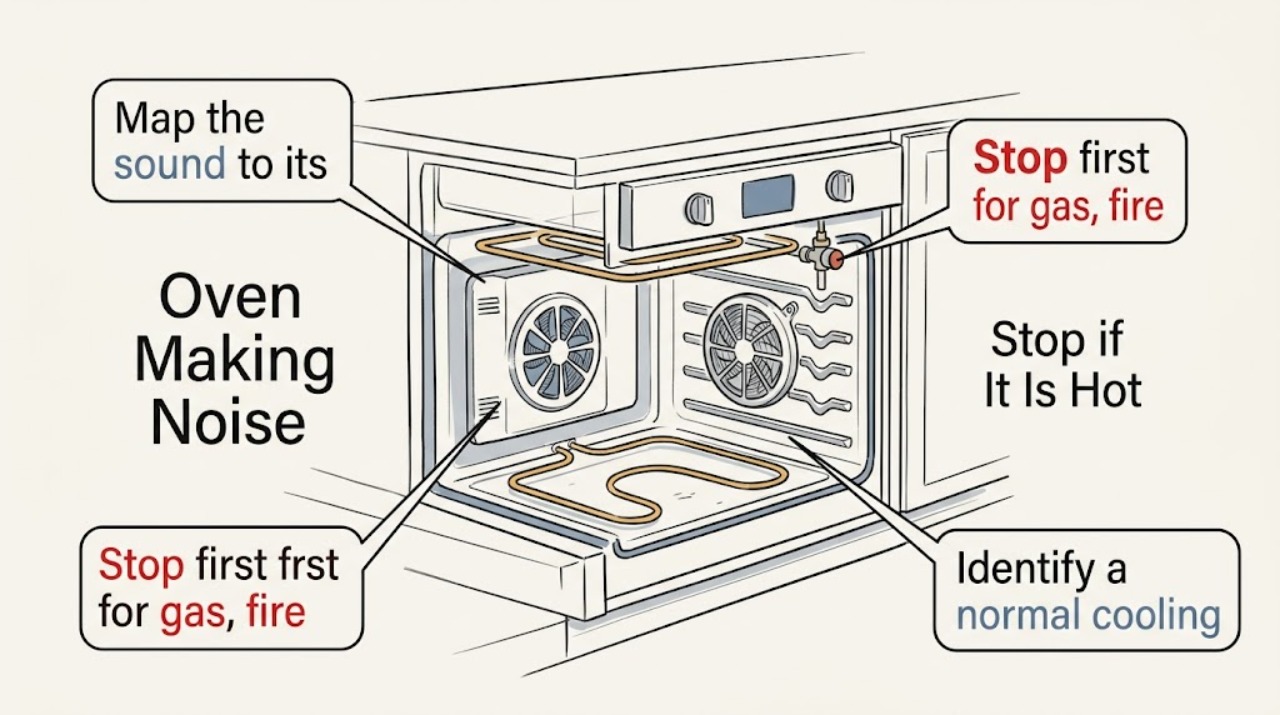
Work through in order
Diagnostic checks
Use only checks that match the exact appliance or system and its official guide.
-
Stop first for gas, fire, or electrical warning signs
Before investigating the sound, ask whether there is a raw-gas or rotten-egg odor, hissing, delayed ignition, an abnormal or yellow flame, smoke, fire, visible arcing, a hot control, a burning electrical smell, or a breaker that trips again. Do not light the oven, operate electrical switches, or use a phone inside for a gas concern; leave and contact the gas supplier or fire department from a safe location.
Expected result: A warning sign is present, or the sound occurs without gas odor, smoke, flame, arcing, overheating, damage, or repeated electrical trips.
Next step: For gas, fire, smoke, carbon-monoxide, or electrical danger, stop troubleshooting and obtain emergency or qualified help from a safe location. If no warning sign exists, continue with sound classification.
Stop if: Stop immediately for gas odor, hissing, delayed ignition, abnormal flame, smoke, fire, arcing, burning smell, or repeated breaker trips.
Why this matters
Why: A noise with a combustion or electrical hazard is not a normal operating sound and must not be reproduced as a test.
-
Map the sound to its timing and location
With the oven Off and safe to approach, note whether the noise comes from inside the cavity, behind the control panel, below the cavity, from the rear, or from the surrounding cabinet. Record whether it occurs at startup, while preheating, when Bake or Broil cycles, during convection, when gas ignites, or after shutdown. Do not restart a hazardous oven just to make a recording.
Expected result: The sound repeats at a specific operating stage or continues after the cycle, or it is intermittent and cannot be localized safely.
Next step: Compare the observation with the fan, thermal, gas-ignition, and mechanical branches below. If the location is uncertain or the sound is worsening, keep the oven off and arrange service.
Why this matters
Why: Timing separates fan movement, ignition, thermal expansion, and a loose or failing mechanical or electrical component more reliably than the sound label alone.
-
Identify a normal cooling or convection fan
If the sound is a steady hum or moving-air sound, check whether it begins while the oven is hot, runs during a cycle, cycles during convection or preheat, and continues for a while after the controls are Off. Keep the vent openings clear and do not reach into them.
Expected result: The sound follows heating or convection use, changes as the oven cools, and has no scraping, grinding, burning odor, smoke, or visible damage.
Next step: Treat this as expected fan operation and follow the exact model manual. If the fan becomes harsh, intermittent with grinding, fails to move air, produces a burning smell, or runs with a cold oven and no explained cycle, stop and request service.
Stop if: Stop for scraping, grinding, exposed or damaged fan parts, smoke, burning odor, overheating, or a fan-related noise that is worsening.
Why this matters
Why: Maytag says an automatic cooling fan can run during and after a cycle, and a convection fan can operate or cycle during preheat and other cooking functions.
-
Classify a pop or crack during heating and cooling
After the oven is cool, note whether the sound is an occasional pop or crack that occurs as porcelain, steel, or an electric element heats or cools. If the model has a removable oven bottom, inspect only its visible seating when cool and follow the manual; do not force, bend, or remove a hot panel.
Expected result: The pop or crack is occasional, follows heating or cooling, and there is no gas odor, smoke, flame outside the burner, damage, or loss of heating.
Next step: Allow the oven to cool and use the model manual's seating guidance if it specifically covers the visible panel. If the sound becomes a bang, repeated impact, scraping, or is paired with a combustion or electrical symptom, keep the oven off and arrange service.
Stop if: Stop for a loud bang, panel deformation, loose or damaged element, gas odor, smoke, fire, arcing, or any need to disassemble the oven.
Why this matters
Why: Maytag identifies thermal expansion or contraction and, on some models, a removable oven-bottom panel that is not seated correctly as possible sources of a pop.
-
Separate normal gas ignition sounds from abnormal ignition
For a Maytag gas oven, note whether a brief click occurs only while the igniter is establishing a visible normal flame, or whether a single pop or whoosh accompanies an established Bake or Broil flame. Do not stare into the burner area, relight repeatedly, or open any gas fitting.
Expected result: The click stops after ignition or the occasional whoosh/pop follows normal heating, with no gas odor, delayed ignition, flare, soot, or abnormal flame; or clicking continues, ignition is delayed, or combustion looks abnormal.
Next step: For normal, brief ignition sounds, use the exact model manual and do not alter the gas path. For continued clicking, delayed ignition, a bang, flare, soot, yellow flame, or any gas odor, stop using the oven and arrange qualified gas service or emergency help as appropriate.
Stop if: Stop for gas odor, hissing, delayed ignition, loud bang, flame outside the intended burner area, yellow or unstable flame, soot, smoke, or continuous ignition clicking.
Why this matters
Why: Maytag describes brief igniter clicking, a gas-valve pop, and a whoosh when gas ignites as possible normal sounds. Continued clicking or delayed or abnormal combustion changes the service decision.
-
Check only the cool, accessible surroundings
When the oven is fully cool and no hazard is present, remove loose cookware, racks, or items stored on top or beside the range that could vibrate. Look for a rack or removable panel visibly touching the cavity, and check that the appliance is not contacting a cabinet or wall. Do not move a connected or hard-piped range and do not open the cabinet or control area.
Expected result: The sound disappears after a loose rack or external contact is corrected, or it continues with the surroundings clear.
Next step: If the sound stops, follow the model's rack and installation instructions. If it continues, worsens, or requires appliance movement or panel access, keep the oven off and request qualified service.
Stop if: Do not operate with a loose, damaged, or exposed component; do not force racks, remove internal covers, or move a hard-piped appliance.
Why this matters
Why: A loose removable item or cabinet contact can transmit vibration, while a persistent internal sound points to a fan, element, motor, valve, mounting, or control issue that needs model-specific diagnosis.
-
Use the model manual before any reset
If the sound is accompanied by an error display or an abnormal control state, photograph or write down the complete code and model number. Only after the oven is cool and there is no gas, smoke, fire, arcing, or burning odor, follow the exact manual's single documented reset or recovery step; do not use repeated resets to mask a noise.
Expected result: The code clears and the sound does not return during normal operation, or the code, noise, or safety symptom returns.
Next step: For a returning code or noise, leave the oven out of service and provide the model and code to qualified service. Do not bypass interlocks or test live electrical parts.
Stop if: Do not reset during an active gas, smoke, fire, arcing, overheating, or electrical hazard; do not open the control panel.
Why this matters
Why: A reset can recover a control state but cannot prove that a fan, ignition system, gas valve, heating element, or wiring is safe.
-
Prepare a service handoff for an unresolved noise
Keep the oven out of service when the sound is scraping, grinding, sustained buzzing, a loud impact, or unexplained. Give the technician the model number, gas or electric configuration, sound description, location, cycle and stage, whether a fan or flame was present, any odor or smoke, error code, recent installation, and what stopped or changed the noise. Do not open panels or replace a part based on sound alone.
Expected result: The noise persists, recurs, changes character, affects heating or ignition, or cannot be identified without operating the appliance.
Next step: Request qualified Maytag appliance service. Use gas or fire emergency help instead for an active gas odor, smoke, fire, carbon-monoxide concern, or electrical hazard.
Stop if: Do not bypass safety devices, move a hard-piped range, open gas connections, perform live electrical tests, or keep operating a noisy oven with a hazard sign.
Why this matters
Why: The same noise can originate from different model-specific parts; safe diagnosis may involve the fan, motor, heating element, gas valve, igniter, mounting, or control system.
Use your observations
Decision map
Find the observation that best matches what you see, then follow the next safe action.
-
PATH 01Next step
What you see
The noise is accompanied by gas odor, hissing, delayed ignition, abnormal flame, smoke, fire, arcing, burning odor, overheating, or repeated breaker trips.
Do this next
Stop immediately. For suspected gas, do not ignite or operate switches and leave before contacting gas or emergency help from a safe location; for smoke, fire, or electrical danger, leave as appropriate and request emergency or qualified service.
-
PATH 02Next step
What you see
A steady hum or airflow sound occurs during or after heating and changes as the oven cools, without scraping or a safety symptom.
Do this next
Treat it as likely cooling-fan operation and follow the model manual; service it if the sound becomes harsh, grinding, or unexplained while cold.
-
PATH 03Next step
What you see
A convection fan cycles during preheat or another cooking function without damage, odor, smoke, or abnormal heating.
Do this next
Treat it as a feature-dependent normal sound and follow the exact model manual.
-
PATH 04Next step
What you see
An occasional pop or crack follows heating or cooling and there is no hazard or loss of function.
Do this next
Allow the oven to cool and check only visible removable items or panels according to the model manual; service a loud, repeated, or damaging impact.
-
PATH 05Next step
What you see
A gas-oven click, valve pop, or whoosh is brief and occurs with normal ignition and flame, without gas odor or delayed combustion.
Do this next
Do not alter the gas system; follow the model manual and stop if the sound continues, grows louder, or changes to a bang, flare, or abnormal flame.
-
PATH 06Next step
What you see
The noise is scraping, grinding, sustained buzzing, loud impact, worsening, or remains after cool accessible items and external contact are ruled out.
Do this next
Keep the oven out of service and arrange qualified Maytag appliance service with the model and sound timeline.
Helpful context
Understand the symptom
The same word—click, hum, pop, or buzz—can describe different mechanisms. First note whether the sound occurs at startup, during heating, when a fan cycles, when gas ignites, during convection, or after the oven is turned off. Use the exact Maytag model manual for the installed fuel and feature set; a sound that changes into a safety symptom is not a normal-sound diagnosis.
Do not remove panels, reach into a burner or fan opening, move a hard-piped range, or keep relighting a gas oven to reproduce a noise. A normal fan or thermal sound should not be accompanied by gas odor, uncontrolled combustion, smoke, sparks, or a burning electrical smell.
When checks do not resolve it
Need a professional?
Request qualified Maytag appliance service for scraping, grinding, sustained or worsening noise, a noise that affects heating or ignition, a repeated error, a sound that remains after safe accessible checks, or any uncertainty that would require panel or gas-path access. For gas odor, hissing, delayed ignition, abnormal flame, smoke, fire, carbon-monoxide concern, arcing, burning odor, overheating, or repeated breaker trips, stop use and contact appropriate gas, emergency, or qualified service help from a safe location.
Common questions
FAQ
Is a humming sound from a Maytag oven normal?
Often. Maytag says an automatic cooling fan can hum during and after a cycle, and a convection fan can operate or cycle during preheat and other functions. Stop and request service if the hum becomes grinding, is accompanied by burning odor or smoke, or occurs with another hazard.
Why does my Maytag oven pop or crack?
Heating and cooling porcelain, steel, or an electric element can make an occasional pop or crack. Some models can also sound like this if a removable oven bottom is not seated correctly. A loud bang, repeated impact, damage, gas odor, smoke, or abnormal flame is not a normal-sound branch.
Is clicking from a Maytag gas oven normal?
Brief igniter clicking while a flame is being established can be normal, and Maytag also describes an occasional gas-valve pop or ignition whoosh. Continued clicking, delayed ignition, a bang, flare, yellow flame, soot, smoke, or gas odor requires stopping use and qualified help.
What should I do about a scraping or grinding noise?
Turn the oven off and let it cool. Remove only loose, accessible cookware or racks and check for visible external contact without moving a connected range or opening panels. If the sound persists, worsens, or is accompanied by heat, smoke, or a burning smell, keep the oven out of service and arrange qualified repair.
When is a Maytag oven noise an emergency?
Treat gas odor, hissing, delayed ignition, abnormal flame, smoke, fire, carbon-monoxide symptoms, visible arcing, burning electrical odor, overheating, or repeated breaker trips as stop-use conditions. Leave when appropriate and contact gas, emergency, or qualified service help from a safe location.
Read the exact guide
Official sources
- How to Check the Gas Regulator Shut-Off Valve on an OvenMaytag Product Help · Official Maytag installation support; not a user procedure for locating or testing a gas leak.
- Whoosh or Poof Noise in Oven - RangeMaytag Product Help · Official Maytag gas-range guidance for a whoosh when gas ignites; an abnormal or delayed event remains a stop-use condition.
- Popping or Cracking Noise in Oven - Wall OvenMaytag Product Help · Official Maytag wall-oven guidance used for the equivalent thermal-noise mechanism; the installed model manual controls.
- Odors or Smells - RangeMaytag Product Help · Official Maytag range guidance used for smoke or odor boundaries; it does not clear an active gas or electrical hazard.
- Click or Clicking Noise in Oven - RangeMaytag Product Help · Official Maytag gas-range guidance; exact model ignition behavior and safety instructions control.
- GAS RANGE Use & Care GuideMaytag · Official Maytag gas-range owner manual for the documented manual family; the exact installed model manual controls.
- Understanding Fan or Humming Noise in OvenMaytag Product Help · Official Maytag guidance for fan or humming sounds; exact model features determine whether a convection fan is present.
- Pop or Popping Noise in Oven - RangeMaytag Product Help · Official Maytag range guidance for occasional popping; gas and electric model features vary.
- Odors or SmellsMaytag Product Help · Official Maytag gas-cooking guidance applied when an oven noise could indicate a gas event.
- Fan Noise - Non Convection - RangeMaytag Product Help · Official Maytag non-convection range guidance; exact model manual controls feature and installation details.
Community feedback
Share a repair observation
Share a plain-text repair observation. Accepted observations are published automatically; this page may take a moment to update.