
On this page
Start here
Quick answer
A Miele dishwasher that is not heating may have a technical heating fault, a circulation problem, or a program result that needs more context. Record whether water and dishes stay cold, whether drying is also affected, and whether an F-code appears. Miele identifies F1 sensor and F24 heating-relay faults as technical faults that require service; do not open the appliance or test live heating parts.
Before you begin
Safety first
- Do not probe live wiring, remove panels, bypass safety controls, or handle hot water while testing.
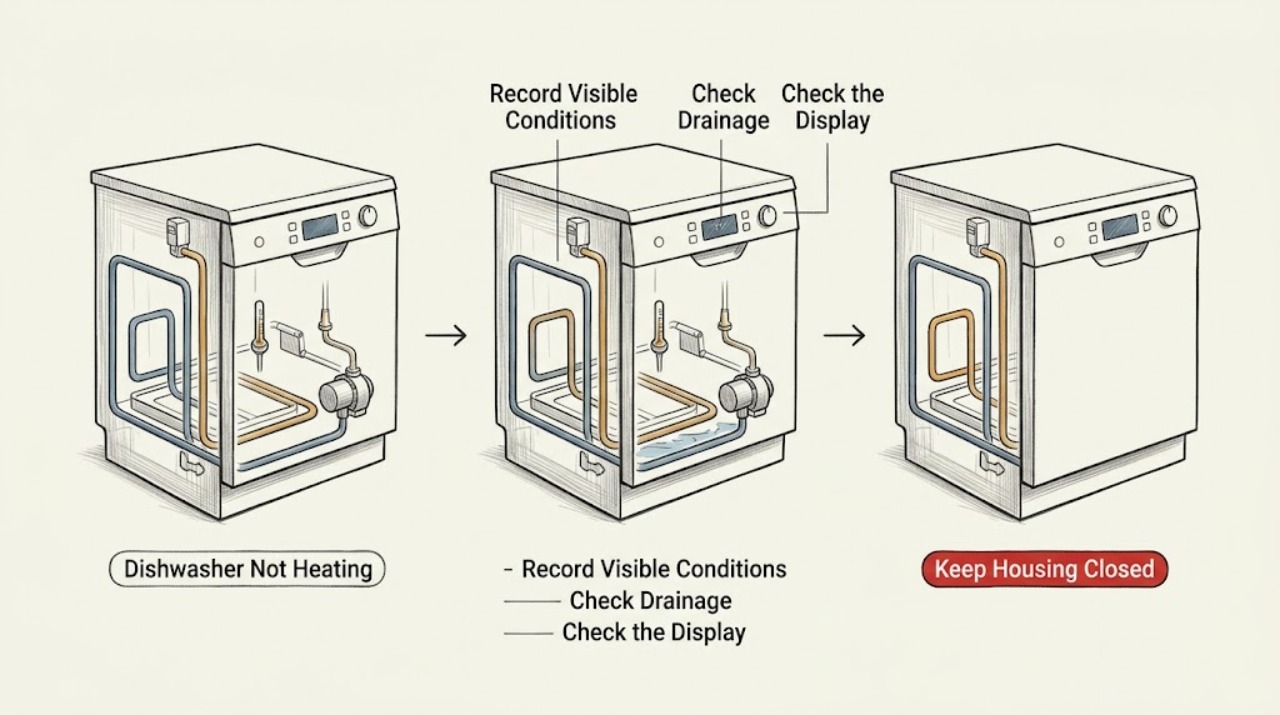
Work through in order
Diagnostic checks
Use only checks that match the exact appliance or system and its official guide.
-
Check 1
Record the program, whether the cycle completes, whether water or dishware is warm at the end, whether drying changed, and any exact F-code.
Expected result: A heating-related code appears, or the result is cool without a code.
Next step: Use the code-specific boundary if present and do not repeatedly run cycles to create heat.
Why this matters
Why: A code can identify a technical sensor or relay path; a symptom without a code still needs separation from circulation, program, or loading conditions.
-
Check 2
Check that the selected program actually completed rather than stopping early, and note whether water remains or a Drainage indication appeared.
Expected result: The program stopped early or water remains, or it completed with the cabinet draining normally.
Next step: Follow the matching cycle or drain diagnosis first; do not infer a failed heater from an interrupted cycle.
Why this matters
Why: An interrupted or undrained program can make the final result appear cold; normal completion shifts attention to heating or circulation.
-
Check 3
Check the display for F1 or F24 and compare the complete code with the Miele support description, without removing panels.
Expected result: F1, F24, or another exact technical code is present, or no code matches.
Next step: Book service for a technical code. If no code matches, provide the model and result pattern for model-specific guidance.
Why this matters
Why: Miele describes F1 as a water/heating temperature sensor short circuit and F24 as a heating-relay contact fault, both outside ordinary user repair.
-
Check 4
If no code is shown, check only accessible loading and filter conditions described for the model, and observe whether spray action and drainage are normal; do not test voltage or continuity.
Expected result: The spray path or filter is restricted, or circulation and drainage are normal.
Next step: Correct only a documented accessible restriction and test once. Arrange service if heat remains absent.
Why this matters
Why: Restricted circulation can affect wash results and apparent heating; normal circulation with consistently cold results makes an internal heating or control fault more likely.
Use your observations
Decision map
Find the observation that best matches what you see, then follow the next safe action.
-
PATH 01Next step
What you see
The cycle stopped early or water remains and the cabinet is cool
Do this next
Resolve the matching door/intake/drain symptom and stop if the interruption repeats.
-
PATH 02Next step
What you see
F1 or F24 appears with the cold result
Do this next
Stop user troubleshooting and book Miele service.
-
PATH 03Next step
What you see
The program completes and drains normally but repeated loads remain cold with no accessible restriction
Do this next
Arrange service and provide the program, result, model, and absence of a code; do not open the appliance.
Helpful context
Understand the symptom
Do not diagnose heat by feel alone
A cool load at the end can have several explanations, but a named technical code has a defined service boundary. Record the program and display before changing settings.
When checks do not resolve it
Need a professional?
Use qualified service for heating, sensor, relay, circulation, or control diagnosis.
Safety scope: Do not probe live wiring, remove panels, bypass safety controls, or handle hot water while testing.
Have this ready
- Provide model, program, completion status, water/dish temperature observation, drying result, code, and filter/drain observations.
Common questions
FAQ
Can a Miele dishwasher be cold because the cycle did not finish?
Yes. A stopped or undrained cycle can make the final result misleading. Record the stop stage and water level before diagnosing heating.
Is a Miele F24 code a user-repairable heater problem?
Miele describes F24 as a heating-relay contact fault and directs users to repair service. Do not open the appliance or test live components.
Read the exact guide
Official sources
- Fault F1Miele USA Support · Miele dishwashers displaying F1
- Fault F24Miele USA Support · Miele dishwashers displaying F24
- Water not pumped away (G 1xxx–G 6xxx)Miele USA Support · Miele G 1xxx–G 6xxx dishwashers; follow model instructions
- Dishwasher will not startMiele USA Support · Miele dishwashers with start or program interruption symptoms
Community feedback
Share a repair observation
Share a plain-text repair observation. Accepted observations are published automatically; this page may take a moment to update.