
On this page
Start here
Quick answer
When a Miele dryer leaves laundry damp, first identify whether the load is mixed, overloaded, still too wet from the washer, or ending early because the moisture sensor sees little moisture. Select the program that matches the fabric and load, then clean the door lint filters and the plinth filter exactly as the model instructions describe. On heat-pump or condenser models, check the accessible heat-exchanger air path and keep the room ventilated; do not touch sharp cooling fins or reinstall a wet filter. Check the condensed-water container and drain hose when your model uses them, and confirm the dryer has power. If the dryer remains cold, repeatedly stops, shows a fault, overheats, smells of burning, or trips protection, stop testing and arrange Miele or qualified appliance service.
Before you begin
Safety first
- This article supports normal-control checks, load and program changes, filter care, accessible airflow observation, and external condensate checks only when the exact manual permits them. Do not open the cabinet, touch cooling fins, test live circuits, bypass sensing, handle refrigerant, or operate after an electrical, fire, leak, or overheating warning.
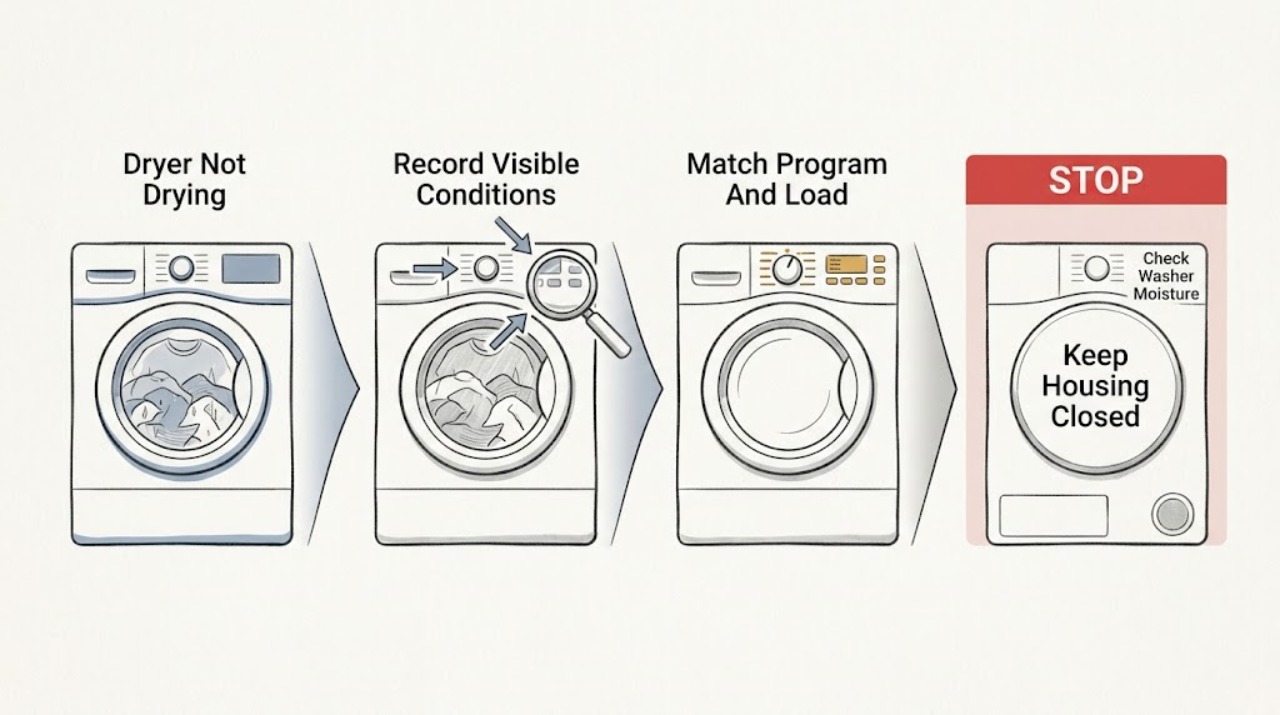
Work through in order
Diagnostic checks
Use only checks that match the exact appliance or system and its official guide.
-
Check 1
From a dry, safe position, record the selected program, load type, approximate load size, whether the drum turns, whether the dryer runs to completion, and every display message; confirm the plug and socket look intact and the display responds normally.
Expected result: The display is dark or abnormal, the drum does not turn, the program ends almost immediately, the drum runs but laundry stays damp, or a filter, water, or fault message appears.
Next step: Follow the matching branch and exact Miele manual; stop and arrange service for a damaged cord or socket, repeated protection trips, a non-responsive control, a drum that will not turn, or a persistent fault message.
Stop if: Do not use a hot, loose, wet, or damaged socket, run with a damaged cord, remove covers, or repeatedly reset a breaker.
Why this matters
Why: A power, control, or drive symptom is not the same as an ordinary program-selection problem. An early cancellation can be caused by a very small or already dry load, while a full cycle with damp laundry keeps program, load, airflow, condensate, sensing, and technical causes in scope.
-
Check 2
Separate the load by fabric and care label, compare it with the selected Miele program, loosen items that have rolled together, and check that the load is neither nearly empty nor above the program limit; keep zippers open when the garment care instructions permit.
Expected result: The load mixes heavy and light fabrics, contains a single small item, is tightly bundled, is over the stated limit, or is already nearly dry; alternatively, it is a compatible, reasonably sized, loosened load.
Next step: Run one suitable program according to the model manual; for a single item or a program that cancels because the load is nearly dry, use the manual-approved timed or warm-air option only as directed. If the compatible load still fails, continue to filter and moisture checks.
Stop if: Do not exceed the program's maximum load, dry items against their care labels, or use heat to dry clothing contaminated with solvent, oil, or another flammable substance.
Why this matters
Why: Mixed fabrics and unsuitable load size can leave some pieces damp or make a moisture-sensing program stop early. A compatible load that remains damp after a correct cycle points beyond simple sorting.
-
Check 3
Compare the laundry's condition immediately after the washer spin with the condition expected for that fabric, and note whether large items hold a wet bundle; if the washer permits, use a higher spin speed that is appropriate for the load and care label.
Expected result: The load enters the dryer dripping or tightly rolled, or it is evenly loosened and only normally damp after spinning.
Next step: Correct the washer spin or untangle the load when safe and permitted, then run one suitable dryer program; do not compensate by repeatedly extending a cycle if the dryer shows overheating or a fault.
Stop if: Stop for a washer leak, standing water near electrical equipment, a burning smell, or any need to reach inside a moving drum.
Why this matters
Why: Laundry that is too wet increases the water-removal work and can make drying appear ineffective. A normally spun, loose load that remains damp keeps the dryer-side airflow, sensing, condensate, and heating system in scope.
-
Check 4
Switch the dryer off and follow the exact manual to remove and clean the accessible door-opening lint filters and, where fitted, the plinth or toe-kick filter; inspect the filter surfaces and seals for lint, detergent residue, damage, or incorrect seating.
Expected result: One or more filters are coated or blocked, a filter is damaged or deformed, a filter is wet or dripping, or the filters are clean, dry as required, intact, and correctly seated.
Next step: Clean and reinstall the filters exactly as directed, allowing a washed plinth filter to dry fully; then run one controlled test. Replace or service a damaged filter according to the exact model guidance rather than improvising a substitute.
Stop if: Do not operate without required filters, reinstall a dripping filter, touch sharp fins, use solvents or abrasive cleaners, or force a filter into place.
Why this matters
Why: Miele identifies clogged or damaged filters as causes of restricted airflow, long drying, program interruption, and ineffective drying. A wet plinth filter can itself cause an operational fault, and a damaged filter can let lint reach the heat exchanger.
-
Check 5
If the model manual permits user cleaning, inspect the accessible heat-exchanger grille, filter insert, air openings, and visible cooling fins for lint or dust after the dryer is off and cool; clean only with the stated method and without pressing on the fins.
Expected result: Lint or dust restricts the accessible air path, the cooling fins are visibly bent or damaged, or the accessible path is clear but drying remains poor.
Next step: Remove only loose visible residue using the manual-approved method, close the access panel and fit the filter correctly, then test once. Arrange service for bent fins, deep blockage, repeated airway messages, or persistent damp laundry.
Stop if: Do not touch cooling fins with bare hands, bend fins, use pressure or sharp tools, remove sealed panels, or run with the heat-exchanger flap open.
Why this matters
Why: Blocked airflow can lengthen drying and trigger filter or airway messages. Miele warns that damaged or bent cooling fins can prevent drying; a clear accessible path does not rule out a fan, heat-pump, sensor, or sealed-system fault.
-
Check 6
For a condenser or heat-pump model, check the condensate container level and visible drain hose for a kink or displacement, then observe one suitable load for early cancellation, uneven drying, or a moisture-sensing message; verify any heat-exchanger or condenser cover is seated as the manual shows.
Expected result: The container is full, the hose is kinked, a water message appears, a cover is not seated, only a nearly dry load cancels, all suitable loads remain damp, or a residual-moisture fault appears.
Next step: Empty the container, correct an accessible hose position, or reseat a cover only as the model manual permits, then test once. Arrange service for recurring leaks, water messages, sensing faults, or persistent dampness after the filter and program checks.
Stop if: Do not operate with a water leak, put water near controls, disassemble a condensate pump, bypass sensing, or restart a faulting dryer repeatedly.
Why this matters
Why: Miele links a full container or kinked drain hose with a stopped program and says a poorly closed condenser system can cause water to escape. Early cancellation with a nearly dry load can be expected, while repeated sensing faults or damp adequate loads need service.
-
Check 7
During one monitored cycle, note whether the room becomes unusually hot, the dryer gives a burning or gas-like smell, the cabinet or plug becomes abnormally hot, smoke or sparking appears, or an electrical protection device trips; stop immediately if any warning sign appears.
Expected result: The room is poorly ventilated but there is no smoke or abnormal heat, or there is a hot plug, burning smell, smoke, sparking, repeated trip, damaged cord, or unusual mechanical symptom.
Next step: If the manual permits, ventilate the room without blocking required clearances and retest only when no safety symptom exists; otherwise leave the dryer off and arrange qualified Miele or electrical service.
Stop if: Do not continue operating with smoke, burning odor, hot or damaged electrical parts, sparking, repeated trips, gas odor, or a suspected sealed-system leak.
Why this matters
Why: A warm room can lengthen drying on a heat-pump model, but burning, smoke, arcing, repeated trips, or excessive heat is a safety boundary rather than a drying adjustment.
Use your observations
Decision map
Find the observation that best matches what you see, then follow the next safe action.
-
PATH 01Safety boundary
What you see
The load mixes fabric weights, is tightly rolled, is over the program limit, or enters the dryer unusually wet.
Do this next
Separate and loosen the load, use an appropriate washer spin and Miele program, and follow the model's maximum-load guidance before testing once.
Why this path and its safety boundary
Why it matters: The dryer may be operating normally while the selected program and load condition prevent an even drying result.
Safety stop: Do not overload, dry items against their care labels, or keep extending cycles when overheating or a fault appears.
-
PATH 02Safety boundary
What you see
The program stops soon after starting with a nearly empty load, a single item, or laundry that is already nearly dry.
Do this next
Open and close the door if the model guidance calls for clearing the message, then use the manual-approved timed or warm-air program for the item; use service if an adequate damp load also cancels.
Why this path and its safety boundary
Why it matters: Miele says the electronic system can decide that little or no drying is required and cancel some programs.
Safety stop: Do not bypass the sensing system or enter undocumented controls.
-
PATH 03Safety boundary
What you see
Lint, detergent residue, hair, a dirty plinth filter, a dirty filter insert, or accessible heat-exchanger debris is present, or a clean-airway message appears.
Do this next
Switch off, clean and dry the required filters and accessible air path as the exact manual directs, reinstall every filter and close the panel, then perform one test.
Why this path and its safety boundary
Why it matters: Restricted airflow can make drying take too long, stop, or become ineffective, and can allow lint to reach the heat exchanger if a filter is damaged.
Safety stop: Do not touch cooling fins, press on them, run without the plinth filter, or continue if the filter or fins are damaged.
-
PATH 04Safety boundary
What you see
The condensed-water container is full, a visible drain hose is kinked, the water message remains, or water appears after heat-exchanger cleaning.
Do this next
Empty the container, correct a visible hose position, or reseat an accessible cover only as the model manual directs; arrange service if the message, leak, or interruption recurs.
Why this path and its safety boundary
Why it matters: The condensate path or closure can interrupt drying or allow water to escape even when the drum and heater appear to run.
Safety stop: Do not operate with water entering controls or electrical parts, and do not disassemble the pump or condenser system.
-
PATH 05Safety boundary
What you see
A suitable load remains damp after correct program selection, clean dry filters, clear accessible airflow, and a normal condensate path, or the dryer repeatedly reports a sensing or fault condition.
Do this next
Leave the dryer off and arrange Miele or qualified appliance service with the model, program, load, messages, filter history, and symptom timing.
Why this path and its safety boundary
Why it matters: A moisture sensor, fan, heat-pump, heater, control, or other internal fault remains possible and cannot be safely identified by cabinet disassembly.
Safety stop: Do not open the cabinet, bypass a sensor, probe live circuits, handle refrigerant, or repeatedly restart a faulting dryer.
-
PATH 06Safety boundary
What you see
There is smoke, a burning smell, sparking, a hot plug or socket, a damaged cord, repeated protection trips, abnormal cabinet heat, or an unusual gas-like odor.
Do this next
Stop the cycle, keep clear, and only isolate power from a dry safe position if that can be done without touching damaged equipment; arrange qualified electrical or Miele service.
Why this path and its safety boundary
Why it matters: Electrical, fire, or other safety risk takes priority over restoring drying.
Safety stop: Do not reset protection repeatedly, use the appliance, open the cabinet, or attempt a live test after a smoke, spark, burning, or repeated-trip event.
Helpful context
Understand the symptom
First decide whether the dryer is under-drying or ending early
Damp laundry after a complete cycle and a program that cancels shortly after starting are related but not identical symptoms. A mixed load, a small load, or laundry that was already nearly dry can make the moisture-sensing program end early. A normal-sized load that remains damp points more toward the selected program, load condition, restricted airflow, a full condensate path, or a technical fault. Record the program, load type, whether the drum tumbles, and any display message before changing several things at once.
Filters and the heat path matter on condenser and heat-pump models
Lint, detergent residue, hair, and a clogged plinth filter can restrict the air path and lengthen drying. Miele's support instructions also call for checking the filter insert and heat exchanger where applicable. Clean only the parts and surfaces named in the exact manual, keep hands away from cooling fins, and let a washed plinth filter dry as directed before reinstalling it. A heat exchanger access panel and its seal must be closed correctly before operating the dryer.
Load condition, moisture sensing, and water collection are separate checks
A dryer cannot remove moisture efficiently when the washer leaves laundry excessively wet, the load is over the program limit, or large items roll into a bundle. Miele recommends a suitable washer spin, staying within the selected program's load limit, and untangling or selecting a large-items program when the load has rolled up. A full condensate container, kinked drain hose, or poorly closed condenser system can also interrupt operation. Check each only as the model manual allows.
Safety boundary
Stop conditions
- Stop using the dryer for smoke, burning odor, sparking, a hot or damaged cord or socket, repeated electrical protection trips, or abnormal cabinet heat; arrange qualified electrical or Miele service.
- Do not operate without the required lint or plinth filter, with a dripping filter, with the heat-exchanger access panel open, or with a damaged filter or bent cooling fins.
- Do not touch cooling fins with your hands, press or bend them, use sharp tools, remove cabinet panels, probe live circuits, or handle refrigerant or sealed heat-pump components.
- Stop for water near controls or electrical parts, a recurring condensate leak, a damaged drain hose, or a water message that remains after the manual-approved external checks.
- Do not bypass residual-moisture sensing, enter undocumented service settings, or repeatedly restart a program that cancels with a fault.
- Do not dry clothing contaminated with solvents, oils, or other flammable substances, and follow every garment care label and the exact Miele operating instructions.
Only after diagnosis
Potential parts
- Miele dryer lint or plinth filter
Consider this category only when the exact model's filter is damaged, deformed, worn, or cannot be cleaned as the manual requires and restricted filtration is confirmed.
Confirm the exact Miele model and filter design before ordering; never operate with a missing, wet, damaged, or ill-fitting filter. - Miele dryer moisture-sensing component
Consider this category only after a qualified diagnosis confirms a residual-moisture sensing fault following suitable load, program, filter, and airflow checks.
Verify the exact model and technician diagnosis; do not replace or bypass a sensing component based only on damp laundry. - Miele dryer condensate drain component
Consider this category only when the container, visible hose, and manual-approved closure checks do not explain a recurring water message, interruption, or leak and service confirms a drain fault.
Confirm the exact model, drain configuration, and installation requirements; internal pump or hose work may require qualified service.
When checks do not resolve it
Need a professional?
Arrange Miele or qualified appliance service when a compatible load remains damp after the correct program, washer spin, clean dry filters, accessible airflow, and condensate checks; when a residual-moisture sensing fault or repeated cancellation appears; when the drum does not turn or the dryer does not heat as expected; or when filters, cooling fins, internal airflow, a pump, control, heater, or heat-pump system may be faulty. Use qualified electrical service for smoke, burning odor, sparking, a hot or damaged plug or cord, or repeated protection trips.
Safety scope: This article supports normal-control checks, load and program changes, filter care, accessible airflow observation, and external condensate checks only when the exact manual permits them. Do not open the cabinet, touch cooling fins, test live circuits, bypass sensing, handle refrigerant, or operate after an electrical, fire, leak, or overheating warning.
Have this ready
- Provide the exact Miele model, selected program, load fabric and size, washer spin condition, cycle duration and whether it ends early, display messages, filter and heat-exchanger cleaning history, condensate-container or drain-hose observations, room conditions, and any heat, smell, noise, leak, smoke, spark, or protection-trip event.
Common questions
FAQ
Why does my Miele dryer stop before the clothes are dry?
A small, already-dry, or unsuitable load can make a moisture-sensing program end early. If an adequate damp load repeatedly stops, clean the required filters, confirm the program and load, and arrange service for a persistent sensing or technical fault.
Can a dirty filter make a Miele dryer stop drying?
Yes. Miele identifies lint, residue, and a dirty plinth filter or heat exchanger as possible causes of restricted airflow, long drying, or program interruption. Switch off and clean only the accessible parts using the exact model instructions; keep hands away from cooling fins and reinstall a washed filter only when dry as directed.
Should I use a timed program when the Miele dryer leaves laundry damp?
It can be an appropriate limited finish for an individual item or mixed load when the Miele guidance for your model recommends it. It does not repair blocked airflow, a condensate fault, a failed sensor, or a heating problem; persistent dampness after correct filters and program selection needs service.
What if the dryer leaks after I clean the heat exchanger?
Stop the cycle and check from the outside that the heat exchanger and condenser-system lid are seated as the operating instructions show. If water remains, the closure is damaged, or the leak recurs, leave the dryer off and arrange service rather than opening the pump or cabinet.
When should I stop using a Miele dryer that is not drying?
Stop for smoke, a burning smell, sparking, a hot or damaged plug or cord, repeated protection trips, abnormal heat, a water leak near electrical parts, or a fault that recurs after the manual-approved checks. These symptoms require qualified help, not repeated test cycles.
Read the exact guide
Official sources
- Dryer not drying correctlyMiele USA · Miele tumble dryers; exact program names and residual-moisture settings vary by model.
- Water leaks after cleaning heat exchangerMiele USA · Miele tumble dryers with the described condenser system; consult the exact operating instructions.
- Program canceled after brief periodMiele USA · Miele tumble dryers; the displayed program and timed option depend on model.
- Miele Tumble Dryer | --- appears in the tumble dryer display. The program has been interrupted.Miele USA · Miele tumble dryers with the described filter and heat-exchanger arrangement; follow the exact model manual for access and cleaning.
- Operating instructions 12127330-00Miele · The Miele tumble-dryer manual represented by this document; model-specific instructions must be used for a different appliance.
- Adjust the load and appear on the tumble dryer display. The program has been interrupted. The buzzer sounds.Miele USA · Miele tumble-dryer models that show the described load-adjustment display; exact display symbols vary by model.
Community feedback
Share a repair observation
Share a plain-text repair observation. Accepted observations are published automatically; this page may take a moment to update.