
On this page
Start here
Quick answer
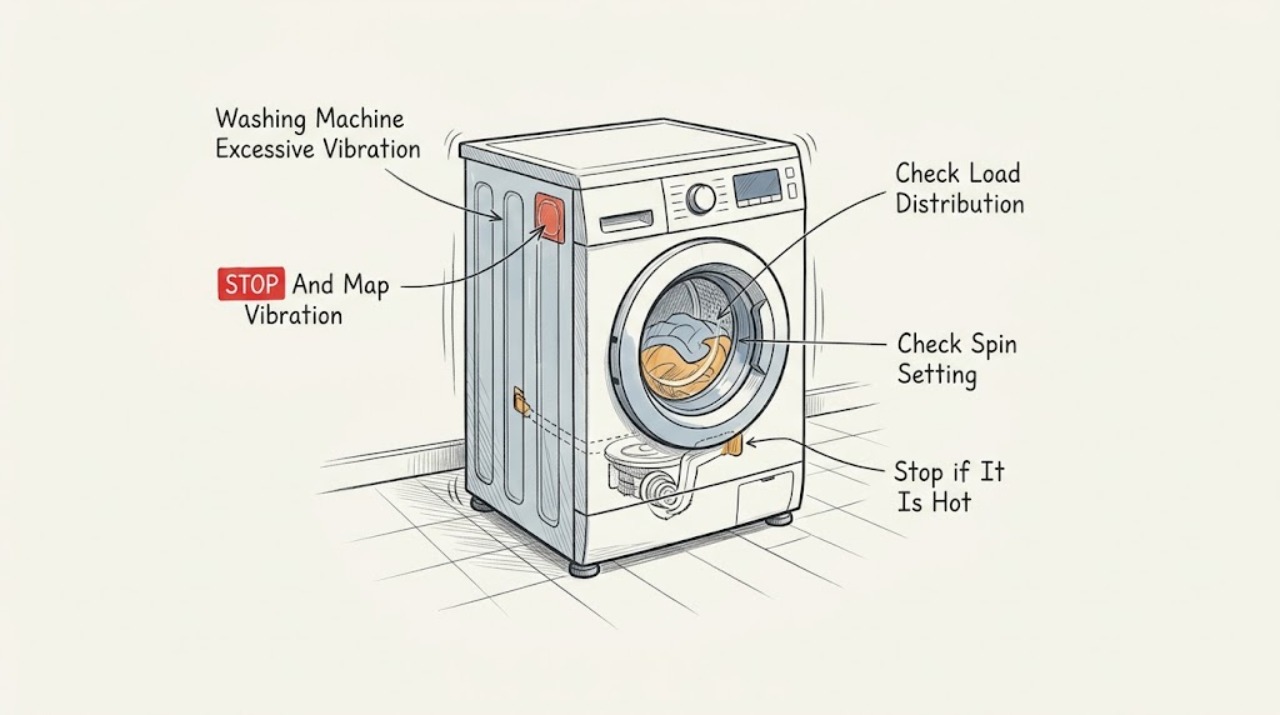
If a Miele washing machine is shaking, walking, or striking the cabinet, stop the cycle and keep people away until the drum is stationary. Miele identifies an installed transport safety device, an incorrectly aligned machine, loose foot locknuts, and an unsuitable or soft base as causes of spin vibration; it also says an uneven load can trigger imbalance control and reduced spin speed. First record whether the problem occurs only during spin, redistribute a mixed load only after the drum stops, and check the machine's visible level and stability without tilting it. Transport struts or bars must be checked only against the exact model's installation manual, never removed by guessing. Persistent movement, metal-on-metal noise, leaking water, a damaged cabinet, smoke, a burning smell, or an electrical symptom is a stop-use condition requiring qualified Miele appliance service.
Work through in order
Diagnostic checks
Use only checks that match the exact appliance or system and its official guide.
-
Check 1
Stop the program and wait until the drum is fully stationary before opening the door; from a safe position, note whether the cabinet moved, walked, struck a wall, or only vibrated during a particular phase.
Expected result: Record the phase, direction of movement, duration, load condition, water on the floor, unusual impact or metal sound, and whether the machine returned to its original position.
Next step: Keep the washer out of service until the safe checks below identify a clear load or installation issue; photograph the final position and any visible damage without moving the machine.
Stop if: Stop immediately for walking, cabinet impact, a falling or unstable machine, exposed wiring, smoke, a burning smell, a shock, a metal-on-metal sound, or active water leakage.
Why this matters
Why: Movement limited to a high-speed spin can fit an imbalance or installation problem, while walking, repeated impacts, vibration outside spin, or a new mechanical sound raises the urgency for professional assessment.
-
Check 2
With the drum stopped and the door safe to open, observe whether the load is a single bulky item, a tightly wrapped group, very few items, or a mixed group of large and small items; redistribute only loose laundry that can be handled without reaching through a damaged or hot opening.
Expected result: The load is clearly concentrated or single-item, the laundry is evenly distributed, or the drum contains an unknown object or damaged garment hardware.
Next step: For a safe, intact load, use a lower spin option or a balanced mix only as allowed by the exact program instructions; if vibration repeats with an ordinary balanced load, stop testing and arrange service.
Stop if: Do not reach into a moving drum, force a door, lift the machine, remove a trapped or sharp object, or continue a cycle when there is violent movement, scraping, or damage.
Why this matters
Why: Miele says the washer may detect an uneven load and reduce spin speed; a concentrated load can therefore produce a one-cycle vibration without proving a failed part. An even load with the same violent movement points back to installation or a machine fault.
-
Check 3
Record the selected program and spin setting from the controls, then compare the vibration pattern with the lower-spin or no-spin option described for that exact Miele model, without using a high-speed cycle as a diagnostic test.
Expected result: The movement occurs only at a high spin setting, occurs at every spin setting, or appears during wash, drain, or another phase as well.
Next step: Use the lower setting only as a temporary operating choice when the washer remains stable and no stop condition exists; otherwise leave it out of service and provide the program and phase record to Miele service.
Stop if: Do not keep running cycles to compare speeds, hold the machine in place, disable imbalance protection, or add an unapproved mat, block, weight, or improvised restraint.
Why this matters
Why: A high-speed setting magnifies an imbalance and can make a floor or leveling problem more visible; vibration at low or no spin, or outside spin, is less consistent with a simple speed choice and needs service assessment.
-
Check 4
From outside the appliance and without tilting or moving it, inspect whether all four visible foot contact points appear planted, the floor is dry and firm, the machine is touching a soft covering, and the cabinet has a visible lean; use a level only if it can be placed safely without climbing or shifting the washer.
Expected result: The washer appears level and stable on a firm surface, one foot or corner is not planted, the floor is soft or uneven, the feet are wet, or the cabinet is leaning or moving.
Next step: If the installation can be adjusted without moving or lifting the appliance, follow the exact model installation instructions or have the installer level and secure it; otherwise request qualified service and do not compensate with loose objects.
Stop if: Do not tilt, lift, drag, climb around, wedge, shim with loose items, or place hands near the feet while the machine is connected or unstable.
Why this matters
Why: Miele requires the machine to stand perfectly level on all four feet and notes that a firm floor is less prone to spin vibration. An unseated foot or unsuitable surface can explain movement, but a stable-looking installation does not rule out an internal fault.
-
Check 5
If the exact Miele installation instructions permit an external check, observe whether the adjustable feet and their locknuts appear to match the installed setup and whether any locknut is visibly backed away from the housing; do not put a wrench on a foot while the washer is unstable or connected.
Expected result: All four feet appear secure and the locknuts are seated, one foot or locknut is visibly loose, or the foot area cannot be safely seen without moving the appliance.
Next step: Give the exact model and photos to the installer or qualified technician for leveling; do not guess a foot adjustment direction or run the washer to see whether tightening helped.
Stop if: Do not reach under the cabinet, adjust feet on an unstable machine, loosen plumbing or electrical connections, or use a wrench as a substitute for safe support.
Why this matters
Why: Miele states that a counter nut not firmly against the housing can allow the machine to move during operation. A loose foot supports an installation correction, while an inaccessible or apparently secure foot shifts attention to the floor, load, shipping hardware, or internal service fault.
-
Check 6
If vibration began immediately after delivery or relocation, record the installation date and consult the exact model's Miele installation manual to identify the transport struts or safety device; inspect only the locations and covers the manual permits without tilting or dismantling the washer.
Expected result: The exact manual confirms a transport device that may still be installed, the device was documented as removed, or the model and installation instructions are unknown.
Next step: Pause use and have the installer or Miele service verify the transport-device status and installation; preserve the device if it was removed so it can be refitted before a future move.
Stop if: Do not remove covers, transport bars, screws, or shipping hardware without the exact manual; do not tilt, move, or dismantle the appliance to reach them.
Why this matters
Why: Miele identifies a transport safety device left mounted as a cause of spin vibration, but the hardware and removal sequence must be model-specific. Unknown hardware or missing documentation is not permission to remove a rear part by trial.
-
Check 7
With the washer stopped and not being moved, make a final external note of leaks, hose strain, cabinet damage, drum play or scraping visible from the door, repeated error messages, smoke, odor, hot surfaces, and electrical behavior.
Expected result: The machine is stable and dry with no unusual sound or hazard, or it walks, strikes, leaks, scrapes, smells hot, smokes, trips power, shocks, or shows visible damage.
Next step: Leave the washer out of service for the hazardous or persistent pattern and contact qualified Miele appliance service; include the movement timeline, load, spin setting, installation history, photos, and exact model.
Stop if: Do not run another cycle, open panels, reach behind the drum, inspect energized wiring, tilt the appliance, or attempt to repair a suspension, bearing, motor, control, hose, or electrical fault.
Why this matters
Why: A stable, dry washer with a clear load or installation correction may be monitored only according to the exact manual. Any hazard or persistent vibration needs professional diagnosis because suspension, drum support, bearing, motor, control, water, or electrical faults cannot be cleared by a home spin test.
Use your observations
Decision map
Find the observation that best matches what you see, then follow the next safe action.
-
PATH 01Next step
What you see
Vibration occurs only during spin with a single bulky, wrapped, or concentrated load, and the machine remains stable with no leak, impact, unusual noise, or damage.
Do this next
After the drum stops, redistribute the laundry with a balanced mix as the model instructions allow or choose a lower spin setting. Stop and arrange service if the pattern repeats with an ordinary balanced load.
-
PATH 02Next step
What you see
The washer was newly installed or moved and vibration began immediately, while the exact Miele manual indicates transport safety hardware that may still be present or its status is unknown.
Do this next
Do not remove or reach for the hardware by guesswork. Keep the washer out of service and have the installer or Miele service verify the exact model's transport-device procedure.
-
PATH 03Next step
What you see
The washer leans, one foot is not planted, a foot locknut is visibly loose, or the base is soft, wet, uneven, or unstable.
Do this next
Have the installer or qualified technician level and secure the appliance according to the exact Miele installation instructions. Do not lift, tilt, wedge, shim with loose objects, or run a trial cycle.
-
PATH 04Next step
What you see
Movement is limited to high-speed spin and disappears at a lower setting, with a stable dry machine and no impacts, scraping, damage, or other hazard.
Do this next
Use the lower setting only as a temporary choice allowed by the model instructions, reduce concentrated loads, and arrange service if vibration returns or the machine becomes unstable.
-
PATH 05Next step
What you see
The washer vibrates violently or repeatedly with balanced ordinary loads, at lower spin, during another phase, or while the installation appears level and secure.
Do this next
Stop use and request qualified Miele appliance service for suspension, drum support, bearing, drive, controls, or installation assessment. Do not open the cabinet or repeat the test.
-
PATH 06Next step
What you see
The washer walks, strikes a wall or cabinet, changes position, rocks on its feet, or could fall from a plinth or platform.
Do this next
Keep people away and leave the washer stopped. Do not hold it, move it, or add a restraint; arrange urgent qualified service and installation assessment.
-
PATH 07Next step
What you see
Water is leaking, the cabinet is damaged, the drum scrapes or has abnormal play, or metal friction is heard.
Do this next
Stop use. If it is safe to reach without contact with wet electrical parts, close the water supply; keep away from any water near electricity and arrange qualified appliance and electrical assessment.
-
PATH 08Next step
What you see
There is smoke, a burning or hot electrical smell, a hot or discolored connection, a shock, repeated breaker trip, sparking, or another electrical symptom.
Do this next
Do not touch, reset, or operate the washer. Leave the area for fire or smoke risk and obtain emergency or qualified electrical help from a safe location, followed by appliance service.
Helpful context
Understand the symptom
Start with the movement pattern, not a guessed part
A brief controlled vibration during a high-speed spin is different from a washer that walks, bangs, scrapes, or keeps shaking after the drum slows. Note whether the movement begins while filling, washing, draining, or spinning; whether it is worse with one load; and whether the cabinet or feet visibly shift. Miele's own guidance begins with load distribution, the transport safety device, level on all four feet, and a firm base. That sequence can separate a load or installation issue from a suspension, bearing, drive, or cabinet fault that needs service.
Use the exact installation information for transport hardware
Transport struts, bars, or other shipping restraints vary by model and installation document. Miele manuals show that transport hardware is removed as part of installation and refitted before moving the appliance again, while the washer must remain level and secure. Do not reach behind the machine to guess which hardware is present, tilt the washer to inspect it, or remove a restraint without the exact manual and a safe installation setup. If the washer was recently installed or moved and vibration began immediately, give the installation record to the installer or Miele service.
Know when vibration is no longer a homeowner check
A machine that walks toward a wall, hits cabinetry, leaks, produces metal friction, smells hot, smokes, trips power, or has a damaged panel can create injury, water, or electrical risk. Stop rather than holding the cabinet, adding improvised anti-vibration material, opening panels, or running repeated test cycles. A technician can assess the suspension, drum support, bearing, motor, controls, and installation without turning a safe observation into a moving or electrical hazard.
Safety boundary
Stop conditions
- Stop immediately if the washer walks, strikes a wall or cabinet, rocks on its feet, or could fall from a platform; do not hold, move, or restrain it while operating.
- Stop for water leakage, flooding, wet electrical parts, a damaged cabinet, a loose or trapped object, metal-on-metal scraping, or abnormal drum movement.
- Stop for smoke, a burning or hot electrical smell, sparking, a hot or discolored connection, a shock, or a repeated breaker trip; do not reset or operate again.
- Do not tilt, lift, drag, or dismantle the washer to inspect transport hardware, suspension, bearings, the drum, wiring, or controls.
- Do not remove transport struts or safety bars without the exact Miele model installation manual and a safe installation procedure.
- Do not add loose blocks, weights, improvised restraints, or unapproved anti-vibration materials, and do not hold the cabinet during a spin.
- Do not reach into a moving, hot, damaged, or obstructed drum, force the door, or run repeated cycles to reproduce vibration.
Only after diagnosis
Potential parts
- transport safety device or shipping hardware
Only consider this category if the exact model installation manual or installer confirms that transport hardware is present, missing, or incorrectly handled after installation or relocation.
Transport hardware is model- and installation-specific; do not remove, replace, or refit it from a generic vibration symptom. - adjustable foot or foot locknut
Only consider this category if a qualified installation assessment finds a damaged foot or locknut after confirming the floor and leveling setup.
Confirm the exact Miele model and installation instructions before considering any hardware; do not use loose shims or substitute restraints. - suspension, drum support, or bearing component
Only consider this category after qualified diagnosis finds persistent vibration, abnormal drum movement, or mechanical noise that is not explained by load or installation.
A symptom does not establish part fit or failure. Verify the exact model, diagnosis, and professional repair requirements before any component is selected.
When checks do not resolve it
Need a professional?
Call qualified Miele appliance service when vibration persists with balanced loads, appears outside high-speed spin, returns after an exact-manual installation correction, or is accompanied by walking, impacts, scraping, drum movement, leaks, cabinet damage, or an error. Obtain electrical or emergency help from a safe location for smoke, burning odor, sparking, a shock, hot or discolored electrical connections, or repeated breaker trips.
Common questions
FAQ
Why is my Miele washing machine vibrating so much during spin?
Miele points to an uneven load, an installed transport safety device, incorrect leveling, loose foot locknuts, and an unsuitable or soft base. Start by stopping the drum and recording the phase and load; do not keep running a violent or walking machine to identify the cause.
Can an unbalanced load make a Miele washer reduce spin speed?
Yes. Miele says the washer can detect that items were not distributed evenly and automatically reduce the final spin speed. Include both large and small items when the load is safe to handle, but arrange service if vibration persists with a balanced ordinary load.
Should I remove the transport bars from a Miele washer?
Only by following the exact model's Miele installation manual or having the installer do it. Do not guess which rear hardware is a transport restraint, tilt the washer, or remove parts by trial. Transport hardware also needs to be refitted before moving the appliance again.
How level does a Miele washing machine need to be?
Miele says the machine must stand perfectly level on all four feet, with the feet and counter nuts secured as specified. Observe the installation from safe access and have the installer or qualified technician correct an unseated foot or uneven base; do not wedge loose objects under the cabinet.
Is it safe to keep using a washer that walks?
No. A washer that walks, strikes a wall or cabinet, rocks on its feet, or could fall from a platform should remain stopped. Do not hold it in place or add an improvised restraint; arrange qualified appliance and installation service.
What if the washer vibrates with every load?
Stop repeated testing and arrange qualified Miele service. Persistent vibration with balanced loads or at lower spin can require assessment of the floor, leveling, transport hardware, suspension, drum support, bearing, drive, or controls. Do not tilt or dismantle the washer.
When is Miele washer vibration an emergency?
Stop and seek appropriate help for a leak near electrical parts, smoke, a burning or hot electrical smell, sparking, a shock, repeated breaker trips, metal scraping, a damaged cabinet, or violent movement. Keep away from the hazard and contact emergency or qualified electrical and appliance service from a safe location.
Read the exact guide
Official sources
- Operating and Installation InstructionsMiele USA · Miele WWH 860-US-en washer installation, transport strut handling, leveling, and safety warnings for that manual's model family
- Vibrations during spinningMiele USA · Miele washer vibration during spin, transport safety device, leveling, foot locknuts, and floor guidance
- Installation planMiele · Miele washing machine installation-plan guidance on transit bars, firm level surfaces, clearance, plinth security, and leveling
Community feedback
Share a repair observation
Share a plain-text repair observation. Accepted observations are published automatically; this page may take a moment to update.