
On this page
Start here
Quick answer
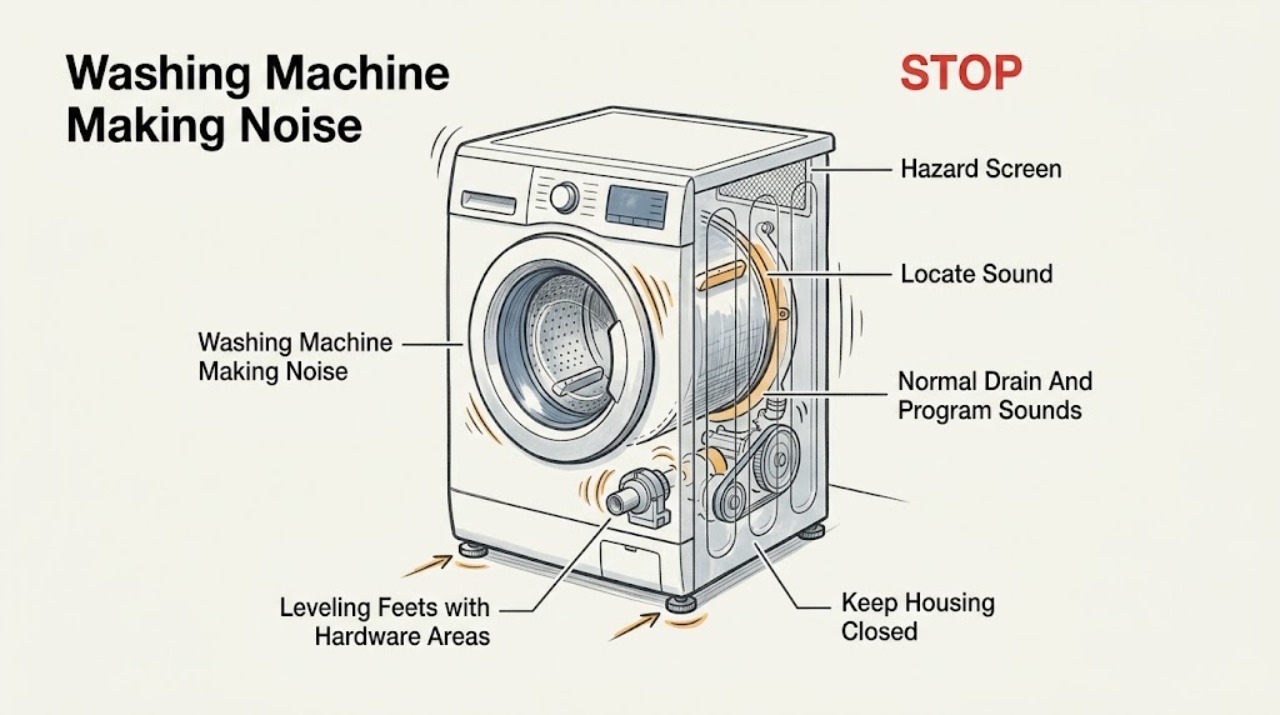
A Miele washing machine may normally gurgle when the drain pump starts or stops, and IntenseWash 2.0 can make a kettle-like sound while water is heated. A new rubbing, grinding, metallic, repeated knocking, or loud impact sound needs a different path. First note whether it occurs during filling, washing, drum rotation, draining, or spinning. If the machine walks, strikes cabinetry, leaks, smells hot or burnt, shows smoke or sparks, repeatedly trips protection, or makes metal-on-metal contact, stop it. For a safe external check, confirm that a front-loading model has no transit bars, the machine is level on all four feet and a firm base, the drain hose is not kinked or too high, and any drain-filter check is done only with the machine off and the water released slowly. Do not reach into a moving drum, remove covers, or dismantle the pump or drive; use the exact regional Miele manual and arrange service when a rubbing noise persists or a fault returns.
Before you begin
Safety first
- This article covers sound classification and ordinary-access checks only. Do not reach into a moving drum, tip a heavy washer alone, open covers, test live wiring, or dismantle pump, drive, suspension, or bearing components.
Work through in order
Diagnostic checks
Use only checks that match the exact appliance or system and its official guide.
-
Check 1
Stop the program and observe from a safe position for walking or violent impacts, a leak, water near the cord or outlet, smoke, burning or hot-plastic odor, sparks, a hot cord or outlet, repeated breaker trips, or metal-on-metal contact.
Expected result: Record whether this is a sound-only complaint or whether movement, heat, water, fire, or electrical evidence is present.
Next step: Cancel only if safe, keep the washer out of service, close the water supply for an active leak if safely reachable, and arrange qualified appliance, electrical, or emergency help according to the hazard.
Stop if: Do not touch wet electrical equipment, keep resetting protection, reach into a moving drum, or run another cycle to reproduce a dangerous sound.
Why this matters
Why: A stable washer with an ordinary cycle sound can be classified. Any listed hazard can turn continued testing into property damage, shock, fire, or injury risk.
-
Check 2
Without opening the cabinet, note the phase and location: inlet or rear during filling, front or lower area during drain, tub or drum during rotation, cabinet and floor during spin, or a brief sound after the program.
Expected result: Classify the sound as gurgling, kettle-like heating, hum or pump noise, clicking, rattling, thumping, rubbing or scraping, or whole-machine vibration; record whether the drum was empty or loaded.
Next step: Follow the matching branch below and preserve a short recording only if doing so does not require another hazardous cycle.
Stop if: Do not place hands, tools, or a phone inside the washer or near moving parts while it runs.
Why this matters
Why: Phase and location narrow the path: Miele documents normal drain gurgling and an IntenseWash 2.0 kettle-like sound, while rubbing during drum rotation is a technical-fault path.
-
Check 3
If the noise is a brief gurgle at the start or end of draining, or a kettle-like sound only during IntenseWash 2.0, compare its timing with the exact Miele manual and observe whether draining, washing, and the final result remain normal.
Expected result: Record whether the sound stops with the pump sequence or heating phase and whether there is any drain restriction, fault message, leak, or change in wash result.
Next step: If the sound matches the documented phase and no hazard or performance fault exists, monitor it. If it is new, louder, continuous, or paired with poor drainage, use the drain branch or arrange service.
Stop if: Do not dismiss smoke, burning odor, impact, scraping, a leak, or a fault message as an ordinary program sound.
Why this matters
Why: Miele describes drain-sequence gurgling as normal and explains that IntenseWash 2.0 can make a kettle-like sound while water is heated. A persistent or changing noise is not covered by that normal explanation.
-
Check 4
When the sound is strongest in spin, observe from outside whether the cabinet moves, the feet stay planted, the machine is level on all four feet, and the base is firm; for a recently installed front-loader, verify from the exact manual whether transport safety hardware was removed.
Expected result: Record walking, repeated cabinet strikes, a visible gap under a foot, loose foot locknuts, a sloped or flexible base, or shipping hardware that remains installed.
Next step: Stop high-speed cycles. If safe and the appliance is accessible, use the model installation instructions to correct only an external leveling or installation condition; otherwise arrange qualified installation or service.
Stop if: Do not tip or drag a heavy washer alone, remove structural covers, or continue spinning while it walks, strikes, or threatens a hose or cabinet.
Why this matters
Why: Miele identifies transport safety hardware, incorrect alignment, and an unsuitable base as causes of spin vibration. A loose or moving washer can damage itself or nearby surroundings.
-
Check 5
With the washer switched off and the drum stationary, inspect only the visible door seal, drum opening, and surrounding floor for a trapped item, damage, or water; do not force the drum or remove any panel.
Expected result: Record whether the rubbing or scraping is visible at the seal or opening, whether the drum turns abnormally, and whether Miele's described rubbing noise occurs whenever the drum rotates.
Next step: Remove only a loose object that is plainly accessible without tools and only after power is off; if the sound persists, the drum feels rough, or damage is visible, stop and contact Miele Service.
Stop if: Do not reach through a gap, dismantle the door or seal, pull the drum, or run a cycle to test a rubbing or metal sound.
Why this matters
Why: A visible loose item may be an external obstruction, but Miele treats a rubbing sound during drum rotation as a technical fault. Sound alone cannot identify a bearing, suspension, belt, motor, or other part.
-
Check 6
If the noise occurs while draining or water remains in the drum, with the washer off, check the accessible drain hose for a kink or excessive height and follow the exact Miele manual to access the drain filter; place a suitable container and loosen the filter slowly only as instructed.
Expected result: Record a kinked or high hose, restricted flow, hot water, foreign objects in the filter or pump area, an impeller that will not move freely, or a filter or access flap that leaks after refitting.
Next step: Correct only a visible hose loop or model-approved filter obstruction, refit the filter on the correct side and tighten it as directed, then arrange service if the noise, restriction, leak, or fault persists.
Stop if: Do not unscrew a filter quickly, drain hot water onto the floor, reach into a running pump, use tools to force the impeller, or continue when water approaches electrical parts.
Why this matters
Why: Miele identifies hose routing and a blocked drain filter or pump as possible drainage causes. A blocked outlet can leave water behind, and hot wash water can scald; an incorrectly tightened filter can leak.
-
Check 7
Only when the washer is dry, stable, odor-free, and free of impact or electrical danger, make one model-approved low-risk confirmation after the external condition is corrected; remain nearby and stop at the first abnormal sound.
Expected result: Record whether the noise is gone, repeats at the same phase, appears with an empty drum, returns with vibration, or is accompanied by a drain or display fault.
Next step: Stop using the washer and provide Miele Service with the exact model, phase, sound, load state, fault message, installation history, and checks already completed when the noise persists or returns.
Stop if: Do not repeat tests, run high-speed cycles, bypass a door lock, open panels, or continue after a leak, smoke, odor, spark, hot outlet, or repeated protection trip.
Why this matters
Why: A quiet confirmation after correcting installation or a visible drain obstruction supports that branch; a repeated rubbing, grinding, impact, or pump noise points to a technical fault and is not a reason for repeated cycles.
Use your observations
Decision map
Find the observation that best matches what you see, then follow the next safe action.
-
PATH 01Safety boundary
What you see
The washer walks, strikes the cabinet, leaks, smells burnt or hot, smokes, sparks, trips protection again, or makes metal-on-metal contact.
Do this next
Stop the program if safe, keep clear of wet electrical areas, close the water supply if safe for an active leak, and arrange qualified appliance or electrical help.
Why this path and its safety boundary
Why it matters: Continued operation can cause injury, water damage, shock, or fire; the sound diagnosis stops.
Safety stop: Do not run another cycle, touch energized or wet parts, keep resetting protection, or try to restrain a moving washer by hand.
-
PATH 02Safety boundary
What you see
A brief gurgle occurs only at the beginning or end of a drain-pump sequence, with normal drainage and no fault or leak.
Do this next
Monitor the sound and use the exact model manual if it becomes continuous, louder, or paired with a drainage problem.
Why this path and its safety boundary
Why it matters: Miele identifies this timing as a normal part of operation.
Safety stop: Do not apply the normal-sound explanation to a grinding, scraping, impact, leak, smoke, or electrical symptom.
-
PATH 03Safety boundary
What you see
A kettle-like sound occurs only during the documented IntenseWash 2.0 water-heating phase and the cycle otherwise performs normally.
Do this next
Compare the feature and timing with the exact model manual; arrange service if the sound occurs outside that phase or performance changes.
Why this path and its safety boundary
Why it matters: Miele explains that this function wets and spins laundry more frequently and can make a kettle-like sound while water is heated.
Safety stop: Stop for a burning smell, smoke, leak, abnormal vibration, or a sound that becomes impact or metal rubbing.
-
PATH 04Safety boundary
What you see
The noise is a spin thump or vibration and the washer is not level, has loose foot locknuts, sits on a weak base, or still has model-specific transport hardware.
Do this next
Stop high-speed operation and correct the external installation only with the exact Miele instructions and safe lifting help; otherwise book qualified service.
Why this path and its safety boundary
Why it matters: The installation can make the washer move and damage the appliance or surroundings without proving an internal drive fault.
Safety stop: Do not tip a heavy appliance alone, drag it across hoses, or continue while it walks or strikes.
-
PATH 05Safety boundary
What you see
A rubbing or scraping sound occurs whenever the drum rotates, including after visible external checks.
Do this next
Stop using the washer and arrange Miele Service with the exact model, sound phase, and whether the drum feels rough or damaged.
Why this path and its safety boundary
Why it matters: Miele classifies this symptom as a technical fault; the sound cannot safely identify which internal component is responsible.
Safety stop: Do not run an empty test, remove panels, pull the drum, or replace a bearing, belt, pump, or motor by guesswork.
-
PATH 06Safety boundary
What you see
The sound occurs during draining and there is slow flow, water in the drum, a drain indicator, a kinked or high hose, or a blocked filter or pump.
Do this next
Switch off, follow the exact model's slow-drain and filter procedure, then contact Miele Service if the restriction, noise, leak, or display fault remains.
Why this path and its safety boundary
Why it matters: A restricted drain path can cause pump noise and leave water behind; hot water and a loose filter create scald or leak risk.
Safety stop: Do not open a hot or pressurized path quickly, reach into a running pump, or continue with water near electricity.
-
PATH 07Safety boundary
What you see
The sound persists after safe external installation and drainage checks, returns after one confirmation, or cannot be classified without opening the cabinet.
Do this next
Stop use and book Miele or qualified appliance service; provide the model, region, sound recording, phase, load, display state, movement, leakage, and checks performed.
Why this path and its safety boundary
Why it matters: A drive, suspension, bearing, motor, pump, control, hose, or other model-specific fault is possible and requires qualified diagnosis.
Safety stop: Do not dismantle the washer, bypass interlocks, or continue operating to collect more evidence.
Helpful context
Understand the symptom
Describe the sound by phase and location
Write down the exact phase: when water enters, during wash movement, as the drum accelerates, while water drains, or after the program ends. Also note whether the sound is a gurgle, hum, click, kettle-like hiss, thump, rattle, scrape, or metal rubbing. A sound that is brief and tied to a documented pump or IntenseWash phase may be normal. A sound that is new, louder, present with an empty drum, or paired with movement or leakage needs service-oriented troubleshooting. Miele washer features and controls vary by model and region, so use the matching manual.
Keep an installation cause in the decision path
A Miele washer that walks or bangs in spin can be affected by remaining shipping hardware, poor leveling, loose foot locknuts, or a weak base. These are external installation conditions, not proof of a failed bearing or motor. Do not tip or move a heavy appliance alone. If the machine is newly installed, compare the back and installation instructions with the exact model manual; if the hardware is uncertain or the machine is built in, stop and arrange qualified help.
Drain noises need water and scalding control
A gurgle at the beginning or end of pumping can be normal. A persistent growl, rattling pump, restricted drain, or water left in the drum is different. Miele's drain guidance identifies a high or kinked hose and a blocked drain filter or pump as possible causes. Water from a hot program can scald, and a filter that is not refitted tightly can leak. Use only the exact model procedure, place a suitable container first, and stop if water is near electricity or the access area is damaged.
Do not turn a noise into an internal repair
A rubbing sound when the drum rotates is listed by Miele as a technical fault. Drum bearings, suspension, belt, motor, pump, and foreign-object faults cannot be selected safely from sound alone. Disconnect power before any model-approved external cleaning check, never reach into a moving drum, and do not remove the lid or panels. Give service the sound recording, phase, load state, model, display message, and whether the washer moved or leaked.
Safety boundary
Stop conditions
- Stop immediately for walking or violent impacts, water near electrical parts, a leak that continues, smoke, burning or hot-plastic odor, sparks, a hot cord or outlet, repeated protection trips, or metal-on-metal contact.
- Do not reach into a moving drum, restrain the washer by hand, force the drum, or run another cycle to reproduce a dangerous sound.
- Do not remove the lid, panels, pump housing, drive parts, wiring, door lock, or structural hardware; do not test live electrical parts.
- Do not drain hot water quickly or loosen a filter without the exact model procedure, a suitable container, and a stable dry area.
- Do not tip or drag a heavy washer alone, continue high-speed spinning while it walks, or assume a persistent rubbing sound is normal.
Only after diagnosis
Potential parts
- drain pump or drain filter component
Consider this category only after the exact model's drain path is clear and qualified diagnosis links persistent drain noise or restriction to the pump or filter assembly.
Confirm the exact regional model and diagnosis before ordering; do not dismantle a pump or reach into it while connected to power. - leveling foot or installation hardware
Consider this category only when the exact installation instructions and inspection show damaged or missing external leveling hardware after the cause of movement is confirmed.
Confirm the exact model and installation design; heavy-appliance movement should be performed with appropriate help. - suspension or drive component
Consider this category only after qualified diagnosis links persistent impact, rubbing, or abnormal drum motion to an internal suspension or drive fault.
Confirm the exact model, region, diagnosis, and manufacturer fit information; do not open the cabinet or select a component from sound alone.
When checks do not resolve it
Need a professional?
Arrange Miele or qualified appliance service when a rubbing or scraping noise persists, a pump or drain noise remains after a safe hose or filter check, the washer moves after model-approved installation correction, a sound is unclear, or any fault message, leak, electrical symptom, smoke, odor, or repeated protection trip occurs. Provide the exact model and region, phase and location of the sound, load state, display message, installation history, and checks already completed.
Safety scope: This article covers sound classification and ordinary-access checks only. Do not reach into a moving drum, tip a heavy washer alone, open covers, test live wiring, or dismantle pump, drive, suspension, or bearing components.
Common questions
FAQ
Is a gurgling sound from a Miele washing machine normal?
It can be. Miele says gurgling at the beginning and end of a drain-pump sequence is a normal operating sound. If the sound becomes continuous or is paired with slow drainage, water left in the drum, a leak, grinding, or a fault message, stop and follow the model-specific drain path or arrange service.
Why does my Miele washer sound like a kettle?
If the washer has IntenseWash 2.0, Miele explains that the function wets and spins laundry more often and may make a kettle-like sound while water is heated. The sound should be limited to the documented phase; a new or persistent sound outside it needs evaluation.
Why is my Miele washer rubbing when the drum rotates?
Miele treats rubbing during drum rotation as a technical fault. With power off and the drum stopped, you may inspect the visible seal and opening for a loose item without tools. If rubbing remains, the drum feels abnormal, or damage is visible, stop using the washer and arrange service rather than testing internal parts.
Why does my Miele washing machine shake or walk during spin?
Miele identifies remaining transport safety hardware, incorrect leveling, loose foot locknuts, and an unsuitable base as installation causes. Stop high-speed cycles while it moves, and use the exact installation instructions and safe lifting help to correct an external condition. Persistent movement needs qualified service.
Can a blocked drain make a Miele washer noisy?
Yes. Miele lists a high or kinked drain hose and a blocked drain filter or pump as causes of drainage faults. Switch off first, account for hot water, use a suitable container, and release water slowly only as the exact model manual directs. Do not reach into a running pump or continue near wet electrical parts.
When should I stop using a noisy Miele washing machine?
Stop for walking or violent impacts, a leak, water near electricity, smoke, burning or hot-plastic odor, sparks, a hot cord or outlet, repeated protection trips, or metal-on-metal contact. Also stop when rubbing persists after safe external checks. Do not open covers or run repeated cycles to collect evidence; arrange qualified help.
Read the exact guide
Official sources
- WWF 060 WCS-US-en Operating and Installation InstructionsMiele USA · Specific Miele WWF 060 US manual; installation and safety examples must not be generalized to other models or regions.
- Rubbing noises when drum rotatesMiele USA · Miele washer and washer-dryer models covered by this support article.
- Vibrations during spinningMiele USA · Miele USA washer support article; installation details vary by model.
- Water drainage faultMiele USA · Miele washer and washer-dryer models covered by the support article; filter layout is model specific.
- Fault F138Miele USA · Miele washer and washer-dryer models showing the specific F138 fault.
- Gurgling noises during drainingMiele USA · Miele washer and washer-dryer models covered by the support article.
- Drain indicator light flashesMiele USA · Miele washer and washer-dryer models with the described drain indicator.
- Kettle-like noises during IntenseWash 2.0Miele USA · Miele washer or washer-dryer models that provide IntenseWash 2.0.
- Troubleshooting for Noises problem with Miele WasherMiele USA · Miele USA washer support index; exact sound guidance remains model and region specific.
Community feedback
Share a repair observation
Share a plain-text repair observation. Accepted observations are published automatically; this page may take a moment to update.