
On this page
Start here
Quick answer
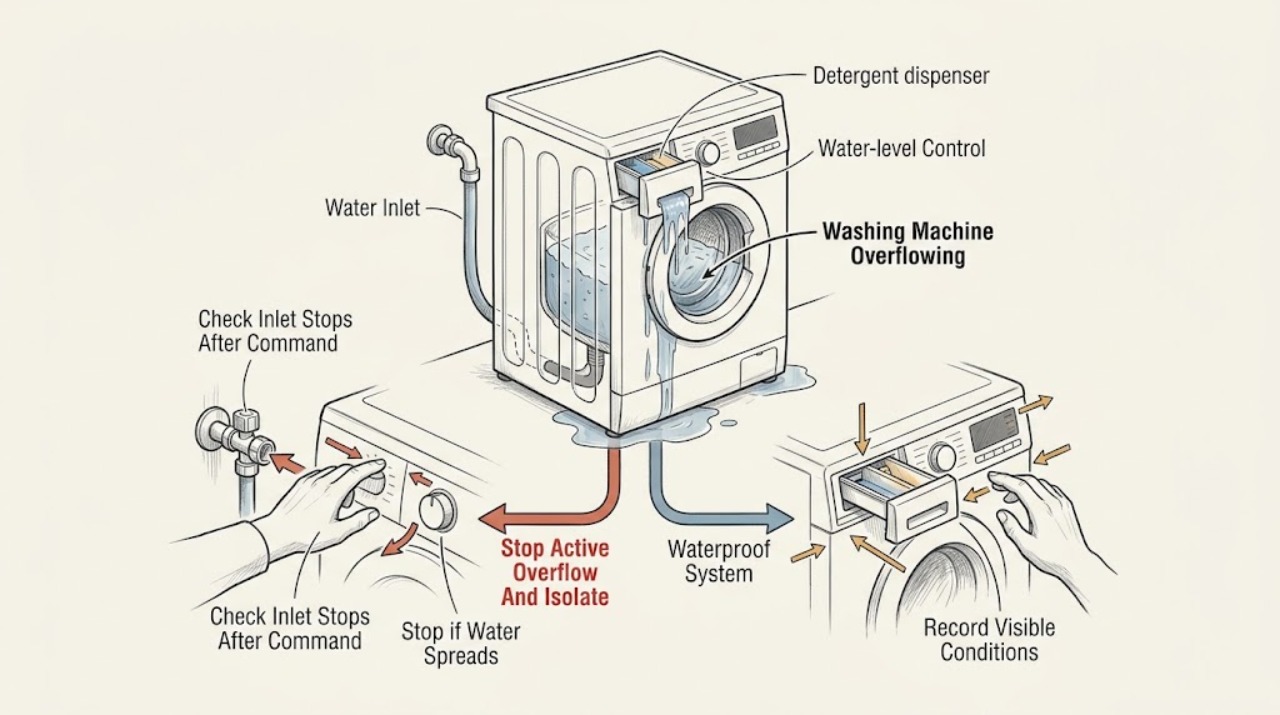
If a Miele washing machine is actively taking in water or water is approaching the door or tub rim, stop the programme, close the water tap from a dry safe position, and isolate power without touching wet electrical equipment. Then distinguish a true overfill from suds rising, a blocked drain or drain-pipe backflow, a leaking detergent drawer, or water escaping underneath. Miele models may use a Waterproof or overflow-protection system, but that protection is not permission to keep running a machine that is overflowing. With the machine off, record when the water rises, whether the inlet stops when the programme is stopped, whether the water is soapy, the exact display message, and where it escapes. Check only model-permitted external hose, drain, drawer, and filter conditions; never open a pressurized inlet, reach into moving or hot water, or dismantle the water-level or inlet system. A continuing inlet after the programme stops, a water-protection message, hot water, uncontrolled leak, water near electricity, smoke, burning smell, sparking, or a repeated breaker trip needs qualified service.
Before you begin
Safety first
- This article covers stopping the programme, closing the accessible water tap, dry-position power isolation, visible hose and drain checks, drawer cleaning, and model-permitted filter care only. Do not touch wet electrical equipment, handle hot or pressurized water, open the cabinet, perform live tests, disconnect pressurized hoses, or bypass the Waterproof system.
Work through in order
Diagnostic checks
Use only checks that match the exact appliance or system and its official guide.
-
Check 1
If water is rising, flowing from the drawer or door, spraying from a hose, or pooling near the washer, stop the programme, close the accessible water tap from a dry position, and isolate power only without touching wet electrical equipment.
Expected result: Record whether water stops entering, whether a drain pump runs, whether water remains in the drum, and whether any water reached the plug, outlet, control, or floor around electrical equipment.
Next step: Keep the washer off and arrange appliance or plumbing service when the inlet continues, the tap will not close, water reaches electrical equipment, or the source is not safely accessible. If safe and dry, continue only with external observations.
Stop if: Do not touch a wet plug or outlet, reach into standing water, run another programme, or repeatedly reset the machine.
Why this matters
Why: Stopping the supply separates an active inlet problem from a retained-water or drain problem and limits flood damage; water near electricity is an immediate safety boundary.
-
Check 2
With the washer stopped, record the complete Miele model, the exact display message or symbol, whether water is clear or sudsy, the water level, and when the rise occurs: fill, dispensing, wash, rinse, drain, spin, or after the programme.
Expected result: Classify the event as continuous clear-water filling, suds expansion, drain backflow or retained water, dispenser overflow, an external hose or connection leak, or an internal leak with no visible source.
Next step: Photograph the display and model label before clearing a message; use only the exact model manual for code meaning, filter access, and any reset.
Stop if: Do not clear an error before recording it, substitute a code from another Miele model, or restart an overflowing machine to reproduce the event.
Why this matters
Why: Timing and water appearance change the next check: inlet and level control for continuous filling, detergent or drawer for foam and dispensing, drain path for backflow, and service for hidden or internal leaks.
-
Check 3
From a dry safe position, stop or cancel the programme using the model's normal control and observe whether clear water continues to enter after the machine should have closed the inlet.
Expected result: Record that water stops, the machine pumps excess water, or water continues despite the stop command and closed programme state.
Next step: If water continues, keep the tap closed and the machine off and arrange qualified Miele service; do not test or replace the valve yourself. If water stops, continue to the drain, drawer, and detergent branches without restarting until safe.
Stop if: Do not leave the washer unattended with the tap open, open the cabinet, perform a live valve test, or repeatedly start and cancel the programme.
Why this matters
Why: Water that continues after a valid stop points toward an inlet valve, control, water-level sensing, or safety-system fault rather than detergent or drain routing. A machine that stops taking water but retains it has a separate drain or level issue.
-
Check 4
With the water tap closed and the machine off, inspect only the visible inlet hose, tap connection, seals, and floor for kinks, damage, drips, or a loose connection; do not disconnect a pressurized hose.
Expected result: Record a kinked or damaged hose, a leaking tap or connection, no visible leak, or a water-inlet fault message with a normal external connection.
Next step: Correct only an obvious accessible kink after the tap is closed. Leave a damaged hose, leaking connection, low pressure, or persistent inlet fault for qualified plumbing or Miele service; reopen the tap only for a supervised model-approved check after the connection is secure.
Stop if: Do not force the tap, remove a hose under pressure, use tools on an uncertain fitting, or run the washer with a damaged or leaking hose.
Why this matters
Why: An external supply problem can leak during filling without being an overfill. A normal external path with a continuing inlet or inlet message shifts suspicion to the inlet filter, valve, pressure, or control system.
-
Check 5
If water enters normally but rises, returns, or remains during drain, inspect the visible drain hose for kinks, an excessive height, insecure insertion, or a loose sink connection, and check whether the household drain or standpipe backs up.
Expected result: Record a blocked or backing-up drain, incorrect hose routing, water returning from the drain, a pump that runs without emptying, or normal visible routing with retained water.
Next step: Correct only visible routing allowed by the exact installation instructions. Use a qualified plumber for a blocked household drain and Miele service for persistent pump, filter, or internal drainage faults.
Stop if: Do not run a chemical drain treatment through the washer, open a filter with hot or pressurized water, or continue if water is pooling near electricity.
Why this matters
Why: Drain restriction, routing, or backflow can make a normal fill look like an overflow and can leave a larger quantity of water inside. A normal visible path with no drain indicates a filter, pump, internal hose, or control fault.
-
Check 6
Only if the exact Miele manual permits owner access, turn the machine off, allow hot water and suds to cool, place a suitable container under the drain access, and inspect or clean the drain filter and pump impeller as directed.
Expected result: Record hot or substantial retained water, coins or other debris, an impeller that cannot move as the manual expects, a clean filter, or a filter that was not safely accessible.
Next step: Stop and arrange service if water is hot or uncontrolled, the filter or impeller is damaged, the filter cannot be refitted securely, or the washer still retains water after permitted care. Verify all filter seals and threads are correctly seated before any supervised normal operation.
Stop if: Do not reach into a moving drum, drain hot suds rapidly, unscrew filters completely without the model procedure, use sharp tools, or open internal pump access.
Why this matters
Why: A blocked filter or pump can prevent drainage and make the tub appear to overfill. Hot suds and retained water create a scald and flood risk, and a filter that is not tightened correctly can itself leak.
-
Check 7
If water or foam escapes from the detergent drawer during dispensing, stop the programme and, when safe, remove and clean the drawer, siphon, and accessible drawer slot exactly as the Miele manual allows.
Expected result: Record a clogged drawer or siphon, detergent or limescale residue at the jets, excessive foam, liquid starch use, or a clean drawer that still overflows.
Next step: Rinse and refit only accessible drawer parts as directed, use the exact detergent and dosage instructions, and arrange service if the drawer still overflows or water appears from inside the cabinet.
Stop if: Do not add more detergent to suppress foam, use sharp tools in jets, force the drawer, run another cycle while it overflows, or treat a clear-water continuous fill as a detergent problem.
Why this matters
Why: Miele says a dirty or clogged drawer can prevent products from flushing into the suds container, and its manual warns that a clogged siphon can overflow. Excess detergent or unsuitable dosing can also make foam rise without a true water-level overfill.
-
Check 8
If the water is mostly foam rather than clear water, record the product, approximate dose, load size, programme, and whether liquid starch or a dosing system was used; do not add water or restart until the foam has settled safely.
Expected result: Record unusually dense foam, a recent detergent or dose change, a small load with excess product, liquid-starch residue, or clear water rising independently of foam.
Next step: Follow the exact Miele detergent and programme instructions on the next safe use only after the source is resolved. Persistent foam, a water-protection response, or clear-water overfill needs Miele service rather than repeated cycles.
Stop if: Do not run a hot cycle to clear foam, mix chemicals, open the door against pressure or heat, or use a larger load as a test.
Why this matters
Why: Foam expansion can spill through the drawer or door without the inlet having overfilled the drum. Clear water that continues to enter or a water-level fault points away from dosage and toward inlet, sensing, or control service.
-
Check 9
If the display or indicator says Waterproof, water protection, inlet, or another fault, record the exact message and whether the inlet tap is closed; follow only the model's instruction for stopping, draining, and contacting service.
Expected result: Record a one-time message that clears after the documented safe action, a water-protection system that remains active, repeated inlet or drain messages, or no message despite visible overflow.
Next step: Keep the tap closed and the machine out of service for a persistent or recurring message. Give Miele service the exact model, message, water state, timing, and whether water continued after stopping.
Stop if: Do not bypass the Waterproof system, clear a recurring message with repeated resets, dry or defeat a float switch, or open the base or control area.
Why this matters
Why: Miele water protection can detect a leak or excess level and shut the intake or run the pump, but a repeated protection response indicates unresolved water, inlet, drain, float, sensor, or control risk.
-
Check 10
After the water is contained and all visible checks are normal, perform no more than one supervised model-approved programme start only if the manual permits it and no safety condition remains; stop immediately if the water rises, leaks, or the same message returns.
Expected result: Record normal filling and draining, clear-water overfill, foam overflow, drain backflow, a recurring protection or inlet message, or any leak or electrical symptom.
Next step: Keep the tap closed and arrange qualified Miele appliance or plumbing service for any repeated overflow, uncontrolled inlet, retained water, internal leak, or technical message. Provide the complete model and record.
Stop if: Do not run repeated test cycles, leave the machine unattended, open panels, bypass safety systems, or continue after hot water, water near electricity, smoke, burning smell, sparking, or a breaker trip.
Why this matters
Why: One controlled result can distinguish a corrected hose, drawer, or drain condition from an unresolved inlet, level, pump, or control fault. Repeated cycles add flood and electrical risk without improving diagnosis.
Use your observations
Decision map
Find the observation that best matches what you see, then follow the next safe action.
-
PATH 01Safety boundary
What you see
Clear water continues entering while the programme is stopped or cancelled, or the drum rises beyond the expected level.
Do this next
Close the water tap, isolate power only from a dry safe position, and arrange qualified Miele appliance service with the exact model and timing record.
Why this path and its safety boundary
Why it matters: The inlet valve, water-level sensing, control, or protection system may not be closing the intake; this is a service branch rather than a detergent or load issue.
Safety stop: Do not leave the tap open, perform live tests, open the cabinet, or keep restarting the programme.
-
PATH 02Safety boundary
What you see
Foam or water escapes mainly from the detergent drawer during dispensing or washing, while clear-water intake stops normally.
Do this next
Stop the programme, clean only the model-permitted drawer and siphon, follow Miele dosing instructions, and request service if the drawer still overflows or leaks from inside.
Why this path and its safety boundary
Why it matters: A clogged drawer or siphon, residue at the jets, liquid starch, or excess or unsuitable detergent can create a foam or dispensing overflow without a failed water-level control.
Safety stop: Do not force the drawer, use sharp tools or chemicals in the jets, add more detergent, or run another foamy cycle.
-
PATH 03Safety boundary
What you see
The washer fills normally but water rises during drain, returns from the drain, the pump runs without emptying, or a drain fault appears.
Do this next
Check visible hose and drain routing, use a qualified plumber for a blocked household outlet, and use only the exact manual's cooled, contained filter procedure before Miele service.
Why this path and its safety boundary
Why it matters: A blocked household drain, kinked or incorrectly routed hose, blocked filter or pump, or internal drain restriction can make normal fill look like an overflow.
Safety stop: Do not handle hot suds, open a filter without safe containment, use chemicals, or run a cycle with water pooling near electricity.
-
PATH 04Safety boundary
What you see
Water appears at an inlet connection, drain hose, sink connection, drain pipe, or underneath rather than rising from the drum.
Do this next
Close the water tap, stop the machine, dry-isolate power if safe, and correct only a clearly accessible permitted routing or clip condition. Use qualified plumbing or Miele service for damage, hidden leaks, or recurring water underneath.
Why this path and its safety boundary
Why it matters: The event is an external supply or drain leak, loose connection, damaged hose, blocked on-site drain, or filter-seal issue rather than necessarily an overfill.
Safety stop: Do not disconnect pressurized hoses, move the washer to inspect behind it, or run a leak test near electrical equipment.
-
PATH 05Safety boundary
What you see
A Waterproof or water-protection indicator appears, the machine shuts the intake, pumps unexpectedly, or a leak sensor response repeats.
Do this next
Keep the tap closed and the machine out of service. Follow only the exact model's safe drain or reset instruction and arrange qualified Miele service if the response recurs.
Why this path and its safety boundary
Why it matters: Miele's protection system may have detected a leak or excess level, but the underlying inlet, hose, drain, float, sensor, or control condition remains unresolved.
Safety stop: Do not bypass the protection system, dry a sensor by opening the base, or repeatedly reset and run the washer.
-
PATH 06Safety boundary
What you see
An inlet fault appears, the tap is closed, the visible inlet hose is kinked, or the machine fills abnormally after a supply interruption.
Do this next
With the tap closed, inspect only visible hose routing and use the exact model's permitted inlet-filter procedure. Restore water only when connections are secure and stop for drips or repeated fault messages.
Why this path and its safety boundary
Why it matters: The accessible possibilities include a closed tap, kinked hose, restricted inlet filter, low supply pressure, or a technical inlet fault; a true overflow after stop needs service.
Safety stop: Do not remove an inlet hose under pressure, force a tap, remove a fixed screen, or run the washer with a leaking connection.
-
PATH 07Safety boundary
What you see
Water or suds remain after a hot programme, the drum cannot safely drain, or water temperature is uncertain.
Do this next
Keep the washer off, allow it to cool without opening unsafe access, and use the exact manual or qualified Miele service for controlled drainage.
Why this path and its safety boundary
Why it matters: Retained water can scald and can escape when a filter or door is opened; the overflow or drain condition is not safe for ordinary owner handling.
Safety stop: Do not open the door against pressure, reach into the drum, rapidly unscrew a filter, or handle hot suds.
-
PATH 08Safety boundary
What you see
Water reaches the plug, outlet, control, or floor electrical equipment, or there is smoke, burning smell, sparking, a hot cord or outlet, or a repeated breaker trip.
Do this next
Keep people away, stop use, isolate water and power only from a dry safe position, and arrange qualified appliance, electrical, or plumbing service.
Why this path and its safety boundary
Why it matters: The priority is electrical, fire, shock, or flood safety, not identifying the washer component.
Safety stop: Do not touch wet electrical equipment, reset a tripping breaker, run the washer, or open panels after a safety event.
-
PATH 09Safety boundary
What you see
The tap, visible hoses, drawer, drain routing, permitted filter care, and one model-approved action are normal, but overflow, retained water, a protection response, or an inlet fault returns.
Do this next
Keep the washer out of service and arrange qualified Miele appliance or plumbing service with the model, message, timing, water appearance, and all observations.
Why this path and its safety boundary
Why it matters: An internal valve, pressure or level system, pump, hose, float, sensor, control, or seal issue is possible, but the symptom alone does not identify a part.
Safety stop: Do not order a component from the symptom alone, open the cabinet, bypass a water-protection device, or keep testing.
Helpful context
Understand the symptom
Stop the water before diagnosing the cause
An overflowing washer can be a true overfill, foam expansion, a blocked drain, drain-pipe backflow, a dispenser overflow, or a leak that only looks like an overfill. If water is still entering, stop the programme and close the accessible water tap from a dry position. Keep water away from the plug and outlet; isolate power only if it can be done without touching wet equipment. Do not keep running the washer to see whether its Waterproof or overflow protection reacts.
Use timing and water appearance as the first split
Record whether the water rises during fill, detergent dispensing, wash, rinse, drain, or after the programme ends. Clear water entering continuously points toward an inlet valve, water-level sensing, or control problem. Sudsy water rising mainly during washing points toward detergent amount, product, or a clogged dispenser. Water returning from the drain or appearing underneath during pump-out points toward drain routing, a blocked outlet, filter, pump, hose, or connection. Exact Miele model and display text matter; do not apply a code from another platform.
Keep owner checks to accessible conditions
After the washer is stopped and safe, inspect visible inlet and drain hoses, the drain-pipe connection, the detergent drawer and siphon, and any model-permitted drain filter. Miele's support pages warn about scalding from hot suds and remaining water and say filters must be correctly refitted to prevent leaks. Do not remove fixed inlet screens, disconnect a pressurized hose, open the cabinet, or test an inlet valve or pressure system live.
The persistent-fault boundary
If the inlet continues after the programme is stopped, the tap cannot be closed, a water-protection message returns, water leaks from underneath, the drain path is blocked, or the machine cannot safely be made dry, leave it out of service and arrange qualified Miele appliance or plumbing help. Stop immediately for hot water, smoke, burning or electrical odor, sparking, a hot cord or outlet, or a breaker that trips again. A safety system that pumps excess water away reduces damage; it does not identify which component failed.
Safety boundary
Stop conditions
- Stop the programme and close the water tap when water is actively entering, rising, or escaping; isolate power only from a dry safe position.
- Do not touch wet plugs, outlets, controls, or other electrical equipment, and stop for smoke, burning or electrical odor, visible sparking, a hot cord or outlet, or a repeated breaker trip.
- Treat hot water, hot suds, retained water, an inaccessible filter, or a door under pressure as a scald and flood hazard; do not open or drain it outside the exact model procedure.
- Do not disconnect a pressurized inlet, move the washer to inspect a gas or water connection, open the cabinet, perform live valve or sensor tests, or bypass the Waterproof system.
- Do not force the detergent drawer or door, use sharp tools or chemicals in filters and jets, or add detergent or water to suppress foam.
- After a continuing inlet, recurring overflow or protection message, hidden leak, blocked drain, or one safe model-approved action fails, keep the machine off and arrange qualified Miele or plumbing service.
Only after diagnosis
Potential parts
- Miele washer water inlet valve or Waterproof inlet assembly
Consider only when the tap, visible inlet hose, permitted filter checks, and qualified testing show that water continues or the inlet does not close as commanded.
Confirm the complete Miele model and whether it uses a Waterproof inlet assembly; do not infer valve failure from foam, drain backflow, or an external hose leak. - Miele washer pressure or water-level sensing component
Consider only when a persistent true overfill remains after inlet and drain checks and qualified diagnosis identifies a level-sensing or pressure-path fault.
Sensing systems vary by model; confirm the model and diagnostic evidence before selecting any internal component. - Miele washer drain pump, filter, or drain hose
Consider only when water is retained or returns during drain after visible routing and model-permitted filter care, and qualified testing supports a pump, filter, or hose fault.
Filter access, pump design, and hose routing are model-specific; hot-water handling and secure refitting are required before any service. - Miele detergent dispenser drawer or siphon
Consider only when overflow is localized to dispensing and cleaning the drawer, siphon, jets, and dosage does not resolve it.
Confirm the exact drawer and dosing configuration; do not treat a clear-water drum overfill as a dispenser-part problem.
When checks do not resolve it
Need a professional?
Arrange qualified Miele appliance service when clear water continues after a programme stop, a water-protection or inlet fault returns, the washer overfills again, the water-level behavior is abnormal, the drain remains restricted after visible routing and model-permitted filter care, the detergent drawer still overflows, or water leaks from underneath or inside the cabinet. Use qualified plumbing service for a blocked household drain, weak supply, leaking on-site inlet or drain, or unsafe connection. Treat water near electricity, hot or uncontrolled water, smoke, burning smell, sparking, a hot cord or outlet, or a repeated breaker trip as an immediate stop condition.
Safety scope: This article covers stopping the programme, closing the accessible water tap, dry-position power isolation, visible hose and drain checks, drawer cleaning, and model-permitted filter care only. Do not touch wet electrical equipment, handle hot or pressurized water, open the cabinet, perform live tests, disconnect pressurized hoses, or bypass the Waterproof system.
Common questions
FAQ
What should I do first if my Miele washer is overflowing?
Stop the programme, close the accessible water tap from a dry position, and isolate power only without touching wet electrical equipment. Record whether water is still entering, whether the water is clear or sudsy, and where it escapes. Do not run another cycle until the cause is separated.
How can I tell a true overfill from too much suds?
Clear water that continues entering after a stop points toward inlet, level sensing, control, or protection service. Dense foam that rises mainly during dispensing or washing points toward detergent amount, product, or a clogged drawer or siphon. Treat either active overflow as a stop condition and do not add water or detergent.
Why does my Miele washer fill and then overflow during draining?
A kinked or incorrectly routed drain hose, blocked household drain, backflow, blocked filter, or pump restriction can leave water in the machine or return water during pump-out. Check visible routing only when safe, and use the exact model procedure for a cooled, contained filter check.
What does Miele Waterproof or water-protection activation mean?
Miele describes protection that can shut the water intake or run the drain pump when a leak or excess level is detected. It limits damage but does not identify the failed component. Keep the tap closed and arrange service if the protection message or behavior returns.
Can a clogged Miele detergent drawer cause water to overflow?
Yes. Miele says a dirty or clogged drawer or siphon can prevent products from flushing into the suds container and can cause the drawer to leak or overflow. Clean only the accessible parts permitted by the model manual, then use the specified detergent and dosage.
Is it safe to open the drain filter when the washer has overflowed?
Only when the exact model manual permits it and the machine is off, the water and suds have cooled, and a suitable container can safely contain the flow. Miele warns about scalding and leaks from incorrectly refitted filters. Stop and use qualified service if water is hot, uncontrolled, or near electricity.
Why does water continue entering after I cancel the wash?
If the tap is open and clear water continues after a valid stop, an inlet valve, water-level system, control, or protection fault may be present. Close the tap, keep the washer off, and arrange qualified Miele service. Do not perform a live valve test or open the cabinet.
When should I call service for a Miele washer overflow?
Call when the inlet does not stop, a water-protection or inlet message returns, the drain remains restricted, water leaks from underneath or inside, the drawer continues to overflow, or one model-approved external check does not resolve the event. Stop immediately for hot water, water near electricity, smoke, burning smell, sparking, a hot outlet, or a repeated breaker trip.
Read the exact guide
Official sources
- WEJ 885-HK-enMiele · Miele operating and installation documentation for a specific model family; protection hardware and water connections vary by model.
- Kurz-GA WWD 164-AU-enMiele · Miele quick-start guide for WWD 164 family in AU/NZ; exact symbols, settings, and procedures vary by model.
- Miele Washer | Water inlet fault appears in the display of the washing machine/washer-dryer.Miele USA · Miele USA washer and washer-dryer support; use the exact model manual for inlet-filter access and reconnection.
- Operating and Installation InstructionsMiele USA · Miele operating manual for model WWH 860; use only the safety principles and follow the exact manual for the washer being serviced.
- Miele Washer | Water drainage fault appears in the washing machine display.Miele USA · Miele USA washer support; exact filter access, drain height, and model procedure vary.
- Miele Washer | The detergent drawer of the washing machine/washer-dryer is leaking.Miele USA · Miele USA washer and washer-dryer support; drawer and dosing configurations vary by model.
- Miele Washer | Water is leaking out under the washing machine/washer-dryer.Miele USA · Miele USA washer and washer-dryer support; installation and connection details vary by model and site.
Community feedback
Share a repair observation
Share a plain-text repair observation. Accepted observations are published automatically; this page may take a moment to update.