
On this page
Start here
Quick answer
An oven that appears to be leaking may be releasing food liquid, steam condensation, water from a model-specific steam or cleaning function, or a true leak from a door, reservoir, or internal component. Let the oven cool, identify the first wet point, and check whether the moisture appeared after high-moisture food, steam use, or cleaning. Do not operate the oven if you smell gas, see smoke or an abnormal flame, or find water near electrical parts. If the source is not an accessible spill or normal condensation, or the leak repeats after the model instructions are followed, stop using the oven and arrange appliance service.
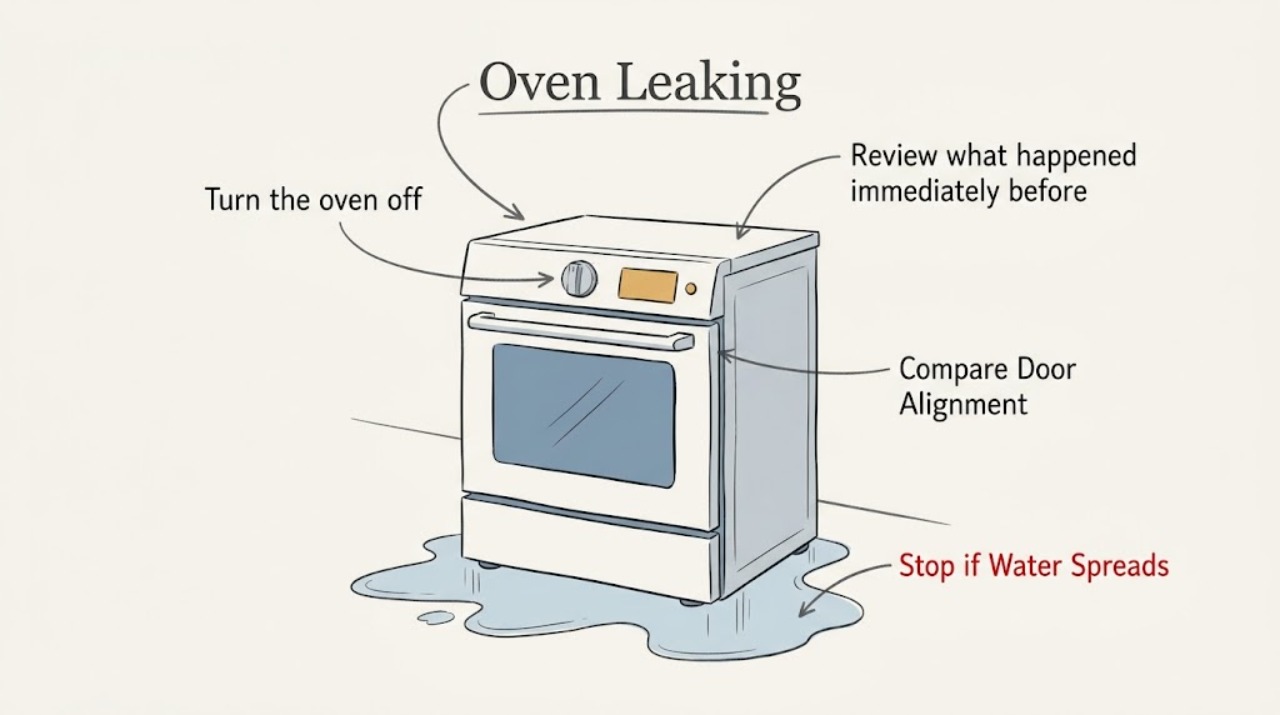
Work through in order
Diagnostic checks
Use only checks that match the exact appliance or system and its official guide.
-
Check 1
Turn the oven off and wait until it is cool enough to touch safely; place a dry towel outside the appliance and trace the first wet point without removing panels or reaching behind the cabinet.
Expected result: Moisture begins at the cavity floor, door edge or seal, water-reservoir area, vent path, floor beneath the unit, or an adjacent surface rather than inside the oven.
Next step: Photograph the location after cooling and continue only with the matching low-risk branch. If the source is behind the cabinet, under the unit, or near wiring, stop and arrange service.
Stop if: Stop for hot liquid, active leaking, wet electrical parts, smoke, a burning odor, or any need to move or dismantle the oven.
Why this matters
Why: The location separates a food spill or condensation path from a model-specific water system, door-seal issue, cabinet leak, or water source outside the oven.
-
Check 2
Review what happened immediately before the moisture appeared: high-moisture food, a gas bake cycle, a steam function, a steam-clean cycle, a drain cycle, or cleaning and removal of a water container.
Expected result: Moisture is limited to the door or cavity after moist food or gas heating, or it follows a steam or cleaning cycle and remains in the reservoir or cavity.
Next step: Follow the exact owner instructions for the identified function, allow the oven to cool, and wipe visible residual moisture with an appropriate cloth or sponge. If water appears during an ordinary non-steam cycle or outside the instructed areas, stop using the oven and request service.
Stop if: Do not add water, start another steam or cleaning cycle, or continue cooking to test the leak when the source is unclear or the amount is increasing.
Why this matters
Why: Steam condensing on cool surfaces can be normal for some cooking conditions; a steam or cleaning system can also leave residual water, but its fill, drain, and cleanup rules are model-specific.
-
Check 3
With the oven cold, inspect the visible door glass, gasket, hinge area, and cavity rim for food debris, a displaced seal, cracks, gaps, or a door that does not close evenly; clean only accessible surfaces with the method allowed by the manual.
Expected result: The door closes evenly and the seal is intact, or the seal is torn, displaced, hardened, the glass is cracked, or liquid follows the door edge on every use.
Next step: If the seal or glass is damaged, stop operating the oven and arrange service. Do not force the door, remove the door, or substitute an unverified gasket.
Stop if: Stop for cracked glass, a loose door, exposed insulation, sharp metal, a door that cannot latch, or hot steam escaping toward a person.
Why this matters
Why: An intact door and moisture limited to cool surfaces favors condensation; a damaged seal, glass, hinge, or repeated edge leak needs appliance diagnosis and may allow heat or steam to escape abnormally.
-
Check 4
If the oven has a steam function or water container, compare the water level and container seating with the exact model instructions after the oven has cooled; check only visible seating and the marked maximum line.
Expected result: The container is above its maximum mark, was pulled out while tilted, is not seated correctly, or the model has no water feature but water is present.
Next step: Stop using the steam feature until the container is correctly positioned and the manual's drain or residual-water procedure is complete. If the container, valve seat, drain, or cabinet continues to leak, use appliance service.
Stop if: Do not open a water-system panel, force a stuck container, exceed the marked fill level, or use a steam function when water is near electrical controls.
Why this matters
Why: An overfilled or incorrectly removed container can overflow or drip at its valve area on applicable steam models; water in a non-steam area or outside the instructed path is not explained by that feature.
-
Check 5
From a safe position during a normal cycle only when there is no gas odor, smoke, active leak, damaged door, or wet electrical area, note whether the moisture is clear food liquid, clean water, oily residue, or condensation and whether it returns at the same location.
Expected result: A one-time food spill dries after cooling, condensation dissipates, or clear water repeatedly returns from a seam, vent, reservoir, or underside.
Next step: Stop further cooking if the water returns or the amount increases. Give the technician the cycle, food, location, color, timing, and photos instead of repeating the test.
Stop if: Stop immediately for gas odor, abnormal flame, smoke, electrical odor, arcing, water near controls, or a leak that could reach the floor or cabinetry.
Why this matters
Why: A one-time spill or expected condensation is different from a recurring leak; repeated water at a seam, vent, reservoir, or underside indicates a seal, drain, reservoir, installation, or internal fault.
-
Check 6
Before requesting service, record the model and fuel type if known, the cycle and food involved, the first wet point, whether the door was opened during cooking, and any error or safety message; do not remove panels to identify the part.
Expected result: The evidence identifies an accessible spill or expected condensation, or it shows a persistent leak, damaged door, unexplained reservoir loss, or water reaching the appliance base.
Next step: Use the documented evidence to arrange service when the cause is persistent or uncertain. Keep the oven off until a damaged, wet, or gas-related condition has been assessed.
Stop if: Do not continue operating an oven with recurring leakage, wet wiring, cracked glass, abnormal flame, smoke, or a gas odor.
Why this matters
Why: The first group may be resolved by cooling and the exact manual procedure; the second group needs an appliance technician to inspect seals, water routing, venting, controls, or internal components safely.
Use your observations
Decision map
Find the observation that best matches what you see, then follow the next safe action.
-
PATH 01Next step
What you see
The moisture is a one-time food spill or light condensation on the door or cavity after moist food or gas heating.
Do this next
Let the oven cool and wipe visible moisture using the method in the owner instructions. If it returns from an unexpected seam or continues during ordinary cycles, stop and request service.
-
PATH 02Next step
What you see
A steam, steam-clean, or water-container feature was used.
Do this next
Use only the exact model's drain, fill, seating, and residual-water procedure; do not exceed the marked maximum or improvise a water path. Persistent leakage requires service.
-
PATH 03Next step
What you see
Water follows the door edge, the door does not close evenly, or the gasket or glass is damaged.
Do this next
Stop using the oven and arrange appliance service. Do not force the door, remove it, or run another cycle to test the seal.
-
PATH 04Next step
What you see
Water comes from the underside, cabinet, wall, or a hidden area, or the cause cannot be identified after cooling.
Do this next
Keep the appliance off and have a technician inspect it; do not move the oven, open panels, or dismantle plumbing or electrical parts.
-
PATH 05Next step
What you see
A rotten-egg gas odor, hissing, abnormal flame, smoke, burning smell, or electrical arcing is present.
Do this next
Leave the area without operating switches, appliance controls, phones, or flames, and contact emergency or gas authorities from a safe location. Do not return until the appropriate authority says it is safe.
Helpful context
Understand the symptom
Start with the first wet point, not the largest puddle. A spill can run along the cavity floor or door and make a harmless cooking event look like an appliance leak. Steam can also condense on a cool door, seal, or cavity surface, especially after cooking foods with a lot of water. These clues do not prove that every oven is safe to keep operating, so the source and timing still matter.
Steam ovens and some cleaning systems have a water container, drain function, or reservoir. Those features are model-specific. Use only the owner instructions for the exact model, respect the marked maximum level, and remove residual water only after the cavity has cooled. Do not add water to a non-steam oven or improvise a drain path.
Gas odor is a separate emergency, not a type of water leak. If the odor resembles rotten eggs or you hear escaping gas, leave the area without operating switches, controls, phones, or flames and contact emergency or gas authorities from a safe location. If water has reached electrical equipment, keep away and arrange qualified help before using the appliance again.
Safety boundary
Stop conditions
- Stop immediately for a gas odor, hissing, abnormal flame, smoke, burning or electrical odor, arcing, or repeated tripping of electrical protection.
- Stop using the oven when active water reaches controls, wiring, the floor, or adjacent cabinetry, or when water is coming from behind the cabinet or underside.
- Do not continue if the check requires opening panels, removing the door, dismantling a steam system, moving a built-in oven, or operating a damaged appliance.
Only after diagnosis
Potential parts
- oven door gasket
Consider this only after inspection confirms that the exact model's gasket is torn, displaced, hardened, or no longer sealing evenly.
Confirm the model-specific gasket design and installation requirements; do not substitute a generic seal or remove the door without the manual or a qualified technician. - steam oven water container seal
Consider this only for a model with a water container when the exact manual or technician diagnosis identifies a failed seal or valve-seat component.
Confirm the exact model and water-system configuration before ordering or replacing any seal.
When checks do not resolve it
Need a professional?
Arrange appliance service when water repeatedly returns, the first wet point is behind the cabinet or under the oven, the door or gasket is damaged, or a steam reservoir or drain leaks after the exact manual procedure., Stop using the oven and seek urgent qualified help for water near electrical controls, smoke, burning odor, abnormal flame, cracked glass, or a door that will not close safely., If you smell or hear natural gas, leave immediately and contact emergency or gas authorities from outside the area; do not try to locate the gas source yourself.
Common questions
FAQ
Why is water coming out of my oven door?
Steam from gas combustion or high-moisture food can condense on a cool oven door, and some steam functions can leave residual water. A recurring stream, damaged gasket, unevenly closing door, or water from an unexpected seam is not something to keep testing; let the oven cool and arrange service.
Is water in an oven after steam cleaning always a failure?
Not necessarily. Applicable steam-clean or steam-oven systems may leave residual water that the model instructions tell you to remove after the oven cools. Do not add extra water or use that explanation for a leak from the underside, cabinet, or electrical area.
What should I do if the oven leak smells like gas?
Treat the odor as a gas emergency, not as a water or condensation symptom. Leave the area without operating switches, appliance controls, phones, or flames, and contact emergency or gas authorities from a safe location.
Can I keep using an oven that drips a small amount of water?
Only a one-time food spill or expected condensation that stops after cooling may be handled by the exact owner instructions. Repeated or unexplained water, water near electrical controls, damaged glass or seals, smoke, abnormal flame, or any gas odor means stop using the oven and seek qualified help.
Read the exact guide
Official sources
- Water Dripping or Condensation - Wall OvenWhirlpool Product Help · Whirlpool wall ovens with applicable steam or water-container functions
- Moisture on the Inner WindowWhirlpool Product Help · Whirlpool gas oven door-glass moisture and high-moisture cooking guidance
- Recognizing and Responding to Pipeline EmergenciesU.S. Department of Transportation Pipeline and Hazardous Materials Safety Administration · U.S. government natural-gas emergency response guidance
- Interior or Cavity - Wall OvenWhirlpool Product Help · Whirlpool steam wall oven cavity moisture and steam-clean guidance
- Moisture On Door - RangeWhirlpool Product Help · Whirlpool ranges with gas-oven, high-moisture-food, and steam-bake guidance
Community feedback
Share a repair observation
Share a plain-text repair observation. Accepted observations are published automatically; this page may take a moment to update.