
On this page
Start here
Quick answer
Some oven noise is designed operation: a cooling or convection fan can hum and continue after a cycle, relays can click as heating is controlled, and metal can crack or pop as it heats and cools. The useful first distinction is gas versus electric, then the sound's timing, location, and effect on cooking. Grinding, squealing, persistent loud noise, a gas-ignition boom, a door movement, continuous sparking, smoke, burning odor, or an electrical arc is not a normal sound to troubleshoot by repeated testing. Stop using the oven and arrange qualified appliance service; for a gas odor or carbon-monoxide alarm, leave the area and follow emergency guidance.
Before you begin
Safety first
- The homeowner scope ends at identifying fuel and mode, observing timing and location from a safe position, and handling cool user-accessible racks or trays. Internal fans, motors, relays, elements, igniters, gas valves, wiring, and live electrical or fuel testing require qualified service.
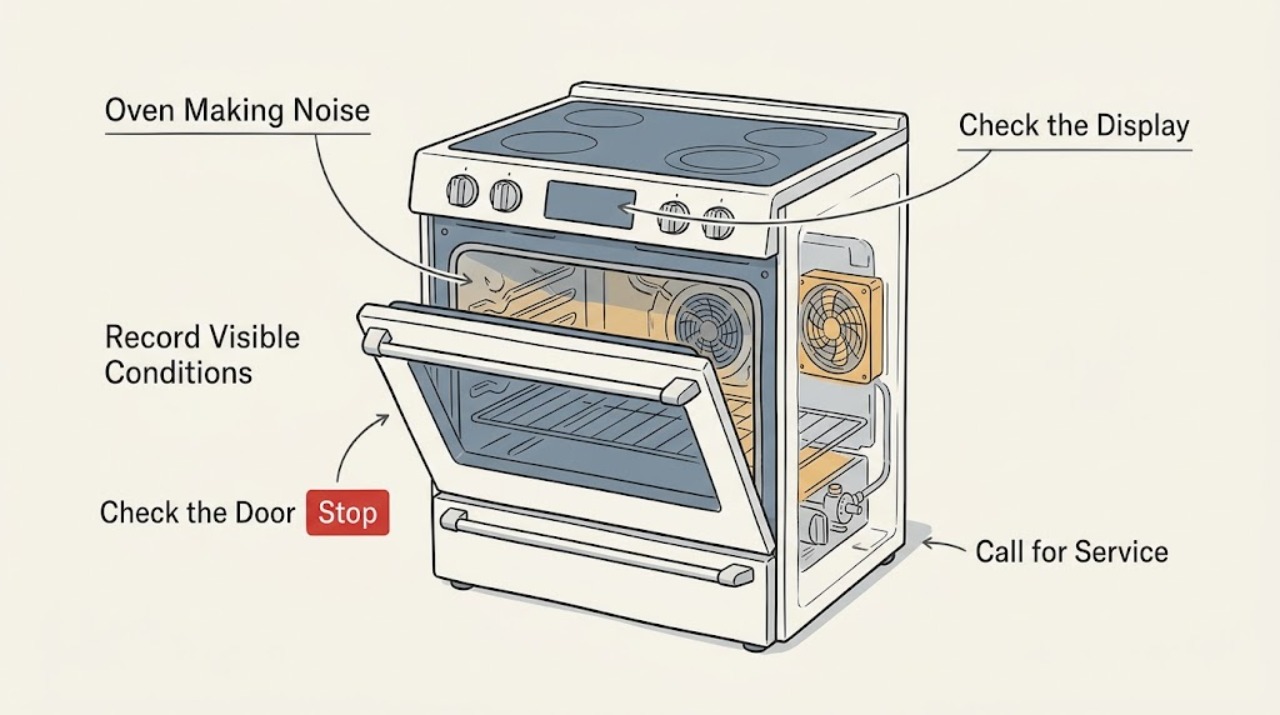
Work through in order
Diagnostic checks
Use only checks that match the exact appliance or system and its official guide.
-
Check 1
Identify whether the appliance is electric, gas, or dual-fuel from its controls, manual, or existing installation information, without removing a panel or testing a burner; record the cooking mode and whether self-clean or convection was selected.
Expected result: The sound occurs on an electric heating cycle, a gas bake or broil cycle, a convection cycle, a cooling phase, or an unknown mode.
Next step: Use the exact model manual or arrange appliance service if the fuel type or mode cannot be confirmed. Do not make a gas or electrical repair based on a generic sound description.
Why this matters
Why: Fuel type and mode change which fan, relay, element, igniter, or burner sounds can be normal; an unknown identity means model-specific guidance is needed before interpreting the noise.
-
Check 2
Note when the sound begins and ends in relation to preheat, heating cycles, door opening, convection, self-cleaning, the end of cooking, or the oven becoming cool; do not keep restarting the cycle to reproduce it.
Expected result: The sound is brief during heat-up or cycling, continues while the oven cools, occurs only with convection, or persists after the oven is cool.
Next step: Compare the timing with the exact manual's normal-sounds guidance. If the sound is persistent, louder than before, or not explained by the manual, stop using the oven and request service.
Why this matters
Why: Brief relay, metal-expansion, or fan sounds can be designed behavior, while a noise that persists after cooling or appears only as a harsh mechanical sound is less consistent with normal operation.
-
Check 3
From a cool, safe position, localize the sound as coming from the rear or top cooling area, the convection fan area, the control panel, the oven cavity, the burner area, or the cabinet; do not reach through vents or remove guards.
Expected result: The sound is a soft airflow or hum, a repeated click, a short crackle or pop, a rubbing or grinding sound, a hiss, or a sharp bang.
Next step: Keep the observation external and report the sound type and location to an appliance technician. Do not diagnose an internal fan, element, igniter, valve, or wiring from sound alone.
Why this matters
Why: Airflow, relay, and heat-expansion sounds can be normal in the right phase; rubbing or grinding points toward a fan or mechanical issue, while a hiss or bang requires fuel-type and safety evaluation.
-
Check 4
When the oven is completely cool, remove only loose, user-accessible racks, trays, foil, or cookware that the manual allows you to handle, then check whether an external pan or rack was vibrating against the cavity; do not bend supports or use the oven again if damage is visible.
Expected result: The noise changes when a loose rack or tray is removed, or it remains unchanged with the cavity clear and cool.
Next step: Reseat the accessible rack or tray only if it is undamaged and the manual supports it. For continued noise, stop using the oven and arrange appliance service.
Why this matters
Why: A movable rack or pan can transmit harmless vibration, but unchanged grinding, scraping, or knocking is more consistent with an internal fan, motor, mount, or other service issue.
-
Check 5
If the sound is a fan or hum, observe whether airflow comes from the designed vent area and whether the noise occurs during or after cooking; do not insert anything into a fan opening or attempt to lubricate or spin a fan.
Expected result: The fan runs quietly during a documented cooling or convection phase, or it squeals, grinds, rattles, stops and starts harshly, or continues unusually after cooling.
Next step: Stop using the oven for a harsh or persistent fan noise and call appliance service. Keep the model and the fan phase available for the technician.
Why this matters
Why: A quiet, phase-linked fan can be normal, but squealing, grinding, rubbing, or unexplained persistence may indicate a fan or motor problem and should not be tested by repeated cycles.
-
Check 6
If the oven is gas, observe only from a safe position whether a click or soft brief poof coincides with normal burner cycling; never relight, adjust, or repeatedly test an ignition event, and never search for a gas leak.
Expected result: There is a brief cycle-linked click or poof, a delayed boom, the door moves, clicking continues without a heat call, the flame sounds abnormal, or an unburned-gas odor is present.
Next step: Stop using the gas oven and arrange qualified gas-appliance service for any abnormal event. For a strong or persistent gas odor, do not operate switches or flames; leave and contact the local emergency or gas-safety channel from outside.
Why this matters
Why: Some models make brief ignition or valve sounds, but a boom, door movement, persistent ignition noise, abnormal flame, or unburned-gas odor can indicate delayed ignition or a fuel fault.
-
Check 7
If the sound is electrical rather than a normal relay click, observe only from a safe distance for a flash, arc, sizzling, smoke, burning odor, hot control area, or a breaker trip; do not open the oven, touch wiring, or repeat the event.
Expected result: There is visible arcing, continuous sparking, smoke, a burning smell, heat damage, or a protective device opens.
Next step: Stop using the oven, keep people away, and arrange urgent qualified appliance or electrical service. Leave and contact emergency services for active smoke or fire.
Why this matters
Why: These are potential fire or shock indicators and are not normal heating-control sounds, even if the oven still appears to operate.
-
Check 8
Prepare a service handoff with the exact model, fuel type, mode, sound description, phase, location, frequency, door or flame behavior, error display, and any odor, smoke, heat, or breaker event; do not guess a replacement part.
Expected result: The record identifies a documented normal fan, relay, or expansion sound, or an unexplained mechanical, gas, or electrical sound.
Next step: Use the oven only if the sound is clearly normal for the exact model and there are no warning signs. Otherwise leave it off until qualified service confirms safe operation.
Why this matters
Why: A precise sound pattern helps the technician compare the appliance with the correct model behavior without unsafe live testing or unnecessary part replacement.
Use your observations
Decision map
Find the observation that best matches what you see, then follow the next safe action.
-
PATH 01Next step
What you see
The noise matches the mode and timing described by the exact model manual, with stable operation and no warning symptom.
Do this next
Treat it as likely normal operation, continue to monitor, and request service if it becomes louder, harsher, persistent, or changes the oven's performance.
-
PATH 02Next step
What you see
A fan or blower sound is mechanically harsh, louder than before, or continues after the oven has cooled.
Do this next
Stop using the oven and arrange appliance service. Do not reach into the fan, remove a guard, lubricate it, or replace a motor based only on the sound.
-
PATH 03Next step
What you see
The oven is confirmed gas and the sound is more than a brief normal cycle-linked click or poof, or unburned gas is suspected.
Do this next
Stop using the oven. Do not ignite, switch electrical controls, search for the leak, or repeat the event; leave for a strong gas odor and arrange qualified gas-appliance service from safety.
-
PATH 04Next step
What you see
There is arcing, continuous sparking, sizzling, smoke, burning odor, heat damage, or a breaker trip.
Do this next
Stop using the oven and keep clear. Arrange urgent qualified appliance or electrical service; leave and contact emergency services for active smoke or fire.
-
PATH 05Next step
What you see
The appliance identity, mode, or sound source is unclear.
Do this next
Do not generalize gas ignition or electric heating behavior across models. Keep use conservative and obtain the exact manual or appliance service assessment.
Helpful context
Understand the symptom
Normal sounds depend on the model and phase
A fan may cool the controls or circulate convection air, and its timing differs between electric, gas, dual-fuel, freestanding, and wall-oven designs. Temperature controls and relays can click as elements cycle. Metal can make short crackling or popping sounds while expanding or contracting. These explanations apply only when the sound is quiet or expected for the selected mode, the oven remains stable, and there is no smoke, odor, flame abnormality, or loss of control.
Do not turn a noise question into a live repair
Keep inspection to the controls, cool exterior, racks, trays, and other user-accessible parts described by the exact manual. Do not remove covers, reach near an element or igniter, probe a fan, adjust a gas valve, bypass a door or safety switch, or repeat a gas-ignition or electrical-arcing event. A noise that is loud, persistent, mechanically harsh, or associated with gas, smoke, heat damage, or an alarm needs service rather than a part guess.
Safety boundary
Stop conditions
- Stop immediately for smoke, flame outside the intended burner, visible electrical arcing or continuous sparking, sizzling, a burning or melting odor, a hot or discolored control area, or a breaker trip.
- For a strong or persistent unburned-gas odor, do not operate switches, flames, or the oven. Leave the area and contact emergency or gas-safety help from outside; do not search for the leak.
- If a carbon-monoxide alarm sounds or anyone has possible carbon-monoxide symptoms, leave for fresh air and follow emergency guidance. Do not re-enter or reuse a fuel-burning oven until trained personnel clear it.
- Do not remove covers, reach near elements, igniters, fans, valves, or wiring; probe a fan; adjust gas controls; bypass a door or safety switch; or repeat a suspected ignition or electrical-arc event.
- Stop using the oven for grinding, scraping, a loud persistent fan, a delayed-ignition boom, door movement, or a noise that changes with heat in an unexplained way; arrange qualified service.
When checks do not resolve it
Need a professional?
Call appliance service for grinding, squealing, persistent or worsening noise, unexplained humming, abnormal fan operation, repeated sharp popping, a gas-ignition boom, abnormal flame, or any noise accompanied by an error, heat problem, odor, smoke, or door movement. Use qualified electrical service when arcing, wiring, a hot control area, or a breaker trip is involved.
Safety scope: The homeowner scope ends at identifying fuel and mode, observing timing and location from a safe position, and handling cool user-accessible racks or trays. Internal fans, motors, relays, elements, igniters, gas valves, wiring, and live electrical or fuel testing require qualified service.
Common questions
FAQ
Is it normal for an oven to click or pop?
Often, yes: relays or temperature controls can click, and metal can crackle or pop as it heats and cools. It is only reassuring when the sound is brief, phase-linked, and matches the exact model's guidance without smoke, odor, flame abnormality, or performance change.
Why does my oven fan keep running after cooking?
A cooling fan may continue after a cycle to cool the oven or its controls, and some convection fans operate in selected modes. If the fan grinds, squeals, rubs, becomes unusually loud, or continues after the oven is cool, stop using the oven and request service.
What does a boom from a gas oven mean?
A boom or door movement can indicate delayed ignition rather than a normal brief cycle sound. Stop using the oven and arrange qualified gas-appliance service; do not repeat the ignition test. For unburned-gas odor, leave and seek emergency or gas-safety help from outside.
Can I remove the oven cover to find the noise?
No. Internal fans, relays, heating elements, igniters, gas valves, and wiring can present burn, shock, or fuel hazards. Limit yourself to cool user-accessible parts and external observation, then use qualified appliance service for an unexplained noise.
Read the exact guide
Official sources
- Samsung Wall Oven FAQsSamsung · Manufacturer guidance distinguishing normal wall-oven fan, relay, and metal-expansion sounds from grinding, squealing, or persistent noise
- Gas Range - What is Normal Operation vs What Requires ServiceGE Appliances · Manufacturer gas-oven sound, ignition, flame, gas-odor, and delayed-ignition service boundaries
- Range & Wall Oven - Fan Noise and Normal OperationGE Appliances · Manufacturer examples of convection and cooling fan operation across electric, gas, and dual-fuel models
- Range & Wall Oven - Clicking and Other NoisesGE Appliances · Manufacturer examples of normal range and wall-oven clicking, humming, fan, and metal-expansion sounds
- Carbon Monoxide Fact SheetU.S. Consumer Product Safety Commission · Carbon-monoxide risk, fuel-burning appliance safety, and alarm response
Community feedback
Share a repair observation
Share a plain-text repair observation. Accepted observations are published automatically; this page may take a moment to update.