
On this page
Start here
Quick answer
Do not tap, shake, or keep using a Panasonic NN-SC668S that starts heating only after the cabinet is struck. That is an intermittent symptom, not a repair, and it can indicate an unsafe door/latch or electrical connection condition that cannot be identified from the outside. Stop the oven, disconnect it if this can be done safely, and record what was already observed without repeating the test. The exact Panasonic manual forbids cabinet disassembly and tampering with door safety interlocks; arrange qualified Panasonic or microwave service rather than testing a magnetron, inverter, capacitor, switch, or control board.
Before you begin
Safety first
- Do not tap, shake, or continue operating the oven to make heating return. Do not remove the cabinet or waveguide cover, defeat or bypass door safety interlocks, discharge a capacitor, probe live circuits, or substitute a magnetron, inverter, turntable motor, switch, or control board from a symptom alone. Keep the unit disconnected for smoke, burning smell, arcing, unexpected operation, damaged door/cavity/cord, hot plug, water near electrics, or repeated breaker operation.
Work through in order
Diagnostic checks
Use only checks that match the exact appliance or system and its official guide.
-
Check 1
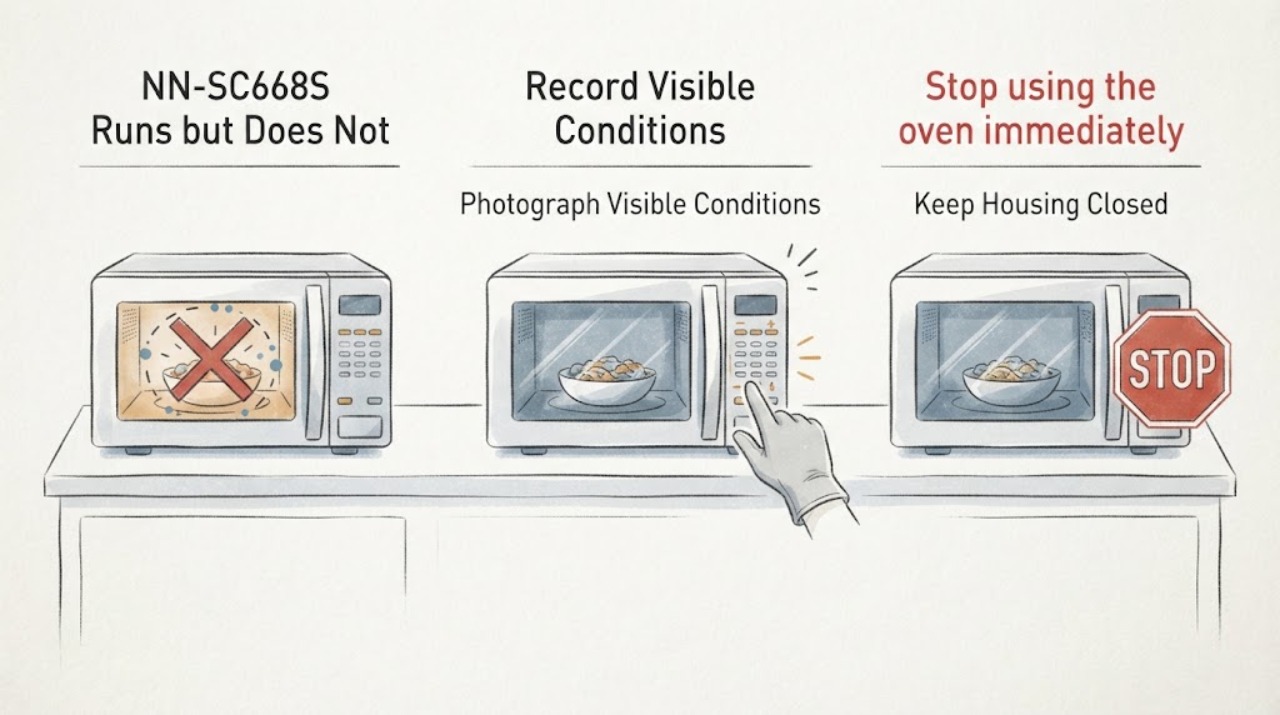
Stop using the oven immediately. Do not tap, slap, shake, lean on, or repeatedly start it to see whether heating returns. If there is no smoke, fire, exposed damage, or wet electrical area, disconnect the plug by holding the plug itself; otherwise keep clear and use the appropriate electrical-safety response.
Expected result: The oven is now disconnected, or it is still connected because reaching the plug would be unsafe; note any smoke, burning smell, arcing, damaged cord, heat at the plug, or breaker operation.
Next step: Keep the NN-SC668S out of service and continue only with unpowered external documentation. Do not reconnect it for a confirmation run, a cup-of-water test, or a different outlet test.
Why this matters
Why: A temporary response to impact is an intermittent safety warning, not a user repair. Panasonic says not to operate an oven that is not working properly or has been damaged, and its manual reserves service and adjustment for qualified personnel.
-
Check 2
Write down what happened before power was removed, without trying to reproduce it: whether the timer counted down, the interior light and fan ran, the turntable rotated, food stayed cold, and whether tapping changed the turntable or only the heating result. Record when the symptom began and whether the door had been opened during the cycle.
Expected result: The oven appeared to run but the turntable did not rotate, the turntable and fan ran while food stayed cold, operation stopped, or the earlier observation is uncertain.
Next step: Give the timeline and the no-retest instruction to the service provider. If the oven ever ran with the door open, showed arcing, or changed behavior when the door or cabinet was struck, mark that as an urgent safety detail and do not energize it again.
Why this matters
Why: These are different service clues, not interchangeable diagnoses. The exact Reddit case reports the first pattern, but its commenters' switch theory is unverified; the observation alone cannot prove a door interlock, turntable motor, inverter, magnetron, or control failure.
-
Check 3
With the plug disconnected, read the identification plate and photograph the complete model, serial number, and any market or rating information. Confirm that it says NN-SC668S rather than a similar NN-SC, NN-SN, or NN-SA model.
Expected result: The identification plate confirms NN-SC668S and the service market is known, or the suffix, serial, or market cannot be read or differs from the assigned identity.
Next step: Use Panasonic support for the confirmed market and identity. If the label does not match, stop applying this article's model-specific boundary and provide the actual identity to service instead.
Why this matters
Why: Panasonic's model page and manual are specific to NN-SC668S, and the product page marks it discontinued. A similar model can have different control, door, or service documentation; the label is needed before any compatibility or warranty discussion.
-
Check 4
While the oven remains unplugged, inspect only from the outside: the door should sit squarely, close without force, and show no bent frame, loose hinge, broken latch, cracked seal, or visible cavity damage. Look through the door at the glass tray, roller ring, cavity floor, and waveguide-cover area without removing anything.
Expected result: There is visible door, latch, hinge, seal, cavity, waveguide-cover, cord, or cabinet damage, or all visible surfaces appear intact.
Next step: For any visible damage, stop and request qualified inspection; do not bend, lubricate, tape, remove, or realign the door or waveguide cover. If nothing visible is wrong, still leave the oven disconnected because tapping has already shown an unresolved intermittent condition.
Why this matters
Why: The exact manual says not to operate if the door, hinges, latches, seals, or sealing surfaces are damaged, and identifies the waveguide cover as a part that must not be removed. An intact exterior does not clear an intermittent internal electrical or door-safety fault.
-
Check 5
Prepare a service handoff rather than a new heating test: provide the model/serial photos, purchase and market information, the exact no-heat timeline, what moved when the cabinet was tapped, whether the turntable rotated, and any smoke, smell, arcing, door, cord, or breaker symptom. Do not open the cabinet, remove the waveguide cover, bypass a door interlock, perform capacitor work, or make a live measurement.
Expected result: The provider can reproduce the history from the record, or requests that the customer reconnect or strike the oven to demonstrate the symptom.
Next step: Decline to energize or strike the oven for demonstration and arrange an authorized or otherwise qualified microwave technician to inspect it. Keep it disconnected until that inspection is complete.
Why this matters
Why: Panasonic requires qualified service for examination, repair, or adjustment. A service request that depends on repeated impact or cabinet access crosses the safe owner boundary; the model's inverter architecture also does not justify importing conventional high-voltage tests.
Use your observations
Decision map
Find the observation that best matches what you see, then follow the next safe action.
-
PATH 01Next step
What you see
The NN-SC668S heats only after tapping, or its heating/turntable behavior changes when the cabinet or door is disturbed.
Do this next
Keep the oven unplugged and request qualified microwave service. Give the provider the exact model, timing, and the fact that impact changed behavior; do not try to reproduce it.
Why this path and its safety boundary
Why it matters: This is a repeatable intermittent safety symptom, not evidence for one replaceable part. A loose or damaged door-safety condition and an internal electrical or control fault remain possible, and neither can be cleared by another tap.
-
PATH 02Next step
What you see
The door, latch, hinge, seal, cavity, waveguide-cover area, cord, or plug shows visible damage, or the oven ever operated with the door open.
Do this next
Do not power the oven. Keep clear of the damaged area and arrange qualified inspection; do not force the door, bridge an interlock, remove the waveguide cover, or attempt alignment.
Why this path and its safety boundary
Why it matters: Panasonic treats door and sealing damage and tampering with safety interlocks as exposure and injury hazards; the appliance should not be operated merely because the display or fan still works.
-
PATH 03Next step
What you see
The oven is unpowered and no visible damage is found, but the previous no-heat event is not fully documented or the model/market is uncertain.
Do this next
Do not perform a new water test or reconnect it. Confirm the identification plate and send the recorded history to Panasonic or a qualified microwave service provider for an identity-specific decision.
Why this path and its safety boundary
Why it matters: A clean exterior and incomplete history cannot rule out an intermittent internal fault, and the exact NN-SC668S documentation may not apply to another suffix or market.
-
PATH 04Next step
What you see
There is smoke, fire, an electrical smell, arcing, a hot or damaged plug/cord, water near electrics, repeated breaker operation, or the oven starts operating unexpectedly.
Do this next
Do not approach or touch the appliance unnecessarily. Disconnect power only if it is safe, keep the door closed if there is an internal fire, leave the area for an active hazard, and use qualified emergency or appliance service.
Why this path and its safety boundary
Why it matters: The situation is an immediate electrical, fire, or microwave-safety hazard, not a normal no-heat troubleshooting branch.
Helpful context
Understand the symptom
Why tapping is a stop signal
A report that the NN-SC668S temporarily heats after the cabinet is tapped is an intermittent change in behavior, not evidence that tapping has repaired anything. The exact Reddit case reports the same model appearing to run while the turntable did not turn and the food did not heat, followed by a temporary response after a hard slap; the post does not establish a verified repair or a failed part. Do not turn that report into a door-switch, turntable-motor, inverter, or control-board diagnosis. The safer decision is to stop using the oven and preserve the symptom for a qualified service provider.
The exact model and market still matter
Panasonic's North American product guide identifies NN-SC668S as a 2019, discontinued inverter microwave with a membrane control panel, glass tray, roller ring, and 1200 W cooking power. The opened owner's manual is a Panasonic Corporation of North America document and its warranty section is for the United States. Read the identification label and confirm the market before requesting parts or service; do not transfer a procedure from a similar-looking Panasonic model.
When checks do not resolve it
Need a professional?
Request qualified Panasonic or microwave service immediately for the tap-dependent symptom, even if the oven is currently heating. Service is also required for no heat with a secure door, any visible door or cavity damage, operation with the door open, an H-code, smoke, arcing, or any request that would require cabinet access or high-voltage work.
Safety scope: Do not tap, shake, or continue operating the oven to make heating return. Do not remove the cabinet or waveguide cover, defeat or bypass door safety interlocks, discharge a capacitor, probe live circuits, or substitute a magnetron, inverter, turntable motor, switch, or control board from a symptom alone. Keep the unit disconnected for smoke, burning smell, arcing, unexpected operation, damaged door/cavity/cord, hot plug, water near electrics, or repeated breaker operation.
Have this ready
- Provide the complete NN-SC668S model and serial information, market, purchase or warranty details, the no-heat timeline, whether the display counted down, whether the fan/light/turntable ran, what was struck and what changed, and every visible or electrical safety symptom. Do not send a provider a conclusion that a specific part has failed.
Common questions
FAQ
Why does tapping the Panasonic NN-SC668S make it heat again?
It indicates an intermittent change in operation, not a repair. An exact community post reports the same symptom but does not prove whether the cause was the door system, turntable path, inverter, control, or another internal condition. Stop using the oven and give the history to qualified service.
Can I tap it once more to confirm the fault?
No. Repeating the impact or running the oven only when it responds can worsen a loose or damaged condition and does not safely identify a component. Record what already happened while the oven is unpowered instead.
Can I test the NN-SC668S by heating a cup of water?
Panasonic's general no-heat guide describes a water test for ordinary no-heat complaints, but this topic has an impact-dependent intermittent symptom. Do not reconnect this oven for a confirmation test; the tap response is already a reason for qualified inspection.
Is the problem definitely the door switch, turntable motor, or inverter?
No. The display, light, fan, turntable, and heating result should be reported separately, but none of those observations alone selects a part. The NN-SC668S is an inverter microwave and cabinet or high-voltage work belongs to qualified service.
What if the model label is not exactly NN-SC668S?
Do not apply this model-specific guidance to a different suffix or market. Photograph the full identification plate and obtain the matching Panasonic manual and service path before any compatibility or warranty decision.
Read the exact guide
Official sources
- Panasonic Inverter Microwave NN-SC668s: Slap it and it worksReddit r/Appliances · Exact Reddit post naming Panasonic NN-SC668S and reporting temporary recovery after a hard slap; community evidence only, with no verified component diagnosis or repair result.
- Panasonic - NN-SC668SPanasonic · Exact Panasonic North America product page opened to confirm NN-SC668S identity, 2019 release, discontinued status, inverter cooking technology, owner manual link, and model-specific support links.
- No Heat, Low HeatPanasonic · Panasonic official no-heat page opened as general comparison only; its ordinary water-test, door, power-level, turntable, error-code, and authorized-service guidance is not used to justify repeating a tap-dependent test.
- NN-SC668S Operating ManualPanasonic Corporation of North America · Exact Panasonic NN-SC668S manual opened for model identity, door/latch/seal safety, no-disassembly and qualified-service boundaries, turntable/waveguide-cover handling, and U.S.-market documentation scope.
Community feedback
Share a repair observation
Share a plain-text repair observation. Accepted observations are published automatically; this page may take a moment to update.