
On this page
Start here
Quick answer
If food freezes in a refrigerator’s fresh-food section, check temperature settings and food placement before assuming a sealed-system fault. GE says cold air enters from the freezer, vent/damper areas can be coldest, and food load affects freezing. Move sensitive food away from vents and adjust only as the manual allows; persistent widespread freezing needs service.
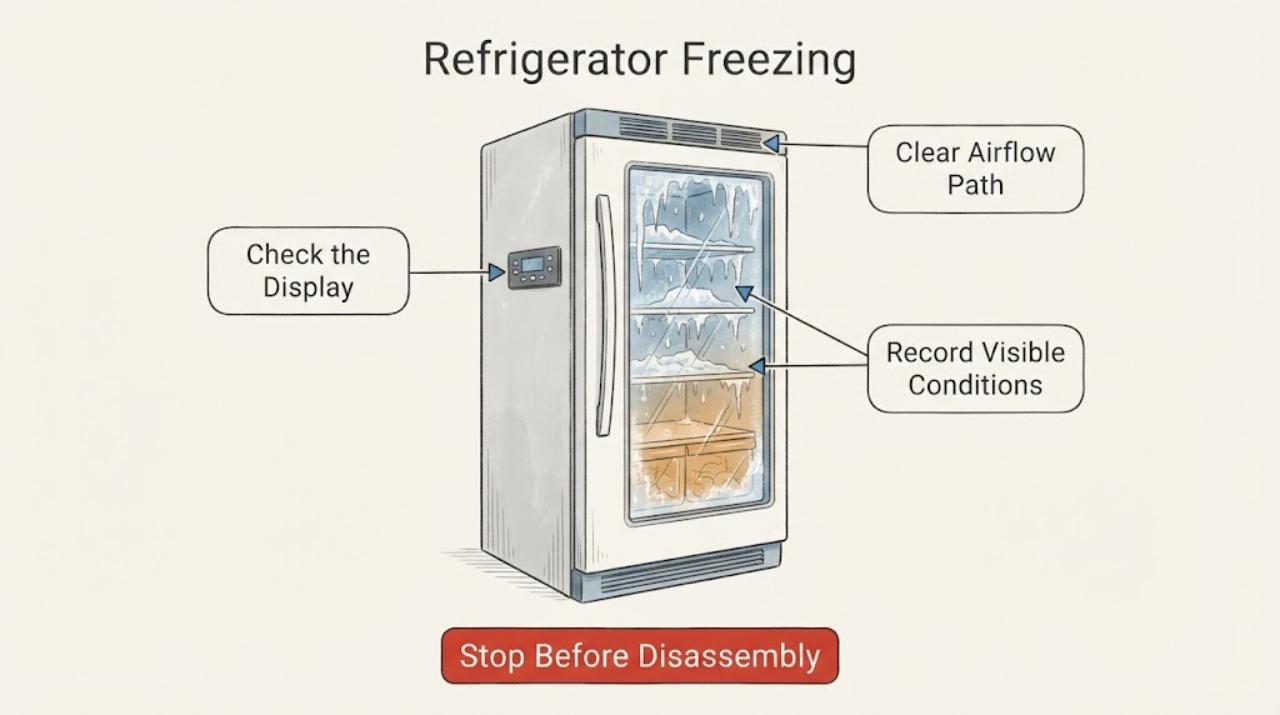
Work through in order
Diagnostic checks
Use only checks that match the exact appliance or system and its official guide.
-
Check 1
Record which compartment/shelf freezes, control setting, and whether freezer is also unusually cold.
Expected result: Only food near a vent freezes or all fresh-food areas freeze.
Next step: Continue placement/setting checks for localized freezing; service widespread freezing.
Stop if: Stop if there is a safety hazard or internal access would be required.
Why this matters
Why: Localized freezing points to airflow/placement; widespread freezing points to setting, sensor, damper, or control behavior.
-
Check 2
Check controls against the manual and move delicate food away from freezer-originating vents.
Expected result: Control is colder than intended or food sits in the cold-air path.
Next step: Adjust one setting as manual permits; do not block the vent completely.
Stop if: Stop if there is a safety hazard or internal access would be required.
Why this matters
Why: GE identifies controls and freezer-originating airflow as common contributors.
-
Check 3
Check whether compartment is nearly empty or a drawer is directly in the coldest airflow.
Expected result: Load is sparse or drawer is at vent.
Next step: Redistribute food while keeping airflow open and monitor one cycle.
Stop if: Stop if there is a safety hazard or internal access would be required.
Why this matters
Why: GE notes food load absorbs cold and placement near the freezer air source can freeze items.
-
Check 4
If freezing continues, record frost pattern and control response without removing panels.
Expected result: Persistent freezing, abnormal frost, or unresponsive control/damper.
Next step: Arrange qualified refrigerator service.
Stop if: Stop if there is a safety hazard or internal access would be required.
Why this matters
Why: A control, sensor, airflow, or defrost problem needs model diagnosis.
Use your observations
Decision map
Find the observation that best matches what you see, then follow the next safe action.
-
PATH 01Next step
What you see
Only food at vent or in lightly loaded drawer freezes
Do this next
Move food and adjust setting one step as manual allows.
Why this path and its safety boundary
Why it matters: Airflow/placement is more likely than whole-cabinet fault.
-
PATH 02Next step
What you see
Entire fresh-food section freezes at normal setting
Do this next
Arrange service and keep vents open.
Why this path and its safety boundary
Why it matters: Sensor, damper, or control fault is more likely.
-
PATH 03Next step
What you see
Frost or damaged seal accompanies freezing
Do this next
Check visible closure/seal and service if damaged.
Why this path and its safety boundary
Why it matters: Door sealing/airflow is affecting temperature.
Helpful context
Understand the symptom
How to read the result
If food freezes in a refrigerator’s fresh-food section, check temperature settings and food placement before assuming a sealed-system fault. GE says cold air enters from the freezer, vent/damper areas can be coldest, and food load affects freezing. Move sensitive food away from vents and adjust only as the manual allows; persistent widespread freezing needs service.
When checks do not resolve it
Need a professional?
Arrange service for widespread persistent freezing, unresponsive controls, abnormal frost, or damaged seal/airflow.
Common questions
FAQ
Should I block the refrigerator vent?
No. Move delicate food away while keeping airflow open.
When does freezing need service?
When it persists throughout the section after correct settings and placement, or controls/frost are abnormal.
Read the exact guide
Official sources
- Side-by-Side Refrigerator - Too Cold, Freezing FoodGE Appliances · refrigerator fresh-food freezing
Community feedback
Share a repair observation
Share a plain-text repair observation. Accepted observations are published automatically; this page may take a moment to update.