
On this page
Start here
Quick answer
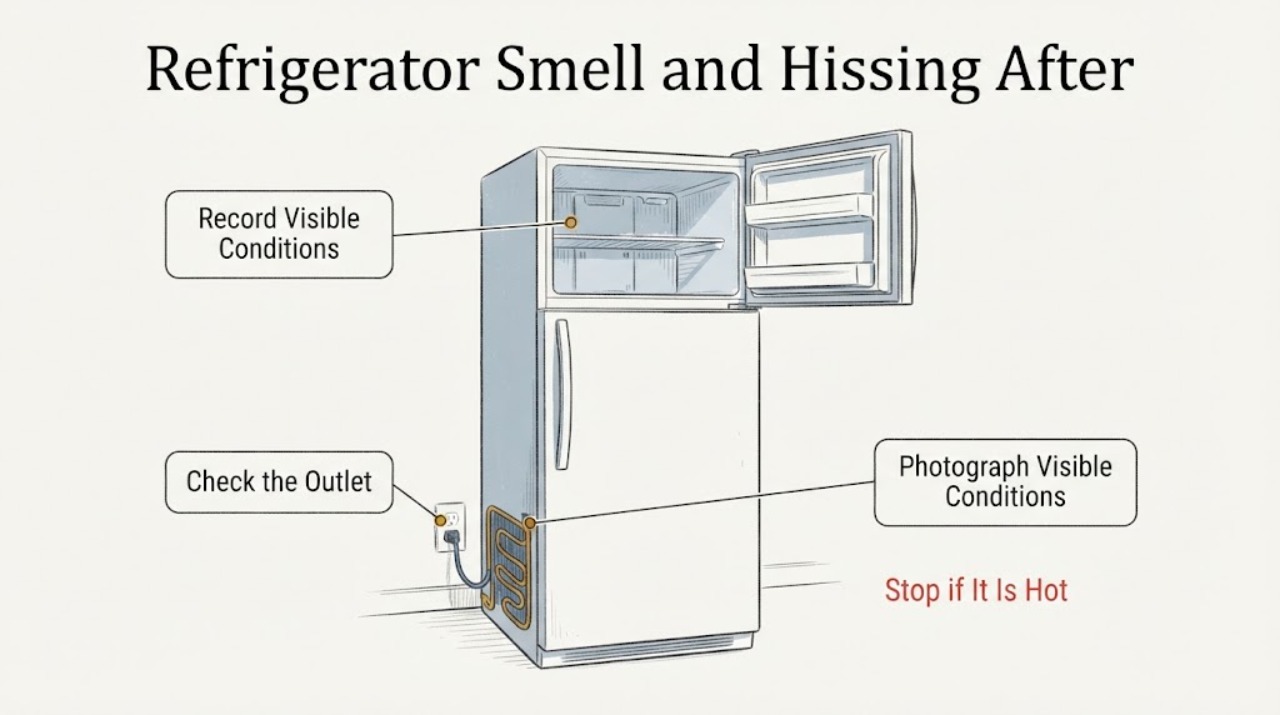
A brief hiss can be a normal refrigeration sound on some refrigerators, but a new smell and hiss that began immediately after scraping freezer ice must be treated as possible damage until the scraped area is checked safely. Stop using the refrigerator, disconnect power only from a dry, safe location if there is no immediate electrical hazard, ventilate the room without creating a spark, and keep flames and other ignition sources away. Do not scrape again, puncture tubing, open panels, or keep restarting the compressor to test it. Photograph the accessible damage and arrange qualified refrigerator service, especially if cooling is falling, an odor persists, or you see a cut, wet/oily mark, frost change, smoke, heat or damaged wiring.
Work through in order
Diagnostic checks
Use only checks that match the exact appliance or system and its official guide.
-
Check 1
Stop the refrigerator and record the sequence without restarting it: when the ice was scraped, where the smell is strongest, whether the hiss happens only at compressor start/stop, whether cooling has changed, and whether smoke, heat or a burning-electrical odor is present.
Expected result: The symptom started immediately after scraping, the odor persists or cooling is declining, or there is visible smoke, heat or electrical damage.
Next step: Do not restart the appliance for a test. If there is smoke, heat, sparking or a strong burning odor, leave the area and use appropriate emergency or qualified service help; otherwise continue only with the safe isolation and external checks below.
Stop if: Stop immediately for smoke, flame, sparking, heat or a worsening chemical or burning odor.
Why this matters
Why: A new paired symptom after mechanical scraping raises concern for damage that cannot be distinguished from a normal refrigeration sound remotely. Smoke, heat, burning odor or damaged wiring adds an electrical stop condition.
-
Check 2
From a dry, safe location, disconnect the refrigerator from power if doing so does not require touching a wet or damaged plug, cord or outlet. Open doors or windows only in a way that does not create a spark, and keep flames, smoking, hot tools and other ignition sources away from the appliance and suspected odor area.
Expected result: Power is safely isolated and the room can be aired without approaching damaged electrical parts, or isolation would require handling a wet, hot or visibly damaged connection.
Next step: If isolation is unsafe, leave the area and contact qualified help from a safe location. Keep the appliance off and do not use switches, flames or tools near a suspected leak until the area is judged safe.
Stop if: Do not touch a wet or hot electrical connection, remove covers, or make any live electrical test.
Why this matters
Why: Possible refrigerant damage and electrical damage require different professional handling, and the user cannot confirm which is present from the smell. EPA safety material identifies ignition hazards associated with leaked flammable refrigerant mixtures and electrical arcs.
-
Check 3
Without scraping, pressing, wiping inside a cut, removing panels or touching tubing, look at the accessible freezer area and photograph any gouge, puncture, cut liner, damaged wire, frost change or wet/oily residue.
Expected result: A visible cut or puncture is present; a wire or liner is damaged; residue or an unusual frost pattern is visible; or no damage can be seen from the accessible surface.
Next step: Keep the refrigerator off, preserve the photo and provide it to the service professional. Do not probe, seal, bend, cut, splice or otherwise alter the area.
Why this matters
Why: A visible mark confirms that the scraping event caused an observable change but does not identify whether it involves insulation, wiring or the sealed refrigeration circuit. No visible mark does not rule out hidden damage.
-
Check 4
Separate the symptom from ordinary food or cleaning residue using only a visual, external check: note whether the odor is confined to a spill or food container, or instead follows the scraped wall, cord area or the space behind the refrigerator. Do not use a flame, chemical spray or powered test to identify it.
Expected result: The odor has an identifiable food or spill source away from the damaged area, or it remains unexplained or is strongest near the scraped wall, rear of the refrigerator or an electrical connection.
Next step: If the source is not clearly harmless, leave the refrigerator off and arrange qualified service. Do not clean inside a cut or continue running the appliance to compare odors.
Why this matters
Why: A food or spill source can explain an odor without proving anything about the hiss, while an unexplained odor paired with a new hiss or visible damage remains a possible sealed-system or electrical safety issue.
-
Check 5
Give the technician the exact model and serial information, the time of scraping, the tool used, the location of the odor and hiss, cooling changes, photos and whether power was safely isolated. Ask for diagnosis of possible freezer-liner, wiring or sealed-system damage rather than ordering a part from the symptom alone.
Expected result: The technician can match the refrigerator's manual and refrigerant warning label, or the appliance identity remains unknown.
Next step: Use trained refrigerator service for any inspection behind the liner or for sealed-system or electrical work. Keep the appliance out of service until the professional says it is safe to operate.
Why this matters
Why: Model-specific construction and refrigerant information determine the safe service procedure. The Reddit post does not provide a verified model or outcome, and a generic hiss cannot identify a failed component.
Use your observations
Decision map
Find the observation that best matches what you see, then follow the next safe action.
-
PATH 01Next step
What you see
A cut or puncture, new persistent odor, worsening hiss, cooling loss or a visible damaged wire appeared after scraping freezer ice.
Do this next
Keep the refrigerator off, ventilate only safely, avoid ignition sources and arrange trained refrigerator service. Do not scrape, probe, seal or restart it for a test.
Why this path and its safety boundary
Why it matters: The timing and visible change make possible mechanical or electrical damage more important than treating the hiss as an ordinary sound; the exact failed part is still unconfirmed.
-
PATH 02Next step
What you see
There is no visible damage, no persistent unexplained odor, no cooling change, and the exact model manual identifies a brief hiss as a normal operating sound.
Do this next
Keep the exact manual and model information with the appliance record; if the odor or hiss returns or changes, stop use and request service rather than repeating an ice-scraping or start-up test.
Why this path and its safety boundary
Why it matters: A normal refrigeration or defrost sound becomes plausible, but it is not established for this unidentified refrigerator by Whirlpool's manufacturer-specific example alone.
-
PATH 03Next step
What you see
The odor smells electrical or burning, there is smoke, heat, sparking, a hot cord or water near the plug or outlet.
Do this next
Leave the area if needed, avoid switches and flames, and contact appropriate emergency or qualified electrical/appliance service from a safe location. Do not touch wet or hot electrical parts.
Why this path and its safety boundary
Why it matters: This is an electrical or fire stop condition in addition to the unresolved refrigerator symptom; it is unsafe to investigate by powering the appliance again.
-
PATH 04Next step
What you see
The odor is clearly from a removable food container or visible spill away from the scraped wall, while there is no cooling loss or damage and the hiss matches the exact manual's normal-sound description.
Do this next
Do not scrape further or clean inside a damaged area; document the location and have service clear the appliance if any uncertainty, recurrence or cooling change remains.
Why this path and its safety boundary
Why it matters: The odor may be unrelated to the refrigeration circuit, but the post-scraping event still does not prove that the freezer wall or wire is undamaged.
Helpful context
Understand the symptom
Why the timing changes the safe response
The exact post describes a freezer that had heavy ice, a chisel used to scrape it, and then a new smell plus a hiss when the refrigerator motor started or stopped. That timing is not enough to prove a refrigerant leak: Whirlpool explains that hissing may be a normal refrigerant-flow sound on its refrigerators. It does mean that a possible liner, wire or refrigeration-tube injury has to be considered before the appliance is run again. The post's comments speculate about a puncture but do not establish what was damaged.
Treat an unknown smell as a safety symptom, not a refrigerant identification
Do not identify the odor as a particular gas from smell alone, and do not repeat the start-up to see whether the hiss continues. EPA-hosted safety material describes fire and explosion hazards when a flammable refrigerant leaks and says refrigerant tubing must be protected from mechanical damage. It also gives a trained-service boundary for refrigerators that use flammable refrigerants. This article therefore limits the user checks to safe, visible observations and service preparation; it does not provide leak testing, refrigerant recovery, charging, tubing repair or wiring repair.
A normal hiss is only a possibility when there is no new damage or odor
If an exact model manual later confirms a short hiss as normal and there is no damage, persistent odor, cooling loss or electrical warning, that model-specific information may explain the sound. It does not override the immediate post-scraping warning signs. With no brand or model in the assigned topic, the refrigerator's manual and a qualified technician are needed before the appliance is cleared for normal use.
When checks do not resolve it
Need a professional?
Arrange qualified refrigerator service when a smell and hiss begin after scraping ice, especially with a cut or puncture, damaged wire, residue, frost change, cooling loss or a persistent unexplained odor. Seek urgent help for smoke, flame, sparking, heat, a strong burning odor or an unsafe electrical connection.
Common questions
FAQ
Is a refrigerator hiss always a refrigerant leak?
No. Whirlpool says hissing can occur as refrigerant flows and may be normal on its refrigerators. A new hiss paired with an odor immediately after scraping ice is a different safety context, and the unnamed refrigerator cannot be cleared from sound alone.
Can I run the refrigerator briefly to see whether the hiss stops?
Do not use a start-up test when a new odor or possible scrape damage is present. Photograph the accessible area, keep the unit off, and give the timing and observations to qualified service.
Can I patch the freezer wall or reconnect the cut wire myself?
No. A visible mark does not show whether the liner, a wire or the sealed refrigeration circuit is involved. EPA-hosted safety material warns against mechanical damage to refrigerant tubing and directs flammable-refrigerant refrigerator repair to trained service personnel.
What should I tell the service technician?
Provide the exact model and serial, the time and tool used to scrape the ice, where the smell and hiss occur, any cooling change, the photos and whether power was safely isolated. Do not order a replacement component from the symptom alone.
Read the exact guide
Official sources
- Scrapped out the freezer unit and now a smell is coming out when the fridge motor startsReddit r/appliancerepair · Opened the exact Reddit post. It supports the reported timing, ice-scraping action, smell, start/stop hiss and cut-wire observation for this case, but it does not verify the cause or outcome.
- White Paper: Revisiting Flammable RefrigerantsU.S. Environmental Protection Agency · Opened the EPA-hosted UL white paper. It is general safety material, not evidence that this unnamed refrigerator uses a particular refrigerant or that a leak occurred. It supports the conservative no-puncture, no-mechanical-defrost and trained-service boundary when tubing damage is possible.
- Why is my refrigerator making noise?Whirlpool · Opened Whirlpool's official general refrigerator-noise article. It is manufacturer-specific context, not a model match for the unnamed refrigerator in this task; it supports only the limited point that hissing can be normal on some refrigerators and unexplained excessive noise warrants professional investigation.
Community feedback
Share a repair observation
Share a plain-text repair observation. Accepted observations are published automatically; this page may take a moment to update.