
On this page
Start here
Quick answer
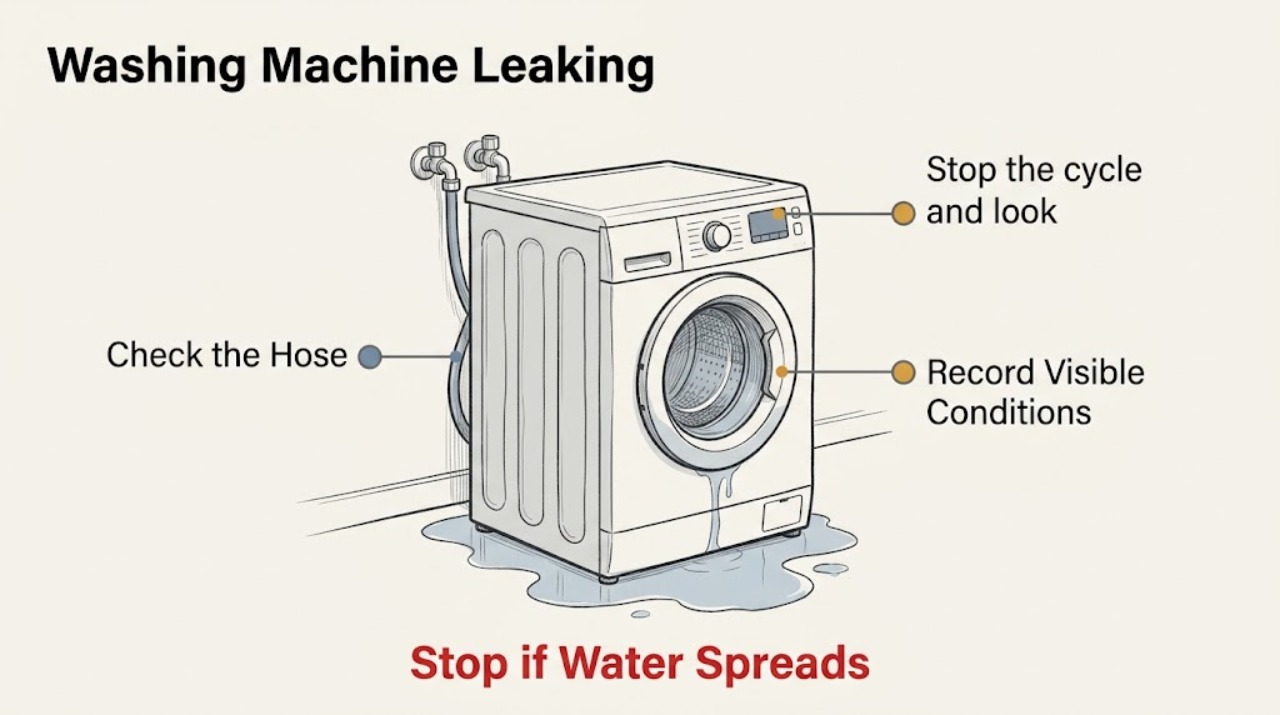
Stop the cycle and identify where the water first appears: behind the washer, over the top, inside the tub while idle, or underneath. If the water is near the outlet, cord, or other electrical parts, do not touch the plug or enter the wet area; isolate the water only from a dry, safe location and arrange qualified help. With a dry floor and no electrical warning, check the model-specific inlet-hose connections, drain hose and household drain, load/level, and detergent use. Keep the Roper lid open when the basket is dry, and do not tilt the cabinet or remove panels to search for an internal leak.
Work through in order
Diagnostic checks
Use only checks that match the exact appliance or system and its official guide.
-
Check 1
Stop the cycle and look from a dry, well-lit position at the first wet point; note whether water is behind the machine, over the top, inside the tub while the machine is off, or underneath.
Expected result: Water near an outlet, cord, plug, or other electrical part, or a hot/discolored outlet, smoke, sparks, burning odor, or a repeated breaker trip is present.
Next step: Do not touch the plug or walk through the wet area. From a dry and safe location, isolate water or power only if that can be done without contact with water; otherwise leave it isolated and call a qualified professional.
Why this matters
Why: The leak has become an electrical or fire hazard, so a normal test cycle could increase the risk of shock or damage.
-
Check 2
With the washer stopped and the floor dry, identify the exact Roper model under the lid and record the cycle stage, water temperature setting, load type, and whether the leak continues when the machine is idle.
Expected result: The leak continues while idle, begins as soon as a faucet is open, or occurs only during filling; alternatively, it starts only during drain or spin.
Next step: Close both water faucets while waiting for service, then follow the branch below that matches the first wet point and cycle stage. Do not tilt the cabinet or remove a panel to locate a hidden leak.
Why this matters
Why: An idle or fill-time leak prioritizes the water inlet, valve, or tub area; a drain- or spin-time leak prioritizes the drain hose, household drain, load movement, or a model-specific internal fault.
-
Check 3
For a leak behind the washer, inspect only the visible ends of both inlet hoses, their sealing washers, the faucet connections, the visible drain hose, and the nearby laundry drain or sink.
Expected result: A hose end is loose or missing its washer, the drain hose is loose, or the household drain backs up when water is discharged.
Next step: Keep the faucets closed, correct only an obvious hand-loose external connection without forcing it, and have the household drain or a persistent hose leak assessed if the problem remains. Do not run a confirmation cycle while water is pooling.
Why this matters
Why: The visible supply connection or household drain can account for the leak; a blocked or slow drain can push water back onto the floor even when the washer itself is sound.
-
Check 4
For water over the top or front of a top-load Roper, check from outside that the washer stands level and that the load was not oversized, tightly packed, uneven, or water-resistant.
Expected result: The cabinet is visibly out of level, the basket or load is heavily unbalanced, or the leak occurs only with bulky or water-resistant items.
Next step: Stop and redistribute or reduce the load according to the exact Roper manual. If leveling needs more than a safe external adjustment, or the leak returns with a normal load, arrange service rather than opening the cabinet.
Why this matters
Why: Water can splash over the basket when the washer is not level or the load holds and shifts water; this does not prove an internal seal failure.
-
Check 5
Check the detergent and dispenser practice against the exact Roper model instructions; look for excessive suds, detergent residue, or water escaping around a dispenser, but do not add a second cleaning chemical to the washer.
Expected result: The product is not the required type for the model, the amount is excessive, suds overflow, or the dispenser is blocked or retaining an unusual amount of product.
Next step: Use only the detergent type and amount specified by the model manual, clean an accessible dispenser as that manual permits, and stop if the leak persists or the water is hot, chemically irritating, or reaching electrical parts.
Why this matters
Why: Excess suds or a dispenser problem can cause poor draining, overflow, and apparent leaks; changing products without identifying the model can create a different problem.
-
Check 6
If water appears inside the tub while the Roper is switched off, leave the washer unused and close both water faucets; if the model manual gives a safe external check, compare the visible water level before and after the faucets are closed.
Expected result: The tub level rises while the washer is idle, or the leak remains after the faucets are closed.
Next step: Do not start another cycle, tilt the machine, or reach into a moving or wet cabinet. Provide the model, water level, leak location, and faucet result to a qualified appliance technician.
Why this matters
Why: A rising idle level points toward water entering when it should not; continued water after the supply is closed points away from a simple inlet connection and needs service-level diagnosis.
Use your observations
Decision map
Find the observation that best matches what you see, then follow the next safe action.
-
PATH 01Next step
What you see
Water is near electrical parts, the outlet or cord is hot or discolored, there is smoke, an arc, a burning smell, a shock, or the breaker trips again.
Do this next
Stop using the washer and do not touch the wet plug or reset the breaker repeatedly. Keep clear and obtain qualified electrical or appliance help; a professional must determine whether the supply or washer is safe.
-
PATH 02Next step
What you see
The first wet point is behind the washer or the laundry drain backs up during discharge.
Do this next
Close both water faucets, inspect only visible hose and drain connections, and escalate a persistent connection leak or household drain backup without running another cycle.
-
PATH 03Next step
What you see
Water appears over the top or front only with an uneven, bulky, or water-resistant load, or the cabinet is not level.
Do this next
Use the exact Roper loading and leveling instructions. If a normal load still leaks, stop testing and request appliance service.
-
PATH 04Next step
What you see
The tub gains water while off, water continues after the faucets are closed, or water comes from underneath without a visible external source.
Do this next
Leave the washer unused and arrange a qualified appliance inspection; do not tilt, remove panels, or operate it to reproduce the leak.
Helpful context
Understand the symptom
A Roper washer leak is easier to diagnose from its first wet point than from the largest puddle. Do not assume that water at the front came from the front: water can travel along the cabinet or floor. First record whether it starts during filling, agitation, draining, or spinning, then use the matching check below. The older Roper models covered by the linked manual are top-load machines, but Roper configurations vary; use the model number under the lid before applying any model-specific instruction.
A leak that continues while the washer is idle, reaches an outlet, or appears with a hot cord, smoke, burning smell, sparks, or a tripped breaker is not a normal troubleshooting run. Keep people away from the wet area, do not operate the washer again, and use a qualified appliance or electrical professional as appropriate.
Only after diagnosis
Potential parts
- inlet hose or hose washer
Consider this category only when the leak is visibly at an inlet connection and the exact model and hose connection require replacement rather than simple reseating.
Confirm the complete Roper model and connection specification before ordering any part. - drain hose
Consider this category only when the visible drain hose is cracked, loose, or incompatible with the model installation.
Verify the model and installation requirements; do not substitute a hose based only on appearance.
When checks do not resolve it
Need a professional?
Have this ready
- Give the technician the exact Roper model, first wet point, cycle stage, water-temperature setting, load type, whether the tub fills while idle, faucet and drain observations, and any electrical warning signs.
Common questions
FAQ
Why is water under my Roper washer when the hoses look dry?
Water can travel from a drain backup, a splash caused by an unlevel or overloaded top-load washer, or an internal source. Dry the area only when it is safe, identify the first wet point during a stationary inspection, and stop if the source is underneath or cannot be seen.
Should I keep running the washer to see where it leaks?
No if water is near electrical parts, the leak is active while idle, the floor is wet, or there is an electrical warning. Close the water faucets from a dry, safe location when possible and arrange qualified help.
Can I fix a Roper washer leak by tilting it or removing the cabinet?
Do not tilt or open a wet washer as a user-level leak check. The Roper manual assigns installation, repair, and part replacement to qualified people; provide the model and leak timing to an appliance technician.
Read the exact guide
Official sources
- Leaking Inside the Tub - WasherWhirlpool Corporation · Whirlpool-family washer guidance for water entering the tub while not in use; use as a conditional diagnostic boundary for a matching Roper configuration
- Leaking from Behind - Top Load WasherWhirlpool Corporation · Whirlpool-family top-load washer guidance for inlet hose connections, drain hose placement, and household drain backup; apply to Roper only where the model configuration matches
- Leveling a Top Load WasherWhirlpool Corporation · Whirlpool-family top-load washer leveling guidance; use only where the Roper cabinet and feet match
- Leaking from Front or Top - WasherWhirlpool Corporation · Whirlpool-family washer guidance for front or top splash; apply to a Roper top-load configuration only when the load and cabinet design match
- CPSC Guide to Home Wiring HazardsU.S. Consumer Product Safety Commission · General household electrical hazard recognition and qualified-professional boundary
- Using the Load & Go™ Detergent Dispenser on your Whirlpool Top Load WasherWhirlpool Corporation · Whirlpool-family top-load dispenser and detergent guidance; use only the applicable Roper manual instructions for a Roper model
- Owner's ManualWhirlpool Corporation / Roper Appliances · Roper AL4132V, AL5143V, AL6245V, AX5133V, and AX6245V washers; operation, water and drain installation, maintenance, safety, and service boundaries
Community feedback
Share a repair observation
Share a plain-text repair observation. Accepted observations are published automatically; this page may take a moment to update.