
On this page
Start here
Quick answer
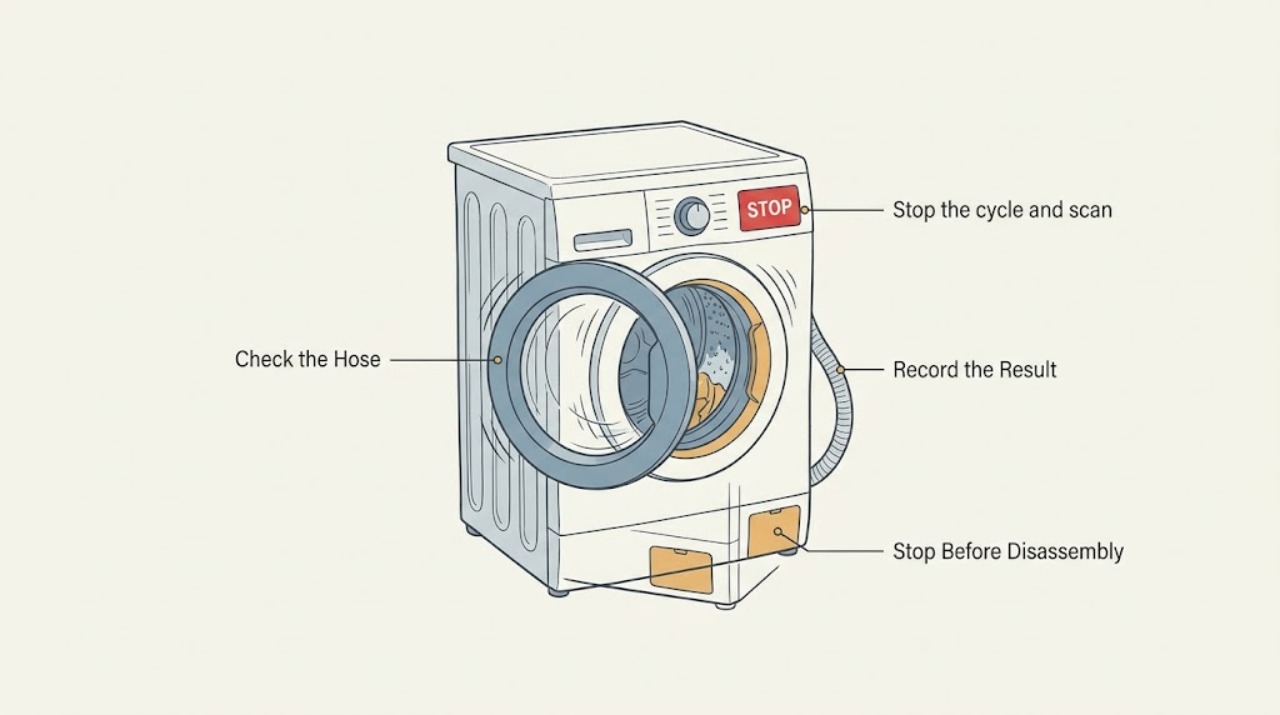
First note whether the sound occurs while filling, washing, draining, or spinning, then locate it at the rear hoses, cabinet, basket, pump area, or floor. A brief hum, pump sound, click, or motor/drive change can be normal, while a new scrape, repeated metal contact, cabinet impact, walking, leak, smoke, burning odor, or electrical symptom is a reason to stop. With the washer unplugged when a hands-on check is needed, inspect the outside, redistribute the load, verify firm foot contact and level, and check shipping hardware only on a front-load model. Whirlpool manufacturer-family guidance describes these checks, but the Roper model manual controls the exact installation and service procedure.
Work through in order
Diagnostic checks
Use only checks that match the exact appliance or system and its official guide.
-
Check 1
Stop the cycle and scan for immediate hazards before trying another test. If there is smoke, a burning or melted-plastic odor, visible sparking, a hot plug or receptacle, repeated breaker trips, a strong impact, or water reaching electrical parts, keep clear and disconnect power only if it is safe to do so; shut off the water supply if a water leak is active.
Expected result: The washer is either safe to inspect from the outside, or a hazard remains present.
Next step: If any hazard remains, do not run the washer or remove panels. Arrange a qualified appliance or electrical professional; for an active unsafe water release, use the local emergency water shutoff or appropriate emergency service.
Why this matters
Why: A hazard changes the task from noise diagnosis to safety response; repeated operation could worsen fire, shock, flood, or mechanical damage.
-
Check 2
With the controls stopped, note the exact phase and place of the noise: fill, wash or agitation, drain, spin, or a phase change; then identify whether it comes from the rear hoses, outside cabinet, basket area, lower pump area, or floor. Check the full Roper model number and whether the machine is top-load or front-load.
Expected result: A brief sound tied to a phase can be separated from a sound present whenever the basket moves or from movement of the cabinet itself.
Next step: Continue only with the branch that matches the phase and washer style; use the model manual before any model-specific installation step.
Why this matters
Why: Phase and location narrow the next check: hoses and nearby items are common at the rear, imbalance and feet are common during spin, and a persistent internal rubbing or grinding sound needs service evidence.
-
Check 3
Inspect around the unplugged washer without reaching inside: look behind the cabinet for the inlet and drain hoses touching it, and remove brooms, racks, hangers, or other objects leaning against the outside. Leave hose connections intact and do not pull a loaded machine by its hoses.
Expected result: A hose or nearby object has a clear contact point, or the outside clearance is already clear.
Next step: If contact is found, secure or reposition the external hose only as the model instructions allow and remove the nearby object, then observe whether the sound is gone on a small supervised test. If not, continue to the load and level checks.
Why this matters
Why: Contact can transmit a tapping or rattling sound, particularly when water moves or the cabinet vibrates at high spin; a clear exterior makes that explanation less likely.
-
Check 4
Check the load and floor stability with the washer stopped. Do not tightly pack the basket; redistribute clothing evenly, and avoid testing one heavy blanket or rug alone. From the top, gently rock the empty or safe-to-move washer diagonally to see whether it teeters, and look for all feet making firm contact.
Expected result: The load is bunched or overloaded, a bulky item is alone, or the cabinet rocks; alternatively the load is loose and the washer is stable.
Next step: Redistribute or reduce the load and level the feet according to the Roper instructions, tightening any model-specified lock hardware. If the washer walks, bangs hard, or remains unstable, stop using it and call service.
Why this matters
Why: An unbalanced load or an unlevel cabinet can cause thumping, excessive vibration, tub-to-cabinet contact, or walking during spin. A stable machine with a repeatable scrape is less consistent with a simple load correction.
-
Check 5
If the washer is front-load and was recently installed or moved, compare the rear installation to the Roper installation instructions and confirm that shipping materials were removed. If it is top-load, do not apply the front-load shipping-bolt procedure; use the top-load leveling and load guidance instead.
Expected result: A front-load shipping item remains, or the front-load installation is clear; the machine may instead be top-load and not applicable to this check.
Next step: Do not guess which hardware to remove. If the model manual confirms remaining shipping material, follow its removal procedure before another test; if the hardware or model is uncertain, stop and request service or installation help.
Why this matters
Why: Shipping material left in a front-load washer can cause severe vibration or walking, while a top-load washer follows a different installation path.
-
Check 6
After the external checks are corrected, run one short supervised test with a light, evenly distributed load and stay nearby. Listen for a brief normal hum, water or pump sound, click, or motor direction change versus a persistent scrape, metal-on-metal sound, hard impact, or noise that grows with basket speed.
Expected result: The sound disappears or remains a brief phase-related operating sound, or it returns as a repeatable abnormal noise.
Next step: Stop the test at the first abnormal impact, leak, odor, smoke, or electrical symptom. If the noise persists without a hazard, record the phase and location and arrange qualified appliance service.
Why this matters
Why: A corrected load or contact point supports an installation or balance cause. A repeatable internal-sounding scrape, grind, hard knock, or pump noise after those checks needs a technician rather than a guessed replacement part.
Use your observations
Decision map
Find the observation that best matches what you see, then follow the next safe action.
-
PATH 01Next step
What you see
Smoke, burning odor, visible sparking, hot electrical parts, repeated trips, active leak near electricity, or destructive impact
Do this next
Stop and keep the washer out of service; use safe shutoff actions and arrange the appropriate qualified professional. Do not open panels or repeatedly reset the breaker.
-
PATH 02Next step
What you see
The sound is a short click, water movement, hum, pump sound, or motor/drive change tied to a normal phase and there is no abnormal movement or odor
Do this next
Compare with the exact Roper manual and monitor. Escalate if the sound becomes new, continuous, louder, or linked to poor draining, spinning, or leaks.
-
PATH 03Next step
What you see
The sound is a rear rattle or tap and a hose or nearby object touches the cabinet
Do this next
Correct the external contact safely, then make one supervised confirmation run. If it remains, move to load and level checks.
-
PATH 04Next step
What you see
The sound is thumping during spin and the load is bunched, a bulky item is alone, or the washer rocks
Do this next
Redistribute or reduce the load and level the washer with the model instructions. Continued walking or hard cabinet impact is a service boundary.
-
PATH 05Next step
What you see
A recently moved front-load washer still has shipping materials or its feet are not secure
Do this next
Use the exact installation instructions to correct the setup; do not apply front-load shipping checks to a top-load model.
-
PATH 06Next step
What you see
A persistent scrape, grind, metal contact, lower pump-area noise, or repeatable sound remains after load, hose, and level checks
Do this next
Stop experimenting and arrange appliance service. Provide the model, phase, location, load, and a safe recording; do not disassemble the pump, drive, cabinet, or wiring.
Helpful context
Understand the symptom
Start with the phase and the location
Do not identify a part from the word noise alone. Record whether the sound starts during fill, wash or agitation, drain, spin, or the transition between phases. A sound at the rear often points to a hose or an object touching the cabinet; a sound that follows the basket during wash or spin needs a different path. Top-load and front-load machines also have different installation checks, so confirm which opening and control layout your Roper has before using a manual.
What may be normal
A short click when a lock or control changes state, a water-moving sound during fill or drain, and a hum or changing motor sound during wash or spin can be part of operation. The useful question is whether the sound is new, getting louder, tied to an abnormal movement, or accompanied by a performance problem. Do not keep testing a sound that includes scraping, an impact that could damage the cabinet, or a burning or electrical warning.
Use the model manual for model-specific work
Whirlpool Product Help is useful manufacturer-family guidance for the diagnostic pattern, but it is not a Roper model manual. Use the full model number from the rating label to find the correct installation instructions. Do not remove panels, reach into a moving basket, handle wiring, or open a pump or drive assembly as a casual noise check.
When the sound needs service
If an external hose, load, level, or installation correction does not change a persistent scrape, grind, hard knock, or pump-related sound, save a short audio or video from a safe distance and arrange appliance service. Tell the technician the phase, sound location, load type, whether the washer moves, and whether any water or electrical symptom appeared.
Safety boundary
Stop conditions
- Stop immediately for smoke, burning or melted-plastic odor, visible sparking, a hot plug or receptacle, repeated breaker trips, or any sign of damaged wiring.
- Stop for a hard impact, rapid walking, exposed or broken moving hardware, or metal-on-metal scraping that continues after the cycle is stopped.
- Stop and keep clear if water is leaking toward an outlet or other electrical part; disconnect power only from a dry, safe position and shut off water when safely reachable.
- Do not reach into a moving basket, remove panels, handle wiring, open the pump, or test a suspected drive or suspension failure as a household noise check.
- Do not run another cycle when the abnormal sound is worsening or the cause is uncertain after the low-risk external checks.
Only after diagnosis
Potential parts
- leveling foot or foot-lock hardware
Consider this only when the model instructions and the stability check show a damaged foot or hardware that prevents firm floor contact.
Confirm the full Roper model number and the manufacturer's fit information before ordering; do not assume a family-level part fits every washer. - drain pump
Consider this only when a qualified diagnosis ties a repeatable drain-phase noise or failed draining to the pump after the external drain path is checked.
Pump design and fit vary by model. A technician or the exact model documentation should confirm the component before any replacement. - suspension or drive component
Consider this only when service diagnosis confirms that persistent internal vibration, scraping, or drive noise is not caused by load, hoses, level, or installation.
Do not infer a failed component from sound alone; confirm model fit and safe repair procedure with qualified service.
When checks do not resolve it
Need a professional?
Arrange qualified appliance service when the noise persists after an appropriate load, external-contact, leveling, and model-specific installation check; when the sound is internal, repeatable, or tied to poor draining or spinning; or when the washer walks or strikes the cabinet. Use an electrician or other appropriate professional for electrical symptoms, and use the Roper model manual to identify the correct support path.
Have this ready
- Provide the complete model number, washer style, cycle phase, sound description and location, load type, whether the machine moves, recent installation or move history, and any leak or electrical observation.
Common questions
FAQ
Why is my Roper washer making a knocking sound during spin?
Check for an uneven or bulky load, a cabinet that rocks, loose foot contact, and hoses or nearby objects striking the cabinet. If it walks or hits hard after those checks, stop and arrange service.
Is a humming or clicking sound always a failure?
No. A short lock click, water or pump sound, or motor sound that changes with a normal phase can be normal. A new continuous sound, scraping, burning odor, smoke, or abnormal movement is not a reason to keep testing.
What should I check if the noise comes from the back?
With the washer stopped, look for inlet or drain hoses touching the rear cabinet and remove objects leaning against it. Do not pull on connected hoses or open the cabinet for this check.
Should I remove shipping bolts from a noisy Roper washer?
Only a front-load washer may use the cited shipping-bolt installation check, and the exact Roper manual must confirm the hardware and procedure. Do not apply that instruction to a top-load model or guess which hardware to remove.
When does a grinding or rubbing sound need service?
Arrange service when a persistent internal-sounding scrape or grind remains after the safe load, hose, level, and installation checks, or when the sound is linked to poor draining, spinning, walking, or a leak.
Can I keep using the washer if the noise is getting louder?
Do not keep running it when the sound worsens, becomes a hard impact or metal contact, or comes with smoke, a burning odor, sparking, a hot electrical connection, a leak near electricity, or repeated trips.
Read the exact guide
Official sources
- Noise and Vibration - Product Help | WhirlpoolWhirlpool Product Help · Use the washer model number to select the applicable noise or vibration instructions
- Rattling or Tapping Noise - Front Load Washer - Product Help | WhirlpoolWhirlpool Product Help · Front-load rattling and tapping checks; exact Roper model instructions take precedence
- Vibration, Walking or Off Balance - Front Load Washer - Product Help | WhirlpoolWhirlpool Product Help · Front-load installation and vibration checks; exact Roper model instructions take precedence
- Grinding or Rubbing Noise - Washer - Product Help | WhirlpoolWhirlpool Product Help · Front-load washer noise checks; exact Roper model instructions take precedence
- Rattling - Noise - Product Help | WhirlpoolWhirlpool Product Help · Top-load rattling checks; exact Roper model instructions take precedence
- Knocking or Thumping - Noise - Product Help | WhirlpoolWhirlpool Product Help · Top-load washer noise and vibration checks; exact Roper model instructions take precedence
Community feedback
Share a repair observation
Share a plain-text repair observation. Accepted observations are published automatically; this page may take a moment to update.