
On this page
Start here
Quick answer
A Roper washer usually gets wash temperature from the household hot and cold water supplies, not from a user-adjustable internal heater. First identify the exact model and cycle, then confirm the temperature setting, both water faucets, and that the hot and cold hoses are not reversed or kinked. A cooler-than-expected wash can be normal when the selected cycle regulates incoming water, the water heater is far away, or several loads have used the hot-water supply. If the washer never receives hot water on a model and cycle that require it, or if an error, leak, burning smell, smoke, sparks, hot outlet, or repeated breaker trip appears, stop and arrange qualified service rather than opening the cabinet.
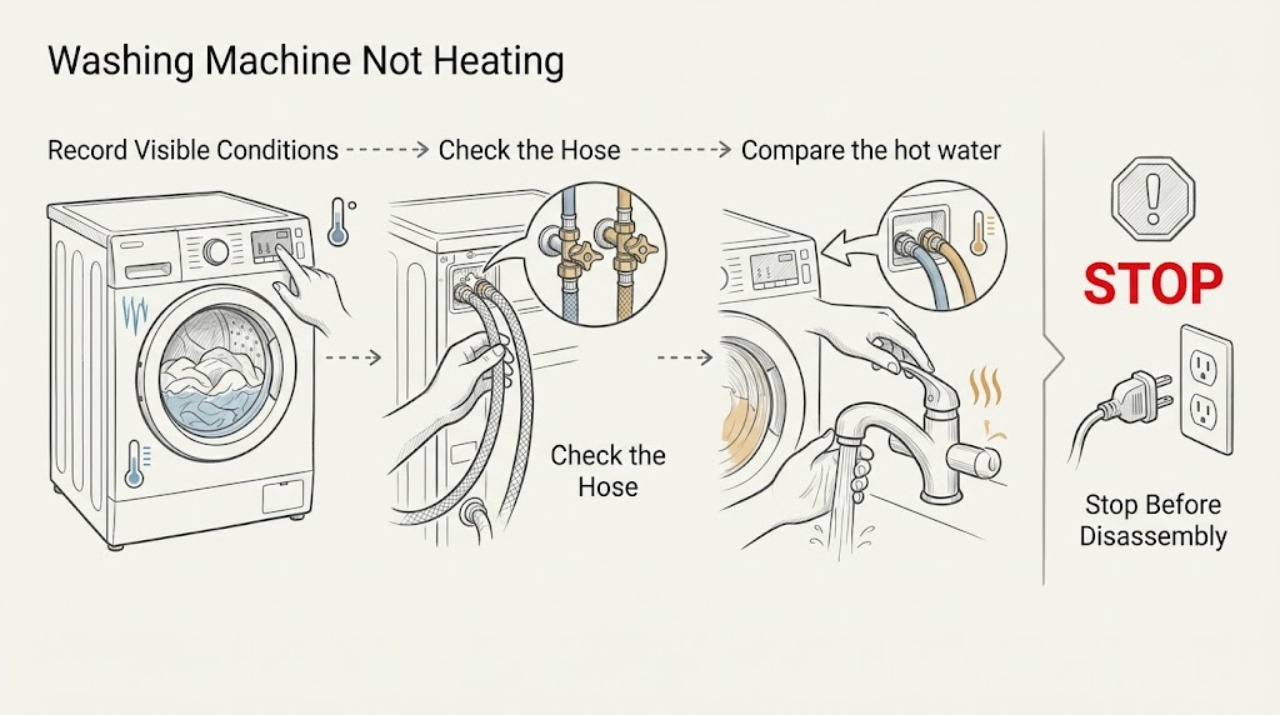
Work through in order
Diagnostic checks
Use only checks that match the exact appliance or system and its official guide.
-
Check 1
Stop the washer and record the exact model number under the lid, the selected wash and rinse temperatures, the cycle, and whether the complaint is that the fill is cold, the completed wash is cool, or the machine shows an error.
Expected result: The model has no published internal-heater instruction, the cycle is cold or energy-controlled, or the first fill is cool before the selected temperature is reached; alternatively, every applicable hot selection stays cold.
Next step: Use the model-specific cycle guide and continue with the supply checks below; do not substitute a generic heater diagnosis for a missing model detail.
Why this matters
Why: A single cool observation does not prove a failed heater. The model manual and cycle behavior determine whether incoming hot water is expected and when it should be present.
-
Check 2
With the washer idle and the area dry, confirm that the household hot and cold faucets are open and that each visible inlet hose runs to the matching faucet without a kink.
Expected result: A faucet is closed, a hose is kinked, or the hot hose is connected to the cold supply or vice versa.
Next step: Close the faucets before correcting any external hose connection, preserve the sealing washers, then reopen slowly and check for leaks. If the connection is damaged or inaccessible, arrange service rather than forcing it.
Why this matters
Why: The washer cannot deliver the selected temperature when a supply is closed, restricted, or reversed; reversed hoses can make a selected hot wash appear cold and a cold rinse appear warm.
-
Check 3
Compare the hot water at the nearest sink with the washer's first hot selection, without reaching into the washer or touching moving parts; note whether the home supply becomes hot only after the line is flushed and whether several loads were run recently.
Expected result: The nearby tap is initially cool, the washer is far from the water heater, or multiple recent loads have depleted available hot water.
Next step: Follow the model manual and local plumbing guidance; when safe and appropriate, start the load after the nearby supply is hot. If the tap itself never becomes hot, address the household water-heating issue instead of replacing a washer part.
Why this matters
Why: Distance and household hot-water recovery can make a hot or warm cycle feel cold at startup even when the washer is operating normally.
-
Check 4
Select a temperature and cycle that the Roper manual says is appropriate for the fabric, then compare the result with the manual's expected temperature behavior rather than with an older washer.
Expected result: The selected cycle uses controlled or cooler temperatures, the fabric label limits a hotter wash, or the water is warmer than the previous machine but not visibly hot.
Next step: Keep the model-specific setting if it meets the fabric and soil requirements. If the exact manual calls for hot water and the supply and hoses are correct but it remains cold, stop user checks and request diagnosis.
Why this matters
Why: Temperature control can blend or regulate incoming hot and cold water, and cycle temperatures vary; a cooler hot or warm wash is not by itself evidence of a failed component.
-
Check 5
Inspect only the visible hose connections and floor for a leak, and note whether the washer fills normally, pauses, stops with a water-related message, or leaves detergent residue after the cool wash.
Expected result: There is a leak, poor fill, kink, residue, unusual water level, or a model-specific water-supply error.
Next step: Close both faucets for a persistent leak, use only the detergent and amount specified for the model, and provide the exact error and observations to a qualified technician if the supply path is not restored by an external correction.
Why this matters
Why: Restricted flow, an inlet problem, or excess detergent can affect water delivery and wash results; a leak also changes the safety boundary and should not be followed by repeated test cycles.
-
Check 6
If all applicable settings, faucets, hoses, and household hot-water checks are correct, compare the symptom across one safe, model-authorized cycle only; stop immediately if the washer leaks or any electrical or burning warning appears.
Expected result: The same model-authorized hot selection still receives cold water, or the control displays a temperature or water-supply error.
Next step: Leave the washer out of service and give a qualified appliance technician the model, cycle, temperature setting, faucet and hose results, error text, and any leak or electrical observations. Do not open the cabinet or test live voltage.
Why this matters
Why: A persistent fault after external supply checks may involve the inlet valve, control, sensor, or another model-specific component that needs service-level testing; the public evidence does not justify naming one part without the model.
Use your observations
Decision map
Find the observation that best matches what you see, then follow the next safe action.
-
PATH 01Next step
What you see
The selected cycle is cold or temperature-controlled, the home hot water is delayed, or several loads were run recently.
Do this next
Use the exact Roper cycle guide and assess the household hot-water supply; do not label the washer defective from one cool fill.
-
PATH 02Next step
What you see
A faucet is closed, a hose is kinked or reversed, or hot water is absent at the nearby tap.
Do this next
Correct only an obvious external supply issue with the water off and hands dry, check for leaks, and escalate a household water-heater or damaged-hose problem.
-
PATH 03Next step
What you see
The applicable Roper manual calls for hot water, the household supply and hoses are correct, and the same symptom or error remains.
Do this next
Stop user-level diagnosis and request qualified appliance service; do not assume a universal internal heater or replace a part without model evidence.
-
PATH 04Next step
What you see
Water reaches electrical parts, or there is smoke, a burning smell, sparks, a hot or discolored outlet, a shock, or a repeated breaker trip.
Do this next
Stop using the washer and do not touch a wet plug, reset repeatedly, or open the cabinet. Keep clear and obtain qualified electrical or appliance help.
Helpful context
Understand the symptom
“Not heating” is often a supply or expectation problem rather than a failed heater. The Roper manual linked here covers specific older top-load models, so use the model number under the lid and its own cycle guide before applying any setting or cleaning instruction. A modern Roper-family machine may regulate temperature differently, and some cycles intentionally use cooler water. Compare the actual incoming water and the selected cycle rather than judging from a brief initial fill.
Keep hands and the floor dry while checking. Never remove a cabinet or test live voltage as a household check. If water reaches electrical parts, or the washer produces smoke, sparks, a burning odor, a hot or discolored outlet, or repeated breaker trips, leave it out of service and obtain qualified help.
Only after diagnosis
Potential parts
- water inlet valve
Consider this category only after the exact model requires hot-water delivery, the household supply and hoses are correct, and a qualified diagnosis indicates the washer is not admitting the selected water.
Confirm the complete Roper model and the manufacturer's fit information before ordering any part. - inlet hose
Consider this category only when an external hose is visibly damaged, kinked beyond safe correction, leaking, or incompatible with the model installation.
Match the complete Roper model and connection requirements; do not choose a hose by appearance alone.
When checks do not resolve it
Need a professional?
Have this ready
- Give the technician the exact Roper model, cycle and temperature setting, whether the nearby hot tap becomes hot, faucet and hose orientation, fill behavior, error text, leak status, and any electrical warning signs.
Common questions
FAQ
Does a Roper washer have a heating element?
Do not assume that every Roper model has the same heating hardware. The linked Roper manual describes hot, warm, and cold water selection and household water connections; identify the exact model before seeking an internal heater diagnosis.
Why is my Roper hot wash only warm?
Check the selected cycle, the nearby hot-water supply, the distance from the water heater, recent hot-water use, and whether the inlet hoses are reversed. Whirlpool notes that cycle temperatures are controlled and may be cooler than an older washer's result.
Should I replace the inlet valve because the washer is not heating?
Not without model-specific evidence. First verify the household hot water, both faucets, hose orientation, kinks, and the applicable cycle; only a qualified diagnosis should identify an inlet valve or control fault.
Read the exact guide
Official sources
- Water Not Hot or Not Warm Enough - Product HelpWhirlpool Corporation · Whirlpool-family top-load washer water-temperature troubleshooting; apply to Roper only where the exact model and configuration match
- Owner's ManualWhirlpool Corporation / Roper Appliances · Roper AL4132V, AL5143V, AL6245V, AX5133V, and AX6245V washers; operation, water temperature selection, water supply, safety, and service boundaries
- Fabric Softener Not Dispensing - Product HelpWhirlpool Corporation · Whirlpool-family dispenser, residue, leveling, and detergent guidance; use only where the Roper model's dispenser and manual support the same check
- F0E4 - Error Code - Product HelpWhirlpool Corporation · Whirlpool-family top-load water-temperature error guidance; do not apply the F0E4 code to Roper without exact model documentation
- Checking the Fill Hoses if the Washer is not FillingWhirlpool Corporation · Whirlpool-family washer fill-hose and water-supply checks; apply to Roper only where the hose and valve arrangement matches
- Getting Cold Water when Warm or Hot was SelectedWhirlpool Corporation · Whirlpool-family explanation of temperature sensing, incoming hot/cold valves, and cycle-controlled water temperature; use conditionally for a matching Roper configuration
- CPSC Guide to Home Wiring HazardsU.S. Consumer Product Safety Commission · General household electrical hazard recognition and qualified-professional boundary
Community feedback
Share a repair observation
Share a plain-text repair observation. Accepted observations are published automatically; this page may take a moment to update.