
On this page
Start here
Quick answer
First determine whether the Samsung cooktop is radiant electric, induction, or gas, and whether one burner or the whole cooktop is affected. Confirm power or gas supply, select the correct burner and heat level, and make sure the control panel is clean and dry. For induction, use a correctly sized magnetic pan centered on the zone and do not test with an empty pan. A radiant element may cycle on and off while maintaining temperature, but a single element that stays cold while the others work, an induction zone that will not heat compatible cookware, or a gas burner with no normal flame needs service. Stop for gas odor, smoke, scorching, cracked glass, exposed wiring, or repeated breaker trips.
Work through in order
Diagnostic checks
Use only checks that match the exact appliance or system and its official guide.
-
Identify the cooktop type and scope of the failure
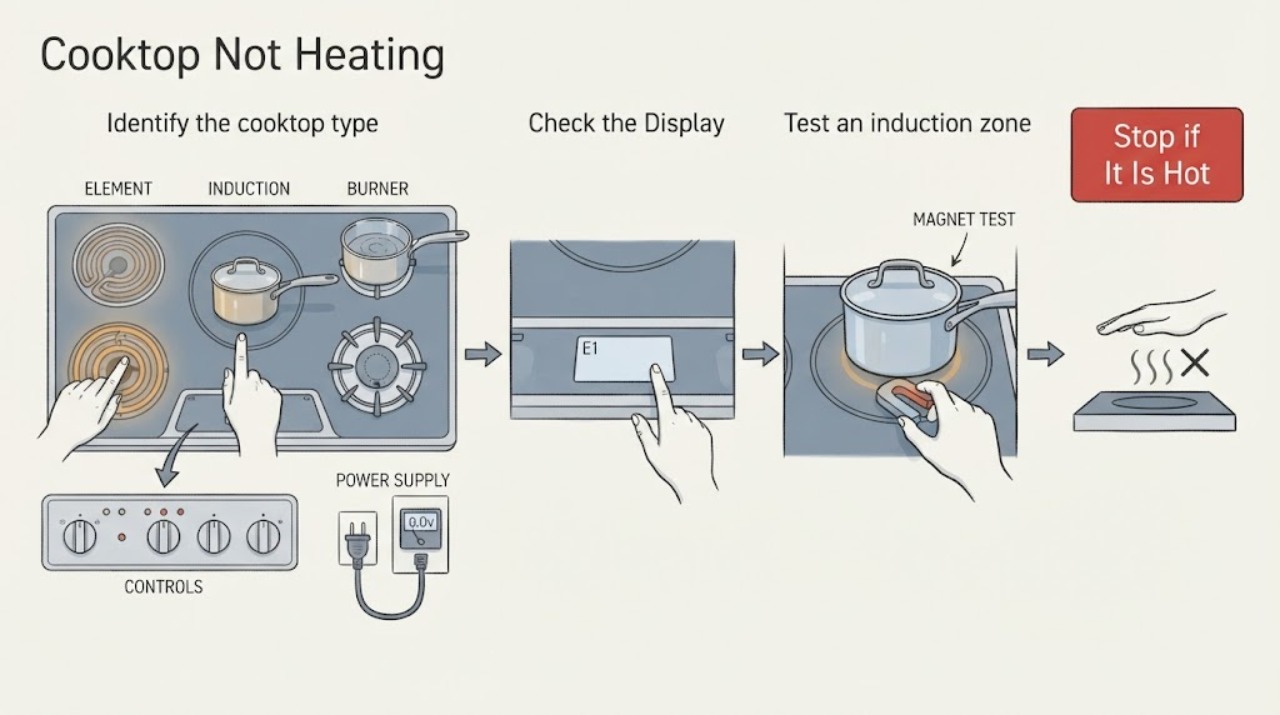
With the surface cool enough to inspect safely, identify whether the Samsung unit is radiant electric, induction, or gas. Note whether every zone is cold or only one zone, whether the display or indicator lights work, whether the controls respond, and whether any error or lock indication appears. Do not touch the glass to judge temperature.
Expected result: The whole cooktop has no response, the controls work but one zone is cold, an induction zone shows no pan detection, a radiant zone cycles visibly, or a gas zone has no normal ignition/flame response.
Next step: Continue to the external power and control check. If there is gas odor, smoke, scorching, cracked glass, exposed wiring, a hot or damaged cord, or repeated breaker trips, stop and arrange qualified or emergency help without testing further.
Why this matters
Why: A whole-unit symptom points first to supply, controls, or a safety state; a single-zone symptom points toward that element, zone, sensor, or local connection. Induction, radiant, and gas zones have different normal behavior, so the same 'not heating' wording does not identify one part.
-
Verify power, gas supply, controls, and a dry panel
Confirm the cooktop is connected as specified for the model and that the household breaker has not tripped. For a gas model, check only that the intended supply is available and the control knob is in the correct operating position; do not loosen a gas fitting. Turn off the cooktop, allow the controls to cool, wipe away visible moisture or grease, dry the touch panel, and verify Control Lock is not active. Select the intended zone and heat level using the model's normal controls.
Expected result: The display remains dead, the breaker trips again, the panel is locked or unresponsive, the cooktop powers up normally, or a code or unusual behavior returns.
Next step: Leave electrical and gas-supply repairs to qualified professionals. If power and controls are stable, continue with the matching cookware or element check and do not bypass a lock or safety feature.
Why this matters
Why: A dead display or repeated trip indicates a supply or appliance fault. A wet, dirty, or locked panel can prevent activation without a failed heater. A powered cooktop that accepts the setting but leaves the zone cold needs the type-specific test rather than more button presses.
-
Test an induction zone with correctly sized magnetic cookware
If the affected zone is induction, place an empty, flat-bottomed pan of the correct size and a small amount of water on the center of the zone. Use cookware with a magnetic base, such as compatible cast iron or magnetic stainless steel, and select the zone and heat level. Stay with the test and do not heat an empty pan.
Expected result: The zone recognizes the pan and heats the water, the zone does not detect the pan, the pan is not magnetic or too small, or a compatible centered pan is detected but the water stays cold.
Next step: Correct only the pan compatibility, size, or placement issue and retest once. If compatible cookware is detected but does not heat, request qualified Samsung appliance service and do not open the cooktop.
Why this matters
Why: Samsung says induction can turn off when cookware is not magnetic, is too small, is not positioned correctly, or is empty. A compatible, correctly positioned pan that is detected but does not heat provides a meaningful service symptom; changing pans cannot repair that condition.
-
Check a radiant element without mistaking cycling for failure
If the affected zone is radiant electric, use the normal control to select the correct element and a low-to-moderate setting on a suitable pan. Supervise the surface and observe whether the element briefly glows, fades, and cycles while the pan warms. If the model's controls were recently cleaned, confirm each knob is seated on the correct stem and matches the printed scale.
Expected result: The element cycles and the pan warms, the element never warms while other zones work, the wrong control scale was selected, or the hot-surface indicator behaves incorrectly.
Next step: If the pan warms, stop the test and use the setting normally. If one zone stays cold, an indicator is unreliable, or the surface behaves unpredictably, stop using that zone and request qualified service.
Why this matters
Why: Samsung describes radiant cycling as normal temperature regulation. A single zone that remains cold while other burners work is a localized service condition; a misplaced control knob can make the selected setting appear wrong. A faulty hot-surface indicator is also a service issue because the glass may still be hot.
-
Apply the gas-burner boundary and make one controlled retest
If the affected zone is gas, verify only the external control state and whether the expected burner response is present, without removing caps or adjusting the gas supply. If the cooktop has been serviced or cleaned, use the exact model manual to confirm burner parts are seated. For any cooktop type, after the matching correction make one supervised test on the affected zone and record whether the pan or water heats.
Expected result: The gas zone has no normal flame response, the flame is abnormal, the electric/induction zone remains cold after its type-specific test, or the zone heats normally after correction.
Next step: If there is gas odor, an abnormal flame, smoke, scorching, or any electrical hazard, shut off use, leave the area if necessary, and contact the appropriate emergency or qualified service resource from a safe location. Otherwise request qualified Samsung appliance service for the persistent no-heat zone.
Why this matters
Why: A gas burner that does not respond normally needs a supply, ignition, burner, or control diagnosis that should not be performed with live gas components. For electric or induction models, failure after the correct external test is evidence for service rather than a reason to increase settings or repeat resets.
Use your observations
Decision map
Find the observation that best matches what you see, then follow the next safe action.
-
PATH 01Safety boundary
What you see
The cooktop has no power, the breaker trips again, there is exposed wiring, smoke, scorching, or a damaged cord or connection.
Do this next
Stop using the cooktop and arrange qualified electrical or appliance service. Do not reset the breaker repeatedly or open the supply connection.
Why this path and its safety boundary
Safety stop: True
-
PATH 02Next step
What you see
The touch panel is wet, dirty, or Control Lock is active, but there is no heat or electrical hazard.
Do this next
Turn the cooktop off and cool, clean and dry the panel, then use the exact model's Control Lock procedure and make one normal test. If it remains unresponsive, request service.
-
PATH 03Next step
What you see
An induction zone does not detect the pan, or it shuts off with an empty or incompatible pan.
Do this next
Use a correctly sized, centered magnetic pan containing water and retest once. If a compatible pan is detected but does not heat the water, stop using the zone and request service.
-
PATH 04Next step
What you see
A radiant element cycles on and off while the pan warms.
Do this next
Treat the cycling as normal temperature regulation, keep the pan attended, and adjust the setting gradually. If the pan never warms or the hot-surface indicator is unreliable, stop using that zone and request service.
-
PATH 05Safety boundary
What you see
One zone remains cold after the correct power, control, cookware, or gas checks, or a gas zone has an abnormal flame or gas odor.
Do this next
Stop using the affected zone; for gas odor leave the area and contact the gas supplier or emergency help from a safe location. Otherwise arrange qualified Samsung appliance service and do not open the cooktop.
Why this path and its safety boundary
Safety stop: True
Helpful context
Understand the symptom
Not heating can mean no activation or slow normal regulation
A radiant element may glow briefly, fade, and cycle again as it regulates temperature. An induction zone may remain inactive when the pan is not magnetic, is too small, is off-center, or is empty. A gas burner requires a normal gas supply and ignition response. Identify the type and the affected zone before assuming a heating component has failed.
Keep power and hot-surface checks external
Use only the controls, cookware, visible surface, and household breaker check described for your model. Keep the cooktop attended and treat the surface as hot even when an indicator is missing or a radiant element is not visibly red. Do not remove the glass, open a junction box, probe terminals, or work on gas fittings.
Clean and dry touch controls before repeating a test
Samsung notes that moisture, grease, or debris can reduce touch-panel responsiveness and that Control Lock can prevent interaction. Clean the panel with the cooktop off and cool, dry it completely, and use the exact manual's Control Lock procedure. Do not spray cleaner into controls or repeatedly cycle power when a fault or hazard is present.
Recently installed units need a professional power check
If a cooktop has never heated correctly since installation, record whether the display powers up and whether any breaker trips. Samsung's installation guidance distinguishes gas and electric requirements and directs installation details to the model manual. Do not change the wiring or open the supply connection yourself; use a qualified installer or electrician.
Only after diagnosis
Potential parts
- radiant heating element
Consider an element only when one radiant zone remains cold after correct controls and stable power are confirmed and qualified diagnosis identifies that zone as failed.
Confirm the complete Samsung model and manufacturer fit information; do not remove the glass or test live terminals. - induction zone or cookware-detection component
An internal induction component is conditional on a compatible centered pan being detected but not heating after the documented external test and a qualified diagnosis.
Verify the complete Samsung model and exact manufacturer service information; do not open the cooktop or infer fitment from the symptom. - gas ignition or burner-control component
Consider an ignition or burner-control component only after safe external observations show a persistent abnormal response and qualified service confirms the fault.
Gas components require model-specific identification and qualified installation; never work on live gas fittings from the symptom alone.
When checks do not resolve it
Need a professional?
Call qualified appliance service for persistent no-heat performance after the external power, control, cookware, and burner checks, or for any fault involving a heating element, induction coil, ignition system, sensor, wiring, or control board.
Common questions
FAQ
Why is my Samsung cooktop on but not heating?
Identify the cooktop type and whether one zone or all zones are affected. Check the selected control, Control Lock, clean and dry panel, power or gas supply, and for induction use a correctly sized magnetic pan centered on the zone. A powered zone that still stays cold after the matching test needs service.
Why does my Samsung induction cooktop not heat my pan?
Induction requires compatible magnetic cookware of the right size, positioned correctly over the zone. Test with water in the pan; an empty pan can make the zone shut off. If compatible cookware is detected but the water does not heat, request service.
Is it normal for a Samsung radiant burner to cycle on and off?
Yes. Samsung says radiant elements can cycle on and off to regulate the selected temperature. The important result is whether the pan warms. If one element remains cold while other zones work, stop using that zone and arrange service.
When should I stop troubleshooting a Samsung cooktop?
Stop for gas odor, an abnormal flame, smoke, scorching, cracked glass, exposed wiring, a hot or damaged cord, or repeated breaker trips. Also stop after one safe type-specific test fails; do not open the cooktop or work on live electrical or gas components.
Read the exact guide
Official sources
- Samsung Cooktop FAQsSamsung USA · Samsung's FAQ guidance for cooktop power, Control Lock, clean and dry controls, no heat, induction cookware, gas supply, and service decisions.
- Samsung electric and induction cooktop temperature issuesSamsung Support · Samsung guidance on cookware, temperature response, hot-surface indicators, and normal radiant-element cycling.
- Install your Samsung gas or electric rangeSamsung Support · Samsung installation guidance distinguishing electric and gas supply requirements and directing model-specific electrical and gas work to installation instructions and qualified professionals.
- Clean and care for your Samsung electric cooktopSamsung Support · Samsung cleaning, dry-pan, cookware, and non-abrasive-care guidance for glass cooktop surfaces and controls.
- One burner on the Samsung cooktop does not workSamsung Support · Samsung's one-burner decision procedure for radiant cycling, single-zone service, induction cookware compatibility, pan placement, and a water-heating test.
Community feedback
Share a repair observation
Share a plain-text repair observation. Accepted observations are published automatically; this page may take a moment to update.