
On this page
Start here
Quick answer
Wipe up the water first and determine whether it returns during a controlled cycle. If it does, stop the dishwasher, inspect the supply and drain-hose connections, door seal, detergent type, level, and spray nozzles. Turn off water for a supply leak and arrange service for a damaged seal, persistent leak, or anything requiring cabinet access.
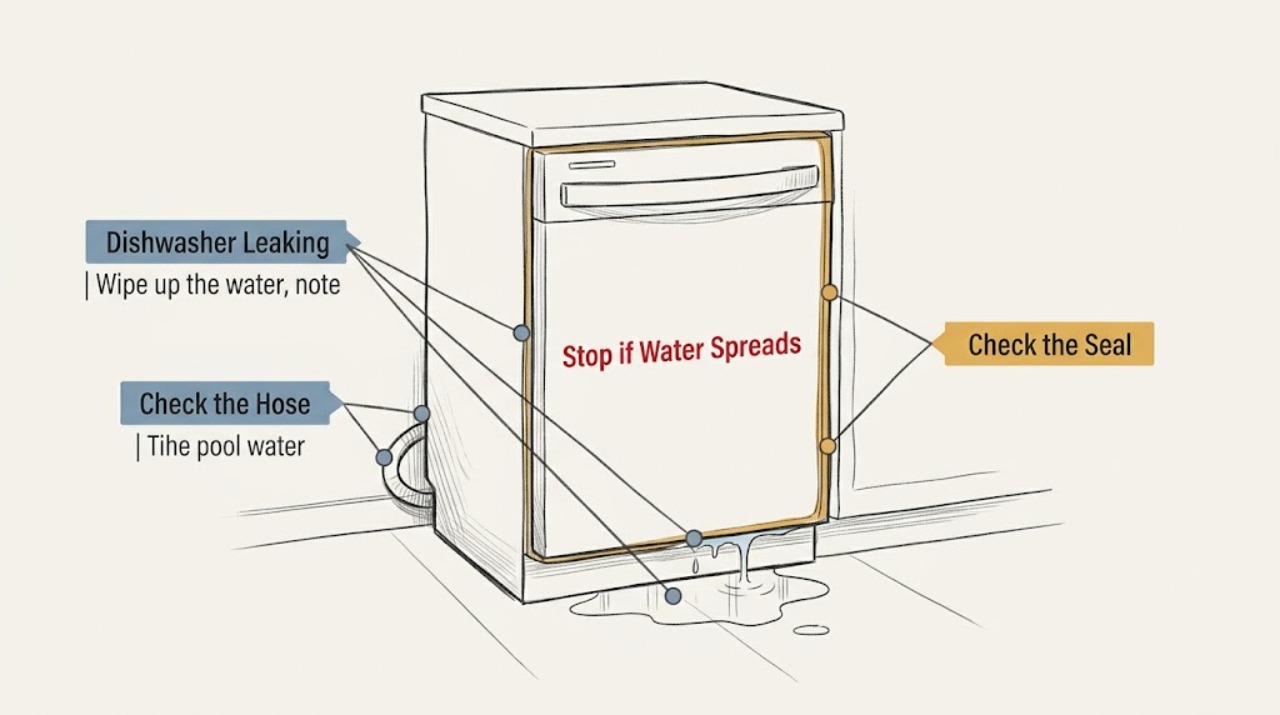
Work through in order
Diagnostic checks
Use only checks that match the exact appliance or system and its official guide.
-
Check 1
Wipe up the water, note where it first appears, and run only a brief supervised cycle if there is no active hazard.
Expected result: Water does not return, or it returns at the door, supply connection, drain connection, or underneath.
Next step: Stop the cycle when the source is confirmed and isolate water/power as safely possible before inspecting connections.
Why this matters
Why: No recurrence supports a spill; recurrence identifies the area that needs inspection.
-
Check 2
Inspect both ends and the length of the water-supply hose and the household drain-hose connection for moisture, looseness, damage, kinks, or incorrect routing.
Expected result: Moisture or a loose/damaged connection is present, or the hoses are dry and correctly routed.
Next step: Turn off the water supply for a supply leak and use the installation guide or a professional installer for reconnection.
Why this matters
Why: A supply or connection leak can be installation-related; a dry hose shifts attention to the door, suds, level, or spray path.
-
Check 3
Clean and inspect the door seal, confirm it sits in its channel, and verify the dishwasher is not blocked from closing or visibly out of level.
Expected result: The seal is dirty/displaced/damaged, or the door closes cleanly with no visible seal problem.
Next step: Clean or reseat only an intact seal; request service for damage or leakage that continues.
Why this matters
Why: A dirty or displaced seal can create a gap; damage or persistent leakage needs service.
-
Check 4
Check the detergent label and accessible spray nozzles for excessive suds or debris.
Expected result: Hand dish soap/excess suds or clogged nozzles are present, or neither is present.
Next step: Use only dishwasher detergent and clear accessible nozzle debris; stop if the leak remains.
Why this matters
Why: Samsung says hand dish soap can create suds that escape, and debris can redirect spray through the door seal.
Use your observations
Decision map
Find the observation that best matches what you see, then follow the next safe action.
-
PATH 01Next step
What you see
Water returns only at the supply connection or drain connection.
Do this next
Shut off the water for a supply leak and have the connection installed or checked professionally.
Why this path and its safety boundary
Why it matters: The hose or household installation is more likely than a tub or door-seal failure.
-
PATH 02Next step
What you see
Suds are present after hand dish soap or detergent outside the dispenser was used.
Do this next
Stop the cycle, remove the source of suds according to the manual, and use dishwasher detergent only on the next test.
Why this path and its safety boundary
Why it matters: Excess suds can escape and mimic a hardware leak.
-
PATH 03Next step
What you see
The seal is damaged, water persists after cleaning/level and nozzle checks, or moisture reaches the base.
Do this next
Keep the dishwasher off and request qualified service.
Why this path and its safety boundary
Why it matters: The leak is beyond a simple user adjustment and may activate the leak sensor.
Helpful context
Understand the symptom
Contain water before diagnosing
A leak near the door has a different path from a supply-hose leak or excessive suds. Keep water away from electrical areas and use the location and timing of the leak to choose the next safe check.
When checks do not resolve it
Need a professional?
Turn off the water supply for a supply leak; disconnect power only if safe. Stop using the dishwasher and request professional service for a damaged seal, persistent leak, water near electrical parts, or any cabinet/internal repair.
Common questions
FAQ
How can I tell a Samsung dishwasher leak from a spill?
Wipe the water up and observe a brief supervised cycle only when safe. Samsung uses whether water returns to separate a spill from a recurring leak.
Can ordinary dish soap cause a leak?
Yes. Samsung says hand dish soap creates excessive suds that can escape. Use detergent labeled for dishwashers only.
Read the exact guide
Official sources
- Samsung dishwasher is not drainingSamsung Support US · Samsung dishwasher drain hose routing and household drain checks
- Routine and deep clean your Samsung dishwasherSamsung Support US · Samsung dishwasher nozzle and filter maintenance
- Samsung dishwasher is leaking or has a leakage error codeSamsung Support US · Samsung dishwasher leak, hose, seal, detergent, leveling, and spray-nozzle troubleshooting
Community feedback
Share a repair observation
Share a plain-text repair observation. Accepted observations are published automatically; this page may take a moment to update.