
On this page
Start here
Quick answer
Some Samsung dishwasher humming, water, or initial-drain sounds are normal, but loud or unusual noise should be localized by sound type and cycle phase. Check for loose dishes or spray-arm contact, clean the accessible filter/pump opening, and record persistent noise. Request service if noise remains during an empty cycle or comes from an inaccessible pump, motor, or electrical area.
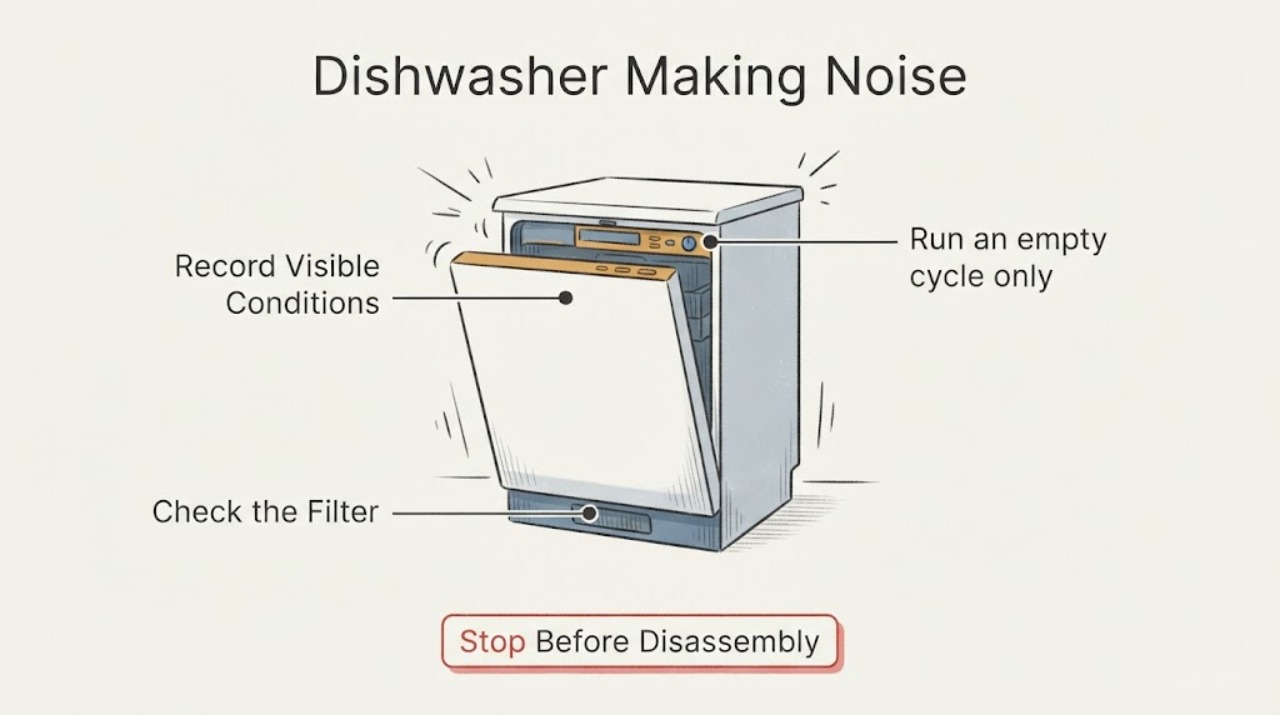
Work through in order
Diagnostic checks
Use only checks that match the exact appliance or system and its official guide.
-
Check 1
Record the sound and note its phase: initial drain, filling, spraying, drying, or door movement.
Expected result: The sound is low water/hum, repeated tapping, grinding/buzzing, hinge squeak, or dry-cycle whining.
Next step: Use the matching check below and keep the recording if service is needed.
Why this matters
Why: Samsung associates these sound patterns with different normal operations, load contact, debris, hinge/kickplate, or service paths.
-
Check 2
Run an empty cycle only if there is no leak or safety concern, after securing dishes and checking that spray arms rotate freely by hand while the unit is off.
Expected result: Noise disappears empty, or it persists without dishes.
Next step: Reload securely if empty operation is quiet; request service if the noise persists empty.
Why this matters
Why: Disappearance supports loose dishes or spray-arm contact; persistence points to an internal or installation-related source.
-
Check 3
With power off, inspect and clean the accessible drain filter and pump opening if the model permits access.
Expected result: Glass, food, labels, or other debris is present, or the accessible area is clear.
Next step: Remove only loose accessible debris and reassemble the filter correctly; do not reach into an inaccessible pump.
Why this matters
Why: Samsung says loud humming, buzzing, or grinding can indicate something caught in the drain-pump impeller; a clear area does not rule out an inaccessible pump issue.
-
Check 4
Check the kickplate for movement and verify the dishwasher's insulation blanket is present; do not remove cabinet panels.
Expected result: The kickplate moves or contacts the door, insulation is displaced, or both are secure.
Next step: Secure an accessible kickplate within the installation guidance; request service for persistent structural or internal noise.
Why this matters
Why: Samsung identifies kickplate contact and missing/damaged insulation as possible contributors to clicking or excessive noise.
Use your observations
Decision map
Find the observation that best matches what you see, then follow the next safe action.
-
PATH 01Next step
What you see
Tapping/knocking occurs only with dishes loaded and disappears on an empty cycle.
Do this next
Secure the load and ensure the spray arms and removable filter have clearance.
Why this path and its safety boundary
Why it matters: A loose item or dish contacting a spray nozzle is more likely than a motor fault.
-
PATH 02Next step
What you see
Loud grinding/buzzing persists and debris is visible in an accessible drain-pump opening.
Do this next
Remove only accessible debris with power off; stop and request service if the impeller is inaccessible or noise remains.
Why this path and its safety boundary
Why it matters: Debris in the pump impeller is a supported possibility.
-
PATH 03Next step
What you see
Noise persists during an empty cycle, occurs in the dry phase, or accompanies a leak/error code.
Do this next
Leave the unit off if noise is concerning and arrange qualified service with the recording and code.
Why this path and its safety boundary
Why it matters: The symptom is outside normal load-noise correction and may involve an internal component or safety condition.
Helpful context
Understand the symptom
Sound type changes the next check
A low hum during filling is not the same decision as grinding during drain or repeated tapping during spray. Note when the sound starts, whether it occurs empty, and whether it follows a leak or code.
When checks do not resolve it
Need a professional?
Stop and request service for persistent empty-cycle noise, loud grinding with no accessible debris, noise during drying, a damaged kickplate/insulation, smoke, burning smell, leak, or any need to open cabinet/electrical areas.
Common questions
FAQ
Is a humming Samsung dishwasher always broken?
No. Samsung says low humming or buzzing and water sounds can be normal. Loud grinding, persistent noise, or noise in an empty cycle needs further checking.
Should I keep running it to identify the noise?
Only a brief supervised empty test is appropriate when there is no leak or safety concern. Stop if the noise is loud, worsening, or accompanied by a code or burning smell.
Read the exact guide
Official sources
- Samsung dishwasher operational soundsSamsung Support Canada · Samsung dishwasher normal and abnormal sound patterns
- Routine and deep clean your Samsung dishwasherSamsung Support US · Samsung dishwasher filter and drain-pump maintenance
- Steps to get your Samsung dishwasher starting and filling with waterSamsung Support Canada · Samsung dishwasher initial drain sound and cycle sequence
Community feedback
Share a repair observation
Share a plain-text repair observation. Accepted observations are published automatically; this page may take a moment to update.