
On this page
Start here
Quick answer
Do not treat a single flashing Express 60 light as proof that the heater has failed. Samsung's blinking-light guide says that Express 60 alone means the water pressure or temperature is not correct, while the separate Heavy plus Express 60 combination means the dishwasher is unable to heat; the DW80R2031 series also has several suffix and color variants, so confirm the complete rating-label model and the exact lights before using a code meaning. For a unit that has never completed a successful cycle, first check the visible water supply, hot-water range, drain routing, door closure, and level without pulling panels or tilting the dishwasher. Assess heating only on one normal cycle: Express 60 is a quick cycle for lightly soiled loads without drying, so damp dishes after that cycle do not by themselves prove a heating failure. If the complete model or light combination cannot be matched, a normal cycle repeatedly stops, or a normal cycle completes cold, stop repeated testing and arrange qualified Samsung appliance service.
Work through in order
Diagnostic checks
Use only checks that match the exact appliance or system and its official guide.
-
Check 1
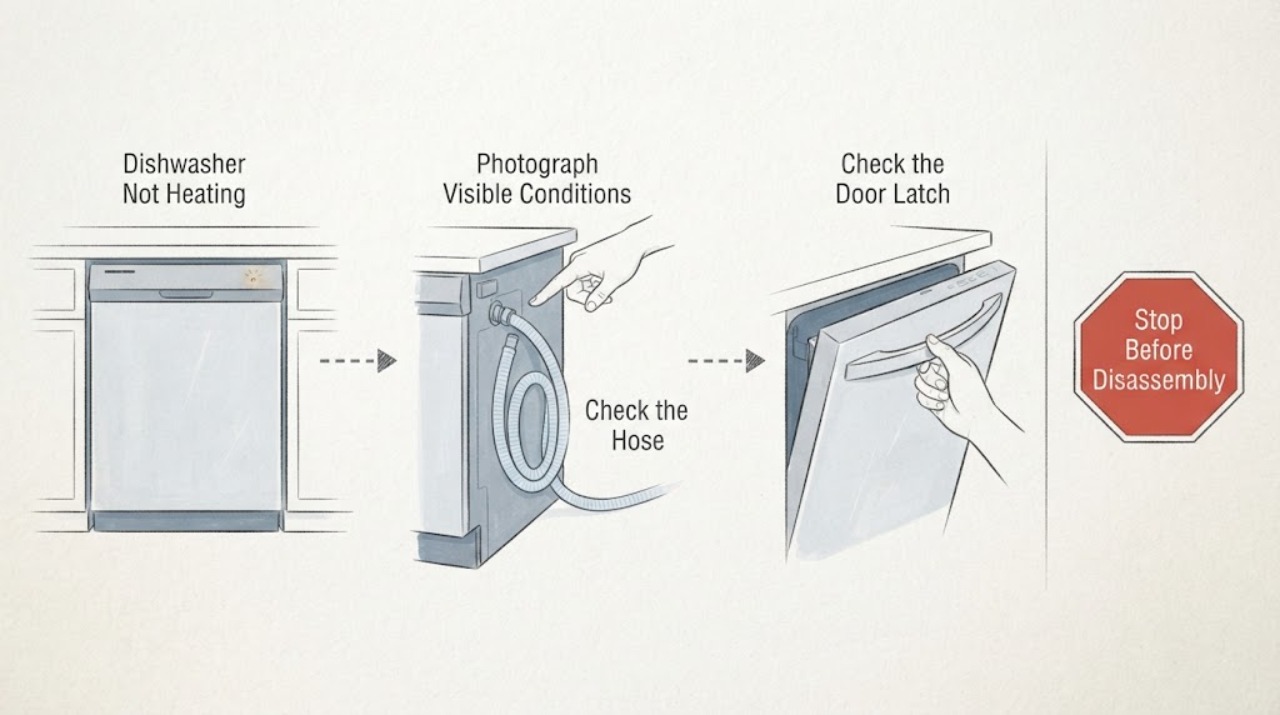
With the dishwasher off, photograph the complete control panel and read the rating label. Record every light that flashes together, whether the dishwasher stops mid-cycle or only leaves cold or damp dishes, and the complete suffix such as the installed DW80R2031 color/market variant; do not enter a service or diagnostic mode.
Expected result: Only Express 60 flashes; Heavy and Express 60 flash together; another combination flashes; or the full model suffix cannot be read.
Next step: Use the exact suffix's owner literature or qualified service when the pattern differs or the suffix is missing. Do not relabel a lone Express 60 light as a heater failure.
Why this matters
Why: Samsung assigns different meanings to different light combinations: Express 60 alone is a water-pressure or temperature condition, while Heavy plus Express 60 is an unable-to-heat condition. A different combination or an unconfirmed suffix cannot safely inherit either meaning.
-
Check 2
From a dry, accessible position, check that the dishwasher's water shutoff valve is fully open, the visible supply line is not kinked or wet, and the household hot water reaches the sink hot tap normally before a cycle. Do not loosen a fitting, disconnect a hose, or reach behind the appliance.
Expected result: The valve is closed, the visible line is kinked or leaking, hot water is outside Samsung's 120–149°F guidance, or the accessible supply looks normal.
Next step: Correct only an obvious, dry, user-accessible valve or routing issue within the installation instructions. If the line leaks, the valve will not operate, or the light returns with normal supply, leave internal diagnosis to service.
Why this matters
Why: Samsung says supply-line problems and inconsistent temperature can cause blinking lights; its stated pressure range is 20–120 psi, but pressure cannot be safely inferred from the light alone. A supply fault can also prevent a cycle from progressing, so it is not proof of a failed heater.
-
Check 3
Check the door edge and gasket for a rack, utensil, or visible debris preventing full closure, and touch the panel buttons only with dry hands to confirm they respond. Select a normal cycle and press Start briefly as Samsung describes; do not hold Start to cancel, force the door, or bypass the latch.
Expected result: The door will not latch, a button is unresponsive, the machine only drains or never begins washing, or it fills and washes normally.
Next step: Resolve only a visible loading or closure obstruction and observe at most one safe cycle. If the latch or controls remain unreliable, or the cycle repeatedly stops before completion, arrange service without opening the panel.
Why this matters
Why: A door or control-state problem can stop a cycle before a heating stage is reached. If the machine fills and washes but a completed normal cycle is cold, that is a different heating branch; Express 60's no-drying design still makes damp dishes alone inconclusive.
-
Check 4
Look underneath the sink and around the visible dishwasher edge for a kinked or disconnected drain hose, standing water, a wet floor, or a visible leak; check that the unit appears level without pulling it forward or tilting it. If the drain route or seal is visibly wet, do not run another cycle.
Expected result: The drain hose is pinched or disconnected, water is standing in the tub or under the unit, the floor is wet, the unit is visibly out of level, or the external installation looks dry and clear.
Next step: Turn off the water supply and power from a safe, dry position for a leak or water near electrical areas, then arrange service or an installer check. Do not tilt the dishwasher, remove the toe-kick, or probe the sensor or pump.
Why this matters
Why: Samsung lists drain and supply connections, the door seal, and leveling among external leak or performance checks. Its leakage sensor can stop a cycle, so a never-successful cycle with water present is not evidence that the heater is the first failed part.
-
Check 5
Only when the supply, door, drain, floor, and controls are normal and there is no burning odor or electrical warning, run one empty normal cycle—not Express 60—to observe fill, wash, completion, and temperature. Record the exact lights or display if it stops; do not repeat cycles to force a result.
Expected result: The normal cycle completes with normal warmth, completes but remains cold, stops before heating, or the Heavy plus Express 60 combination returns.
Next step: If the normal cycle is cold or the heating combination returns, stop testing and arrange qualified Samsung appliance service with the model suffix, photos, timing, and checks. Do not remove panels or test live wiring.
Why this matters
Why: A normal cycle that completes warm weakens the claim of a persistent no-heat fault and makes Express 60 dampness a normal-cycle limitation. A complete normal cycle that stays cold, an early stop, or Heavy plus Express 60 is more consistent with the not-heating/service path, but the light does not identify a heater, sensor, or board part by itself.
Use your observations
Decision map
Find the observation that best matches what you see, then follow the next safe action.
-
PATH 01Next step
What you see
Only Express 60 flashes, the model suffix is confirmed, and the dishwasher is not completing normally.
Do this next
Check the accessible valve, visible hose, and hot-water conditions once. If they are normal or the light returns, arrange model-specific service rather than ordering a heating part.
Why this path and its safety boundary
Why it matters: Samsung's U.S. guide maps this exact single-light pattern to incorrect water pressure or temperature, not directly to a failed heater.
-
PATH 02Next step
What you see
Heavy and Express 60 flash together, or a confirmed normal cycle completes cold and the pattern recurs.
Do this next
Stop repeated cycles, preserve the exact light photo and full model suffix, and request qualified Samsung appliance service. Do not remove panels or test the heater or wiring.
Why this path and its safety boundary
Why it matters: Samsung identifies Heavy plus Express 60 as the dishwasher being unable to heat. This supports a heating-service branch but does not distinguish the heater, temperature sensing, wiring, or control internally.
-
PATH 03Next step
What you see
The dishwasher completes Express 60 but dishes are damp, while a normal cycle completes with expected warmth and no error pattern.
Do this next
Use the correct cycle and loading/drying expectations from the exact manual. Escalate only if a normal cycle is also cold, incomplete, or accompanied by a verified heating pattern.
Why this path and its safety boundary
Why it matters: Express 60 is documented as a quick cycle without drying, so damp dishes from that cycle do not establish that the dishwasher is not heating.
-
PATH 04Next step
What you see
The cycle never advances beyond drain or fill, the door will not latch, the visible drain route is kinked, or the issue has existed since installation.
Do this next
Document the exact stopping stage and have the installer or qualified appliance technician correct the accessible installation or diagnose the appliance. Do not pull out or tilt the dishwasher.
Why this path and its safety boundary
Why it matters: Progress and installation conditions can prevent the dishwasher from reaching a heating stage; Samsung directs installation-related power or connection concerns to the installer and lists visible supply, drain, seal, and leveling checks for leaks.
-
PATH 05Next step
What you see
Water is under the dishwasher, a leak or LE/LC-type warning appears, a burning odor is present, or a breaker trips.
Do this next
Stop using the dishwasher. From a safe, dry position, close the water shutoff and isolate power if doing so does not expose anyone to the hazard, then arrange qualified service; do not reset or retest.
Why this path and its safety boundary
Why it matters: Samsung treats moisture and electrical symptoms as a stop-and-isolate condition; continuing cycles can worsen water or electrical damage.
-
PATH 06Next step
What you see
The complete suffix cannot be read or the observed flashing combination is not one Samsung documents for this series.
Do this next
Do not combine the lone Express 60 observation with the separate not-heating pattern. Obtain the rating-label identity and exact manual, or provide the photos to qualified Samsung service.
Why this path and its safety boundary
Why it matters: The DW80R2031 family has multiple market/color variants, and Samsung says other flashing combinations may represent normal cycle status or a different condition. The assigned short model is not enough to force a code interpretation.
Helpful context
Understand the symptom
First separate the light pattern from the heating complaint
Samsung identifies the DW80R2031 as a dishwasher series with Express 60 among its four cycles and lists US, UB, and UW model variants. The task's short model name does not establish which full suffix or market is installed. On Samsung's U.S. blinking-light guide, Express 60 alone points to water pressure or temperature, whereas Heavy plus Express 60 points to an inability to heat. Other combinations have different meanings, and Samsung warns that some blinking is only cycle status. Record the entire panel pattern and the complete rating-label model instead of combining a lone Express 60 light with the separate heating pattern.
Why Express 60 is a poor heating test
Samsung describes Express 60 as a quick wash for lightly soiled items without drying. Damp dishes after that cycle are therefore not enough to establish a failed heater. Use the model's normal cycle for one controlled observation only when there is no leak, electrical warning, or other hazard; record whether it fills, washes, reaches completion, and leaves the tub and dishes warm. A repeatedly incomplete normal cycle is a progress, door, supply, drain, or leak-protection problem until the exact pattern is identified, not a reason to order a heater or control board.
Installation and water checks matter when no cycle has ever succeeded
Samsung specifies a hot-water supply of 120–149°F and water pressure of 20–120 psi for its dishwashers, and says inconsistent temperature or supply-line problems can produce blinking lights. Its leak guidance also places the visible supply hose, drain hose, seal, and leveling checks before service. These are external observations only: do not pull the DW80R2031 out, open panels, disconnect a pressurized hose, or tilt it to reach the leak sensor or heater.
Only after diagnosis
Potential parts
- dishwasher heating element or temperature-sensing component
Consider a heating-system part only after the complete model suffix is confirmed and qualified service establishes a recurring cold normal cycle or the documented Heavy plus Express 60 heating pattern; the light alone does not select a part.
Confirm the exact DW80R2031 market/color suffix and Samsung fit information before any part decision; do not order from a blinking light alone.
When checks do not resolve it
Need a professional?
Arrange qualified Samsung dishwasher service when a verified Heavy plus Express 60 heating pattern returns, a normal cycle repeatedly stops or completes cold after the external supply, door, drain, and level checks, the complete model suffix or light combination cannot be matched, or any hidden component diagnosis would be required. Stop immediately for water near electrical areas, a leak, burning odor, tripped breaker, damaged wiring, or other electrical hazard. Do not open panels, tilt the dishwasher, bypass the door or leak sensor, or test live wiring.
Common questions
FAQ
Does a flashing Express 60 light prove the DW80R2031 heater is bad?
No. Samsung's U.S. guide maps Express 60 alone to incorrect water pressure or temperature. It separately maps Heavy plus Express 60 to an inability to heat, and even that pattern does not identify which internal component has failed.
Why are dishes damp after Express 60?
Samsung describes Express 60 as a quick wash for lightly soiled items without drying. Use one normal cycle when you need to assess heating; damp dishes after Express 60 alone are not a reliable heater test.
What water conditions should I check?
Samsung specifies a hot-water supply of 120–149°F and water pressure of 20–120 psi. Check only the accessible valve, visible hose, and household hot-water behavior; do not disconnect a line or infer pressure from the light.
Should I remove the dishwasher or test the heating element?
No. A never-successful cycle can involve supply, drain, door, level, leak protection, or heating paths. Keep checks external and arrange qualified service for a recurring heating pattern, water near electrical parts, or any panel or wiring diagnosis.
Read the exact guide
Official sources
- Samsung dishwasher cycles, options, and settingsSamsung · Samsung dishwasher cycle behavior, including Express 60 without drying and normal-cycle start procedure
- DW80R2031US | Samsung Support CASamsung Canada · Samsung DW80R2031US/AA model-support identity and model-specific manual/install-document availability
- Samsung dishwasher water supply requirementsSamsung · Samsung dishwasher hot-water temperature, pressure, supply-line, and shutoff guidance
- Lights are blinking on the Samsung dishwasherSamsung · Samsung U.S. dishwasher flashing-light combinations, including Express 60 and Heavy plus Express 60
- DW80R2031_V5.inddSamsung · Samsung DW80R2031 dishwasher series identity, cycle list, leakage sensor, and U.S. model variants
- Samsung dishwasher is leaking or has a leakage error codeSamsung · Samsung dishwasher visible-leak, leakage-sensor, hose, seal, detergent, and leveling safety guidance
- Samsung dishwasher will not turn onSamsung · Samsung dishwasher power, installation, and safe service escalation guidance
Community feedback
Share a repair observation
Share a plain-text repair observation. Accepted observations are published automatically; this page may take a moment to update.