
On this page
Start here
Quick answer
If a Samsung dishwasher finishes with cold water or damp dishes, first check whether the cycle is actually running and whether a heating-related code appears. A single cool cycle can follow a reset or interrupted program, but repeated cold cycles, a recurring HE-family code, or a cycle that stops mid-run points to a heating-system fault that needs service. Do not open panels or test live wiring.
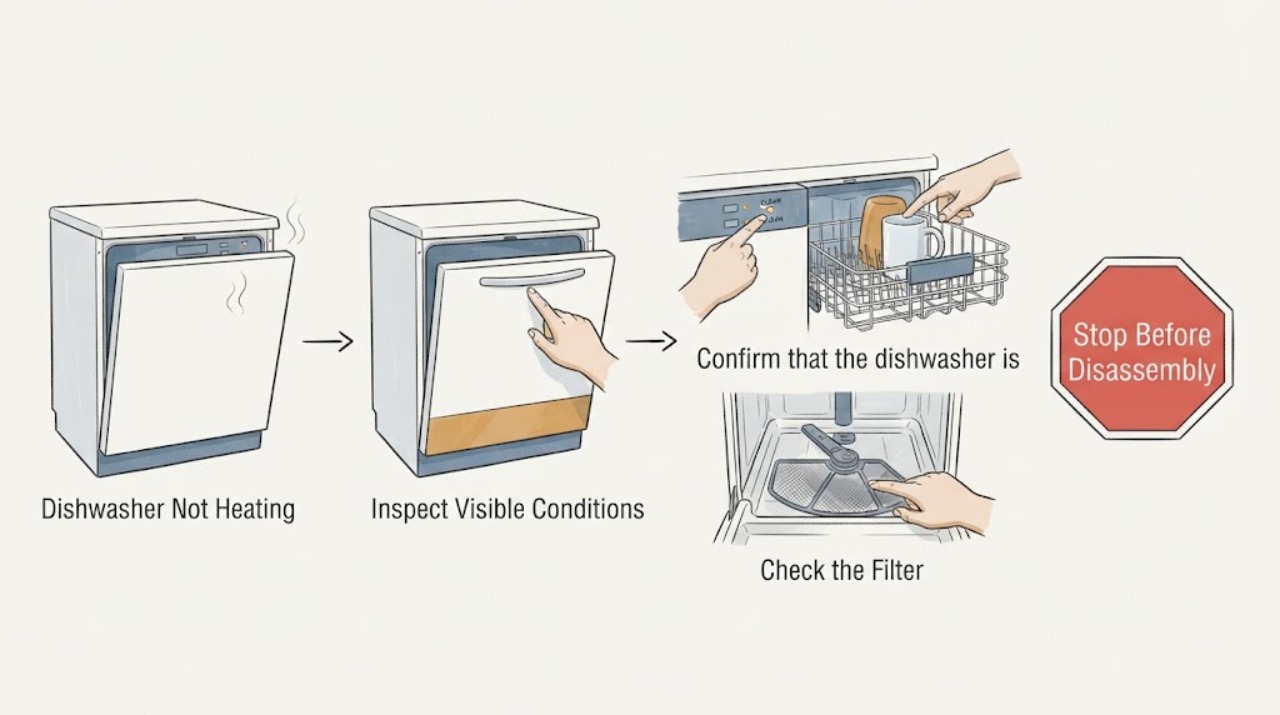
Work through in order
Diagnostic checks
Use only checks that match the exact appliance or system and its official guide.
-
Check 1
Run a normal cycle long enough to observe whether the dishwasher fills, washes, and reaches its drying or completion stage; check the display for an HE, HE1, HE2, or HE3 code.
Expected result: The cycle completes with a heating code, stops early, or completes without a code but dishes and the tub remain cold.
Next step: Record the exact display or light pattern and continue with the low-risk checks below; do not remove panels.
Why this matters
Why: A recurring code or repeated cold result makes a heating-system or temperature-sensing problem more likely; one interrupted cycle is less conclusive.
-
Check 2
Confirm that the dishwasher is starting a complete cycle rather than being paused, cancelled, or left in a drain phase after the Start button was held.
Expected result: The machine only drains or never advances to washing, or it completes a full cycle but still does not heat.
Next step: Select the model's normal cycle and press Start briefly; if a full cycle still ends cold, stop repeating resets and arrange service.
Why this matters
Why: A cycle-control issue can mimic a heating failure; a full cycle with cold water shifts suspicion back to the heating circuit.
-
Check 3
Check the incoming water supply and accessible filter area for a closed valve, a kinked hose, or heavy debris, without reaching under the machine or touching wiring.
Expected result: Water supply is restricted, or the supply is normal but the machine repeatedly reports a heating issue.
Next step: Correct only an accessible supply restriction described by the manual; leave internal diagnosis to a qualified technician.
Why this matters
Why: A supply or flow problem can prevent normal cycle progress; normal filling with repeated heating symptoms makes an internal heater, thermostat, or wiring fault more likely.
-
Check 4
If the dishwasher recently lost power, reset it only after noting any code: switch off its breaker or unplug it, wait for the charge to clear, then restore power and try one normal cycle.
Expected result: The code clears and heating returns, or the code/cold result returns on the next cycle.
Next step: Use the result to decide whether service is needed; do not keep resetting a recurring heating fault.
Why this matters
Why: A one-time electronic interruption may have cleared; a returning symptom indicates the underlying issue remains.
Use your observations
Decision map
Find the observation that best matches what you see, then follow the next safe action.
-
PATH 01Next step
What you see
The dishwasher never reaches a wash cycle, only drains, or Start was held long enough to cancel the cycle.
Do this next
Check the door, controls, and brief Start press; if it then completes cold, use the heating branch.
Why this path and its safety boundary
Why it matters: This is more consistent with cycle control or door/start behavior than proof that the heater failed.
-
PATH 02Next step
What you see
A complete cycle runs but dishes stay cold and an HE-family code returns or the cycle repeatedly stops.
Do this next
Stop using repeated resets, keep the exact code, and request qualified Samsung appliance service.
Why this path and its safety boundary
Why it matters: The heating system, temperature sensor, or internal connection is more likely than a simple setting.
-
PATH 03Next step
What you see
One cycle is cool after a power interruption, but a subsequent normal cycle completes with normal heat and no code.
Do this next
Monitor the next cycle; escalate if cold results or any heating code returns.
Why this path and its safety boundary
Why it matters: A temporary control interruption is more likely than a persistent component failure.
Helpful context
Understand the symptom
What the symptom tells you
A dishwasher can seem not to heat when it has not completed the wash program, while a repeated heating code or repeated cold results points toward the heater, temperature sensing, or related wiring. Samsung's guidance separates a simple restart from a fault that needs professional inspection.
Only after diagnosis
Potential parts
- dishwasher heating element or temperature-sensing component
Consider a part only after a qualified diagnosis confirms that the repeated cold result is caused by that component for the exact model.
Verify the complete dishwasher model and Samsung fit information before ordering; the article does not establish compatibility.
When checks do not resolve it
Need a professional?
Stop troubleshooting and arrange qualified service if an HE-family code returns, the dishwasher repeatedly stops mid-cycle, a complete cycle remains cold, water is present near electrical parts, or the breaker trips again. Do not remove the toe-kick or test the heater, thermostat, or wiring while energized.
Common questions
FAQ
Can a Samsung dishwasher fail to heat because it was reset?
A reset can clear a temporary electronic interruption, but it does not repair a heating fault. If the next complete cycle is still cold or a heating code returns, stop resetting and arrange service.
Is it safe to test the heating element myself?
No. Keep the checks to controls, cycle behavior, and accessible supply conditions. Testing or replacing internal heating parts and wiring should be done by a qualified technician with power safely isolated.
Read the exact guide
Official sources
- How to reset your Samsung dishwasherSamsung Electronics America · Samsung dishwasher reset behavior and limits when an underlying fault remains
- Why does my dishwasher show HE, HE1, HE2, or HE3?Samsung Electronics · Samsung dishwasher heating-related codes, water temperature symptoms, and professional-service boundary
- Steps to get your Samsung dishwasher starting and filling with waterSamsung Electronics Canada · Samsung dishwasher cycle start, drain phase, door, controls, and water-supply checks
- Samsung Dishwasher FAQ | Product, Shipping & SupportSamsung Electronics America · Samsung dishwasher start, heating-code context, and support escalation
Community feedback
Share a repair observation
Share a plain-text repair observation. Accepted observations are published automatically; this page may take a moment to update.