
On this page
Start here
Quick answer
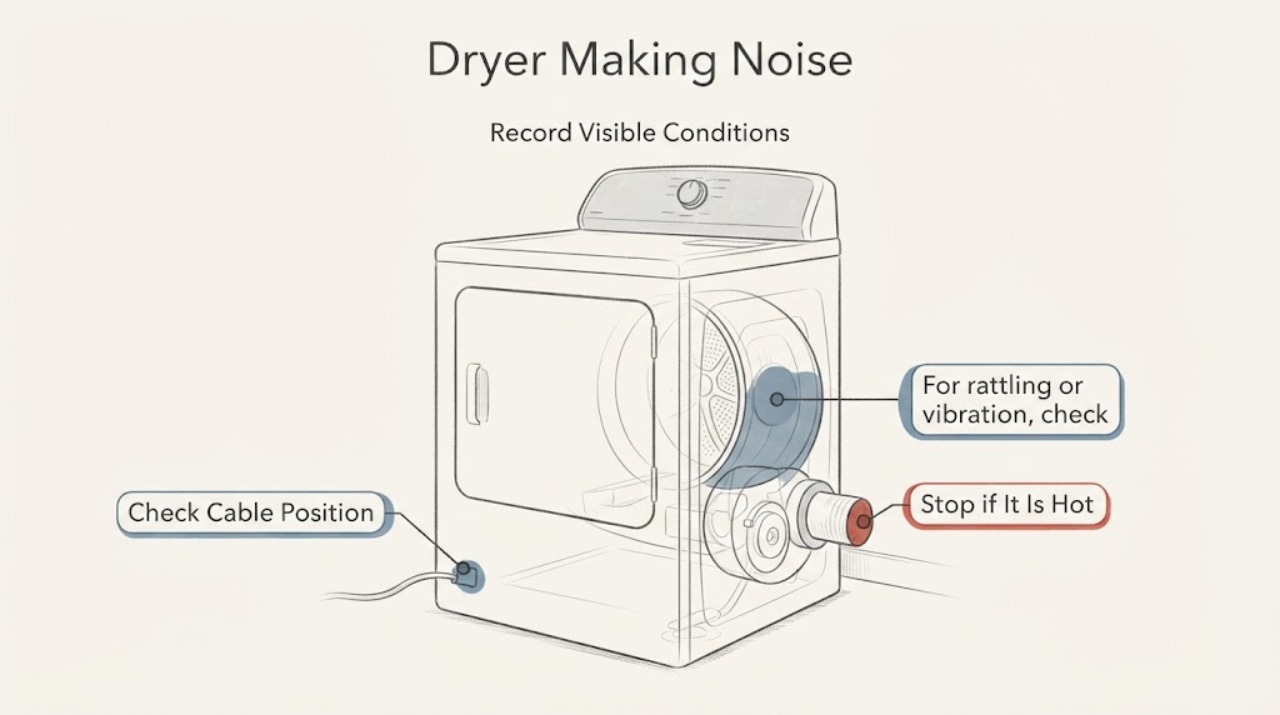
Classify the sound by type and stage before opening anything. Rattling commonly comes from a loose object, an unsecured exhaust vent or cord, or an unlevel dryer; thumping only with clothes often points to the load or overloading; squealing, squeaking, or grinding should be stopped and retested only with a normal light load; and a soft humming or buzzing can be the blower motor. A noise that remains with an empty drum, is loud or violent, or comes with burning smell, smoke, overheating, sparking, electrical odor, or a gas odor requires the dryer to stay off and qualified service. Do not remove panels or test belts, rollers, pulleys, fans, pumps, compressors, or wiring as a live appliance.
Work through in order
Diagnostic checks
Use only checks that match the exact appliance or system and its official guide.
-
Check 1
Identify the exact Samsung model and whether it is electric, gas, vented, ventless, or heat-pump. Note when the noise starts—door closing, motor start, drum rotation, heating, venting, a particular cycle, or shutdown—and record whether the drum is empty or loaded.
Expected result: The sound has a repeatable stage and location, or the model/fuel type is unknown and the sound is accompanied by heat, odor, smoke, or electrical symptoms.
Next step: Use the exact user manual for model-specific operating sounds and service instructions. If the identity is uncertain, limit the work to safe external observations and arrange service for a persistent noise.
Stop if: Do not remove panels, move the dryer to reach the back, or continue a cycle with smoke, burning odor, gas odor, sparking, overheating, or exposed wiring.
Why this matters
Why: Model type determines whether a gas valve, exhaust blower, heat-pump compressor, drain pump, or particular control is present. A stage-linked sound narrows the check; a hazardous symptom overrides sound classification.
-
Check 2
Stop the cycle and empty the drum. From outside the drum, check pockets and the drum surface for coins, buttons, pens, zippers, bra wires, or another loose object; gently remove only an object that is plainly accessible without reaching into a moving or hot machine.
Expected result: The noise disappears when the object or load is removed, continues with an empty drum, or appears as a repeating scrape/thump synchronized with drum rotation.
Next step: Remove the accessible object, turn garments with hard fasteners inside out, and use a smaller normal load. Arrange service for a repeating empty-drum noise, scraping, or suspected drum/drive fault.
Stop if: Do not reach through the door while the drum moves, use tools to pry an object out, or disassemble the drum or front panel.
Why this matters
Why: A loose object or a garment feature can strike the drum and create rattling or thumping. Noise that remains empty or follows rotation can involve drum support, rollers, belt, idler, motor, or another internal drive part and cannot be confirmed safely from the outside.
-
Check 3
For rattling or vibration, check the dryer from outside on a solid, level floor. Confirm nothing touches the cabinet, power cord, or exhaust vent; inspect the visible vent connection for a loose or misaligned section, and use a carpenter's level and the model manual before making only the minimum leveling-foot adjustment.
Expected result: The dryer rocks, the vent or cord touches another surface, a panel or object vibrates against the cabinet, or the installation is stable and clear.
Next step: Clear the contact and correct only the documented leveling adjustment. If the cabinet still shakes, walks, bangs, or rattles after the safe installation check, stop and arrange service.
Stop if: Do not stack, lift, tilt, or move the dryer alone; do not disconnect a gas line or open the rear panel to inspect the vent.
Why this matters
Why: An unlevel or unstable installation can transmit vibration and create rattling without an internal failure. A secure, level installation with a persistent noise shifts attention to the drum, blower, or drive system.
-
Check 4
For thumping, squealing, squeaking, or grinding, note whether the sound occurs only with a heavy or wet load. Stop the cycle, remove enough items to make a normal load, distribute bulky items, and use the washer's spin cycle first when the clothes are excessively wet; do not use a heavy load as a stress test.
Expected result: The noise disappears after reducing the load, occurs only with hard buttons or zippers, or continues with a normal light load or an empty drum.
Next step: Use smaller balanced loads and turn hard fasteners inside out if the noise was load-dependent. Arrange service if the noise remains with a normal load or empty drum.
Stop if: Do not keep running an overloaded drum, spray lubricant through the cabinet, or open the dryer to adjust a belt, roller, pulley, or bearing.
Why this matters
Why: Large items can hit the drum and an excessive wet load increases drive load. A squeal or grind with a normal load or an empty drum is more consistent with an internal drum-support, belt, pulley, motor, or bearing issue than with ordinary loading.
-
Check 5
For a hum, buzz, whoosh, or noise that changes with airflow, check the lint filter and visible exhaust path only when the dryer is off and cool. Confirm the vent is not kinked, crushed, loose, or touching the cabinet; use a model-supported vent test if available rather than inserting an object into the duct.
Expected result: The sound is a soft steady hum, airflow is restricted, the vent rattles, a vent-blockage indication appears, or the sound is loud/rough and the path is clear.
Next step: Clean the lint filter and correct a visible, safe vent alignment problem as the manual permits. Arrange service for a loud internal airflow noise, a persistent blockage indication, abnormal heat, or a model-specific pump/compressor sound.
Stop if: Do not run the dryer with a blocked duct, remove the blower housing, insert tools into the vent, or continue if heat, smoke, or burning odor is present.
Why this matters
Why: Samsung identifies a normal hum with the blower motor, while a loose vent or restricted duct can add rattle and heat. A loud rough blower sound with a clear vent may involve the blower wheel or motor; a pump or heat-pump compressor is model-dependent and requires the exact manual or service diagnosis.
-
Check 6
If the dryer is a gas model, separate a brief model-normal valve or ignition sound from a gas emergency. Without opening panels or moving the appliance, note whether there is gas odor, a delayed ignition, a loud ignition event, abnormal flame, smoke, or only a brief sound described by the model manual.
Expected result: Gas odor, escaping-gas sound, delayed ignition, abnormal flame, or smoke is present, or the sound is brief and occurs only at the model's documented gas/heat stage without any hazard sign.
Next step: For gas odor, escaping gas, smoke, or abnormal ignition, leave immediately and seek emergency or gas assistance from a safe location without using switches or a phone inside. Otherwise follow only the model manual and arrange service for a persistent or worsening gas-stage noise.
Stop if: Do not relight, repeatedly start, adjust a gas valve, move the dryer, or inspect a gas connector yourself.
Why this matters
Why: Unburned gas or abnormal combustion can cause fire, explosion, or carbon-monoxide risk. A brief model-specific sound is not proof of a defect, but any odor, smoke, or delayed ignition changes the path to immediate safety and service.
-
Check 7
Check for safety symptoms before any optional repeat observation: burning or electrical odor, visible smoke, sparking, a hot plug or outlet, unusual cabinet heat, repeated breaker trips, or a violent impact. If none is present, record a short description of the sound and its timing rather than repeatedly running the dryer.
Expected result: A safety symptom is present, or the sound is merely soft/cyclical and the dryer remains stable with normal heat and airflow.
Next step: Stop and isolate power only from a dry, safe position when possible for smoke, electrical odor, sparking, or repeated trips; for gas odor leave first. Otherwise monitor the documented normal sound and arrange service if it becomes loud, continuous, or appears with a normal load.
Stop if: Do not reproduce a spark, smoke, violent bang, gas odor, overheating, or electrical fault for diagnostic purposes.
Why this matters
Why: Safety symptoms can indicate an electrical, fire, gas, motor, or blocked-vent fault. A soft hum, load-dependent thump, or brief relay/control sound may be normal, but normality depends on the model and the absence of worsening symptoms.
-
Check 8
If the noise persists, capture the model, cycle, load size and wetness, sound type, location, start/stop stage, level and vent checks, whether it occurs empty, and any codes or safety symptoms. Leave internal diagnosis to a qualified technician.
Expected result: The noise stops after a load, object, vent, or leveling correction, or it persists with a normal load/empty drum or is paired with poor drying, heat, smoke, odor, or electrical symptoms.
Next step: Monitor a resolved, quiet cycle with an ordinary load. For persistent or hazardous symptoms, keep the dryer off and provide the recorded pattern to qualified service.
Stop if: Stop user troubleshooting for smoke, burning/electrical odor, gas odor, sparking, repeated breaker trips, severe impact, overheating, exposed wiring, or any need to open the cabinet.
Why this matters
Why: A correction tied to the load or installation is different from a persistent internal fault. Empty-drum noise and noise with safety or performance symptoms can involve the drum support, drive, blower, pump, compressor, controls, vent system, or wiring.
Use your observations
Decision map
Find the observation that best matches what you see, then follow the next safe action.
-
PATH 01Safety boundary
What you see
The noise is rattling and changes when the dryer, vent, cord, or a loose drum object is stabilized.
Do this next
Correct the visible contact, secure the vent as the manual permits, remove the accessible object, and level the dryer with minimum adjustment.
Why this path and its safety boundary
Safety stop: Continue with empty-drum and load-dependent checks.
-
PATH 02Safety boundary
What you see
Thumping occurs only with clothes or disappears after reducing a heavy or bulky load.
Do this next
Use smaller balanced loads and turn garments with large fasteners inside out.
Why this path and its safety boundary
Safety stop: Treat thumping with an empty or normal load as a service symptom.
-
PATH 03Safety boundary
What you see
Squealing, squeaking, grinding, or scraping continues with a normal load or empty drum.
Do this next
Stop the cycle and arrange service for possible internal drum-support or drive components.
Why this path and its safety boundary
Safety stop: Use lighter loads and monitor for recurrence without stress-testing the dryer.
-
PATH 04Safety boundary
What you see
The sound is a soft hum or buzz that follows airflow and the dryer has normal heat and no safety symptom.
Do this next
A blower-related operating sound may be normal; keep the lint filter and visible vent path clear.
Why this path and its safety boundary
Safety stop: Arrange service for a loud, rough, continuous, or performance-linked airflow sound.
-
PATH 05Safety boundary
What you see
The model has a pump or heat-pump compressor and the noise is tied to that stage.
Do this next
Use the exact model manual for normal sound guidance and stop short of opening the sealed or pump system; service persistent or abnormal noise.
Why this path and its safety boundary
Safety stop: Do not assume a pump or compressor is installed; continue with the load, drum, blower, vent, and installation branches.
-
PATH 06Safety boundary
What you see
A gas dryer has gas odor, escaping-gas sound, delayed ignition, abnormal flame, or smoke.
Do this next
Do not operate switches or restart; leave immediately and seek gas or emergency assistance from a safe location.
Why this path and its safety boundary
Safety stop: Follow the exact model manual and arrange service if a gas-stage sound persists or worsens.
-
PATH 07Safety boundary
What you see
Burning/electrical odor, visible smoke, sparking, hot wiring, repeated breaker trips, overheating, or severe impact is present.
Do this next
Stop the dryer, isolate power only from a dry safe position when possible, do not reproduce the fault, and arrange qualified service.
Why this path and its safety boundary
Safety stop: Document the sound and complete only low-risk external checks.
-
PATH 08Safety boundary
What you see
Noise remains after the load, object, level, vent, and safe external checks, especially when the drum is empty.
Do this next
Keep the dryer off and provide a qualified technician with the sound recording or description, stage, model, and observations.
Why this path and its safety boundary
Safety stop: Monitor the corrected condition during normal use and stop if the noise returns with a safety symptom.
Helpful context
Understand the symptom
A Samsung dryer can make different sounds during loading, tumbling, heating, venting, and shutdown. The useful first question is not “which part should I buy?” but “does the sound follow the clothes, the drum rotation, the airflow, or the installation?” A brief low hum can be normal, while the same sound that is loud, continuous, or present in an empty drum needs a different decision.
Samsung dryers include electric, gas, and heat-pump models, so an internal blower, burner-related component, pump, or heat-pump compressor is not present in every unit. Use the model manual to identify what your dryer actually has. A user can safely inspect the load, drum, level, vent alignment, lint path, and visible power connection; internal drum supports, belt, idler, rollers, motor, fan, pump, compressor, and wiring are service boundaries.
Noise plus a safety symptom is not a normal-noise troubleshooting problem. Stop the cycle for smoke, burning or electrical odor, exposed or melted wiring, sparking, unusual heat, repeated breaker trips, severe impact, or a gas smell. For a gas odor or visible smoke, leave the area and seek emergency help from a safe location without operating switches or using a phone inside.
When checks do not resolve it
Need a professional?
Provide the model and fuel type, cycle and stage, sound description and location, empty-versus-loaded result, load size and wetness, level and vent observations, recent installation or movement, error codes, and any odor, smoke, spark, heat, or breaker detail.
Have this ready
- Have a short sound recording made from a safe position, the model manual, and the checks already completed. Do not open the cabinet, move a gas dryer, or attempt belt, roller, motor, pump, compressor, or wiring work.
Common questions
FAQ
Why is my Samsung dryer making a rattling noise?
Check that the dryer is level and stable, the vent and cord are not touching another surface, and the drum has no loose buttons, coins, or other objects. If the rattle continues with an empty drum, arrange service.
Why does my Samsung dryer thump only with clothes inside?
A bulky or overloaded load can hit the drum, especially when garments have large buttons, snaps, or zippers. Stop the cycle, reduce and balance the load, and turn hard fasteners inside out. Thumping in an empty drum needs service.
Are squealing or grinding sounds normal on a Samsung dryer?
They can occur with an excessively heavy load, but Samsung advises stopping and reducing the load. If the sound remains with a normal load or empty drum, a drive or drum-support problem is possible and the dryer should be serviced.
Is a humming or buzzing Samsung dryer normal?
A soft operating hum or buzz can be the blower motor. A loud, rough, continuous, or airflow-related noise—especially with poor drying or excess heat—requires a vent check and possibly service.
Could a dryer pump or compressor be making the noise?
Only some Samsung models have a pump or heat-pump compressor. Confirm the dryer type and model manual first; do not open a pump or sealed cooling system. Persistent stage-linked noise should be diagnosed by qualified service.
What should I do if the noisy Samsung dryer smells like gas or is smoking?
Stop immediately. For a gas odor or smoke, do not operate switches or use a phone inside; leave the building and seek emergency or gas assistance from a safe location. For an electric dryer with smoke or electrical odor, stop and arrange service without reproducing the fault.
Read the exact guide
Official sources
- Samsung dryer is vibrating or shakingSamsung Support · Official Samsung installation and vibration guidance applicable to dryer stability checks; exact model manual controls.
- Samsung dryer is too noisySamsung Support · Official Samsung dryer noise guidance; exact model instructions control and internal component diagnoses require service.
- Samsung Dryer FAQ | Product, Shipping & SupportSamsung Support · Official Samsung product support page used to distinguish electric, gas, and heat-pump dryer types and model-dependent troubleshooting.
- Clothes are not dry after using Samsung dryerSamsung Support · Official Samsung vent guidance used when noise changes with airflow or accompanies long, hot, or poor-drying cycles.
- Samsung dryer loses power or won't turn onSamsung Support · Official Samsung power safety guidance used for noise-plus-electrical-symptom stop conditions.
- Samsung dryer smells or smokesSamsung Support · Official Samsung safety guidance for gas and electric dryers when a noisy cycle includes smoke, gas odor, burning smell, or electrical odor.
Community feedback
Share a repair observation
Share a plain-text repair observation. Accepted observations are published automatically; this page may take a moment to update.