
On this page
Start here
Quick answer
First find where the water begins instead of diagnosing from the puddle alone. Dry the floor safely, then check for a spill or condensation, a door or lid that is not sealing, frost or a blocked drain path, and an accessible ice-maker or water-line connection. Keep food protected, and do not use a knife, ice pick, hair dryer, heater, or direct heat to remove ice. Stop if water is near an outlet or electrical part, an external supply line is continuously leaking, the freezer is warming, or the source is concealed; arrange qualified appliance service.
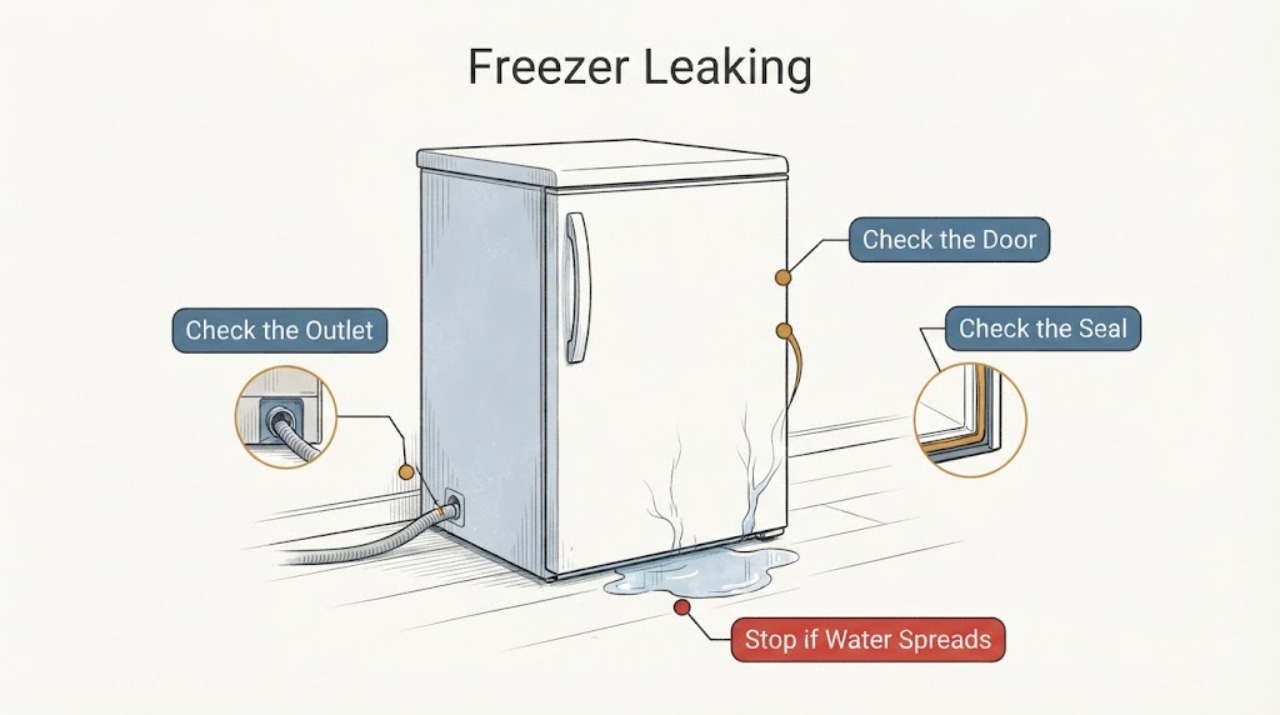
Work through in order
Diagnostic checks
Use only checks that match the exact appliance or system and its official guide.
-
Check 1
Protect the room and food, dry the accessible floor and exterior, and check whether water is actively flowing or is close to the cord, outlet, controls, or other electrical parts.
Expected result: A small, contained wet area with no electrical contact is different from continuous water flow, a wet outlet or cord, a damaged cabinet, or food that is no longer safely cold.
Next step: For active flow or water near electricity, stop using the freezer and isolate water or power only from a safe, dry position; arrange qualified appliance or plumbing service. If safe, keep the door closed and trace the first wet point.
Why this matters
Why: The first observation sets the safety boundary before any troubleshooting. A supply leak, electrical exposure, or unsafe food condition is not an invitation to continue testing.
-
Check 2
Trace the source after the area is dry: inspect the freezer floor and rear wall, the door or lid edge, the cabinet base, and the accessible area behind the appliance without pulling a loaded freezer.
Expected result: Water only inside or under the freezer points toward condensation, frost melt, a defrost drain, or a seal; moisture at an ice maker, filter housing, dispenser path, or external hose points toward a water system; water that does not start at the freezer may be a spill or another appliance.
Next step: Choose the door-and-frost, drain, or ice-maker-and-water-line branch that matches the first wet point. If the source stays hidden, stop opening panels and request service.
Why this matters
Why: The first wet point is more useful than the location of the puddle. Samsung's leak guide organizes checks by where the water is coming from, including under drawers, under the appliance, and the dispenser or filter area.
-
Check 3
Check the door or lid closure and accessible gasket: remove a package that blocks the seal, wipe the gasket clean with a suitable damp cloth, and use a sheet of paper or a hand check around the closed edge.
Expected result: A paper sheet that pulls out without resistance, a visible gap, cold air escaping, a torn gasket, or frost concentrated at the edge indicates a sealing or alignment problem. An even seal with no gap makes the gasket less likely to be the source.
Next step: Rearrange only accessible food and monitor with the door closed. If the gasket remains damaged, the door is misaligned, or frost and water return, stop forcing the door and arrange model-specific service.
Why this matters
Why: Samsung explains that a door that does not close properly allows warm, humid air in; that moisture can form water or frost. Food blocking the door can create the same symptom without a failed gasket.
-
Check 4
Inspect the interior for heavy frost, ice at the bottom or rear, and blocked air vents; clear only loose, accessible debris and follow the exact Samsung manual if a manual defrost is permitted.
Expected result: Light frost that stays on the liner, heavy frost that returns, ice covering a drain area, or blocked vents together with water suggests moisture entry, restricted defrost drainage, or an airflow problem. A clear liner with water that starts outside points elsewhere.
Next step: Protect food and flooring and use only the model-approved procedure. Never chip ice with a sharp tool or use a hair dryer, heater, or direct heat; if the drain is behind a panel or frost rapidly returns, request service.
Why this matters
Why: Samsung links frost to warm air entering through an open or poorly sealed door and warns that some frost conditions require defrosting. The model determines the location and safe procedure for a drain or defrost path.
-
Check 5
Check whether the freezer drains toward the intended path and whether the cabinet is standing as installed; keep vents clear and inspect the accessible floor or rear area without tilting or moving a loaded unit.
Expected result: Water returning at the bottom after the surrounding floor is dry, an uneven installation, or a blocked airflow space supports a drainage or installation issue. Water that tracks from a wall, pipe, or neighboring appliance is not a freezer drain diagnosis.
Next step: Do not pull or tilt the loaded appliance to reach hidden parts. Correct only an obvious accessible obstruction according to the manual; if the cabinet, drain path, or installation needs adjustment, arrange qualified service.
Why this matters
Why: Samsung says the appliance is designed to tilt slightly backward so doors close and water can drain correctly. A nearby spill or source can mimic an appliance leak.
-
Check 6
If the freezer has an ice maker, dispenser, filter, or connected water supply, inspect only the accessible filter seating, ice chute or bucket seal, and external hose or coupler for moisture, kinks, cracks, or a recent installation or door-removal connection event.
Expected result: Moisture that appears after ice or water dispensing, an incorrectly seated filter, a gap at an ice-chute seal, or a wet accessible hose points toward the water system. A continuous drip or water line that will not stop is an active supply leak.
Next step: Stop the ice maker or water use if safe and close the household water supply only from a dry, accessible shutoff when there is an active supply leak. Do not dismantle a coupler or valve; arrange appliance or plumbing service if moisture persists.
Why this matters
Why: Samsung identifies filter, ice chute, bucket seal, water lines, and couplers as possible leak paths, especially after a filter change, installation, or door work. These parts are model-specific and not all freezers have them.
-
Check 7
After an accessible cleanup and seal or source check, dry the floor and record when water returns, where it first appears, whether frost or dispensing preceded it, and whether the freezer is maintaining safe food conditions.
Expected result: No recurrence supports a one-time spill or condensation event; recurring water, warming food, rapid frost return, a damaged liner or gasket, or water from a hidden area shows the fault remains.
Next step: Stop using the freezer and request qualified service for recurrence, warming, concealed drainage, cabinet damage, or any diagnosis requiring panels, wiring, or sealed-system access. Protect or discard food according to applicable food-safety guidance if it has become unsafe.
Why this matters
Why: A temporarily dry floor does not prove the leak is repaired. A repeat pattern gives a technician information needed to distinguish drain, seal, installation, and water-system faults.
Use your observations
Decision map
Find the observation that best matches what you see, then follow the next safe action.
-
PATH 01Next step
What you see
The water was a spill or condensation and does not return after the floor and freezer exterior are dried.
Do this next
Keep the door closed as much as practical and monitor. If water returns from the same location, use the source-specific branch rather than treating it as a one-time spill.
-
PATH 02Next step
What you see
Frost or water is concentrated around the door or lid edge, or the paper and hand checks show a gap.
Do this next
Remove accessible obstructions, clean the gasket, and confirm the door closes evenly. Arrange model-specific gasket or alignment service if the seal remains damaged or the leak recurs.
-
PATH 03Next step
What you see
Ice or water appears at the bottom or rear inside the freezer, especially with heavy frost or a recurring sheet of ice.
Do this next
Follow the exact manual's defrost and drain guidance only when safe; do not remove concealed panels or use sharp tools or direct heat. Request service when the drain is inaccessible or the condition returns.
-
PATH 04Next step
What you see
Moisture follows ice making, dispensing, a filter change, installation, or door work and is near an accessible filter, chute, bucket seal, hose, or coupler.
Do this next
Stop ice or water use, inspect only the accessible connection, and arrange appliance or plumbing service for a continuing drip or damaged part. Do not dismantle the water system.
-
PATH 05Next step
What you see
Water is near electrical parts, continuously flowing from a supply line, or the freezer is warming food.
Do this next
Stop troubleshooting. Isolate power or water only from a dry, safe position and request qualified service; do not touch wet electrical parts or keep testing the freezer.
Helpful context
Understand the symptom
A Samsung freezer can appear to leak for several different reasons: a spill or normal condensation, meltwater from frost, a door gasket that admits humid air, an obstructed defrost path, or a water connection serving an ice maker or dispenser. The puddle may travel, so begin by drying the area and tracing the first wet point.
The exact freezer layout varies by model. Use the owner's manual for any model-specific drain, filter, ice-maker, or defrost procedure. These checks stay on the safe, accessible side: do not remove concealed panels, open the refrigeration system, or force a wet appliance.
Separate a spill or condensation from a recurring leak
Samsung notes that water under a refrigerator can be condensation, a spill, or water that froze and later melted. A dry floor that stays dry after cleanup supports a one-time event; water that returns from the same cabinet, drain, gasket, or water connection needs the matching branch below.
Protect food and electrical areas first
Keep the freezer closed while you assess the leak so food stays cold. If water has reached the outlet, cord, controls, or another electrical part, do not touch the wet area. Disconnect power only when it can be done without contacting water; otherwise leave it alone and get qualified help.
Safety boundary
Stop conditions
- Stop immediately if water reaches the cord, outlet, controls, wiring, or another electrical part, or if the cord or outlet is wet or damaged.
- Stop if an external water line is actively or continuously leaking, or if water cannot be isolated safely from a dry, accessible shutoff.
- Do not use a hair dryer, heater, direct heat, ice pick, knife, or other sharp tool to defrost; do not remove concealed panels or open the refrigeration system.
- Stop using the freezer and protect the food if it is warming, the liner or cabinet is damaged, or food safety cannot be established.
- Arrange qualified service when the leak recurs after accessible checks, the source is hidden, or diagnosis requires wiring, panels, valves, or sealed-system work.
When checks do not resolve it
Need a professional?
Call qualified Samsung appliance service when water returns after the accessible source, door, frost, and installation checks; the defrost drain or pan is concealed or damaged; the freezer is warming; the cabinet or gasket is damaged; or an ice-maker, filter, valve, hose, or coupler continues to leak. Use plumbing service for a household supply line or external water source.
Common questions
FAQ
Why is my Samsung freezer leaking water at the bottom?
Dry the area and find the first wet point. A spill or condensation may not return, while recurring water at the bottom can follow frost, a defrost drain, a door seal, leveling, or a connected water system. Use the exact model manual and request service if the source is hidden or the leak returns.
Can a Samsung freezer door seal cause leaking or ice?
Yes. A gap, damaged gasket, or package preventing closure can admit warm humid air and create frost or meltwater. Check the closed edge with a sheet of paper and your hand, remove accessible obstructions, and arrange service if the seal remains faulty.
Can I use a hair dryer or knife to remove ice from a leaking Samsung freezer?
No. Samsung's frost guidance warns against using a hair dryer to speed defrosting. Do not use a knife, ice pick, heater, direct heat, or other sharp or electrical tool; follow the model manual or use qualified service.
What if the leak is from the Samsung ice maker or water line?
Stop ice or water use and inspect only the accessible filter, chute, bucket seal, hose, or coupler for moisture or damage. A continuing drip or active supply leak needs appliance or plumbing service; do not dismantle the water system.
Read the exact guide
Official sources
- What should I do if I suspect my Samsung fridge/freezer is leaking water?Samsung UK · Samsung fridge/freezer door seal, defrost drain, rear connections, leveling, spill distinction, and repair escalation
- Frost forms in the Samsung freezer, refrigerator, or ice bucketSamsung · Samsung freezer frost, door seal, airflow, defrost safety, ice bucket, and door alignment
- Water leaks in a Samsung refrigeratorSamsung · Samsung refrigerator and freezer water-source diagnosis, condensation, filters, ice paths, water lines, leveling, and service escalation
Community feedback
Share a repair observation
Share a plain-text repair observation. Accepted observations are published automatically; this page may take a moment to update.