
On this page
Start here
Quick answer
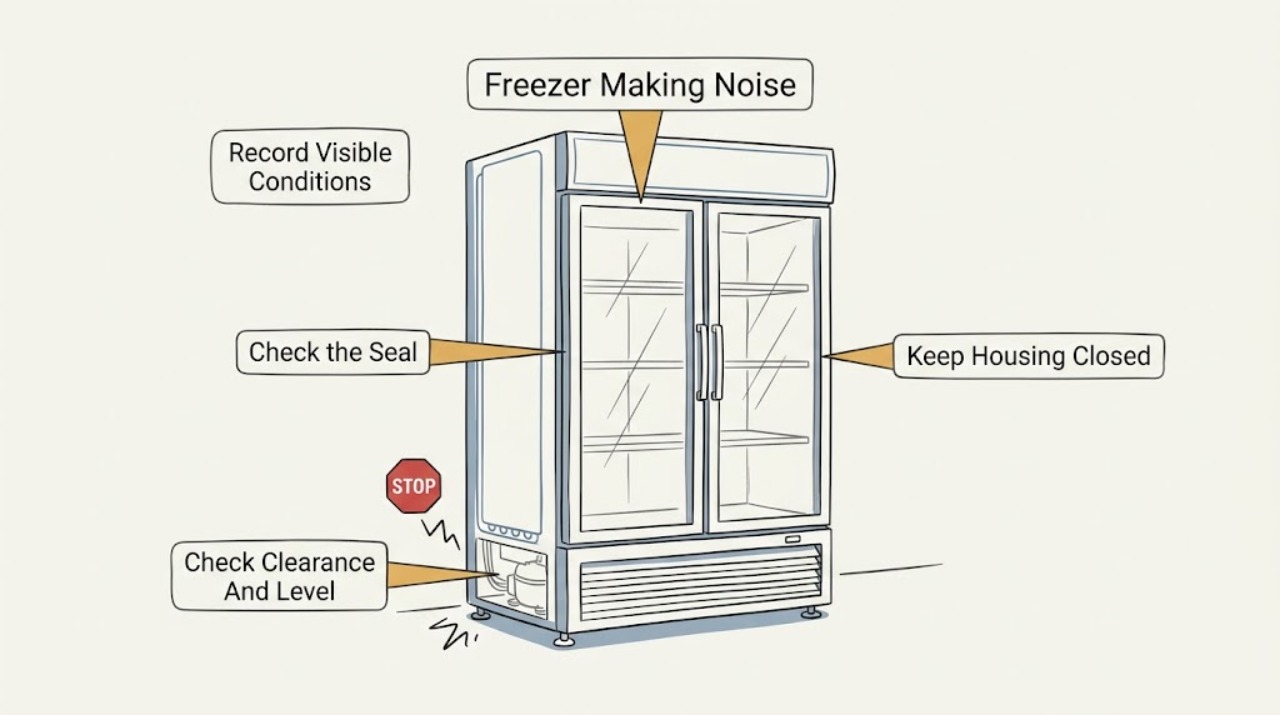
Some Samsung freezer sounds are normal: a compressor hum or click, air movement from a fan, bubbling or hissing from refrigerant and defrost water, and brief cracking or popping as materials change temperature. A rattle, scrape, or vibration deserves a short, safe isolation check. Record when the sound occurs, confirm the freezer is level and not touching a wall or object, separate vibrating containers, check that the door seal closes, and look for significant frost that could obstruct a fan. If the noise sounds like a fan striking ice, becomes a loud impact or grinding sound, continues with poor cooling, or is accompanied by overheating, burning smell, smoke, sparking, a damaged cord, or another electrical risk, stop using the freezer and arrange qualified service; do not remove covers or reach into a fan.
Work through in order
Diagnostic checks
Use only checks that match the exact appliance or system and its official guide.
-
Check 1
From a safe position, record the sound for a short interval and note whether it is a hum, buzz, click, bubbling, hiss, airflow, crackle, rattle, scrape, or impact; also note whether it starts with cooling, defrost, door movement, or the ice maker and whether food is still frozen.
Expected result: A periodic hum, airflow, bubbling, defrost crackle, or brief click follows an operating event; an irregular scrape, fan-strike sound, grinding, or loud impact is new, persistent, or paired with warming.
Next step: For a normal operating pattern with stable cooling, proceed to the external vibration check. For persistent abnormal sound or warming, stop and prepare a service report without opening the cabinet.
Why this matters
Why: Samsung classifies several compressor, fan, refrigerant, defrost, and ice-maker sounds as normal. A sound outside those patterns, especially with a cooling change, is an abnormal-noise branch rather than a volume complaint.
-
Check 2
Inspect from outside whether the freezer or refrigerator cabinet touches a wall, cabinet, pipe, or nearby object; check that stored containers are not knocking together, and verify level and stable footing using the model's safe leveling instructions.
Expected result: The cabinet touches something, items vibrate against each other, the unit rocks or is visibly out of level, or no external contact or instability is present.
Next step: Separate contacting containers, clear safe surrounding space, and make only the model-documented minor leveling adjustment. If moving the appliance or removing a cover would be needed, stop and use qualified service.
Why this matters
Why: Samsung identifies clearance, contents, and leveling as common causes of rattling or vibration and says leveling can reduce noise and prevent cooling or leak problems.
-
Check 3
Visually inspect the door path and gasket for an obstruction, dirt, gap, or poor closure, and look through the freezer compartment for significant frost around vents or the rear wall; do not pry at ice or reach toward a fan.
Expected result: The door does not close cleanly, the gasket has a visible gap or buildup, or heavy frost is present near the fan or air path; alternatively, the door seals and no significant frost is visible.
Next step: Remove only a simple door obstruction and wipe the gasket with the model-approved method. If frost is heavy, hidden behind a cover, or returns, follow the owner's manual or arrange service; do not chip, heat, or disassemble the freezer.
Why this matters
Why: Samsung links door closure and gasket condition with abnormal operation and identifies significant freezer frost as a possible obstruction to free fan operation and a source of rattling.
-
Check 4
Compare the noise with cooling performance and, if the freezer has an ice maker, note whether the sound occurs during ice-making or water-fill activity; use the model controls to stop the ice maker only when the manual permits and no hazard is present.
Expected result: The sound occurs during a documented ice-maker event while cooling remains normal, or it continues outside that event and the freezer is warming, showing frost changes, or losing airflow.
Next step: If the sound is clearly an ice-maker event and cooling is stable, document it and monitor. If cooling is worsening or the sound is a scrape, grinding, or repeated impact, stop relying on the freezer and arrange qualified service.
Why this matters
Why: Samsung describes ice-maker hums and bangs as possible normal events, but a sound that is not event-linked or is paired with cooling loss needs a service decision. Cooling failure can make food unsafe even when the noise itself seems minor.
-
Check 5
Find the exact Samsung model manual and record whether the sound began after moving, door removal, cleaning, defrost, a temperature change, installation, or an ice-maker event; do not assume another Samsung model uses the same layout or sound pattern.
Expected result: The manual identifies a normal sound or a documented user-level check, or the sound is not described, is newly worsening, or requires access behind a cover.
Next step: Follow only the model-specific external instruction. If the manual does not resolve an abnormal sound, retain the recording and arrange Samsung or qualified appliance service.
Why this matters
Why: Samsung's support pages state that sequences and settings can vary by location and model and direct users to the model manual when the sound does not match the listed patterns.
-
Check 6
Stop immediately if the abnormal noise is accompanied by poor or lost cooling, a fan striking ice or a component, smoke, burning smell, overheating, visible sparking, a hot or damaged cord or plug, water near electrical parts, or repeated electrical trips.
Expected result: The hazard or cooling loss persists, or the sound cannot be isolated without removing a cover, reaching into a fan, moving heavy equipment unsafely, or exposing sealed-system or energized parts.
Next step: Stop using the freezer and keep people away. If safe to do so, unplug it without touching water or damaged wiring and move food to a safe cold location. Do not remove covers, probe wiring, defrost with improvised heat, or touch a fan; arrange qualified service.
Stop if: Stop and call Samsung or a qualified appliance technician.
Why this matters
Why: These signs can involve food safety, moving parts, fire, electric shock, water damage, or a sealed refrigeration system and are beyond a safe user-level noise check.
Use your observations
Decision map
Find the observation that best matches what you see, then follow the next safe action.
-
PATH 01Next step
What you see
The sound is a periodic hum, click, airflow, bubbling, defrost crackle, or ice-maker event and cooling is stable.
Do this next
Treat it as a likely normal operating sound, keep clearance and level correct, and document it if it changes. Use the exact model manual if the pattern becomes persistent or different.
-
PATH 02Next step
What you see
The cabinet touches a wall or object, stored items touch each other, or the appliance is unstable or out of level.
Do this next
Clear safe surrounding space, separate contacting containers, and make only documented minor leveling adjustments. Arrange service if the unit must be moved or hardware is loose behind a cover.
-
PATH 03Next step
What you see
Significant frost is visible near vents or the sound resembles a fan striking ice.
Do this next
Do not reach into the fan or chip the frost. Check the door seal and model manual; hidden or recurring frost needs qualified service.
-
PATH 04Next step
What you see
The sound occurs only during a documented ice-maker fill or ice-drop event and freezer temperature remains normal.
Do this next
Record the event and use the model control to stop the ice maker only if appropriate. Persistent noise outside the event or cooling loss requires service.
-
PATH 05Next step
What you see
The noise is grinding, scraping, repeated impact, or otherwise new and is paired with warming, reduced airflow, or worsening frost.
Do this next
Stop using the freezer, protect the food, and arrange qualified service. Do not remove covers or attempt fan, compressor, or sealed-system repair.
-
PATH 06Next step
What you see
Smoke, burning smell, overheating, sparking, hot or damaged power parts, water near electrical parts, or repeated trips occur.
Do this next
Stop immediately and isolate power only if safe. Keep clear, protect food if possible without approaching the hazard, and use qualified emergency or appliance service.
Helpful context
Understand the symptom
First identify the sound and its timing
Samsung describes compressor hums and clicks, fan airflow, refrigerant bubbling, defrost crackles, and brief cabinet noises as normal operating sounds on its refrigerator and freezer support pages. A recording made from a safe distance can help a technician. The useful distinction is not simply loud versus quiet: note whether the sound follows compressor starts, defrost, door opening, the ice maker, or a fan speed, and whether the freezer continues to hold temperature.
Rule out vibration before suspecting a part
Samsung says rattling can come from the appliance touching another object, items touching each other, loose installation hardware, or a refrigerator that is not level. Its leveling guide explains that leveling helps prevent noise, cooling issues, and leaks. These are appropriate external checks; do not pull a heavy freezer by unprotected leveling legs or open a rear cover to inspect tubing.
Frost and cooling performance change the decision
Significant frost can interfere with fan movement and produce rattling, while a normal fan or compressor sound should not be paired with a freezer that is warming. A user may check the door seal, visible frost, clearance, and food placement, but hidden ice, a fan that appears to strike something, a sealed-system issue, or a cooling failure requires service. Keep the door closed and protect food if temperatures are rising.
Only after diagnosis
Potential parts
- evaporator or condenser fan component
Only consider this after qualified diagnosis confirms a fan-related noise or fan obstruction that is not caused by an accessible door, frost, or clearance condition.
Confirm the complete Samsung model and manufacturer fit information; do not reach into or replace a fan based on sound alone. - door gasket or leveling hardware
Only consider this if a damaged seal or failed leveling component is confirmed after the external inspection.
Use the exact model documentation and qualified diagnosis; no fit or part number is implied. - compressor or sealed-system component
Only consider this after abnormal sound is paired with cooling loss and a qualified technician confirms a sealed-system or compressor fault.
Sealed-system work is professional service; confirm model-specific compatibility through Samsung or the technician.
When checks do not resolve it
Need a professional?
Arrange Samsung or qualified appliance service when an abnormal noise persists after safe clearance and leveling checks, a fan appears to strike ice, frost returns, cooling is poor, the sound is grinding or a repeated impact, or diagnosis would require a cover, fan, compressor, tubing, or electrical access.
Common questions
FAQ
Is a humming or clicking Samsung freezer normal?
Often. Samsung identifies compressor hums and clicks and fan airflow as normal operating patterns. Treat a new grinding or impact sound, or any sound paired with warming, frost obstruction, smoke, heat, or electrical risk as a service condition.
Why is my Samsung freezer rattling?
Check whether the cabinet touches a wall or object, stored containers touch each other, the unit is level, or significant frost is obstructing a fan. Samsung lists these as causes of vibration or rattling; hidden frost or persistent recurrence needs service.
Can frost make a Samsung freezer fan noisy?
Samsung says significant freezer frost can obstruct free fan operation and produce rattling. Do not reach into the fan or chip the ice. Check the door seal and model manual, and arrange service for heavy, hidden, or recurring frost.
Why does my freezer make bubbling or hissing sounds?
Samsung describes refrigerant movement, defrost water, and airflow as possible normal sounds. The sound should still be evaluated if cooling is poor, the noise is new and severe, or it is accompanied by smoke, burning smell, overheating, or electrical symptoms.
When should I stop using a noisy Samsung freezer?
Stop for abnormal noise with poor cooling, a fan striking ice, smoke, burning smell, overheating, sparking, a hot or damaged cord or plug, water near electrical parts, or repeated trips. Protect food in a safe cold location and arrange qualified service without removing covers.
Read the exact guide
Official sources
- Why there is an 'Abnormal noise' from the refrigeratorSamsung India · Samsung abnormal refrigerator noise checks for clearance, contents, ice maker, level, door seals, and freezer frost
- Abnormal noise is coming from the refrigeratorSamsung Hong Kong · Samsung refrigerator abnormal-noise classification and model-manual escalation
- Abnormal noise is coming from the refrigeratorSamsung New Zealand · Samsung refrigerator abnormal noise patterns, fan, compressor, refrigerant, defrost, door, clearance, and service guidance
- How to level your Samsung refrigeratorSamsung USA · Samsung refrigerator leveling, safe clearance, and minor leveling adjustment guidance
- What to do when the refrigerator makes noiseSamsung Philippines · Samsung refrigerator normal sound causes, leveling, clearance, contents, and model service escalation
- Quels sont les types de bruits possibles pour mon réfrigérateur/congélateur Samsung ?Samsung France · Samsung refrigerator-freezer sound classification for refrigerant, fan, defrost, compressor, and vibration behavior
- What should I do when the refrigerator makes noise?Samsung Caribbean · Samsung refrigerator and freezer normal compressor, fan, refrigerant, defrost, and ice-maker sounds
Community feedback
Share a repair observation
Share a plain-text repair observation. Accepted observations are published automatically; this page may take a moment to update.