
On this page
Start here
Quick answer
A Samsung oven that appears to be leaking may be releasing steam or condensation, retaining water after an applicable Steam Clean cycle, or allowing liquid food residue to run toward the door. Samsung says Steam Clean models can have a significant amount of hot water left in the cavity after the cycle, and that some wall-oven models use water for Steam Cook; let the oven cool before wiping it and follow the exact model manual. A door that does not close fully, a damaged seal, or recurring liquid outside the cavity needs service rather than a test run. If the smell is fuel-like, treat it as a gas emergency: do not operate switches, appliances, phones, or flames in the area, leave immediately, and contact emergency or fuel-gas help from a safe location. Water near the cord, outlet, controls, or wiring, smoke, sparks, a burning smell, an uncontrolled flame, or a hot active leak is also a stop-use condition. Do not remove panels, force the door, search for a gas leak with a flame, or restart the oven to see whether the leak returns.
Before you begin
Safety first
- This article covers only cool, ordinary-access observation and model-approved cleanup. Do not remove panels or door hardware, probe wiring, open gas fittings, relight to test, use a flame for leak detection, or energize a wet appliance.
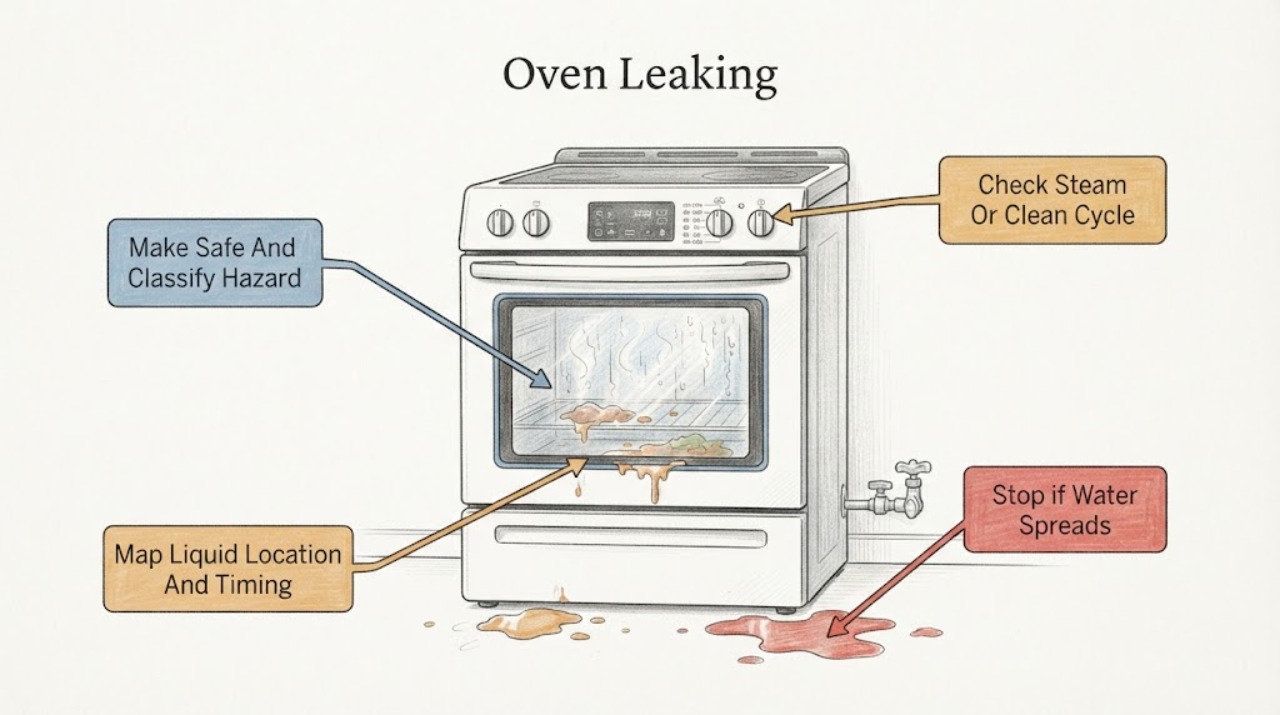
Work through in order
Diagnostic checks
Use only checks that match the exact appliance or system and its official guide.
-
Check 1
From a safe position, stop the cooking task and determine whether the immediate symptom is hot water or steam, liquid outside the oven, a fuel-like odor, smoke, sparks, or a burning smell; do not touch a wet plug, outlet, control, or hot liquid.
Expected result: Record any gas odor or hissing, fuel-gas alarm, smoke, visible flame outside the normal burner area, electrical arcing, burning odor, water near electrical parts, or active hot flow.
Next step: For gas odor, smoke, flame, sparks, burning odor, or water near electrical parts, stop immediately and use the matching stop condition. Otherwise leave the oven off and let it cool before inspecting the source.
Stop if: Stop for fuel odor or hissing; smoke, flames, sparks, arcing, or burning smell; water entering controls, outlets, cords, or wiring; or a hot active leak.
Why this matters
Why: A fuel or electrical warning is not an ordinary leak diagnosis. Hot steam and liquid can burn, and water near energized parts can create shock or fire risk.
-
Check 2
After the oven is off and cool, use a dry cloth and a flashlight from outside the appliance to map where moisture starts: cavity floor, door edge, between door glass, underside, cabinet, rear area, or a steam reservoir or hose if the model has one; note the cycle and food present.
Expected result: Note whether the moisture followed Steam Clean, Steam Cook, a high-water food, a spill, a cleaning event, a recent installation, or appeared while the oven was idle; record whether it is clear water, greasy liquid, or has an unusual odor.
Next step: If the liquid is outside the cavity, recurring, unexplained, or near electrical parts, do not run the oven; document it and arrange service. If it is cool, limited to the cavity, and clearly follows the model's steam-clean procedure, continue with the cool cleanup check.
Stop if: Stop when the source is under, behind, or inside electrical areas, the liquid continues to collect, or its odor is fuel-like or chemically abnormal.
Why this matters
Why: Water in the cavity after an applicable steam-clean cycle or moisture associated with food can have a different explanation from recurring water under or behind the oven. The location determines whether a simple cool-down cleanup is reasonable or service is needed.
-
Check 3
Compare the observed cycle with the exact Samsung manual: check whether the oven has Steam Clean, Hybrid Clean, Steam Cook, a tray, or a reservoir, and after full cooling wipe only the accessible cavity water as instructed; do not pour extra water into an unlisted opening.
Expected result: After the model-approved cool-down and wipe, the cavity is dry and the moisture does not return when the oven remains unused; or water returns without a steam/clean function, appears at the door exterior, or reaches the base or controls.
Next step: If the water is only the expected cooled cleaning residue, clean it and follow the model manual. If it returns, is outside the cavity, or is not covered by the exact manual, keep the oven off and request service.
Stop if: Stop for hot water or steam, water entering door gaps or controls, any need to remove panels, or any recurring leak outside the documented steam/clean procedure.
Why this matters
Why: Samsung documents that some cleaning modes deliberately use water and may leave a significant amount behind. Water that returns outside that context suggests a seal, reservoir, connection, installation, or internal fault that cannot be confirmed by a generic test.
-
Check 4
Once cool, inspect the pan, rack, cavity floor, and door threshold for a visible food or grease spill, and clean only accessible surfaces using the model's approved method; keep liquid out of the gasket, door cracks, vents, and control panel.
Expected result: The trail starts at a pan or food residue and stops after the cooled residue is removed; or the liquid is clear and reappears with no spill, comes from a door gap or vent, or collects beneath the unit.
Next step: If the spill fully explains the moisture, dry the accessible surfaces and follow Samsung's cleaning guidance. Otherwise leave the appliance off, photograph the safe exterior location, and request service.
Stop if: Stop for hot grease or liquid, liquid in door glass gaps or controls, smoke, or any cleaner reaction; never mix cleaning chemicals or use an unapproved oven cleaner.
Why this matters
Why: A food spill can look like a leak and can smoke when heated. Recurrent clear water or water from a seam, base, vent, or rear connection is not explained by food residue and should not be tested by another bake cycle.
-
Check 5
With the oven cool, look at the door, visible gasket, hinges, latch area, racks, and divider from the outside; confirm racks and divider are fully seated and nothing blocks an even door closure, but do not disassemble the door or force the latch.
Expected result: The door closes evenly and the seal appears seated with no visible damage; or a rack or divider blocks it, the door was recently removed, the latch is stuck, the gasket is displaced or damaged, or the frame or glass is physically damaged.
Next step: Remove only a clearly mis-seated cool rack or divider as the manual allows and recheck closure. For a damaged seal, glass, hinge, latch, or frame, or a door that still will not close, stop using the oven and request service.
Stop if: Stop for broken glass, bent or loose hinge, damaged seal, a door that will not close, hot steam escaping toward a person, or any need to remove door hardware.
Why this matters
Why: Samsung identifies rack placement, reattachment, latch position, and physical damage as different door problems. A door that cannot close evenly can release steam and heat toward the front and may allow moisture to escape.
-
Check 6
If the Samsung appliance is a gas model and any fuel-like smell, hissing, delayed ignition, abnormal flame, or fuel-gas alarm is present, stop troubleshooting immediately without operating nearby controls, lights, appliances, phones, or flames.
Expected result: The odor or alarm continues, or there is a delayed/burst flame, soot, smoke, or hissing; or there is no fuel odor and the appliance is confirmed to be electric or an ordinary steam/food-moisture event.
Next step: For any gas warning, leave immediately, contact emergency or fuel-gas help from outside or another safe location, and do not return or restore gas service until professionals clear it. If there is no gas warning, continue only with the low-risk cool inspection path.
Stop if: Stop permanently for this episode at any gas odor, alarm, hissing, delayed ignition, burst flame, or unexplained combustion symptom; do not find a leak with a flame or relight to test.
Why this matters
Why: A suspected fuel leak can ignite while a person searches for its source. NFPA treats an alarm, gas smell, or suspected leak as an emergency and requires a safe-location handoff to responders or a fuel-gas professional.
-
Check 7
After the oven is cool and the surrounding air is clear, inspect only the accessible exterior for water near the outlet, cord, controls, cabinet, or floor and record the model, fuel type, cycle, liquid path, and any displayed code; do not energize, pull out a built-in oven, or remove panels.
Expected result: The area is dry and the issue was a one-time, documented cool cavity residue; or water, odor, damage, a code, or the leak returns, reaches electrical areas, or prevents the door from closing.
Next step: Keep the appliance out of service and arrange a qualified appliance or gas professional when the cause is recurring, outside the manual, concealed, or connected with a gas or electrical warning. Provide the recorded details without performing a restart test.
Stop if: Stop for water near electrical components, repeated breaker trips, smoke, burning odor, sparks, damaged wiring or cord, concealed access, or any request to perform live electrical or gas work.
Why this matters
Why: A repeat or concealed leak can involve a door, reservoir, hose, installation, valve, or internal electrical area and cannot be assigned safely from a generic Samsung page. A one-time documented steam-clean residue is the only low-risk resolution path.
Use your observations
Decision map
Find the observation that best matches what you see, then follow the next safe action.
-
PATH 01Next step
What you see
A fuel-like smell, hissing, fuel-gas alarm, delayed ignition, burst flame, soot, or abnormal combustion is present.
Do this next
Do not operate switches, appliances, phones, or flames in the area. Leave immediately and contact emergency or fuel-gas help from a safe location. Do not return, restore gas, or relight until professionals clear the appliance and supply.
-
PATH 02Next step
What you see
The moisture is inside the cool cavity and follows an applicable Samsung Steam Clean, Hybrid Clean, or Steam Cook procedure.
Do this next
Follow the exact manual, allow full cooling, and wipe accessible water only after it is cool. If water returns without the cycle, escapes outside, or reaches controls, stop and request service.
-
PATH 03Next step
What you see
The trail starts at a pan or visible food or grease residue and does not recur after the cool, approved cleaning step.
Do this next
Keep the oven off until cool, clean accessible surfaces using Samsung's model guidance, and do not allow moisture into the gasket or door cracks. Recurrence means service, not another test bake.
-
PATH 04Next step
What you see
The door is blocked, uneven, damaged, recently reattached, or the gasket is displaced or damaged.
Do this next
Correct only a clearly mis-seated cool rack or divider as the manual allows. Do not force, disassemble, or bend the door; request service if closure or sealing remains abnormal.
-
PATH 05Next step
What you see
Water appears under, behind, at a reservoir or connection, or near the cord, outlet, controls, or wiring, or keeps returning while the oven is idle.
Do this next
Do not energize or move the appliance. Keep people away from wet electrical areas and arrange qualified appliance service; use emergency help for smoke, arcing, fire, or a fuel odor.
Helpful context
Understand the symptom
Identify what is actually leaking
Look at the timing and location before assuming a failed oven water system. A small amount of moisture at the door after cooking can be steam or condensation from the food. Water inside the cavity after an applicable Steam Clean cycle can be expected, and some Samsung models have Steam Cook or a reservoir. A greasy or colored trail that begins at a pan is more likely a food spill. Water that appears under the appliance, in a cabinet, at the rear connection, or around the control area is a different problem and should not be chased while the oven is hot or energized. A fuel-like smell is not a water leak; use the emergency branch immediately.
Steam and cleaning water need a cooling boundary
Samsung's Steam Clean instructions call for water in the tray or cavity on applicable models and warn that significant water can remain and be very hot afterward. Do not open the door into a burst of steam, reach into hot water, or wipe the cavity until the oven has cooled. Once cool, remove only loose water with a soft, dry cloth or sponge as the model manual directs. If water appears when no steam or cleaning function was selected, or returns after it has been removed, stop using the oven and arrange a model-specific service assessment rather than repeatedly heating it.
A door or seal problem can move heat and liquid toward the front
With the oven off and cool, check from the outside whether a rack, divider, pan, or visible debris prevents the door from closing evenly. Samsung's door guidance also distinguishes a recently removed or incorrectly reattached door, a latch that is stuck, and physical damage that needs service. Do not pull the door apart, bend a hinge, wet the gasket, force a latch, or run the oven with a door that will not close. Moisture in the door glass or a seal that is visibly torn, loose, displaced, or unable to close the door is a repair boundary.
Gas odor is a separate emergency, not a leak test
Only some Samsung oven and range configurations use fuel gas, so confirm the fuel type from the model documentation only when the surrounding air is clear and there is no odor. If you smell gas, hear hissing, see a delayed or abnormal flame, or a fuel-gas alarm sounds, do not try to identify the fitting, relight the burner, cycle the breaker, open a valve, or test with a flame. Leave immediately without operating nearby electrical controls or phones, and contact emergency or fuel-gas help from a safe location. Do not return or restore gas service until qualified responders or a fuel-gas professional says it is safe.
When a wet oven needs a professional assessment
Service is the appropriate next step for recurring water outside the cavity, a leak at a steam reservoir or connection, water reaching the controls or outlet, a door that will not close, visible seal or glass damage, or a problem that returns after the applicable model procedure. Record the full model number, fuel type, selected mode, whether Steam Cook, Steam Clean, Hybrid Clean, or Self Clean was active, where the liquid appeared, its color or odor, and whether the oven was hot. This gives the technician useful context without requiring a dangerous restart.
Safety boundary
Stop conditions
- Fuel-like odor, hissing, fuel-gas alarm, delayed ignition, burst or abnormal flame: leave without operating nearby switches, appliances, phones, or flames and contact emergency or fuel-gas help from a safe location.
- Smoke, fire, sparks, electrical arcing, burning or plastic odor, a hot surface that remains energized, or an oven that continues heating unexpectedly: stop using it and obtain emergency or qualified service help as appropriate.
- Water near an outlet, cord, plug, control panel, wiring, or other electrical area; active water under the appliance; or repeated unexplained water: do not energize, move, or test the oven.
- Hot water or steam, hot grease, broken glass, a damaged seal or hinge, or a door that will not close: keep clear until cool and do not force or disassemble the door.
- Do not remove panels, perform live electrical or gas work, open a gas fitting, find a leak with a flame, relight a gas burner, or run another cycle solely to reproduce a leak.
Only after diagnosis
Potential parts
- oven door gasket or seal
Only consider this category if the exact model manual and a technician confirm that a damaged or displaced gasket is allowing heat or moisture to escape.
Confirm the complete Samsung model number and approved fit information before ordering; do not substitute a generic seal. - steam reservoir, hose, or valve component
Only applicable to Samsung models with a documented steam or reservoir system and only after a qualified diagnosis of an actual water-system leak.
Verify that the model has the relevant steam system and have the service provider confirm compatibility before any replacement.
When checks do not resolve it
Need a professional?
Request qualified appliance service when the leak is recurring, external, unexplained, connected to a steam reservoir or hose, associated with a damaged door or seal, reaches electrical areas, or remains after the exact model cleaning procedure. Use emergency or fuel-gas help from a safe location for a gas odor, alarm, hissing, smoke, fire, or abnormal combustion.
Safety scope: This article covers only cool, ordinary-access observation and model-approved cleanup. Do not remove panels or door hardware, probe wiring, open gas fittings, relight to test, use a flame for leak detection, or energize a wet appliance.
Common questions
FAQ
Is water inside a Samsung oven always a leak?
No. On applicable models, Steam Clean deliberately uses water and can leave hot water in the cavity, and steam or food moisture can condense. Let the oven cool and follow the exact manual. Water that returns outside a steam or cleaning context, appears under or behind the oven, or reaches controls needs service.
Why is moisture coming from the Samsung oven door?
Steam from food or a steam function can collect at the door, but a blocked, misaligned, damaged, or poorly closing door can also release heat and moisture toward the front. Check only cool, accessible rack and divider placement; do not force or disassemble the door.
What should I do if a Samsung gas oven smells like gas while it is leaking?
Treat the odor as an emergency. Do not operate switches, appliances, phones, or flames in the area, leave immediately, and contact emergency or fuel-gas help from a safe location. Do not search for the leak, relight the oven, or return until professionals clear it.
Can I run the Samsung oven again to confirm the leak?
Do not run another cycle to reproduce an unexplained leak, especially when water is outside the cavity, near electrical parts, or accompanied by smoke, burning odor, sparks, or gas odor. A qualified technician can test it safely after the cause and model are documented.
Read the exact guide
Official sources
- Door will not close on Samsung ovenSamsung · Samsung's official troubleshooting guidance for racks, dividers, reattached doors, latches, physical damage, and service
- Samsung Wall Oven FAQs | Samsung USSamsung · Samsung wall-oven FAQ describing model-dependent Steam Cook, Steam Clean, door seals, vents, and door alignment
- Educational Messages Desk ReferenceNational Fire Protection Association · NFPA fuel-gas safety guidance for suspected leaks, alarms, evacuation, and professional clearance
- How to clean your Samsung ovenSamsung · Samsung's official oven cleaning guidance, including Steam Clean water, hot-water cooling, spills, gasket moisture, and Self Clean safety
Community feedback
Share a repair observation
Share a plain-text repair observation. Accepted observations are published automatically; this page may take a moment to update.