
On this page
Start here
Quick answer
A Samsung refrigerator that is not cooling needs a compartment and power split first. Check whether lights/display work, confirm doors seal and visible vents are clear, and keep doors closed while observing. Persistent warmth, abnormal frost/noise, or any electrical hazard requires qualified service.
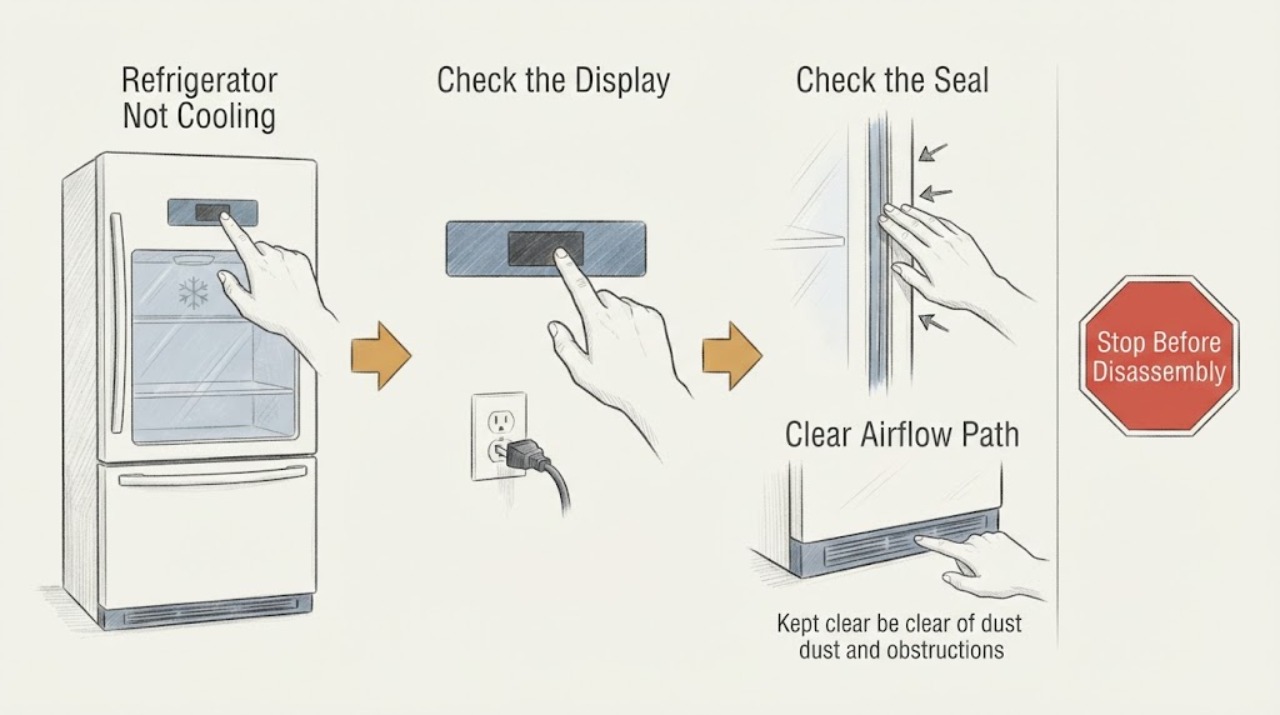
Work through in order
Diagnostic checks
Use only checks that match the exact appliance or system and its official guide.
-
Check 1
Check whether the refrigerator compartment, freezer compartment, or both are warm, and note whether lights and display still work.
Expected result: Observe the result of this check and compare it with the symptom described.
Next step: Keep doors closed while observing and record the temperatures shown, if any.
Why this matters
Why: Samsung’s cooling troubleshooting is different from a complete power loss; compartment pattern and operating signs guide the first branch.
-
Check 2
Inspect the door gasket and confirm the door closes fully without food or shelves preventing a seal.
Expected result: Observe the result of this check and compare it with the symptom described.
Next step: Reposition only loose items and clean the visible gasket; arrange service if the seal is damaged.
Why this matters
Why: A poor seal can allow warm air in and make cooling ineffective; it does not prove a compressor or fan failure.
-
Check 3
Check that interior vents are not blocked by food and that airflow is not restricted.
Expected result: Observe the result of this check and compare it with the symptom described.
Next step: Move items away from vents without dismantling panels and observe one normal cooling period.
Why this matters
Why: Blocked airflow can create uneven compartment temperatures even when the refrigerator has power.
-
Check 4
Confirm the refrigerator has power and that no breaker or outlet problem is present; do not repeatedly cycle the supply.
Expected result: Observe the result of this check and compare it with the symptom described.
Next step: Use the Samsung power branch if lights/display are absent; otherwise continue with cooling service guidance.
Why this matters
Why: No power is a separate diagnosis from a powered refrigerator that is warm.
-
Check 5
Note whether cooling returns after doors remain closed and whether frost, unusual noise, or repeated clicking is present.
Expected result: Observe the result of this check and compare it with the symptom described.
Next step: Do not remove sealed-system covers or attempt refrigerant work.
Why this matters
Why: A temporary seal or airflow issue is more plausible when cooling recovers; persistent warmth or abnormal sounds needs diagnosis.
-
Check 6
Record model/serial information, which compartment is warm, display setting, door/seal and vent observations, and any noise or frost.
Expected result: Observe the result of this check and compare it with the symptom described.
Next step: Arrange qualified Samsung service if cooling remains inadequate or food safety is in doubt.
Why this matters
Why: These observations let service distinguish airflow, door, control, and sealed-system possibilities without guessing a part.
Use your observations
Decision map
Find the observation that best matches what you see, then follow the next safe action.
-
PATH 01Next step
What you see
Only one compartment is warm and a door gasket or vent obstruction is found.
Do this next
Correct only the accessible obstruction and monitor; arrange service if temperatures remain unsafe.
Why this path and its safety boundary
Why it matters: A localized seal or airflow issue is more likely than complete power loss.
-
PATH 02Next step
What you see
Both compartments are warm but the lights/display work.
Do this next
Keep doors closed, protect perishable food, and arrange qualified service.
Why this path and its safety boundary
Why it matters: The refrigerator is powered but has a persistent cooling problem requiring model-specific diagnosis.
-
PATH 03Next step
What you see
Lights and display are also absent.
Do this next
Check the accessible supply once when safe and use qualified service for a recurring power fault.
Why this path and its safety boundary
Why it matters: This follows Samsung’s no-power path rather than a cooling-only path.
-
PATH 04Next step
What you see
There is smoke, burning odor, repeated electrical trip, damaged cord, or abnormal heat.
Do this next
Stop use, isolate only if safe, and arrange qualified help.
Why this path and its safety boundary
Why it matters: This is an immediate appliance/electrical safety boundary.
Helpful context
Understand the symptom
The Samsung cooling decision is to separate a powered cooling failure from no power and from localized seal/airflow restriction by checking both compartments, door seal, vents, and interior power signs before service.
When checks do not resolve it
Need a professional?
Provide the full model and serial information, the exact display or symptom, what changed after each safe check, and any visible hazard to a qualified technician.
Common questions
FAQ
Why is my Samsung refrigerator not cooling but the lights work?
A powered refrigerator can still have airflow, seal, control, fan, or sealed-system trouble. Check door closure and vents, then arrange service if both compartments remain warm.
Can a blocked vent cause Samsung cooling problems?
Yes, blocked internal airflow can make temperatures uneven. Move food away from visible vents; do not dismantle panels.
Should I keep opening the door to test cooling?
No. Keep doors closed while observing because repeated opening adds warm air and makes the symptom harder to assess.
When should I call service?
Call when cooling does not recover after accessible seal/airflow checks, both compartments stay warm, frost or abnormal noise appears, or any electrical hazard is present.
Read the exact guide
Official sources
- Cooling issues with Samsung refrigerator or freezerSamsung · Samsung refrigerator not cooling: door seal, airflow, temperature, and service guidance.
Community feedback
Share a repair observation
Share a plain-text repair observation. Accepted observations are published automatically; this page may take a moment to update.