
On this page
Start here
Quick answer
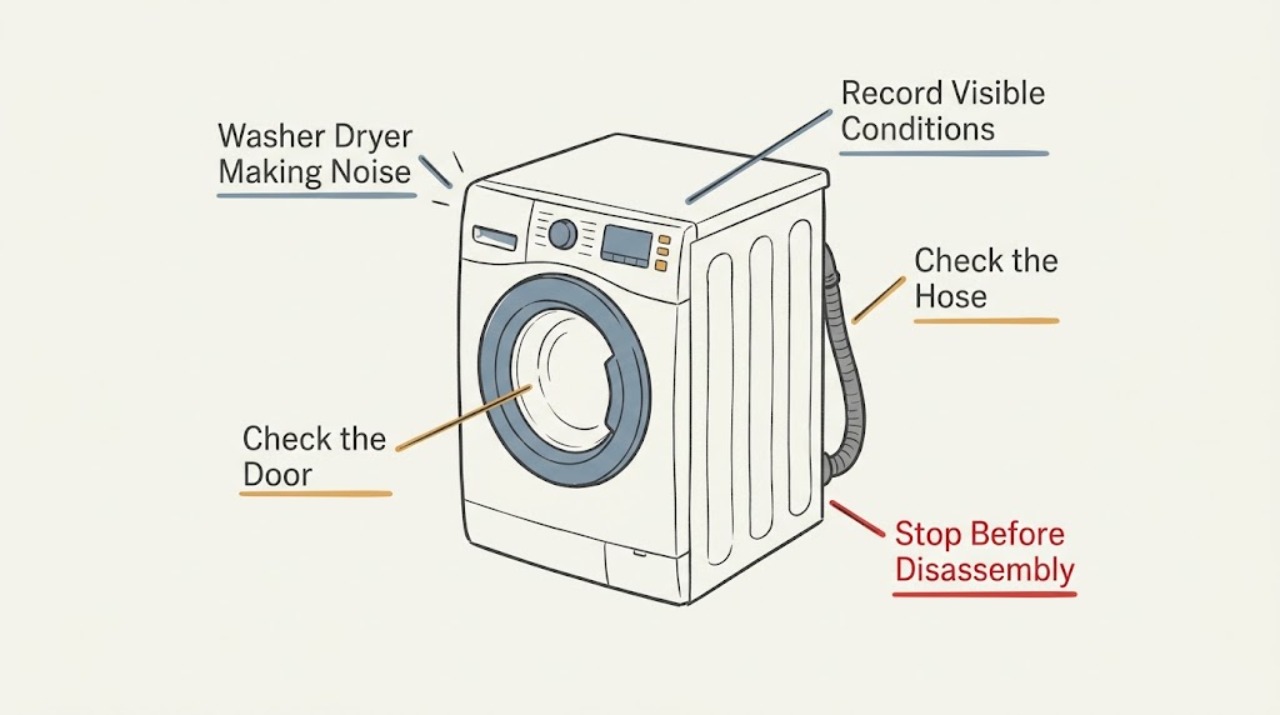
First identify whether the noise occurs during filling, washing, draining, spinning, or drying. A brief click, valve pop, quiet drain hum, or short motor-mode thump can be normal, while repeated rattling, movement, squealing, grinding, or a jet-like sound needs a different check. Stop the cycle for metal-on-metal grinding, a load that makes the machine move violently, smoke, burning odor, or a damaged cord. With the machine off, redistribute the load, remove loose objects, confirm the washer-dryer is level and stable, check that front-load shipping bolts were removed, and clean an accessible pump filter only by the exact model procedure. If the sound remains with a suitable load or occurs when empty, keep the appliance off and arrange service.
Work through in order
Diagnostic checks
Use only checks that match the exact appliance or system and its official guide.
-
Check 1
Record when the noise occurs: filling, washing, draining, high-speed spin, or the dry phase. Describe it as a brief click, pop, hum, rattle, thump, squeal, grind, or jet-like sound, and note whether the machine moves or the sound occurs with an empty drum.
Expected result: A quiet hum during draining, a water-valve pop at fill, or a short click followed by a fading thump occurs only during a normal transition; alternatively, the sound repeats throughout a cycle, increases with speed, or appears with no load.
Next step: If the sound is a documented normal transition and the machine remains stable, monitor it. If it is persistent, violent, occurs empty, or is accompanied by heat, odor, or a fault indication, stop the cycle and continue only with safe visual checks before arranging service.
Why this matters
Why: The stage and sound narrow the branch. Some Samsung operating sounds are expected, while persistent grinding, jet-like noise, or a noise with an empty drum is more likely to require service.
-
Check 2
Stop the cycle, open the door when it is safe, and redistribute or reduce the load. Remove coins, zippers, buttons, and other loose objects from pockets and the drum. For a new front-load unit, with the appliance off, gently press the drum and check for the normal spring-like give described in the manual rather than pulling the machine out immediately.
Expected result: The noise is tied to a bulky or unbalanced load, a loose object, or a drum that feels rigid with almost no give; or the load is balanced and the empty drum has normal movement.
Next step: Correct the load and follow the model manual for shipping-bolt removal; do not remove shipping hardware unless the manual identifies it and the appliance is safely accessible. If the sound remains with a suitable load or occurs empty, request service.
Why this matters
Why: Unbalanced or heavy loads can thump and move the cabinet. A front-load machine that still has shipping bolts may vibrate severely. A normal load and drum response make an installation or internal fault more likely if the noise persists.
-
Check 3
With the washer-dryer stopped, inspect the floor, all accessible feet, and the space around the cabinet. Rock the appliance gently only enough to determine whether it is stable, check that it is level as the manual directs, and look for a power cord, drain hose, vent, or nearby object tapping the cabinet.
Expected result: One corner rocks, a foot does not contact the floor, the cabinet is against a wall, or an external hose, cord, vent, or object is the source of the rattle; or the unit is stable and clear.
Next step: Correct an accessible clearance or leveling issue according to the exact Samsung instructions, then perform one controlled test. If the cabinet remains unstable or the noise returns, stop and arrange service.
Why this matters
Why: A level, stable installation reduces spin vibration, while a loose external item can sound like an internal failure. If the cabinet is stable and the sound is internal, do not compensate by repeatedly tightening or opening components.
-
Check 4
If the sound occurs during draining, read the exact model manual before opening any pump or debris-filter access. If the procedure is user-accessible and the drum can be drained safely, place a towel and container, clean the filter, refit its cap and drain hose securely, and close the access panel.
Expected result: The noise is an intermittent drain-pump rattle and the filter contains debris, or the filter is clean and correctly secured but the same noise occurs every cycle.
Next step: Run no further test if water cannot be drained safely, the filter housing is damaged, or the area is wet near electrical parts. Otherwise perform one manual-approved test; request service if the noise remains.
Why this matters
Why: A pump can make a normal intermittent sound during draining, but recurring grinding or rattling may improve after a correctly completed filter clean. A clean filter with a recurring noise points to a pump or internal issue rather than a reason to keep dismantling the machine.
-
Check 5
After correcting the load, installation, or accessible filter condition, run one model-approved short cycle while watching from a dry, clear position. Do not use an overloaded load to test a grinding or squealing sound; use the manual’s safe test load and stop at the first return of the abnormal noise.
Expected result: The machine stays stable and the noise is gone, or the same noise returns with a normal load, while empty, or during a specific phase.
Next step: If the abnormal sound returns, stop the machine, keep it off, and arrange qualified appliance service. Provide the model, phase, sound description, load condition, and checks already completed.
Why this matters
Why: A sound that disappears after a load or installation correction is consistent with an external condition. Recurrence with a suitable load, an empty drum, or a specific phase is evidence for professional diagnosis.
Use your observations
Decision map
Find the observation that best matches what you see, then follow the next safe action.
-
PATH 01Next step
What you see
The washer-dryer makes a brief fill pop, quiet drain hum, or short click followed by a fading thump and remains stable.
Do this next
Compare it with the exact model manual and monitor for changes. Escalate if it becomes persistent, much louder, or is accompanied by movement or a fault indication.
Why this path and its safety boundary
Why it matters: The sound may be normal operation.
-
PATH 02Next step
What you see
Thumping or knocking follows the spin speed and the cabinet moves, or the noise changes with bulky or unbalanced laundry.
Do this next
Stop, redistribute or reduce the load, confirm stability and leveling, and check front-load shipping-bolt status using the manual. Run one controlled test only after correction.
Why this path and its safety boundary
Why it matters: Load distribution, leveling, or retained shipping hardware is the first branch.
-
PATH 03Next step
What you see
Rattling, squealing, grinding, or jet-like noise continues with a suitable load, occurs with an empty drum, or returns every cycle after external checks.
Do this next
Stop using the washer-dryer and request qualified service. Do not open panels or continue tests to force a diagnosis.
Why this path and its safety boundary
Why it matters: An internal mechanical, pump, motor, or installation fault is more likely.
-
PATH 04Next step
What you see
The noise is accompanied by smoke, burning odor, sparking, a damaged cord, violent movement, or a water leak near electrical parts.
Do this next
Stop the cycle and move clear. Disconnect power only if it is dry and safe to reach, and close water valves when safely accessible. Arrange qualified appliance or electrical service; do not restart the machine.
Why this path and its safety boundary
Why it matters: This is an immediate stop condition.
Helpful context
Understand the symptom
The same noise can mean different things at different stages
A short click or hum while a Samsung washer-dryer changes modes or drains may be normal. A repeated rattle throughout a cycle, a beat that follows spin speed, or grinding that remains with a reasonable load is more useful evidence of a problem. Note the stage and whether the sound changes with load before deciding that a motor or drum part has failed.
Start with the load and installation
Large waterproof items, tangled sheets, a small load gathered on one side, an unlevel floor, or shipping hardware left in a new front-load machine can create movement and thumping. These checks are different from investigating a noise that occurs with an empty drum or only while draining.
Keep inspection low-risk
Stop the cycle before reaching into the drum or pump area. Disconnect power only when the floor, plug, cord, and socket are dry and reachable. Do not remove panels, bypass a door lock, test live wiring, or continue running a machine that is moving violently or producing a burning smell.
Safety boundary
Stop conditions
- Stop immediately for grinding or jet-like noise that persists, violent movement, smoke, burning odor, sparking, or a damaged cord or socket.
- Do not reach into a moving drum, bypass a door lock, or continue a test cycle after the abnormal sound returns.
- Do not open panels or test live electrical parts. Keep the area dry and disconnect power only when it is safe to reach.
- Do not open a pump filter with trapped water unless the exact model manual provides a safe drain procedure and the floor and electrical area can remain dry.
Only after diagnosis
Potential parts
- suspension or leveling component
Only consider this category if a technician confirms an internal suspension or leveling fault after load distribution and installation have been corrected.
Confirm the full model and the manufacturer’s fit information before ordering; do not infer a failed suspension part from noise alone. - drain pump or pump filter housing
Only consider this category if recurring grinding or rattling is isolated to draining and a qualified technician confirms the pump or housing is damaged after a safe filter check.
Confirm model fit and safe installation requirements; water and electrical isolation are required for any replacement. - drum support or motor component
Only consider this category when noise occurs with a normal or empty drum and service diagnosis identifies a worn support, bearing, motor, or related internal component.
Internal drive components are model-specific and should be selected and installed by a qualified technician.
When checks do not resolve it
Need a professional?
Arrange qualified appliance service when abnormal noise persists with a balanced load, occurs with an empty drum, returns after leveling or filter checks, or is accompanied by a fault code, poor draining, a damaged part, smoke, burning odor, sparking, or violent movement. Do not open the cabinet, bypass a door lock, or test live wiring.
Common questions
FAQ
Why does my Samsung washer-dryer make a click and then a short thump?
A click followed by a brief fading thump can be a normal motor clutch transition between wash and spin. It should not be confused with a persistent or increasingly loud grinding sound.
Can an unbalanced load cause a Samsung washer-dryer to make noise?
Yes. Bulky items, tangled sheets, or a small load gathered to one side can create thumping and movement. Stop the cycle, redistribute the load, and confirm the machine is level before one controlled test.
Is a humming sound during draining normal?
A quiet hum or buzz during draining can be normal pump operation. If the noise becomes a recurring grinding or rattling sound, follow the model manual for a safe filter check and request service if it continues.
When should I stop using a noisy Samsung washer-dryer?
Stop for persistent grinding, a jet-like sound, violent movement, smoke, burning odor, sparking, a water leak near electrical parts, or noise that returns with a suitable or empty load. Keep the appliance off and arrange qualified service.
Read the exact guide
Official sources
- Samsung dryer is too noisySamsung · Samsung dryer-side noise, load, external-rattle and service guidance for washer-dryer drying phases
- Samsung washing machine is shaking too muchSamsung · Samsung washer load balance, shipping-bolt, leveling and controlled-test guidance
- Samsung washing machine is too noisySamsung · Samsung washer noise identification, normal sounds, load, leveling, pump and service guidance
Community feedback
Share a repair observation
Share a plain-text repair observation. Accepted observations are published automatically; this page may take a moment to update.