
On this page
Start here
Quick answer
For a Samsung WD80J5A10AW washer-dryer that leaves laundry damp or wetter after drying, first confirm the market suffix and separate the 8 kg wash capacity from the 5 kg drying capacity documented for the WD80J5A10AW EU variant. A load that is acceptable for washing can still be too large for drying. Use the exact model's standard or suitable drying course, sort heavy and light fabrics, and avoid judging the result from a short, low-temperature, or Easy Iron phase. Samsung's official washer-dryer guidance also says drying depends on cold-water supply, correct drain-hose routing, and a clean debris or lint filter. Check those items only from accessible, dry positions and according to the exact manual. If one balanced, model-appropriate load still finishes damp with a clear drain and clean accessible filter, or if water is retained, a warning repeats, the panel behaves abnormally, or there is a leak, burning smell, smoke, abnormal heat, or damaged cord, stop using the machine and arrange qualified Samsung appliance service. For a household managing hay fever, do not treat a drying cycle as sterilization or an allergen-removal claim; prioritize label-compatible, fully dry laundry and safe room ventilation without bypassing the appliance's limits.
Before you begin
Safety first
- Keep the washer-dryer out of service for persistent poor drying after the external checks, retained water, recurring code, abnormal control behavior, damaged filter cover, leak, or any electrical, thermal, or fire symptom. Do not open panels, probe wiring, or bypass protections.
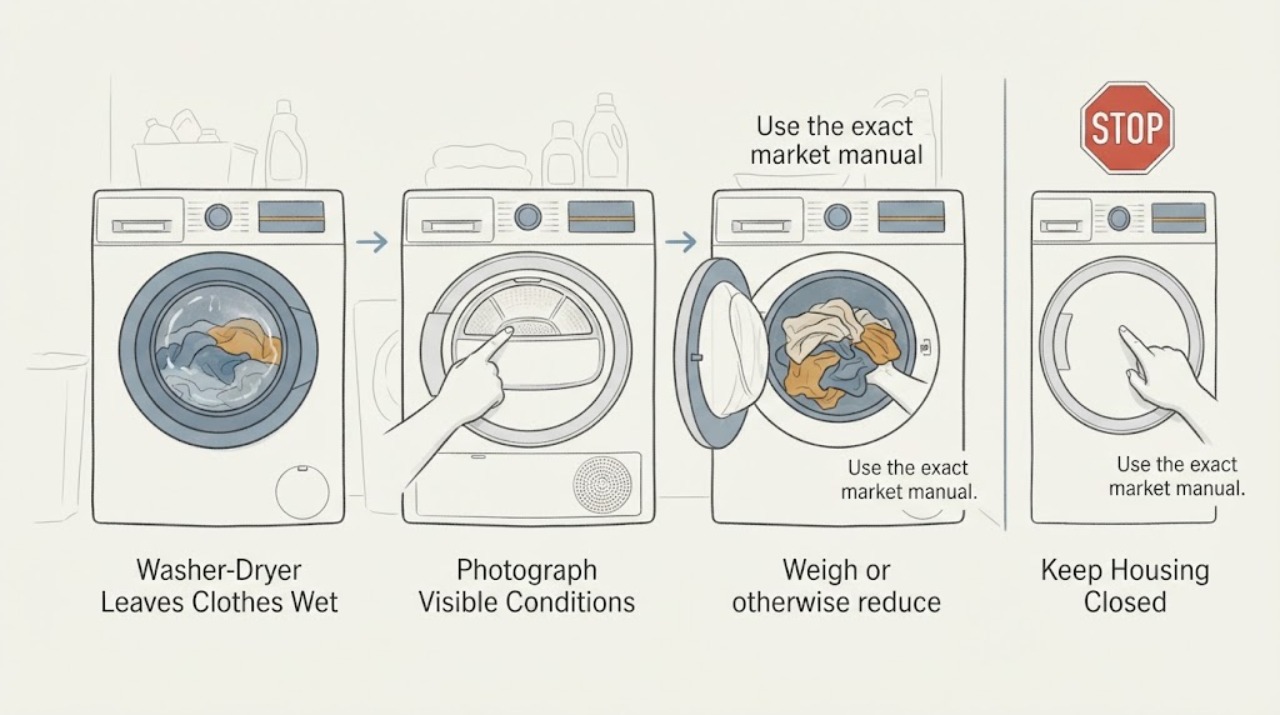
Work through in order
Diagnostic checks
Use only checks that match the exact appliance or system and its official guide.
-
Check 1
Read the rating label and photograph the full model, including any market suffix such as /EP or /LE. Confirm that the appliance is the WD80J5A10AW washer-dryer and record the wash course, drying course, load size, fabric mix, and whether the clothes were merely damp or still soaking wet after the wash.
Expected result: The base model matches but the market suffix differs or is missing, the appliance is a different WD80 variant, or the clothes entered drying already saturated.
Next step: Keep the label photo and use the support page and manual for the confirmed market. If the wash leaves standing water or unusually saturated laundry, resolve that stage first and do not start repeated drying cycles.
Stop if: Do not move the machine to expose hidden labels or hoses, open panels, or continue if there is a leak, smoke, burning smell, abnormal heat, or a damaged cord.
Why this matters
Why: Samsung publishes region-specific support pages for WD80J5A10AW/EP and WD80J5A10AW/LE, and the exact manual controls available courses and cleaning steps. A wet wash result can also make a normal drying cycle appear ineffective; it is not proof of a drying-part failure.
-
Check 2
Weigh or otherwise reduce the load so the drying portion is within the confirmed model's drying capacity, not merely its wash capacity. For the opened EU WD80J5A10AW fiche, treat the documented 5 kg drying capacity as the upper model-specific reference; separate towels and other heavy fabrics from light items and untangle them before one test.
Expected result: The load is near or above the drying limit, heavy and light fabrics are mixed, or the load is already below the documented drying limit and reasonably sorted.
Next step: Reduce and sort the load, then run one standard model-approved dry course. If the smaller balanced load remains damp, continue to the course, water, drain, and filter checks rather than adding more laundry or repeatedly restarting.
Stop if: Do not exceed the drying limit, force a tightly packed drum to turn, or resume if the machine vibrates violently, leaks, overheats, or displays a recurring warning.
Why this matters
Why: The WD80J5A10AW EU fiche lists 8 kg washing but 5 kg drying, and Samsung says overload and mixed fabric weight can leave thick items damp while lighter items finish first. A load correction can change the result without implicating a heater or pump.
-
Check 3
Use the exact market manual to confirm that the selected course actually dries the load and note the Dry Level or time. Avoid evaluating heat during a cooling, low-temperature, wrinkle-care, or Easy Iron phase; for a normal test, choose the model's standard or appropriate stronger dry option for the fabric and follow the care label.
Expected result: The selected course is a normal heated/appropriate dry course, or it is a low-strength, Easy Iron, cooling, or otherwise unsuitable phase; the cycle ends with light items dry but thick items damp.
Next step: Correct only the documented course or Dry Level and run one balanced test. If the proper course still provides no useful warmth or ends abnormally, stop repeated trials and arrange service after the external checks.
Stop if: Do not override a safety warning, enter service mode, change hidden settings, or keep running a cycle when there is smoke, burning odor, abnormal heat, water near electrical parts, or a damaged cord.
Why this matters
Why: Samsung's official guidance says Easy Iron can provide weaker drying, dry levels differ by product, and mixed fabrics finish at different rates. A cycle setting can therefore explain damp results without proving an internal heating fault.
-
Check 4
From a dry, safe position, verify that the cold-water faucet is open and that the visible inlet and drain hoses are connected as the model manual requires. Look for a kink, crushing, submerged drain end, double-siphon or adapter, household backup, or a drain route that is visibly too long; do not disconnect a wet hose or alter hidden plumbing.
Expected result: Cold water is unavailable, the drain hose is kinked/displaced or backing up, the installation has an adapter or double siphon, or the visible supply and drain path is clear.
Next step: Restore only an obvious faucet or hose position when safe and supported by the manual, then make one controlled test. Use plumbing help for an independent backup and appliance service for persistent water retention or a washer-side drain problem.
Stop if: Do not pull the machine by its hoses, disconnect pressurized or wet connections, pour water into the appliance, or open the cabinet to inspect a pump or valve.
Why this matters
Why: Samsung states that this style of washer-dryer uses cold water during drying and that poor drain-hose installation or low water pressure can prevent drying or reduce draining efficiency. An external path issue changes the next step to safe plumbing correction, while a clear path does not prove a pump or valve fault.
-
Check 5
With the machine stopped and cool, clean only the user-accessible debris/lint filter and any heat-exchanger or related filter that the confirmed WD80J5A10AW manual explicitly identifies. Refit every cover and let washable filters dry completely before use; do not touch a heat exchanger with bare hands or clean it with water unless the exact instructions allow it.
Expected result: The accessible filter is visibly clogged or wet, a cleaning indicator is present, a cover is damaged or will not lock, or the accessible path is clean and correctly refitted.
Next step: After one model-approved cleaning, run one appropriately sized test. If drying remains poor, a warning returns, or a cover is damaged, keep the washer-dryer out of service and arrange qualified Samsung service.
Stop if: Do not run without a required filter or locked cover, reach into moving parts, bend heat-exchanger fins, use sharp tools, or open hidden panels.
Why this matters
Why: Samsung links accumulated lint or debris with reduced drying efficiency and warns that cleaning components differs by model. A clean, intact accessible path makes repeated cleaning less useful; it does not identify a heater, sensor, or control part.
-
Check 6
Compare one balanced, model-appropriate dry result and record whether the drum was warm, whether water was used and drained, the total time, the final moisture of thick and light items, any display message, and whether the cycle stopped early. For a hay-fever household, follow garment labels and keep laundry fully dry and the room normally ventilated, but do not treat the appliance as a medical or sanitizing device.
Expected result: The smaller sorted load dries normally, remains damp despite correct load/course/water/drain/filter conditions, ends early, retains water, or is accompanied by a code, leak, odor, abnormal heat, or electrical symptom.
Next step: Keep the machine stopped for persistent poor drying, retained water, recurring code, abnormal stop, leak, or electrical/thermal symptom and arrange qualified Samsung appliance service. Provide the model suffix, load, course, timing, filter, water, and drain record.
Stop if: Do not repeat cycles to force dryness, bypass a warning, operate with exposed parts, or continue after smoke, burning smell, abnormal heat, sparks, damaged power parts, or water near electricity.
Why this matters
Why: A single corrected load that dries normally supports a load, course, water, drain, or maintenance explanation. Persistent poor drying after those checks leaves a model-specific appliance diagnosis unresolved; the observations do not prove a heater, pump, sensor, or control failure.
Use your observations
Decision map
Find the observation that best matches what you see, then follow the next safe action.
-
PATH 01Next step
What you see
The WD80J5A10AW label and market are confirmed, the load is at or below the documented drying capacity, and a standard course dries a sorted test load normally.
Do this next
Keep future drying loads within the model's drying limit, separate heavy items, and use the exact manual's course and Dry Level guidance.
Why this path and its safety boundary
Why it matters: The earlier result is more consistent with the wash-to-dry load limit, fabric mix, or course selection than with a confirmed appliance component fault.
-
PATH 02Next step
What you see
The wash load is within the 8 kg wash limit but exceeds the opened EU fiche's 5 kg drying limit, or thick items were mixed with much lighter fabrics.
Do this next
Split the load, sort by fabric weight, and run one standard dry test. Do not compensate by repeatedly extending cycles on an overloaded drum.
Why this path and its safety boundary
Why it matters: The wash and dry capacities are different, and Samsung says heavy items can remain damp after lighter fabrics finish; this is a load decision rather than proof of a heater failure.
-
PATH 03Next step
What you see
A suitable smaller load still ends damp after the correct course, open cold-water supply, clear visible drain route, and clean accessible filter.
Do this next
Stop repeated drying tests and arrange qualified Samsung appliance service with the full model suffix and the recorded sequence.
Why this path and its safety boundary
Why it matters: The accessible setting, load, water, drain, and maintenance explanations are insufficient. A model-specific internal diagnosis remains possible, but no source justifies naming a heater, pump, sensor, or control.
-
PATH 04Next step
What you see
Cold water is unavailable, the drain route backs up or is visibly kinked, or the machine retains water after drying.
Do this next
Correct only a safe obvious external condition, use plumbing help for an independent backup, and arrange appliance service if water retention or leakage persists.
Why this path and its safety boundary
Why it matters: Samsung's washer-dryer guidance ties drying to cold-water supply and effective drain routing; the external water or plumbing path must be resolved before judging the drying system.
-
PATH 05Next step
What you see
A warning repeats, the cycle stops abnormally, the filter cover is damaged, the panel behaves abnormally, or there is smoke, burning smell, abnormal heat, a leak, sparks, or a damaged cord.
Do this next
Stop using the washer-dryer, isolate power only from a safe dry position if necessary, keep people away from the hazard, and arrange qualified Samsung appliance or electrical service.
Why this path and its safety boundary
Why it matters: The problem has crossed the ordinary load and maintenance boundary and may involve an electrical, thermal, water, control, or mechanical hazard.
Helpful context
Understand the symptom
The key identity issue on this Samsung is that washing and drying do not use the same load limit. Samsung's opened WD80J5A10AW/EP support page identifies an 8 kg washer-dryer, and the opened EU product fiche for the WD8*J5A**** pattern lists 8 kg washing and 5 kg drying. Confirm the market suffix printed on the rating label before applying a setting or capacity from another region. A full wash load may therefore need to be split before drying.
Damp laundry does not by itself identify a heater, pump, sensor, or control failure. Samsung's official guidance separates load size and fabric mix, drying-course and dry-level choices, cold-water supply, drain-hose installation, and filter maintenance. For a family with hay fever and limited space, these checks can improve the chance of fully dry, label-compatible laundry, but the sources do not establish that this washer-dryer sterilizes clothing or removes allergens. Keep the machine's normal safety protections and stop for persistent water or electrical symptoms.
When checks do not resolve it
Need a professional?
Call qualified Samsung appliance service for unresolved drying after one correct-load test, recurring warnings or early stops, water retention, a damaged filter or cover, or a control/display problem. Call plumbing help for an independent drain backup.
Safety scope: Keep the washer-dryer out of service for persistent poor drying after the external checks, retained water, recurring code, abnormal control behavior, damaged filter cover, leak, or any electrical, thermal, or fire symptom. Do not open panels, probe wiring, or bypass protections.
Have this ready
- Provide Samsung WD80J5A10AW and the printed market suffix, the wash and dry courses, load size and fabric mix, whether laundry was soaking wet before drying, final moisture, total time, cold-water and drain observations, filter condition, and any display or hazard symptoms.
Common questions
FAQ
Why can my Samsung WD80J5A10AW wash a full load but not dry it?
The documented capacity differs: the opened EU fiche lists 8 kg for washing and 5 kg for drying for the WD8*J5A**** pattern. A load can fit the wash stage but be too large for effective drying, especially when heavy and light fabrics are mixed. Split and sort the load before judging the appliance.
Does this Samsung washer-dryer need cold water to dry?
Samsung's official washer-dryer guidance says drying requires cold-water supply and that low water pressure can prevent drying. Confirm the cold faucet and visible hose condition from a safe position, then follow the exact market manual; do not disconnect wet or pressurized connections.
Could the drain hose make clothes stay wet after drying?
Yes. Samsung identifies kinks, incorrect routing, adapters, double siphons, submerged hose ends, and household drain problems as possible contributors to poor draining and drying. Correct only an obvious safe external condition; persistent water retention needs plumbing or appliance service rather than a guessed pump.
Will drying the clothes in this machine remove hay-fever allergens?
The opened Samsung sources give operating and maintenance guidance, not a medical or allergen-removal claim for this model. Use the care label, keep loads within the drying limit, clean accessible filters as directed, and seek medical or household-environment advice separately if symptoms remain.
When should I stop troubleshooting the WD80J5A10AW?
Stop after one correctly sized, sorted test if the machine still leaves clothes damp despite the exact course, cold-water supply, visible drain path, and accessible-filter checks. Also stop immediately for retained or leaking water, a recurring warning, abnormal controls, smoke, burning smell, sparks, abnormal heat, or damaged power parts, and arrange qualified service.
Read the exact guide
Official sources
- Fix Wet Clothes After Washing Machine Dry CycleSamsung Gulf · Opened official Samsung washer-dryer guidance. It covers load size and fabric mix, drying course and time, cold-water supply, drain-hose routing, low water pressure, and model-specific manual limits; it is troubleshooting guidance rather than proof of an internal part failure.
- SpecificationsSamsung · Opened Samsung's EU product-information PDF. It identifies the model pattern WD8*J5A**** and lists 8.0 kg washing and 5.0 kg drying; this capacity evidence is scoped to the EU fiche and must not replace the capacity on a different market label.
- O que fazer se a roupa não ficar bem seca?Samsung Portugal · Opened official Samsung Portugal drying guidance linked from the WD80J5A10AW support page. It covers load below drying capacity, fabric sorting, Dry Level, filter and heat-exchanger maintenance, and model-specific manual limits; component layout must be confirmed for the exact appliance.
- Minha lava e seca Samsung não está secando as roupas. O que fazer?Samsung Brazil · Opened official Samsung Brazil washer-dryer support guidance. It identifies water supply, drying-load capacity, bulky-item redistribution, drain-hose routing, adapters/double siphon, pipe routing, and debris-filter maintenance as checks; local model instructions control the exact installation.
- WD80J5A10AW Máquina Lavar e Secar Roupa EcoBubble, 8 kgSamsung Portugal · Opened Samsung Portugal's exact base-model support page, which identifies WD80J5A10AW/EP as an 8 kg washer-dryer and exposes drying, error, cleaning, and model-specific manual/support categories. The market suffix must still be matched to the appliance label.
Community feedback
Share a repair observation
Share a plain-text repair observation. Accepted observations are published automatically; this page may take a moment to update.