
On this page
Start here
Quick answer
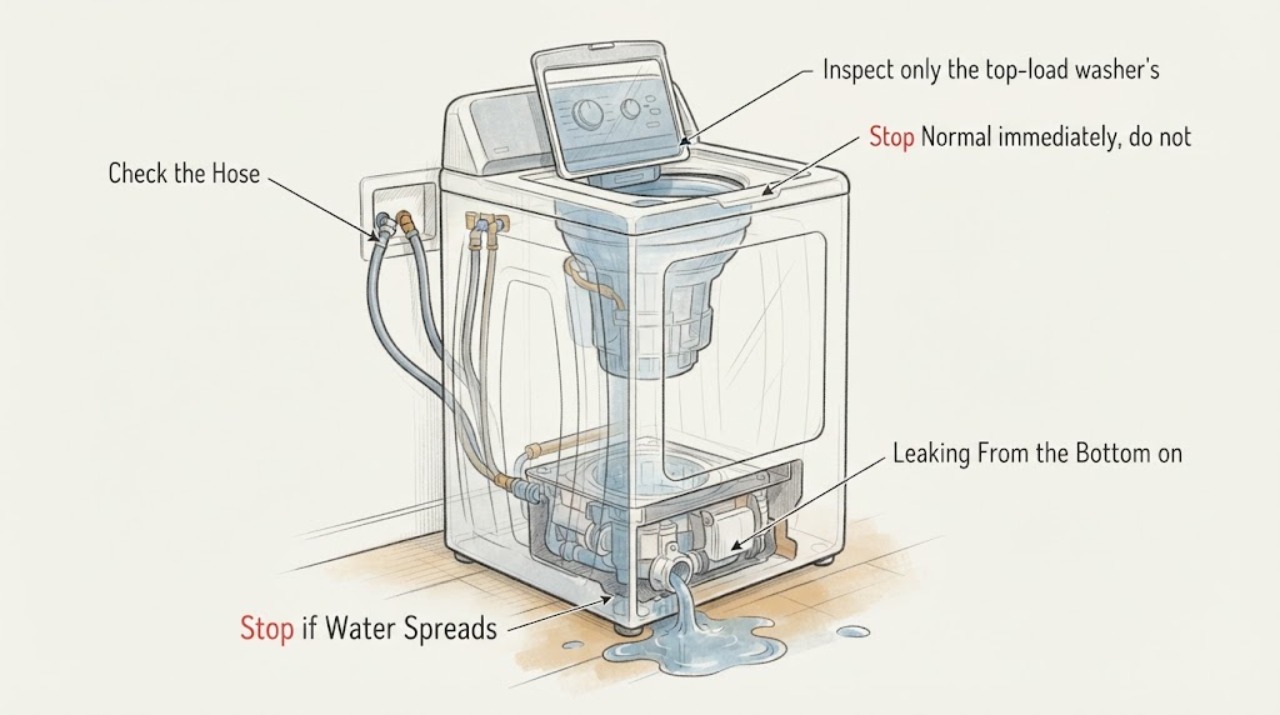
If a Samsung WA50R5200AW top-load washer is actively leaking or flooding from underneath during Normal, stop the cycle, keep people away from the water, close the accessible hot and cold taps, and disconnect power only from a dry, safe position. Do not run another cycle to find the leak, move a wet washer, remove the bottom panel, or inspect live parts. Once the area is safe, document when the first water appears and whether it is at a supply hose, drain hose/standpipe, dispenser or tub rim, or only from the lower cabinet. Samsung's guidance links leaks to hose connections, drain-hose installation, detergent/overfill, and leveling, but water can travel along the cabinet, so “from the bottom” is not a part diagnosis. If no external source is visible, the leak returns after an obvious external correction, or there is water near the outlet or wiring, leave the washer off and request Samsung or qualified appliance service.
Before you begin
Safety first
- Owner checks are limited to stopping the cycle, closing accessible water valves, isolating power from a dry safe position, documenting the model and timing, and looking at accessible external hoses, drain path, dispenser/rim, floor, and clearances. Do not move a wet washer, remove the bottom/top panel, reach under the tub, inspect live wiring, or rerun a cycle to find the leak.
Work through in order
Diagnostic checks
Use only checks that match the exact appliance or system and its official guide.
-
Check 1
Stop Normal immediately, do not restart it, close both accessible water-supply valves, and unplug the washer only if the plug and floor are dry and reachable without stepping through water. Keep the lid closed and do not move the appliance. If water is near the receptacle, cord, or electrical components, leave the circuit isolated from a safe dry location or have an electrician handle it.
Expected result: Water is still flowing, the floor or outlet is wet, the cord is damaged, the washer is on a drip pan full of water, or the leak has stopped after the valves were closed and power was isolated.
Next step: Dry and restrict access to the area, photograph the safe exterior, and leave the washer off until the origin is established. Request service immediately for water near electrics, a damaged cord, uncontrolled flow, or a leak that cannot be isolated.
Stop if: Do not step in water to unplug, reach behind the washer, move a wet appliance, remove a panel, or re-energize the machine to reproduce the leak.
Why this matters
Why: An active leak is a water/electrical and property-damage hazard before it is a diagnosis. Stopping supply and motion preserves evidence and reduces the chance of flooding or shock; it does not identify whether the source is external or internal.
-
Check 2
With water and power isolated and without moving the washer, inspect the accessible rear supply-hose connections, hose bodies, drain hose, standpipe or sink connection, and the floor immediately around them. Look for a first wet point, a kink, a hose pulled out, a missing gasket, or water that only appears at the drain path. Do not loosen a fitting or remove the rear drain-hose holder.
Expected result: A supply connector or hose is wet, the drain hose is displaced/kinked or the standpipe spills, the drain path is dry, or no external connection is wet.
Next step: If an external connection is plainly loose or displaced, document it and have the installation corrected with the exact model instructions; do not test an active leak yourself. If no external source is visible, keep the washer off and continue to the non-running visual checks or arrange service.
Stop if: Stop if a connection is under pressure, a hose is split, the standpipe is backing up, the holder is missing, or checking it would require pulling the washer through water.
Why this matters
Why: Samsung says supply-hose gaskets/connections and drain-hose position, insertion, height, damage, or kinks can cause leaks or siphoning. A dry accessible hose does not clear the appliance: water may be arriving from the dispenser, tub, or concealed lower assembly.
-
Check 3
Inspect only the top-load washer's accessible lid, tub rim, Active WaterJet/dispenser area, detergent/softener/bleach trays, and surrounding cabinet for dried residue, foam residue, overfill marks, a lid obstruction, or a visible crack. Check that the dispenser drawer/trays are fully assembled and not packed beyond the model guidance. Do not pour water into the tub, open the cabinet, or use cleaners to chase the leak.
Expected result: Residue or foam is concentrated below a dispenser, the washer was overloaded or overfilled, the lid/rim was obstructed, a visible crack is present, or the upper area is dry while the lower cabinet is wet.
Next step: Preserve photos and stop use. For a clearly external dispenser/overfill issue, have the exact operating instructions and detergent amount checked before any controlled service-authorized test; for a crack or lower-only wet point, request appliance service without another cycle.
Stop if: Do not remove the top/bottom panel, reach under the tub, scrape residue into openings, or run a Normal cycle to see whether the upper area leaks.
Why this matters
Why: Samsung links excess detergent, a drawer that is not correctly assembled, and an overloaded/too-full washer with leak conditions. A clean upper area with water only at the lower cabinet makes an internal or hidden hose/tub/pump path more concerning, but still does not name a part.
-
Check 4
From a dry, stationary position, check the washer's four-corner stability, visible floor condition, and clearance from walls or neighboring appliances. Do not rock a waterlogged machine or adjust feet while it is wet. Record whether the washer is visibly tilted, a foot is not contacting the floor, or the floor/drip pan is damaged or slippery.
Expected result: The washer is visibly unstable or tilted, a foot is not bearing, a soft/slippery/damaged floor is present, the washer is tightly against a wall, or installation looks stable and clear.
Next step: If the floor or leveling is plainly unsafe, leave the washer off and have the installer or qualified technician correct it. Do not move the machine alone or make adjustments while water or electricity is present.
Stop if: Do not drag, tilt, lift, wedge, or place hands beneath the washer; stop if the floor, pan, or appliance cannot safely support the machine.
Why this matters
Why: Samsung says level, stable flooring and surrounding clearance affect vibration and leak checks; some vibration is expected on a riser, but that does not explain every bottom leak. Leveling can contribute to overflow or water being directed outside the tub, yet a stable installation does not exclude a concealed leak.
-
Check 5
Record the exact model label as WA50R5200AW (including any /US suffix), serial number, Normal-cycle stage when water first appeared, supply-valve state, first wet point, load size/type, detergent and selected options, recent installation or hose work, and whether the leak recurs with the machine off. Take photos only from outside; do not conduct a live or repeated test cycle.
Expected result: The leak occurs only during fill, agitation, drain, or spin; it also leaks while idle with valves open; it is lower-cabinet-only; or the stage cannot be determined because the room was flooded.
Next step: Keep the washer off and send the model/serial, photos, timing, and external inspection to Samsung or a qualified appliance technician. Have a building-side plumber inspect the standpipe if it backs up or spills independently of the washer.
Stop if: Do not open the lower cabinet, inspect live wiring, bypass safety controls, or restart the washer merely to obtain a video.
Why this matters
Why: Timing separates external fill/drain clues from tub/agitation or spin-related clues, but a lower-cabinet observation remains non-specific. Samsung's model support route can provide the matching manual and service path; it cannot turn an unobserved leak into a confirmed pump, valve, tub, or hose diagnosis.
Use your observations
Decision map
Find the observation that best matches what you see, then follow the next safe action.
-
PATH 01Next step
What you see
Water is active, near the outlet/cord, uncontrolled after the valves are closed, or the floor/washer is unsafe to approach.
Do this next
Stop use, isolate power/water only from a safe dry point, keep people away, and arrange qualified appliance service; involve an electrician for a wet or damaged electrical supply and a plumber for a building-side flooding path.
Why this path and its safety boundary
Why it matters: This is an immediate water and electrical safety event, not a user leak-finding exercise.
-
PATH 02Next step
What you see
A supply connector/hose, drain hose, standpipe, or sink connection is the first visible wet point and the appliance cabinet is otherwise dry.
Do this next
Keep the valves closed and power isolated, document the connection, and have the exact installation corrected. If the standpipe backs up independently, use a qualified plumber; if the hose or washer connection is damaged, use appliance service.
Why this path and its safety boundary
Why it matters: The accessible installation path is more likely than a hidden washer component, but a connection must still be repaired and checked without turning an active leak into a repeat test.
-
PATH 03Next step
What you see
Foam, residue, overfill marks, or a dispenser/tray issue is concentrated at the top of the washer, with no lower-only wet point visible.
Do this next
Leave the washer off, clean only accessible residue after power/water isolation, verify detergent and loading instructions for the exact model, and obtain service if any crack, recurrence, or uncertainty remains.
Why this path and its safety boundary
Why it matters: Excess HE detergent, a tray/cover not fully assembled, or an overfull load can contribute to water escaping above the tub, but this does not prove the leak is solved or safe to test.
-
PATH 04Next step
What you see
The washer is visibly tilted/unstable, the floor or drip pan is damaged/slippery, or the cabinet is pressed against a wall; alternatively, the installation is stable and clear.
Do this next
Have the installer or qualified technician correct a wet or unstable installation. Do not move or level a waterlogged washer yourself; if stable but the lower leak remains unexplained, request appliance service.
Why this path and its safety boundary
Why it matters: Level and clearance can amplify vibration and alter how water is retained or directed, but stable installation does not rule out a concealed leak.
-
PATH 05Next step
What you see
All accessible hoses, drain path, dispenser, lid/rim, load/foam clues, and level/clearance checks are inconclusive, or the first wet point is only inside the lower cabinet.
Do this next
Keep WA50R5200AW off and arrange Samsung or qualified appliance service with the timing record, photos, model/serial, and any water-damage details. Do not order a pump, valve, tub, or hose from the floor location alone.
Why this path and its safety boundary
Why it matters: A concealed tub, pump, valve, hose, or other lower assembly may be involved, but the symptom does not identify which part and the owner should not open the base to find out.
Helpful context
Understand the symptom
A leak reported as “from the bottom” is a location observation, not an origin. Water from a loose supply connection, drain hose, dispenser, tub rim, or an internal lower assembly can run along the frame before it reaches the floor. Because this is a top-load model and the event is an active flood, the first decision is to stop and protect the room—not to watch another Normal cycle with the cover removed.
The opened Samsung product and support pages identify WA50R5200AW/US and provide model-specific manuals and support. The public leak guide is symptom-level; it does not establish which internal component is leaking on this exact unit. Keep any proposed pump, valve, tub, or hose replacement conditional on an inspection that first identifies the first wet point.
Only after diagnosis
Potential parts
- model-specific supply/drain hose, dispenser, pump, valve, tub, or lower-cabinet leak component
Consider a part only after a qualified inspection identifies the first wet point and confirms the exact model/serial fit. “Leaking from the bottom” is a travel path, not evidence for one component.
Confirm WA50R5200AW/US, market, revision, and Samsung fit information before ordering anything; do not use a part from a similar Samsung top-load model.
When checks do not resolve it
Need a professional?
Contact Samsung or a qualified appliance technician for any unexplained lower leak, recurrence, visible damage, or internal inspection. Use a qualified plumber for a backing-up household drain and an electrician for wet/damaged electrical supply. Escalate immediately for flooding, shock risk, smoke, burning odor, or repeated breaker action.
Safety scope: Owner checks are limited to stopping the cycle, closing accessible water valves, isolating power from a dry safe position, documenting the model and timing, and looking at accessible external hoses, drain path, dispenser/rim, floor, and clearances. Do not move a wet washer, remove the bottom/top panel, reach under the tub, inspect live wiring, or rerun a cycle to find the leak.
Have this ready
- Provide WA50R5200AW/US, serial number, market, purchase/installation and hose-work history, Normal-cycle stage, first wet point, load/detergent/options, valve and power-isolation status, photos, and any outlet, cord, floor, or drain damage.
Common questions
FAQ
Why does the water look like it is coming from the bottom if the hose connections are dry?
Water can travel along the cabinet from a dispenser, tub rim, drain path, or a concealed lower assembly before reaching the floor. A dry visible hose does not identify the internal source; keep the washer off and have service locate the first wet point.
Can I run another Normal cycle with the bottom panel removed to watch for the leak?
No. An active leak creates water and electrical risk, and removing the panel exposes internal parts. Isolate water and power safely, document the external evidence, and request qualified service.
Could detergent or an overloaded load cause this?
Samsung lists excess detergent, a dispenser that is not correctly assembled, and overfilling/overloading among leak-related checks. Those clues are useful only when residue or water is visibly concentrated at the top; they do not prove that a lower leak is resolved or identify a hidden part.
Read the exact guide
Official sources
- Install a Samsung washing machine in your homeSamsung Support · Opened official installation guidance; used for top-load level/floor checks and supply/drain connection boundaries, not as permission to move a wet washer or repeat an active leak.
- 5.8 Cu.Ft. Top Load Washer with EZ Access Drum | WA50R5200AW/USSamsung Canada · Opened exact-model Samsung product page; used to confirm top-load form, Normal cycle, VRT Plus, model suffix, and support/service context.
- WA50R5200AW: Samsung Top Load Washer with Active WaterJetSamsung Electronics America · Opened official Samsung PDF; used to confirm the exact product family, top-load configuration, Normal cycle, and public model context without inferring a leak source.
- Samsung washing machine is leakingSamsung Support · Opened official leak guide; used for supply/drain hose, detergent/dispenser, overfill, level/clearance, water/electrical caution, and service escalation. It is symptom-level and does not assign an internal part for WA50R5200AW.
- 5.8 Cu.Ft. Top Load Washer with EZ Access Drum | WA50R5200AW/US | Samsung SupportSamsung Canada Support · Opened exact-model support page; used to preserve model-specific manual and support boundaries rather than importing another Samsung top-loader's internal procedure.
Community feedback
Share a repair observation
Share a plain-text repair observation. Accepted observations are published automatically; this page may take a moment to update.