
On this page
Start here
Quick answer
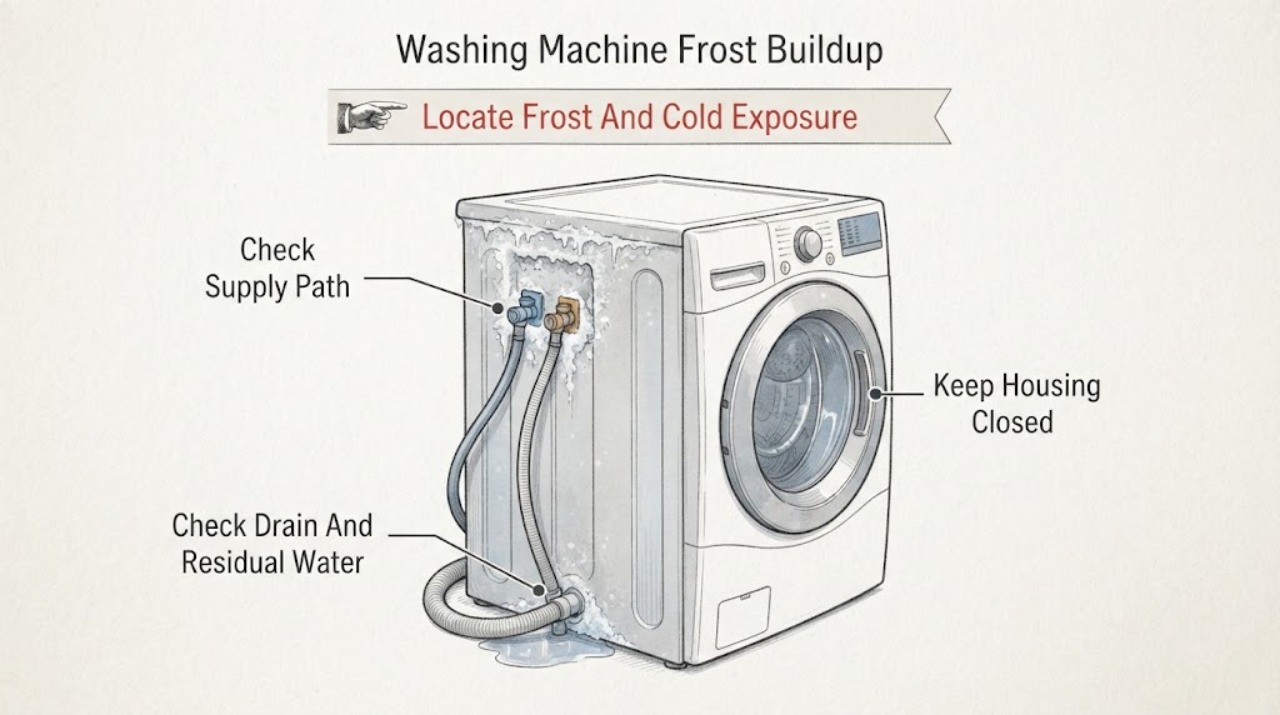
A Samsung washing machine should not develop refrigerator-style frost during normal indoor use. Visible frost or ice around a washer usually means water left in an exposed supply hose, drain hose, residual-water hose, or tub has frozen because the installation became too cold. Unplug the washer if safe, close the water valves, and identify the frozen path without forcing controls, hoses, or panels. Samsung's guidance covers thawing a frozen supply or drain path with gentle warmth and checking for damage before use; frost that returns, a washer that still will not fill or drain, or any split hose, leak, or water near electricity needs qualified Samsung or appliance service.
Before you begin
Safety first
- This article supports ordinary-access observation and only the exact model's gentle thawing and winterizing guidance. It does not authorize panel removal, energized or moving-part work, forced thawing, or improvised hose or tube repair.
Work through in order
Diagnostic checks
Use only checks that match the exact appliance or system and its official guide.
-
Check 1
From a dry, ordinary-access position, photograph the frost and record whether it is on a supply hose or faucet, the drain hose, a front residual-water area, the visible tub, or only the outside cabinet; also note whether the laundry room or balcony is below freezing.
Expected result: Frost is localized to one hose or fitting, appears at the drain or residual-water path, is visible inside the tub, is spread over several areas, or is only surface moisture without ice; the washer may also be unable to fill, unable to drain, or otherwise normal.
Next step: Keep the washer idle while you identify the affected path and check the model manual for cold-weather instructions; do not scrape the frost or start a cycle to force it clear.
Stop if: Stop and arrange service if the cabinet, hose, or fitting is split, water is already leaking, the power connection is wet, or the frost cannot be inspected without moving the appliance or opening a panel.
Why this matters
Why: A localized frozen hose or residual-water path is more likely than a control fault when the washer stopped after cold exposure. Frost limited to the cabinet or moisture without ice does not prove an internal freeze, while frost in several paths raises the risk of remaining water and hidden damage.
-
Check 2
With the washer unplugged if safe and both water valves closed, inspect the visible hot and cold supply hoses and faucet connections for ice, kinks, bulges, cracks, or a loose fitting; do not pull on a frozen hose.
Expected result: The faucet or hose contains visible ice, the hose is merely kinked, both supply paths look clear, or the hose shows a split, bulge, or wet connection; note whether the washer had a no-fill symptom or a 4E/4C-type code.
Next step: If the exact manual permits it, thaw an accessible hose or faucet gently with a warm damp towel and allow the ice to release without force; then inspect again before reopening a valve. Keep the supply closed if damage is present.
Stop if: Do not heat a hose with a flame, boiling water, or a high-heat device, and do not reconnect or run the washer when a hose or fitting is cracked, swollen, or leaking.
Why this matters
Why: Ice in a supply path can explain a washer that does not receive water after cold exposure. A kink without ice is a separate flow restriction, while a split or wet connection means the hose may no longer be safe to pressurize. An error code varies by model, so it is a clue rather than a universal diagnosis.
-
Check 3
Inspect the visible drain hose for a frozen bend, kink, or water trapped in a low section, and on a front-load model check the residual-water hose or filter access only as described in the model manual; keep a container and towels ready for water.
Expected result: The drain hose is iced at a bend, the residual-water path is iced or still contains water, the hose is clear but the tub will not drain, or there is water on the floor; note any 5E/5C-type code without treating it as universal.
Next step: Straighten only a flexible hose that is not frozen, and use the model's documented gentle-thaw procedure for an iced path. After thawing, do not start a cycle until the hose, residual-water cap, filter cover, and floor are dry and intact.
Stop if: Do not force a filter, cap, door, or frozen hose, and stop for a leak, a damaged drain path, a wet electrical connection, or water that cannot be contained safely.
Why this matters
Why: Samsung identifies the drain and residual-water sections as common cold-weather freeze points. Ice or standing water in those paths makes a blockage more likely; a clear path with continued no-drain behavior makes a pump, filter, installation, or other fault possible and cannot be diagnosed by frost alone.
-
Check 4
After the affected path has thawed without force and no visible damage is found, reopen water only while watching the supply connections; if the manual permits, run the shortest empty fill or drain/spin check while remaining nearby.
Expected result: Water enters and drains normally with dry connections, the washer still will not fill, the washer still will not drain, a connection drips or sprays, or the frost returns immediately.
Next step: Record the model, code, frost location, thaw method, and test result; keep the washer out of service and request qualified diagnosis for any persistent symptom, leak, or recurrence.
Stop if: Stop the test immediately for leaking water, unusual noise, smoke, burning odor, electrical contact, or any need to remove a panel or reach a moving or energized part.
Why this matters
Why: Normal flow with dry connections supports a temporary freeze. Persistent no-fill or no-drain behavior points beyond the thawed ice, while a leak after thawing raises concern for a burst or displaced hose or an internal water-path failure. Returning frost indicates that the installation is still too cold or retains water.
-
Check 5
Once the washer is safe and dry, check the installation location and the exact user manual for cold-weather protection; confirm that exposed hoses are not left with avoidable low sections and that residual water is removed only by the documented procedure.
Expected result: The washer is in an unheated or weather-exposed location, the drain hose retains water, the model documents a freeze-protection feature, or no model-specific protection is available; note whether frost returns after the next cold period.
Next step: Keep the location above freezing where feasible, follow only the exact model's freeze-protection and winterizing instructions, and contact Samsung or appliance service if the location cannot be kept safe or frost recurs.
Stop if: Do not invent a button combination from another Samsung model, leave a valve or drain disconnected where it can flood, or move the heavy appliance alone.
Why this matters
Why: Samsung warns against installing a washer where temperatures are low enough to freeze and says some models have model-specific freeze protection. A recurring freeze is an installation or residual-water problem until proven otherwise, not evidence that a replacement control board or pump is needed.
Use your observations
Decision map
Find the observation that best matches what you see, then follow the next safe action.
-
PATH 01Safety boundary
What you see
Frost is on a faucet or supply hose and the washer stopped filling after cold exposure, possibly showing a model-specific no-fill code.
Do this next
Keep power off and valves closed while using the exact manual's gentle thaw guidance; inspect the hose and fitting, then request service if fill does not return or damage is visible.
Why this path and its safety boundary
Why it matters: The supply path is a stronger first suspect than an internal electronic fault, but a damaged hose cannot be confirmed safe merely because its ice has melted.
Safety stop: Do not pressurize a split, bulged, or leaking hose.
-
PATH 02Safety boundary
What you see
Frost is at a drain-hose bend or residual-water area and the tub remains full, the washer will not drain, or a model-specific no-drain code appears.
Do this next
Use the model's documented residual-water and gentle-thaw procedure, then check for a dry, intact drain path before a cautious empty drain test.
Why this path and its safety boundary
Why it matters: Frozen residual water or a frozen drain section is plausible. If the drain path is clear after thawing but the symptom remains, frost is not a sufficient explanation for the pump or drain fault.
Safety stop: Stop if water cannot be contained, a hose or cap is damaged, or electrical equipment is wet.
-
PATH 03Safety boundary
What you see
Ice has melted but a supply or drain connection drips, sprays, bulges, or shows a crack, or frost returns with active wetness.
Do this next
Close the water valves, disconnect power only if safe, contain accessible water without opening panels, and arrange qualified appliance service.
Why this path and its safety boundary
Why it matters: The cold event may have damaged a hose or tube, or an existing leak may have frozen. Continuing to run the washer can turn a small leak into flooding and can create an electrical hazard.
Safety stop: Do not tape, clamp, heat, or operate the washer to test a visibly damaged water path.
-
PATH 04Safety boundary
What you see
The frost is gone, visible hoses and connections are intact, but the washer still will not fill, drain, or complete a safe test.
Do this next
Keep the recorded code and observations with the model number and request Samsung or qualified appliance diagnosis rather than repeating thaw cycles.
Why this path and its safety boundary
Why it matters: A persistent fault may involve installation, a filter, pump, inlet path, control, or another model-specific component; the frost event alone does not identify a replaceable part.
Safety stop: Do not open the cabinet, bypass a control, or substitute a part without exact model-specific guidance.
-
PATH 05Safety boundary
What you see
The washer works after thawing, but frost returns whenever the room or installation area becomes very cold.
Do this next
Keep the location above freezing when feasible and follow the exact model's winterizing or freeze-protection instructions; ask service to assess an installation that cannot be kept from freezing.
Why this path and its safety boundary
Why it matters: The recurring trigger is likely environmental exposure or water retained in a supply, drain, or residual-water path. Samsung's model guidance, not a generic button sequence, determines whether freeze protection is available.
Safety stop: Do not continue normal operation in a location where frost is recurring and tubes may burst.
Helpful context
Understand the symptom
What frost means on a washing machine
Frost on a Samsung washer is a cold-weather water-path problem, not a normal washer cycle feature. Samsung's service guidance explains that residual water in the supply, drain, or residual-water sections can freeze when a washer is installed in a very cold place. Do not assume that every visible white patch is inside the machine: first note whether it is on a hose or fitting, at the drain area, or inside the tub, and whether the surrounding room is below freezing. The location and the washer's current fill or drain symptom determine the next safe check.
Thaw only after isolating water and power
Before touching a frozen water path, use the normal controls to end any active cycle if possible, then unplug the washer or disconnect its circuit only when that can be done safely. Close the supply valves before loosening a hose. Samsung describes gentle thawing with warm water applied to a towel or with warm water for a removed hose, and warns against excessive heat and against forcing a frozen hose. Never use an open flame, strike the ice, or improvise access to internal components.
A thawed washer still needs a damage check
Ice can obstruct flow and can also expose a hose or tube to damage. Once the ice has thawed naturally or by a manufacturer-approved gentle method, inspect visible connections, the hose body, the drain area, and the floor for splitting, bulging, dripping, or a new leak. Keep the washer unplugged and the valves closed if there is damage or water near an electrical part. Restore operation only after the exact model's instructions allow it and a cautious fill or drain observation shows no leak.
Safety boundary
Stop conditions
- Do not scrape, strike, pry, or force ice from a hose, filter, cap, door, or tub path.
- Do not use flame, boiling water, or high heat to thaw the washer, and do not use a hair dryer around wet appliance parts.
- Keep water valves closed and power disconnected when a hose or tube is cracked, bulged, leaking, or wet near an electrical connection.
- Do not open panels, reach into a moving drum, bypass controls, or attempt internal pump, valve, or tube repair as an ordinary frost check.
- Stop using the washer and request qualified service for recurring frost, persistent fill or drain failure, flooding, electrical symptoms, or any uncertainty about safe thawing.
Only after diagnosis
Potential parts
- water supply hose
Consider this category only if post-thaw inspection confirms a split, bulge, leak, or other damage in the supply hose and a qualified provider identifies it as the failed path.
Confirm the exact washer model, hose connection, pressure requirements, and manufacturer's fit information before ordering; do not rely on appearance alone. - washing-machine drain hose
Consider this category only if the drain hose is visibly damaged after thawing or a qualified diagnosis identifies it as the cause of a persistent leak or no-drain condition.
Confirm the exact model and the required hose routing and connection details; a replacement does not substitute for checking the household drain installation.
When checks do not resolve it
Need a professional?
Request qualified Samsung or appliance service if a hose or fitting is split, bulged, leaking, or wet near electricity; if the washer still will not fill or drain after the documented gentle-thaw process; if frost returns; if the installation cannot be kept above freezing; or if diagnosis would require opening a panel or changing an internal part.
Safety scope: This article supports ordinary-access observation and only the exact model's gentle thawing and winterizing guidance. It does not authorize panel removal, energized or moving-part work, forced thawing, or improvised hose or tube repair.
Common questions
FAQ
Can a Samsung washing machine really get frost buildup?
A washer can have frost or ice when water remains in a supply hose, drain path, residual-water section, or tub and the installation becomes cold enough to freeze. It is not normal refrigerator-style frost, and frost can damage tubes, so locate the path and check for damage before use.
Should I run a hot cycle to melt the frost?
Do not start a cycle to force a frozen path clear. Isolate water and power when safe, then use only the exact model's gentle-thaw instructions. Samsung warns about hose damage and excess heat; request service if the path is inaccessible or damaged.
What if the washer works after thawing but freezes again?
Treat recurrence as an unresolved cold-location or retained-water problem. Keep the installation above freezing where feasible and follow the exact model's winterizing or freeze-protection instructions. Samsung documents freeze protection on some models, not as a universal control sequence.
Read the exact guide
Official sources
- Terms and ConditionsSamsung Electronics America · Official Samsung U.S. home-appliance safety information; the exact owner's manual and local requirements also apply.
- Use the features of the new Bespoke AI Laundry Combo unitSamsung Electronics America · Official Samsung feature guidance for the Bespoke AI Laundry Combo; it does not establish availability on other washer models.
- 세탁기 겨울철 결빙 예방 및 해동 방법을 알려주세요Samsung Electronics Service · Official Samsung Electronics Service guidance for washer supply, drain, residual-water, and tub freezing; model-specific instructions control.
- Samsung washing machine information and error codesSamsung Electronics America · Official Samsung U.S. error-code information; displayed codes and controls vary by model.
- Water fill issues with Samsung washing machinesSamsung Electronics America · Official Samsung U.S. troubleshooting guidance for washer water-fill symptoms; error meanings and settings vary by model.
- 전자동 세탁기 결빙 예방 방법을 알려주세요Samsung Electronics Service · Official Samsung Electronics Service prevention guidance for automatic washers installed in cold locations; feature availability varies by model.
Community feedback
Share a repair observation
Share a plain-text repair observation. Accepted observations are published automatically; this page may take a moment to update.